
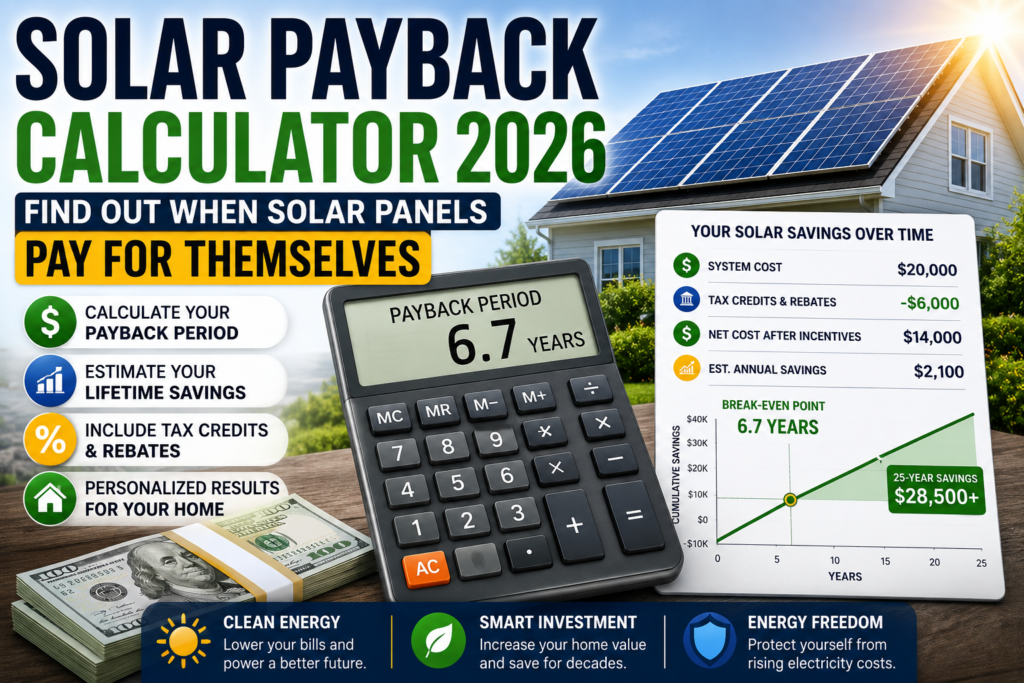
☀️ Solar Payback Calculator 2026
Estimate your solar payback period, potential annual savings, federal incentive value and long-term solar savings in seconds.
Calculate Your Solar Payback
Enter a few basic numbers about your electricity bill and proposed solar installation. The calculator will generate an illustrative estimate based on the assumptions you select.
🎉 Your Estimated Solar Results
Here is an illustrative estimate based on the information you entered.
📊 Estimated Cost Recovery
Enter your information above to calculate your estimate.
Important: This calculator provides an educational estimate, not a quote, tax determination or guarantee of savings. Actual solar production, utility rates, financing costs, degradation, incentives, taxes, maintenance and net-metering rules can materially change the result.
How the Solar Payback Calculator Works
The Solar Payback Calculator 2026 is designed to give homeowners a quick way to estimate how long a solar installation could take to recover its initial cost through electricity savings and applicable incentives.
Instead of looking only at the price of solar panels, the calculator considers several factors together, including your electricity bill, solar system size, estimated installation cost and the percentage of your electricity costs that solar could offset.
Why Calculate Your Solar Payback Period?
Solar panels represent a significant investment for many homeowners. The payback period helps put that investment into perspective by comparing the estimated net project cost with potential annual electricity savings.
A shorter estimated payback period generally means that the system could recover its cost sooner. A longer payback period may indicate that homeowners should compare installation quotes, financing terms, system sizes and available incentives more carefully.
What Information Do You Need?
- Monthly electricity bill: Your typical household electricity cost.
- Solar system size: The approximate capacity of the proposed solar installation.
- Installation cost: The estimated total project price.
- Electricity offset: An estimate of how much of your electricity bill solar could offset.
- Projection period: The number of years you want to use for the long-term estimate.
How to Get a More Accurate Solar Payback Estimate
For a more realistic analysis, homeowners should replace estimates with actual information from their electricity bills and solar quotes. Your utility rate, annual electricity consumption, roof orientation, shading, local climate, system production and financing structure can all affect the economics of a solar installation.
1. Use Your Actual Electricity Bill
Start with an average monthly electricity bill based on several months of utility statements rather than using a single unusually high or low month.
2. Compare Multiple Solar Quotes
Installation prices can vary significantly between companies. Comparing equipment specifications, warranties, labor costs and financing terms can help you determine whether a quoted solar price is competitive.
3. Research Available Incentives
Solar incentives can vary by state, utility territory, household circumstances and installation date. Before purchasing a system, verify the current rules for any federal tax credits, state programs, utility rebates or renewable energy certificate programs that may apply.
See our Solar Tax Credit 2026 Guide for additional information.
Solar Payback vs. Long-Term Solar Savings
The payback period and lifetime savings are related but different measurements. Payback focuses on how quickly the investment may recover its cost. Long-term savings estimate the cumulative benefit over the selected projection period.
For example, a solar system could have an estimated payback period of several years while continuing to generate electricity savings for many additional years afterward.
Pennsylvania Solar Payback Calculator
Pennsylvania homeowners should also consider state-specific factors such as utility rates, net-metering rules, renewable energy certificates and available utility incentives when evaluating solar.
Read our detailed Pennsylvania Solar Rebates 2026 Guide to research potential incentives and programs.
Frequently Asked Questions
What is a solar payback period?
The solar payback period is the estimated amount of time required for electricity savings and other applicable financial benefits to recover the net cost of a solar installation.
Is a shorter solar payback period better?
Generally, a shorter payback period means the initial investment is recovered sooner. However, homeowners should also consider equipment quality, warranties, financing costs, system lifespan, maintenance and long-term electricity savings.
Does the calculator guarantee my solar savings?
No. The calculator provides an illustrative estimate. Actual savings depend on solar production, electricity prices, utility policies, system performance, financing and other factors.
Can I use this calculator for Pennsylvania?
Yes. The calculator can be used as a general planning tool for Pennsylvania homeowners. However, Pennsylvania-specific utility programs and incentives should be researched separately before making a purchase decision.
Should I include financing costs?
For a basic payback estimate, this calculator focuses on the project cost and estimated electricity savings. If you finance your system, interest, loan fees and monthly payments can significantly change the actual financial return.
Explore More Rebate Radar Calculators
Once you have estimated your solar payback period, you can use additional Rebate Radar tools to explore other aspects of your household energy costs and potential incentives.
Solar Savings Calculator 2026 →
Solar Tax Credit Calculator 2026 →
Is Solar Really Worth It in 2026? The Honest Financial Breakdown
After calculating your eligibility and estimating your savings, the final question remains: is solar actually worth it in 2026?
The answer is not universal — it depends heavily on your electricity usage, location, and whether you take advantage of federal and state incentives.
However, most homeowners fall into three categories when evaluating solar:
- High ROI homes: High electricity bills + strong sunlight + state incentives
- Medium ROI homes: Average bills + moderate incentives
- Low ROI homes: Low energy usage or weak incentive regions
Understanding which category you fall into is the key difference between saving thousands or barely breaking even.
Solar vs Utility Bills: What Most People Don’t Realize
Electricity prices in the U.S. continue rising year after year. In many states, utility costs increase faster than inflation.
This creates a long-term financial shift where solar becomes less about “saving today” and more about “locking in future energy prices.”
Here’s what most homeowners don’t realize:
- Utility bills never stop increasing
- Solar payments (if financed) are fixed
- Solar ownership can eliminate 70%–95% of electricity costs
This is why tools like the Solar Rebate Eligibility Checker are becoming essential before making any decision.
Hidden Factors That Change Your Solar ROI
Even if two homes install the same system, their ROI can be dramatically different.
Here are the most important hidden variables:
- Roof angle and direction
- Shading from trees or buildings
- Local net metering rules
- Utility buyback rates
- Future electricity price increases
These factors are rarely explained clearly in sales pitches, which is why independent calculators are becoming so important.
Best Solar + Energy Products for Homeowners (2026)
Many homeowners also combine solar with backup power systems and energy efficiency tools to maximize savings and independence.
Here are some of the most relevant tools and products used by energy-conscious homeowners:
-
BLUETTI Portable Power System
Check on Amazon -
Solar Generator Kit with Panels
View Product -
Smart Home Energy Monitor
View Product -
Smart Thermostat (Energy Saving)
View Product -
Level 2 EV Home Charger (240V)
View Product
These products complement solar systems by improving energy efficiency, storage capacity, and home electricity management.
Should You Install Solar Now or Wait?
Timing matters more than most people think.
In many regions, incentives are gradually decreasing while electricity prices continue rising. This creates a “sweet spot” where acting sooner can result in higher lifetime savings.
However, waiting may still make sense if:
- Your roof needs repairs
- Your electricity usage is very low
- You plan to move soon
Otherwise, most homeowners benefit more from installing earlier rather than later.
FAQ – Final Solar Questions Answered
Is solar free in 2026?
No. Most “free solar” offers are leases or PPAs, not ownership systems.
How long does solar take to pay off?
Typically between 5 to 12 years depending on incentives and location.
Can I combine rebates and tax credits?
Yes, in many cases federal tax credits can be combined with state rebates.
What is the biggest mistake homeowners make?
Not calculating long-term savings and focusing only on monthly payments.
Final Conclusion
Solar energy in 2026 is no longer just an environmental decision — it is a financial strategy.
Homeowners who take time to calculate eligibility, compare incentives, and understand real ROI consistently make better financial decisions than those who rely only on marketing claims.
Before installing solar panels, always evaluate:
- Your eligibility score
- Your long-term savings potential
- Your local incentives
- Your electricity consumption patterns
Start here if you haven’t already:
👉 Solar Rebate Eligibility Checker 2026
And compare full incentives here:
Make smarter energy decisions — before incentives change again.