
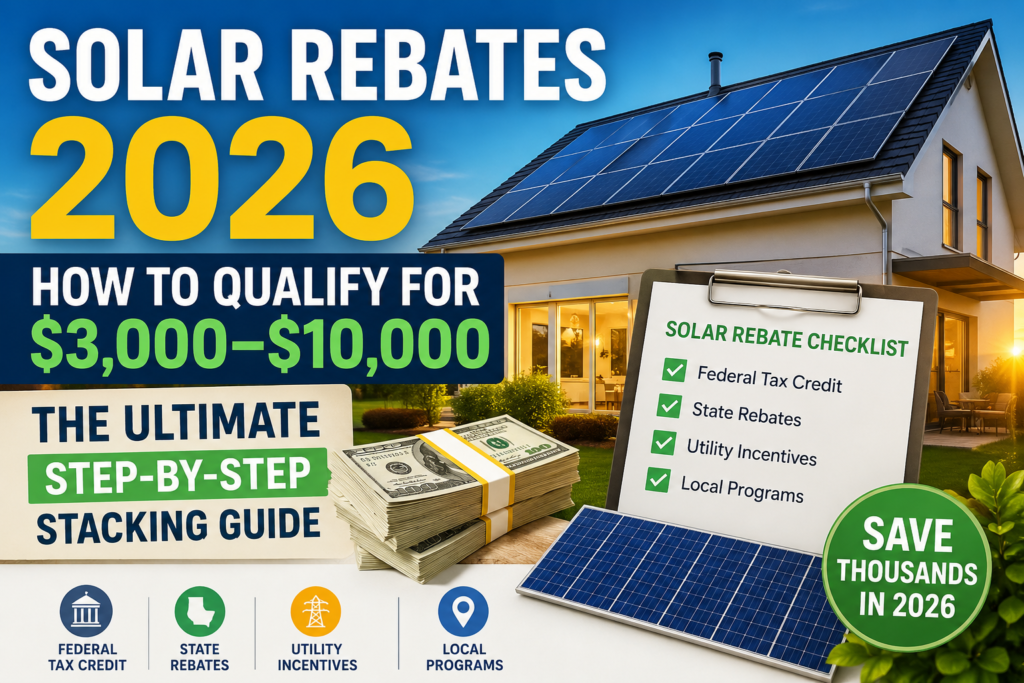
Solar Rebates 2026: What Actually Exists, What Expired & How to Find Every Incentive
The solar incentive landscape changed significantly going into 2026. Some major federal residential tax credits ended, while state programs, utility incentives, performance programs, battery opportunities and home-energy rebates can still vary by location.
Do not assume that a new residential solar installation completed in 2026 automatically qualifies for the old 30% federal solar tax credit. The IRS states that the Residential Clean Energy Credit under Section 25D is not available for qualifying property placed in service after December 31, 2025.
⚡ The 2026 solar rebate reality
There is no universal “$3,000–$10,000 solar rebate” that every American homeowner can claim.
Your actual savings can depend on your state, ZIP code, utility, income, equipment, property type, project timing, available funding and the type of incentive involved.
The smartest strategy is to identify every incentive layer that applies to your specific project and verify each one before signing a contract.
Solar incentives did not disappear — the landscape changed
Search results for “solar rebates 2026” can be confusing because many pages continue to repeat incentive information written before major federal policy changes.
That means a homeowner can easily encounter an article promising a 30% federal solar tax credit without realizing that the rule may not apply to a new residential installation placed in service in 2026.
The goal of this guide is simple: separate the incentives that still deserve investigation from federal programs that have expired for new projects.
What happened to the federal 30% solar tax credit?
This is the most important correction for anyone researching solar incentives in 2026.
The Residential Clean Energy Credit under Section 25D previously provided a 30% credit for qualifying residential clean-energy property during its eligible period.
However, the IRS now states that the credit is not available for qualifying property placed in service after December 31, 2025.
If a solar salesperson tells you that every new 2026 residential solar installation automatically receives a 30% federal credit, verify the claim against current IRS guidance.
Residential solar
The old Section 25D residential clean-energy credit is not available for qualifying property placed in service after December 31, 2025.
Battery storage
Battery storage was included within the previous residential clean-energy credit framework. New 2026 projects must be evaluated under the current federal rules.
Home efficiency
The Section 25C Energy Efficient Home Improvement Credit also ended for qualifying property placed in service after December 31, 2025.
Solar rebates vs. tax credits vs. utility incentives
Not every energy incentive works the same way. Understanding the difference is essential when calculating the true cost of a solar project.
| Incentive | How it works | What to verify |
|---|---|---|
| Tax credit | Reduces qualifying tax liability when the applicable requirements are met. | Tax year, installation date and eligibility. |
| State rebate | A state program may provide a direct incentive for qualifying projects. | Funding, income rules, equipment and application timing. |
| Utility rebate | Your electricity provider may offer incentives for eligible equipment or energy improvements. | Utility territory, program budget and technical requirements. |
| SREC / REC | Renewable-energy certificates can create value for qualifying solar generation in certain markets. | State market rules, registration and current certificate value. |
| Local program | Cities and local agencies may offer additional energy programs. | Location, eligibility and available funding. |
🧮 Calculate your solar economics
Don’t judge a project by the size of an advertised rebate alone. Compare the installed cost, incentives you can actually verify, expected energy savings and estimated payback.
Open Solar Savings Calculator →How to qualify for solar rebates in 2026
Eligibility usually depends on several variables at the same time. Being located in a state with an energy program does not automatically mean that every homeowner qualifies.
Identify your state, ZIP code and utility
Start with your exact location and electricity provider. Utility territory can dramatically change which incentives are available.
Determine your project type
Solar panels, batteries, EV chargers, heat pumps and efficiency upgrades can fall under completely different programs.
Verify equipment requirements
Some programs require specific efficiency ratings, certifications, capacities or eligible equipment models.
Check income requirements
Some programs are broadly available while others are designed specifically for low-income or moderate-income households.
Verify funding before signing
A program can exist while its current funding pool is closed, exhausted or temporarily unavailable.
Keep your documentation
Keep contracts, invoices, equipment information, approvals, utility documentation and installation records.
Explore solar rebates by state
State and utility programs can vary enormously. Use the guides below as starting points for researching current incentives.
Can solar rebates be stacked?
Sometimes. But stacking does not mean automatically adding every incentive you find online.
Each program can have its own rules regarding eligibility, funding, timing and interaction with other incentives.
Federal layer
Determine whether a federal incentive actually applies to your installation date and property.
State layer
Research state solar, battery and clean-energy programs.
Utility layer
Investigate utility rebates, demand-response programs and performance incentives.
Do not subtract an incentive from your project cost until you have confirmed that the program is open, that you qualify and that your project meets the applicable requirements.
9 solar rebate mistakes that can cost homeowners money
01 — Trusting old articles
Federal energy policy changes. Verify current rules.
02 — Assuming every state pays cash
Incentives can be rebates, tax benefits, utility credits or performance programs.
03 — Ignoring your utility
Utility territory can determine which programs are available.
04 — Applying too late
Some programs require approval before purchasing or installing.
05 — Buying equipment first
Some programs impose purchase or installation timing requirements.
06 — Believing “free solar”
Check whether the offer is actually a lease, PPA or financing arrangement.
07 — Forgetting battery economics
Storage can change how a solar system interacts with your utility and household load.
08 — Ignoring the contract
Loans, leases and PPAs have very different financial structures.
09 — Not calculating payback
A large advertised incentive does not automatically make a project financially attractive.
If you are researching “free solar panels,” read our scam-warning guide: Free Solar Panels 2026: Scam Warning Signs .
Batteries, portable power and backup energy
Solar is only one part of the home-energy equation. Batteries and portable power stations can provide additional resilience during outages and may fit homeowners who are not ready for a permanent battery installation.
Powerwall alternatives
Compare alternatives to the Tesla Powerwall ecosystem.
Powerwall Alternatives →You can also compare the differences between permanent solar batteries and portable solar generators: Solar Battery vs. Solar Generator .
Energy products worth researching
These products are included as independent equipment recommendations. An affiliate purchase may generate a commission for Rebate Radar at no additional cost to you. Product availability and pricing can change.
Google Nest Learning Thermostat
A smart thermostat can help homeowners manage heating and cooling schedules and reduce unnecessary HVAC operation when properly installed and configured.
Jackery Explorer 1000
A portable power station can provide backup electricity for selected devices and appliances during an outage.
BLUETTI AC200P
A higher-capacity portable power station may be useful for homeowners who want backup power without immediately installing a permanent home battery.
More Rebate Radar tools and guides
Solar rebates 2026: frequently asked questions
Is the 30% federal solar tax credit still available for a new solar installation in 2026?
The IRS states that the Residential Clean Energy Credit under Section 25D is not available for qualifying property placed in service after December 31, 2025.
Does that mean there are no solar incentives in 2026?
No. State, utility, local and performance-based programs can operate under separate rules. Availability depends on location, utility territory and program requirements.
Can I still receive a state solar rebate?
Potentially. State programs have their own eligibility rules, funding limits and application requirements.
Can solar rebates and utility incentives be combined?
Sometimes. Each program should be checked independently for stacking restrictions and interactions with other incentives.
Should I buy equipment before applying for a rebate?
Not necessarily. Some programs require pre-approval or impose rules concerning when equipment can be purchased or installed.
Is “free solar” really free?
Be cautious. “Free solar” advertising can refer to leases, PPAs or financing arrangements. Compare ownership, total payments and contractual obligations.
How do I find the best solar rebate for my home?
Start with your ZIP code, utility, project type, household circumstances and installation timing. Then compare state, utility and local programs.
☀️ Your best solar incentive is the one you can verify
Solar economics in 2026 require more than copying an old tax-credit percentage. Start with your location, verify current rules and calculate the real economics before signing a contract.
🔎 Find My Solar IncentivesSome links on this page may be affiliate links. If you purchase through an affiliate link, Rebate Radar may receive a commission at no additional cost to you.