
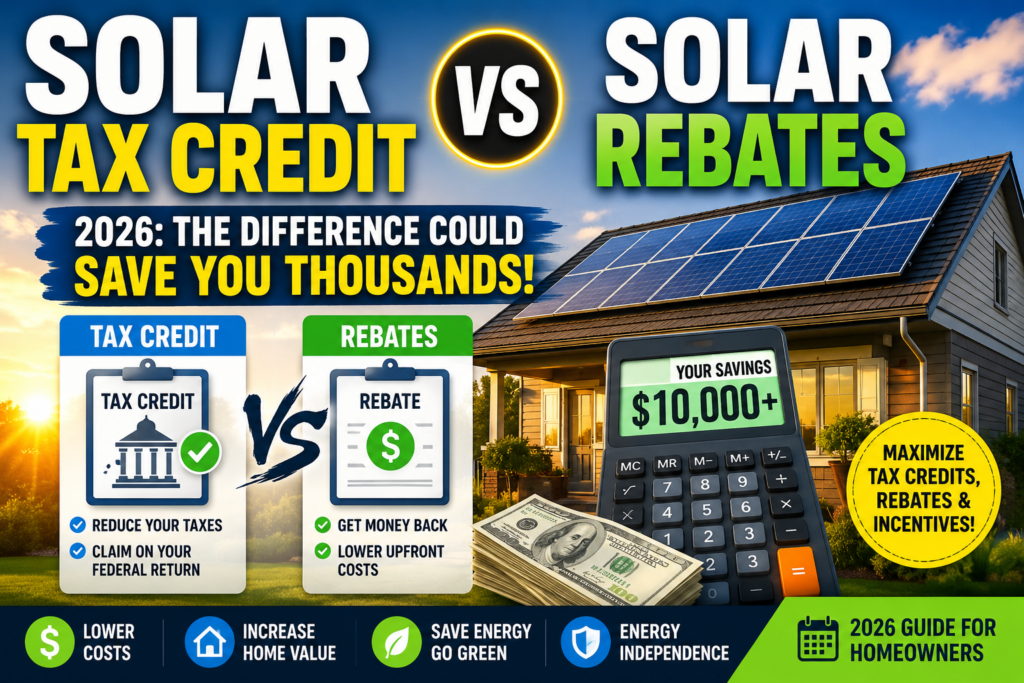
Solar Tax Credit vs Solar Rebates 2026: What Homeowners Need to Know
Solar incentives can dramatically change the economics of a home energy project. But in 2026, homeowners need to understand an important change: the federal Residential Clean Energy Credit for new residential solar expenditures ended after December 31, 2025. State, local and utility incentives may still vary by location.
A tax credit reduces qualifying tax liability, while a rebate generally reduces the cost of a qualifying purchase or installation. They are not the same type of incentive. More importantly for homeowners researching solar in 2026, the federal Residential Clean Energy Credit under Section 25D is no longer available for qualifying expenditures made after December 31, 2025. State, utility and local solar incentives may still exist, but eligibility depends on the specific program and location.
Many older solar articles still describe a 30% federal residential solar tax credit as if it automatically applies to new solar installations in 2026. That information is outdated.
The federal Residential Clean Energy Credit was available at a 30% rate for qualifying property through 2025, but federal law accelerated its termination. The credit is not available for expenditures made after December 31, 2025.
This means a homeowner planning a new residential solar project in 2026 should not build a financial plan around receiving the former 30% federal residential credit.
Solar Tax Credit vs Solar Rebate: What Is the Difference?
The words tax credit, rebate and incentive are frequently used together in solar advertising, but they describe different mechanisms.
Understanding the distinction is especially important when comparing the economics of a solar installation because an incentive may reduce the price of a project, reduce a tax liability, provide a payment, or affect the economics through another program structure.
Solar Tax Credit
A tax credit is generally applied against qualifying tax liability. It is handled through the tax system rather than functioning like a store coupon or immediate utility discount.
For solar, the federal residential credit that many older articles reference was the Residential Clean Energy Credit under Section 25D. That federal residential credit is no longer available for new qualifying expenditures made after December 31, 2025.
Solar Rebate
A rebate generally provides a financial benefit associated with purchasing or installing qualifying equipment. The program may reimburse part of the cost or reduce the purchase price.
Solar rebates can be offered by state agencies, utilities, municipalities and other program administrators. Rules vary considerably by location.
Why the Difference Matters
Imagine two homeowners purchasing similar solar systems. One may have access to a utility rebate, while another may live in a service territory without that program. Their final project economics can therefore be very different even if the equipment and installation prices are similar.
This is why solar savings should always be evaluated using the homeowner’s actual location, utility, project cost and available programs rather than relying on a national advertised number.
What Happened to the Federal Solar Tax Credit in 2026?
This is the most important update for anyone researching solar tax credits in 2026.
Under the federal Residential Clean Energy Credit, qualifying residential clean-energy expenditures were previously eligible for a 30% credit during the applicable period. Qualified solar electric property and certain battery storage technology were among the eligible categories.
Federal legislation enacted in 2025 accelerated the termination of the residential clean energy credit. The IRS now states that the credit is not available for expenditures made after December 31, 2025.
Therefore, a homeowner researching a new solar installation in 2026 should distinguish between:
- Eligible 2025 expenditures that may still be relevant when preparing a 2025 federal tax return in 2026.
- New 2026 residential solar expenditures, which generally cannot rely on the former federal Residential Clean Energy Credit.
This distinction prevents one of the biggest mistakes in solar incentive research: confusing the year a tax return is filed with the year the qualifying energy expenditure occurred.
Federal Residential Clean Energy Credit
Qualifying residential clean-energy property was generally eligible for a 30% federal credit during this period, subject to the applicable rules.
Federal Residential Credit Deadline
The federal residential clean energy credit was terminated for qualifying expenditures made after this date.
Focus on Local & State Incentives
Homeowners planning new residential solar should investigate state, utility and local programs rather than assuming that the former federal residential credit remains available.
How Do Solar Rebates Work in 2026?
Solar rebates can operate differently from federal tax incentives. A program administrator may offer a fixed incentive, reimbursement, point-of-sale reduction, performance-based incentive or another form of financial assistance.
The exact structure depends on the program. Some incentives may be tied to the utility serving the property, while others may be administered at the state or local level.
Utility Rebates
Programs offered through participating electricity or energy providers may support qualifying solar or energy projects.
State Programs
State-level incentives can vary widely and may have their own eligibility, equipment and application rules.
Local Programs
Municipal or regional programs may provide additional incentives depending on the property location.
Do Solar Rebates Still Exist in 2026?
Potentially, yes. The end of the federal residential tax credit does not automatically mean that every state, utility or local solar incentive disappears.
Instead, homeowners should treat solar rebates as location-specific programs. An incentive can expire, run out of funding, change its eligible equipment list or introduce new application requirements.
That is why the correct question is not simply “Are there solar rebates in 2026?” but rather: “Which solar incentives are currently available for this property, through its state and utility?”
State Solar Incentives Can Change the Economics of a Project
Location is one of the most important variables in residential solar. Incentive availability, electricity prices, utility policies, interconnection requirements and local programs can all affect the financial outcome.
This is why Rebate Radar’s state-specific resources are useful when researching solar incentives. Instead of relying on a single national number, homeowners can investigate the programs relevant to their location.
Explore State-Specific Solar & Energy Incentives
Start with the state or energy program that is most relevant to your property.
Solar Tax Credit Calculator 2026: How Should You Calculate Your Savings?
A solar calculator can be useful, but in 2026 it is important to understand exactly what the calculator is estimating.
A calculator should not simply apply a 30% federal credit to a new 2026 solar installation. That would produce an outdated result.
Instead, homeowners should separate the financial analysis into different components.
Think of Solar Savings as a Complete Financial Picture
Start with the total project cost, then identify the incentives that genuinely apply to the property and transaction. After that, evaluate expected electricity savings, financing costs and other ownership expenses.
A calculator should therefore help you compare scenarios rather than promise a universal savings amount.
You can continue the calculation and incentive research with our dedicated:
Solar Tax Credit Calculator 2026
The Main Variables That Affect Solar Economics
- Total system price: equipment, labor and other qualifying project costs.
- System size: the amount of solar generation installed on the property.
- Electricity consumption: how much energy the household actually uses.
- Electricity rates: the price paid for grid electricity can strongly influence potential savings.
- Solar production: sunlight, roof orientation, shading and system design affect generation.
- Utility rules: compensation for exported electricity can affect the economics of a system.
- Financing: interest, loan terms and other financing costs can materially change total project cost.
- Local incentives: rebates and other programs can reduce the effective cost when eligibility requirements are satisfied.
Solar Incentives Are Only One Part of the Home Energy Picture
Homeowners researching solar often discover that the most effective energy strategy involves more than photovoltaic panels.
Depending on the property, homeowners may also evaluate battery storage, EV charging, heat pumps, efficient appliances and other energy improvements.
Rebate Radar’s broader Energy Rebates 2026 guide can help you explore other categories of energy incentives.
Can Solar Batteries Improve Your Energy Savings?
Battery storage changes the way a solar system can be used because electricity generated during one period can potentially be stored and used later.
This can be especially relevant for homeowners evaluating energy independence, backup power and utility-rate structures.
However, adding a battery also increases the project cost. The right decision depends on the household’s electricity consumption, utility rules, backup-power goals and total installed price.
If you are comparing storage equipment, see our:
Best Home Batteries & Solar Generators 2026
Solar Tax Credits, Rebates and the Difference Between Buying, Leasing and a PPA
Another major issue homeowners should understand is ownership. A solar system can be purchased outright, financed through a loan, leased or provided through a power purchase agreement.
These structures are not financially identical.
Buying the System
When the homeowner owns the qualifying equipment, the homeowner is generally the party who evaluates whether applicable ownership incentives and tax rules can apply.
Lease or PPA
With third-party ownership, the homeowner does not necessarily own the solar equipment. Incentive treatment can therefore be different, and the contract itself becomes an important part of the financial analysis.
This is one reason advertisements for “free solar panels” deserve careful examination. “Free” may refer to the absence of a large upfront payment rather than the absence of a long-term financial obligation.
Before signing a solar agreement, compare the total expected cost, escalation provisions, ownership, maintenance responsibilities, transfer requirements and expected savings.
Read our detailed guide:
Free Solar Panels 2026: Are They Real or a Costly Trap?
Solar, Home EV Charging and Energy Independence
Solar becomes even more interesting for homeowners who are electrifying other parts of their household.
An electric vehicle can substantially increase household electricity consumption, which makes home energy planning more interconnected.
Some homeowners therefore evaluate solar, battery storage and EV charging as a combined energy strategy rather than three completely separate purchases.
Related Rebate Radar Resources
10 Common Solar Incentive Mistakes Homeowners Make
Solar incentive mistakes can be expensive because many programs have strict purchase, installation, documentation or eligibility rules.
- Using outdated federal tax-credit information. Older articles may still describe the former 30% residential credit as available for new 2026 installations.
- Checking incentives after signing a contract. Some programs have eligibility conditions that should be reviewed before purchasing.
- Assuming every homeowner qualifies. Eligibility can depend on location, equipment, utility, ownership and program rules.
- Ignoring the utility. Local utility policies can materially affect solar economics.
- Confusing a rebate with a tax credit. These incentives operate through different mechanisms.
- Ignoring financing costs. A low monthly payment does not necessarily mean a low total cost.
- Choosing equipment based only on the incentive. The cheapest eligible equipment is not automatically the best long-term choice.
- Forgetting batteries and other energy upgrades. A homeowner may miss opportunities by looking at only one technology.
- Failing to save documentation. Receipts, contracts, model information and program records may be important when applying for an incentive.
- Trusting “free solar” advertising without reading the contract. Third-party ownership can have very different financial implications from owning the equipment.
2026 Solar Incentive Checklist Before You Buy
Complete These Steps Before Signing a Solar Contract
- Determine your electric utility and service territory.
- Research current state and local solar incentives.
- Verify whether the incentive is a rebate, tax benefit, performance incentive or another program.
- Do not assume the former federal residential 30% credit applies to a new 2026 installation.
- Compare the total installed project price.
- Estimate annual electricity consumption.
- Evaluate expected solar production and shading.
- Compare financing options and total repayment costs.
- If considering a battery, evaluate its additional cost and expected use.
- Compare ownership against lease and PPA structures.
- Keep contracts, receipts and incentive documentation.
- Re-check program requirements immediately before purchase because incentives can change.
Continue Researching 2026 Energy Incentives
Solar is only one part of the broader energy-incentive landscape. If you are planning multiple upgrades, these Rebate Radar resources can help you continue your research.
Solar Tax Credit vs Solar Rebates 2026: Frequently Asked Questions
Is there still a 30% federal solar tax credit in 2026?
The federal Residential Clean Energy Credit under Section 25D is not available for qualifying expenditures made after December 31, 2025. Therefore, homeowners planning a new residential solar installation in 2026 should not assume that the former 30% federal residential credit applies.
Can I still file for a solar tax credit in 2026?
Filing a tax return in 2026 does not automatically mean the underlying solar expenditure occurred in 2026. Taxpayers may still be dealing with eligible 2025 expenditures when preparing a 2025 tax return, subject to the applicable requirements. New expenditures made after December 31, 2025 are not eligible for the former Residential Clean Energy Credit.
Are solar rebates still available in 2026?
Solar rebates can still exist at the state, utility or local level, but availability is location-specific. Programs can change, expire, reach funding limits or modify their eligibility requirements.
What is the difference between a solar rebate and a tax credit?
A tax credit generally reduces qualifying tax liability through the tax system. A rebate generally provides a financial benefit associated with a qualifying purchase or installation. They are different incentive mechanisms and should not be treated as interchangeable.
Can solar rebates and other incentives be combined?
Potentially, depending on the rules of the individual programs. Homeowners should review each program’s eligibility and interaction rules rather than assuming that every incentive can automatically be stacked.
Are solar batteries still worth considering?
A battery can provide additional energy-storage and backup-power capabilities, but whether it makes financial sense depends on the home’s electricity use, utility structure, battery cost, financing and intended use.
Are “free solar panels” actually free?
“Free solar” advertisements can refer to financing, leases or power purchase agreements rather than free equipment ownership. Homeowners should examine the contract, total payments, ownership structure and incentive treatment before signing.
Should I buy solar panels before checking rebates?
Generally, it is better to research applicable incentives before committing to a purchase. Some programs can have specific equipment, retailer, installation, application or timing requirements.
The Smartest Way to Research Solar in 2026
The solar incentive landscape changed significantly going into 2026. Instead of assuming that an old federal tax-credit percentage still applies, start with the actual property, utility, state programs, project cost and ownership structure.
Then compare the total cost of the system with the incentives that genuinely apply and the long-term value of producing your own electricity.
Explore the Solar Tax Credit Calculator →More Solar & Energy Resources
Continue exploring Rebate Radar’s solar and home-energy resources before making a major purchase.
Disclaimer: Rebate Radar provides general educational information about solar incentives, rebates, tax programs and energy technologies. Program availability, eligibility requirements, amounts, deadlines and federal or state rules can change. This content is not tax, legal, financial or professional advice. Always verify current requirements with the applicable government agency, utility, program administrator or qualified tax professional before making a solar purchase, installation or tax decision.