
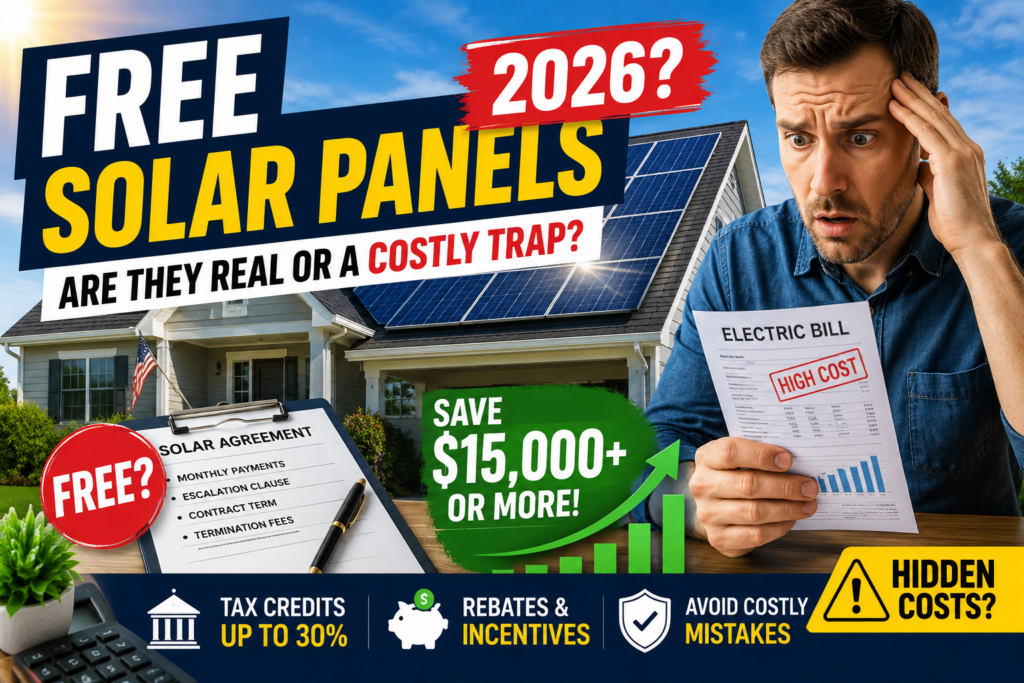
Under current IRS guidance following the 2025 federal legislation, the Residential Clean Energy Credit under Section 25D is not available for qualifying expenditures made after December 31, 2025. For a solar project, the expenditure is generally treated as made when the original installation is completed. That means a new residential solar installation completed in 2026 generally cannot claim the former 30% federal residential solar credit. Always verify your specific tax situation with the IRS or a qualified tax professional.
Quick Answer
No — “free solar panels” usually do not mean the panels are literally free.
In 2026, the phrase commonly refers to a solar lease, Power Purchase Agreement (PPA), or another financing arrangement designed to reduce or eliminate the homeowner’s upfront payment. The solar company or financing provider may own the equipment while the homeowner makes monthly payments or purchases the electricity produced by the system.
Bottom line: Don’t ask only whether the panels are “free.” Ask how much the system will cost you over the entire contract, who owns it, who receives incentives, whether payments increase, and what happens if you sell your home.
📚 What You’ll Learn
The promise sounds simple: get solar panels installed on your home without paying thousands of dollars upfront.
That is the basic idea behind the phrase “free solar panels.” But the phrase can be misleading because a solar system still has a cost. The important question is not whether someone charges you $0 on installation day. The important question is who pays for the system, who owns it, and how much you ultimately pay over the life of the agreement.
In 2026, this distinction is even more important because federal residential solar incentives changed significantly. The federal Residential Clean Energy Credit under Section 25D was accelerated to end for qualifying expenditures made after December 31, 2025. 1
That makes it especially important for homeowners to separate genuine savings opportunities from marketing language.
What Do Companies Actually Mean by “Free Solar Panels”?
In most cases, “free solar panels” means little or no upfront payment, not free equipment.
A solar provider may finance or own the system and then recover its costs through monthly payments, electricity charges, or a long-term contract.
Low Upfront Cost
The homeowner may avoid paying the entire system cost at installation.
Long-Term Contract
The system may be tied to a lease, PPA, loan, or other agreement.
Ongoing Payments
The customer may continue paying for the equipment or solar electricity.
The 4 Main Ways Homeowners Can Get Solar
Understanding the ownership model is more important than the word “free.”
Buy With Cash
You purchase the system and become the equipment owner.
Solar Loan
You finance the system while retaining ownership, subject to the loan terms.
Solar Lease
A third party generally owns the equipment while you pay for its use.
Power Purchase Agreement
You generally pay the provider for electricity generated by the system rather than buying the equipment.
What Happened to the 30% Solar Tax Credit?
The former Residential Clean Energy Credit under Section 25D was a 30% credit for qualifying residential clean-energy expenditures. However, the 2025 federal legislation accelerated its termination.
The IRS states that the credit is not allowed for qualifying expenditures made after December 31, 2025. For solar installations, the IRS explains that the expenditure is generally treated as made when the original installation is completed. 2
🧮 The Number That Actually Matters
Instead of comparing advertisements that say “$0 down,” compare the estimated total cost of electricity and solar payments over the period you expect to own the home.
This is an educational comparison framework, not a personalized financial projection. Actual savings depend on electricity rates, solar production, contract terms, incentives and household energy consumption.
Solar Lease vs. Buying: Which Is Better?
There is no universal winner. The right choice depends on the homeowner’s finances, expected time in the property, risk tolerance, electricity costs and contract terms.
| Factor | Lease / PPA | Owned System |
|---|---|---|
| Upfront payment | Often lower | Usually higher |
| Equipment owner | Usually provider | Homeowner |
| Monthly payment | Usually required | Depends on financing |
| Tax incentives | Ownership determines eligibility | Ownership determines eligibility |
| Selling the home | Contract transfer may matter | System remains with property |
| Maintenance | Often provider-managed | Owner responsibility / warranty |
Lease/PPA may appeal if…
- You want low upfront costs.
- You prefer provider-managed equipment.
- You value predictable service terms.
- The contract clearly produces acceptable savings.
Ownership may appeal if…
- You plan to stay in the property long term.
- You want direct control of the equipment.
- You want to compare financing options.
- You want to capture incentives for which you are personally eligible.
What Happens If You Sell a Home With Solar?
This question should be answered before signing a solar agreement, not after you list the house.
If you own the system, the solar installation is generally part of the property and can be considered alongside the home’s other improvements.
If a third party owns the equipment, the buyer may need to review and potentially assume the remaining agreement, depending on the contract.
- Can the agreement be transferred to a buyer?
- Does the buyer need to qualify?
- Is there a buyout requirement?
- Does the contract affect refinancing?
- Who owns the system when the property is sold?
Should You Improve Energy Efficiency Before Installing Solar?
Sometimes the best first step is not producing more electricity — it is using less electricity.
Reduce heating and cooling losses.
Improve heating and cooling efficiency.
Automate temperature management.
Reduce unnecessary electricity consumption.
Reducing household electricity demand can make it easier to size a solar system appropriately and may also open the door to separate energy-efficiency incentives depending on location and program availability.
Explore broader opportunities in our Energy Rebates 2026 guide .
📍 Solar Incentives Depend on Where You Live
There is no single nationwide “free solar” program that makes solar panels free for every homeowner. State, local and utility programs can differ significantly.
🚩 Solar Deal Red Flags You Should Never Ignore
A solar offer is not automatically bad because it has a $0 upfront cost. But certain sales tactics deserve additional scrutiny.
Ask for the exact government program name and eligibility rules.
A long-term contract deserves time for review.
Ask for complete pricing, production estimates and contract terms in writing.
You should know exactly who owns the equipment.
Ask how electricity-price increases and solar production assumptions were calculated.
Do not sign a 20–25 year agreement you do not understand.
21 Questions to Ask Before Signing a Solar Contract
- Who legally owns the solar equipment?
- Is this a purchase, loan, lease or PPA?
- What is my total expected cost?
- What is the contract length?
- Does my payment increase over time?
- If so, what is the escalation percentage?
- What happens if I sell my home?
- Can the agreement be transferred?
- Does the buyer need to qualify?
- Is there a buyout option?
- How is the buyout price calculated?
- Who receives available tax incentives?
- Which state or utility incentives are included?
- What happens if my utility changes its rate structure?
- Who maintains the equipment?
- Who replaces the inverter if it fails?
- What production guarantee is included?
- What happens if the system produces less electricity than projected?
- What warranties are included?
- What happens if the solar company is sold or goes out of business?
- Can I have an independent professional review the contract?
🔍 How to Verify a Solar Offer Before You Sign
Treat a solar proposal like any other major financial decision. Compare multiple offers and verify the details independently.
Check licensing, business history and customer complaints.
Do not evaluate a single offer in isolation.
Focus on payment increases, transfer rules and buyout terms.
Confirm programs independently rather than relying only on sales claims.
❓ Frequently Asked Questions About Free Solar Panels in 2026
Are free solar panels really free?
Usually not. “Free solar” generally refers to arrangements that reduce or eliminate the upfront installation payment, such as leases or PPAs. The homeowner may still have long-term payments or electricity charges.
Is there a federal free solar panel program in 2026?
There is no universal federal program that simply gives every homeowner free solar panels. Federal residential clean-energy tax rules also changed in 2025, so homeowners should verify current eligibility rather than relying on older 30% credit advertisements.
Can I still get solar incentives in 2026?
Possibly. State, local and utility incentives can differ by location and program. Eligibility, funding and deadlines should be verified with the relevant program administrator.
What is the difference between a solar lease and a PPA?
With a lease, the homeowner generally pays to use solar equipment owned by a third party. With a PPA, the homeowner generally pays for electricity generated by the system. Exact terms vary by provider and contract.
Is buying solar better than leasing?
Not automatically. Ownership may offer greater control and different financial benefits, while leases and PPAs may reduce upfront costs and shift certain maintenance responsibilities. The contract and total lifetime economics matter.
Can a solar contract affect selling my house?
Yes. If a third party owns the equipment, the buyer may need to assume or otherwise address the agreement. Always review transfer and buyout provisions before signing.
Do solar panels eliminate an electric bill?
Not necessarily. Utility charges, connection fees, electricity consumption, solar production and local compensation rules can all affect the final bill.
How long do solar contracts usually last?
Many residential solar agreements can extend for 20 to 25 years, although terms vary. Always read the exact contract rather than relying on an advertised average.
🌎 Explore More Rebate Radar Guides
Continue researching before choosing a solar or home-energy upgrade:
Are “Free Solar Panels” Worth It in 2026?
They can be — but the word “free” should never be the reason you sign the contract.
A $0-upfront solar offer can be attractive if it genuinely reduces your energy costs and the agreement has fair terms. But a low upfront payment does not automatically mean a low lifetime cost.
The smartest approach is to compare the complete economics:
- Ownership vs. lease vs. PPA
- Total lifetime payments
- Annual payment increases
- Electricity rates
- Solar production assumptions
- State and utility incentives
- Maintenance and warranties
- Home-sale and transfer provisions
It is the one that makes the most financial sense for your home over the entire period you expect to own it.
Rebate Radar may earn commissions from qualifying affiliate purchases or referrals at no additional cost to the consumer. Affiliate relationships do not determine the educational information presented on this page.