
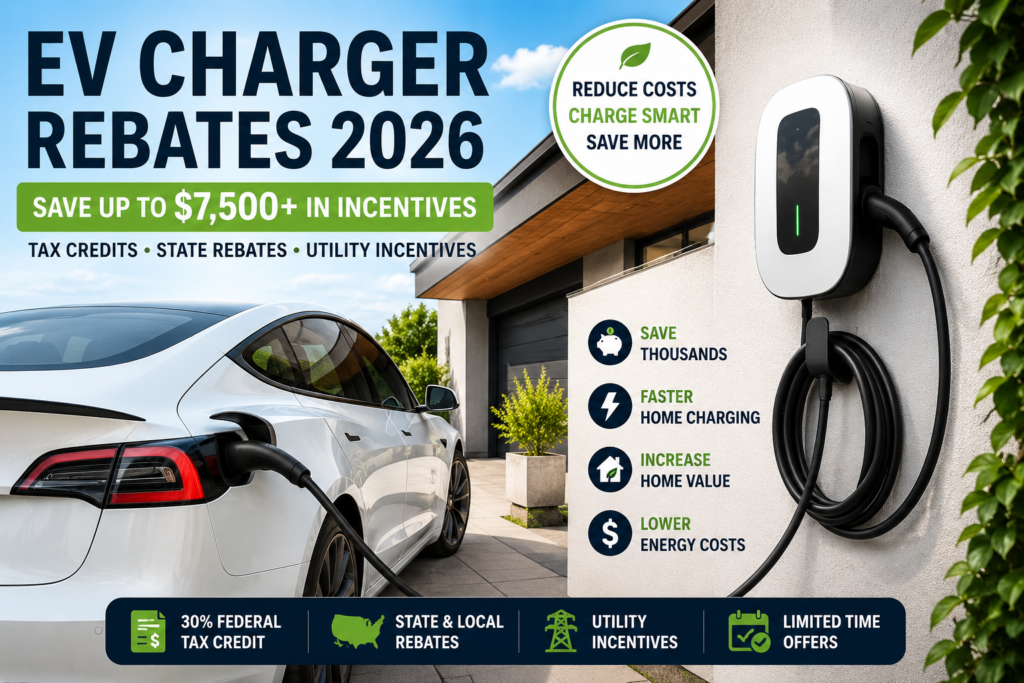
The federal EV charger tax credit does NOT continue for new installations after June 30, 2026
Under current IRS guidance, the federal Alternative Fuel Vehicle Refueling Property Credit under Section 30C was accelerated to end for qualifying property placed in service after June 30, 2026. Therefore, a homeowner installing a new charger after that date should not automatically assume a federal $1,000 charger credit is available.
EV charger savings in 2026 depend heavily on when the charger was placed in service, where the property is located, your utility, and the specific state or local program available to you.
For qualifying residential property placed in service before July 1, 2026, the federal Section 30C credit could equal 30% of eligible costs, subject to a maximum of $1,000 per charging port and additional eligibility rules. After June 30, 2026, homeowners should focus primarily on state, utility and local incentives unless new federal legislation changes the rules.
For qualifying residential property placed in service through June 30, 2026.
Maximum federal residential credit per qualifying charging port.
Property generally had to be placed in service by this date for the federal §30C credit.
The former federal credit required the property to be in an eligible census tract.
What Was the Federal EV Charger Tax Credit?
The federal incentive for residential EV charging equipment was part of the Alternative Fuel Vehicle Refueling Property Credit under Section 30C. For qualifying personal-use property placed in service from January 1, 2023 through June 30, 2026, the residential credit was generally 30% of eligible costs, up to $1,000 per item.
Eligible costs could include the charging equipment and certain associated property and installation costs, such as qualifying labor and directly attributable components. However, the property also had to satisfy specific federal requirements, including installation at the taxpayer’s main home and placement in an eligible census tract.
Does the Federal EV Charger Credit Still Exist in 2026?
This is one of the most important updates for homeowners researching EV charger rebates 2026.
The federal Section 30C credit was originally scheduled to continue longer, but federal legislation accelerated its termination. Current IRS guidance states that qualifying property must have been placed in service before July 1, 2026 to potentially qualify under the modified federal rules.
🚫 Do not advertise a $1,000 federal charger credit for every 2026 installation
If your charger was placed in service after June 30, 2026, the federal Section 30C credit generally is no longer available under current law. Always check the latest IRS guidance before relying on an incentive.
State & Utility EV Charger Rebates May Still Be Available
The end of the federal Section 30C credit does not automatically mean that every EV charger incentive has disappeared. State governments, electric utilities, municipalities and other organizations may offer separate programs.
These programs can differ dramatically by location. Some may offer a fixed rebate, some may cover a percentage of equipment or installation costs, and others may provide special electricity rates or incentives for smart charging.
State Programs
State energy offices may provide EV infrastructure incentives or complementary clean-energy programs.
Utility Rebates
Your electric utility may offer rebates, managed charging programs or special EV electricity rates.
Local Incentives
Municipal or regional programs may provide additional support depending on location and funding.
Smart Charging
Some utilities reward customers for shifting EV charging to preferred times or participating in managed charging programs.
How to Find EV Charger Rebates in Your Area
Because EV charger incentives are highly location-dependent, the best way to estimate your actual savings is to work through your location and utility information before purchasing equipment.
Enter Your ZIP Code
Your location helps identify applicable state and utility programs.
Identify Your Utility
Two homes in the same state can have different utility incentives.
Check Eligibility
Review income, residence, equipment, installation and application rules.
Apply Before Installing
Some utility programs require pre-approval or enrollment before installation.
Level 1 vs. Level 2 EV Chargers
The best charger depends on how much you drive, how long your vehicle remains parked and whether your home’s electrical system can support a dedicated charging circuit.
| Feature | Level 1 | Level 2 |
|---|---|---|
| Typical power | Lower power | Higher power |
| Electrical installation | Often standard household outlet | Usually dedicated circuit |
| Charging speed | Slower | Significantly faster |
| Best use | Low daily mileage | Frequent daily charging |
Popular EV Chargers to Compare in 2026
Equipment selection matters because charger power, connector compatibility, electrical requirements, weather resistance, smart features and warranty support can affect the total cost of ownership.
Tesla Universal Wall Connector
A premium home charging option designed for broad Tesla and North American charging compatibility. Verify connector and vehicle compatibility before purchasing.
Check Current Price →ChargePoint Home Flex
A flexible Level 2 home charger with adjustable charging capability and smart-home features. Confirm current specifications and vehicle connector compatibility.
View Current Price →JuiceBox Smart EV Charger
Smart charging features can help homeowners monitor charging and manage energy use. Product availability and specifications can change.
Check Availability →Grizzl-E Level 2 EV Charger
A rugged Level 2 charging option suited to homeowners looking for durable equipment. Verify the exact model, electrical requirements and current warranty before purchase.
See Current Price →EV Charger Buyer Checklist
Before buying a charger, calculate the complete installed cost rather than comparing hardware prices alone.
How Much Does Home EV Charger Installation Cost?
The total price depends on much more than the charger itself. A simple installation near an existing electrical panel may cost substantially less than a project requiring a long cable run, panel upgrades, trenching, conduit or other electrical work.
Your real project cost can include:
- EV charging equipment
- Electrical labor
- Dedicated circuit installation
- Conduit and wiring
- Electrical panel upgrades, when necessary
- Permits and inspection fees
- Trenching or additional construction work, when required
- Applicable taxes and contractor charges
Can You Combine EV Charging With Solar?
Yes. An EV can become another major electricity load in a home, so pairing charging with solar can make sense for some homeowners. The economics, however, depend on the home’s electricity rate, solar production, charging schedule, utility rules and system design.
☀️ A potential home energy strategy
Other Home Energy Products to Consider
EV charging is only one part of a home’s energy strategy. Depending on your goals, smart energy management and backup power can complement an EV setup.
EcoFlow DELTA Portable Power Station
Portable backup power can be useful during outages and may complement broader home-energy planning. It should not be treated as a replacement for a permanently installed EV charging system.
Check Price →Google Nest Smart Thermostat
Smart thermostat technology can help manage heating and cooling schedules and may complement a broader home energy-efficiency strategy.
View on Amazon →Who Could Qualify for the Federal EV Charger Credit?
For the federal residential Section 30C credit applicable through June 30, 2026, homeowners needed to satisfy several conditions. The rules were more specific than simply owning an EV.
Personal-use property generally had to be installed at the taxpayer’s main home.
The installation location had to meet the federal geographic eligibility rules.
The equipment had to meet the federal definition of qualified recharging property.
The federal residential credit was accelerated to end after June 30, 2026.
How to Claim the Federal EV Charger Credit
If your qualifying residential charger was placed in service during the period covered by Section 30C, the IRS directs taxpayers to use Form 8911, Alternative Fuel Vehicle Refueling Property Credit.
- Keep your purchase invoice and installation documentation.
- Confirm that the property was placed in service within the applicable federal period.
- Verify that the installation location satisfied the applicable census-tract requirement.
- Keep documentation supporting eligible equipment, installation and associated costs.
- Complete the applicable IRS tax forms according to the instructions for your tax year.
EV Charger Rebates 2026 FAQ
Is there a federal EV charger tax credit in 2026?
The federal Section 30C credit was accelerated to terminate for qualifying property placed in service after June 30, 2026. Therefore, new installations placed in service after that date generally do not qualify for the federal residential credit under current law.
How much was the federal residential EV charger credit?
For qualifying residential property placed in service from January 1, 2023 through June 30, 2026, the credit was generally 30% of eligible costs, limited to $1,000 per qualifying item or charging port.
Can I still get an EV charger rebate after June 30, 2026?
Possibly. The expiration of the federal Section 30C credit does not automatically eliminate state, utility or local incentives. Availability depends on your location, utility and program rules.
Does every homeowner qualify for EV charger incentives?
No. Eligibility can depend on the installation location, residence type, equipment, utility, program funding, application timing and other requirements.
Do I need a Level 2 charger to receive a rebate?
Not necessarily. Requirements vary by program. Some incentives may specify charger power, equipment certification, networking capability or installation requirements. Always check the individual program before purchasing.
Can I combine an EV charger rebate with utility incentives?
Sometimes. Some programs allow incentive stacking while others may restrict combining funding sources or require the incentive to be disclosed when calculating another benefit. Verify the specific program rules.
Is a home EV charger worth installing?
For many EV owners, home charging can be substantially more convenient than relying on public charging. The financial value depends on your electricity rate, driving distance, charging schedule, installation cost and vehicle efficiency.
What is a census tract and why does it matter?
A census tract is a geographic area used by the U.S. Census Bureau. Under the federal Section 30C rules, the installation location had to be within an eligible census tract. The IRS provides geographic guidance and lookup information for determining eligibility.
Explore More Rebate Radar Energy Guides
Compare solar incentives, energy rebates, tax-credit information and state-specific programs before making a major home energy purchase.
Check Your EV Charging Savings Before You Buy
The smartest way to approach an EV charger purchase is to calculate the complete installed cost first, then check federal eligibility, state incentives and your utility’s current programs.
Explore Rebate Radar Calculators →Federal Source & Important Information
Federal tax-credit information on this page is based on current IRS guidance concerning the Alternative Fuel Vehicle Refueling Property Credit under Section 30C, including the accelerated June 30, 2026 termination date. Program rules may change after publication.
Rebate Radar is an independent informational publisher and is not affiliated with the IRS, U.S. Department of Energy, any electric utility, vehicle manufacturer or government agency. Incentive availability, eligibility, funding and program terms should be verified with the applicable official source before purchasing equipment or making a financial decision.
Affiliate Disclosure: Some product links on this page are affiliate links. If you purchase through one of these links, Rebate Radar may receive a commission at no additional cost to you. Product availability, pricing, specifications and retailer policies can change.