
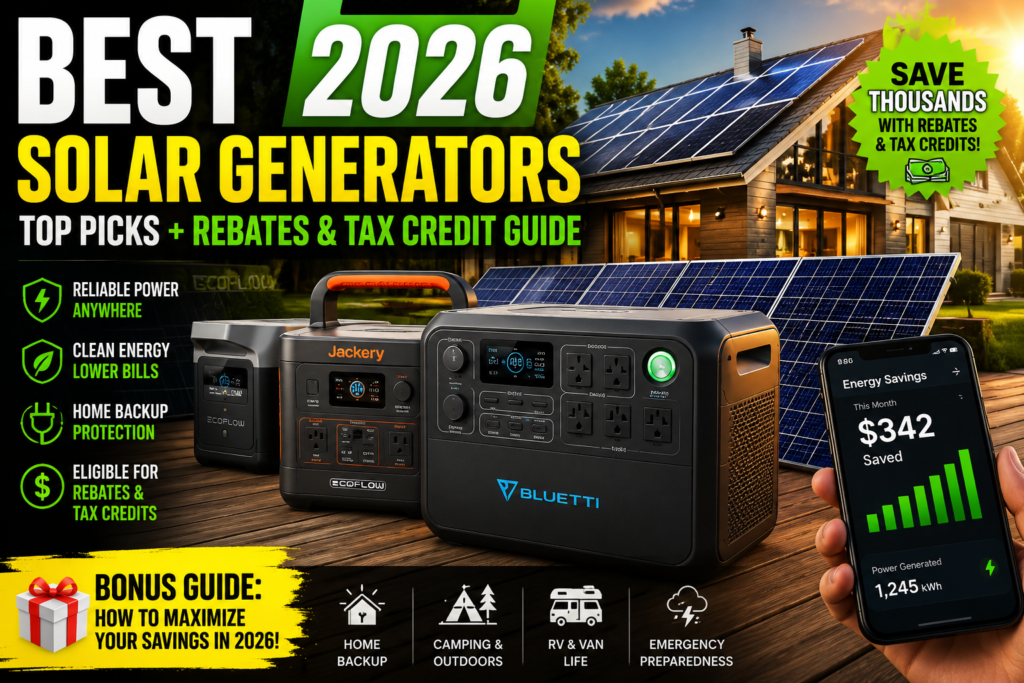
Best Solar Generators 2026: Top Portable Power Stations, Home Backup Batteries & Buying Guide
Looking for the best solar generator in 2026? The right power station depends on what you actually need to run: phones and laptops, refrigerators, medical equipment, appliances, camping equipment, emergency loads, or an entire home.
This guide compares the major types of solar generators and portable power stations, explains battery capacity and inverter power, shows what you should look for before buying, and explains how these systems differ from permanently installed home batteries and traditional gas generators.
1. What Is a Solar Generator?
A solar generator is essentially a battery-based power system that can be recharged using solar panels. Unlike a conventional gasoline generator, it produces electricity without burning fuel while it is operating.
Most modern systems combine several components inside one portable unit:
- Lithium battery storage
- Inverter
- AC outlets
- USB charging ports
- DC outputs
- Solar charging input
- Battery management electronics
- Display or mobile-app monitoring
The term “solar generator” is primarily a consumer-market term. Technically, many of these products are better described as portable power stations.
Think of it as three systems in one:
Battery storage + inverter + charging system.
Solar panels are the energy source that can recharge the battery, but the portable power station itself is the part that stores and converts the energy into usable electricity.
2. Which Type of Solar Generator Is Right for You?
| Type | Best For | Main Advantage | Main Limitation |
|---|---|---|---|
| Small portable power station | Phones, laptops, lights, routers | Lightweight and affordable | Limited runtime and output |
| Mid-size power station | Camping, appliances, refrigerators | Good balance of portability and capacity | May not support large loads simultaneously |
| High-capacity power station | Emergency home backup | Large battery and high inverter output | Heavy and expensive |
| Expandable battery system | Long-duration backup | Capacity can be expanded | Higher upfront cost |
| Permanent home battery | Whole-home backup and solar integration | Automatic, integrated operation | Requires professional installation |
3. Best Solar Generators & Portable Power Stations 2026
There is no single “best” solar generator for every homeowner. A system that is excellent for emergency electronics may be completely inadequate for a refrigerator, air conditioner or whole-home backup.
For that reason, we organize the recommendations by use case rather than pretending one product is automatically best for everyone.
1. High-Capacity Solar Generator — Best for Home Backup
A high-capacity portable power station is the strongest option for homeowners who want meaningful emergency backup without immediately installing a permanent battery system.
Look for a system with a large battery, strong continuous inverter output, high surge capability and expandable storage if you expect outages to last many hours.
- High battery capacity
- High continuous AC output
- Multiple charging options
- Solar input
- Expandable battery capability on selected models
- Suitable for refrigerators and emergency loads when correctly sized
2. Portable Power Station — Best Value
A mid-size portable power station is often the sweet spot for consumers who want emergency backup without paying for an enormous battery.
This category works particularly well for apartments, camping, remote work, electronics, lighting and selected household appliances.
- Portable form factor
- Lower entry price
- Useful for electronics and smaller appliances
- Solar charging capability
- Good option for renters
3. Advanced Battery System — Premium Option
Premium battery systems are designed for consumers who care more about long-duration backup, expansion and energy management than minimum purchase price.
These systems can make sense for homeowners who want to combine portable-style flexibility with much larger energy storage.
- Large storage capacity
- Expandable architecture on selected systems
- Advanced energy management
- Long-term backup potential
- Useful for solar integration
4. Home EV Charger — Energy Upgrade
If you own an electric vehicle, home charging can be a major convenience and can reduce reliance on public charging.
However, homeowners should not purchase an EV charger based on an assumed federal tax credit. The federal residential §30C credit applied to qualifying property placed in service through June 30, 2026, subject to additional eligibility requirements.
Check Availability5. Smart Thermostat — Easy Energy Upgrade
A smart thermostat is not a solar generator, but it belongs in the broader energy-management strategy because reducing unnecessary HVAC consumption can reduce the amount of battery or solar capacity a home needs.
View Product4. How Much Battery Capacity Do You Need?
Battery capacity is usually expressed in watt-hours (Wh) or kilowatt-hours (kWh).
The larger the battery, the more energy it can theoretically store. But usable runtime depends on the actual load, inverter efficiency, operating conditions and the amount of battery capacity the manufacturer allows you to use.
Small Backup
Useful for phones, laptops, lights, routers and small electronics.
Medium Backup
Better suited to refrigerators, electronics and several emergency loads.
Serious Backup
Better for longer outages and larger household loads when inverter output is also sufficient.
These are general categories, not guarantees of runtime. Always calculate based on the actual wattage of the equipment you plan to operate.
5. Watts vs. Watt-Hours: The Most Important Solar Generator Concept
Many buyers focus entirely on battery size and overlook the inverter.
That can lead to an expensive mistake.
Watt-hours = Energy Storage
Watt-hours tell you approximately how much energy the battery can store.
A larger Wh rating generally means longer potential runtime.
Watts = Power Output
Watts tell you how much electrical power the inverter can deliver at a given moment.
A high-capacity battery can still fail to operate an appliance if the inverter cannot provide enough power.
Simple example
A refrigerator may require relatively modest average energy but can demand a higher amount of power when its compressor starts.
That means you need to consider both energy capacity and surge/starting power.
6. What Can a Solar Generator Power?
The answer depends on the generator’s inverter output, battery capacity and the specific appliance.
| Device | Typical Use | What to Check |
|---|---|---|
| Phone | Very low energy demand | Battery capacity |
| Laptop | Low-to-moderate | AC or USB output |
| Wi-Fi router | Low continuous load | Runtime |
| LED lights | Low load | Number of lights and hours |
| Refrigerator | Variable | Running watts + startup surge |
| Microwave | High short-duration load | Inverter output |
| Electric kettle | High short-duration load | Continuous inverter rating |
| Air conditioner | High and variable | Starting surge + sustained output |
7. Can a Solar Generator Run a Refrigerator?
Yes, many appropriately sized portable power stations can run a refrigerator, but the question is not simply whether the generator has enough watt-hours.
You also need to consider the refrigerator’s starting surge.
Compressors can require significantly more power when starting than they consume during normal operation.
Before buying, find:
- Running wattage
- Starting or surge wattage
- Expected operating hours
- Energy consumption over 24 hours
8. Can a Portable Solar Generator Power an Entire House?
Sometimes, but “whole-home backup” can mean very different things.
A portable power station may be capable of powering selected circuits or essential loads, while a permanently installed battery system may be designed to automatically back up a much larger portion of the home.
Essential-load backup
Many homeowners do not actually need to power everything during an outage.
They may prioritize:
- Refrigerator
- Freezer
- Internet router
- Lights
- Phones
- Computers
- Medical equipment
- Selected kitchen appliances
Whole-home backup
Whole-home backup can involve significantly larger power requirements, especially when the home has:
- Central air conditioning
- Electric water heating
- Electric cooking
- Pool equipment
- Large pumps
- Multiple HVAC systems
In those situations, homeowners should compare portable systems against professionally installed battery storage and generator solutions.
9. Solar Generator vs. Home Battery: Which Is Better?
| Feature | Portable Solar Generator | Permanent Home Battery |
|---|---|---|
| Portable | Yes | Usually no |
| Professional installation | Often unnecessary | Usually required |
| Automatic whole-home backup | Usually limited | Designed for this purpose |
| Solar integration | Often available | Designed for deeper integration |
| Expandable storage | Available on some models | Available on many systems |
| Best for renters | Yes | Usually not |
| Emergency portability | Excellent | Low |
10. Solar Generator vs. Gas Generator
Traditional generators and battery-based systems have different strengths.
Solar Generator Advantages
- No gasoline required while operating
- Quiet operation
- No exhaust emissions at the point of use
- Can be recharged from solar
- Low routine maintenance
- Useful indoors when the manufacturer specifically permits the intended operation
Gas Generator Advantages
- Can provide long runtime with sufficient fuel
- High power output available in many models
- Useful for prolonged outages
- Fuel can be replenished
11. How Solar Charging Works
Portable power stations can often be charged from compatible solar panels through a dedicated solar input.
The practical charging time depends on several variables:
- Panel wattage
- Sunlight intensity
- Panel orientation
- Temperature
- Cloud cover
- Solar input limit of the power station
- Battery state of charge
More solar panel wattage does not automatically mean faster charging.
The power station has a maximum solar-input limit. If the panels can produce more power than the input controller accepts, the extra theoretical capacity may not translate into faster charging.
12. How to Choose the Right Solar Generator
List the devices you actually need
Do not start with a battery size. Start with your emergency loads.
Calculate their power requirements
Separate continuous loads from appliances with significant startup surges.
Estimate outage duration
A two-hour backup requirement is completely different from a two-day backup requirement.
Choose inverter capacity
Make sure the inverter can handle the highest simultaneous load and relevant startup requirements.
Choose battery capacity
Once you understand your loads, select enough usable energy for your target runtime.
Check solar input
If solar charging matters, verify the maximum solar input and compatible panel configuration.
Compare warranty and expansion
A cheaper system can become expensive if the battery cannot be expanded or supported over the long term.
13. 10 Common Solar Generator Buying Mistakes
1. Buying only by battery size
Capacity matters, but inverter output matters too.
2. Ignoring surge power
Motors and compressors can require substantially more power when starting.
3. Assuming solar charging is instant
Actual solar charging depends on conditions and the system’s input limits.
4. Buying too small
An undersized system can become frustrating during a real outage.
5. Buying far more capacity than needed
Oversizing can unnecessarily increase cost and weight.
6. Ignoring battery chemistry
Battery chemistry affects weight, cycle life and long-term ownership.
7. Forgetting solar input limits
More panel wattage is not always more usable charging power.
8. Assuming every product qualifies for tax credits
Federal incentive rules are specific and changed significantly for 2026.
9. Confusing portable backup with whole-home backup
The two systems are designed for different use cases.
10. Ignoring warranty terms
Long-term battery ownership makes warranty coverage especially important.
14. Do Solar Generators Qualify for Tax Credits in 2026?
This is one of the most important sections of this guide because many older articles still describe the former federal residential clean-energy credit as though it automatically applies to new 2026 purchases.
It does not.
The IRS also specifically explains that for §25D, paying for property before the deadline does not necessarily preserve the credit if the original installation is completed after December 31, 2025.
What about portable power stations?
Do not assume that purchasing a portable power station from an online retailer automatically creates a federal residential tax credit.
The former §25D rules concerned qualifying residential clean-energy property and had specific requirements. A portable consumer product should not be marketed to you as federally tax-credit eligible without documentation showing why it qualifies under the applicable law.
15. Can Solar Generators Qualify for Rebates?
Potentially—but this is highly location-specific.
Utility programs, state incentives and local energy programs can have their own definitions of qualifying equipment, installation requirements and eligible applicants.
A portable power station purchased online should not automatically be assumed to qualify simply because it stores energy or can be charged by solar panels.
Before assuming you qualify, check:
- Your ZIP code
- Your utility territory
- Program funding
- Equipment requirements
- Installation requirements
- Contractor requirements
- Pre-approval requirements
- Purchase date
- Installation date
- Income requirements, if applicable
Use our Energy Rebate Calculator to start identifying programs that may apply to your location.
16. Are Solar Generators Worth It?
The answer depends on what you are trying to accomplish.
They can be worth it for:
- Emergency preparedness
- Frequent power outages
- Remote work
- Camping and travel
- Temporary backup power
- Reducing reliance on gasoline
- Powering critical electronics
- Supporting selected appliances during outages
They may not be the best solution for:
- Permanent whole-home backup
- Very long outages without enough solar generation
- Very large continuous electrical loads
- Homes with substantial HVAC requirements
Do not calculate value simply as “generator price ÷ electricity savings.”
For many buyers, the primary value is backup power, convenience and resilience, not necessarily a direct reduction in annual electricity bills.
17. The Best Home Emergency Backup Strategy
For many homeowners, the best energy strategy is not choosing one giant battery and trying to power everything.
Instead, identify the loads that matter most.
Priority 1 — Critical
- Medical equipment
- Refrigerator
- Communications
- Internet
- Essential lighting
Priority 2 — Important
- Laptops
- Television
- Small kitchen appliances
- Fans
Priority 3 — Optional
- Large HVAC loads
- Electric water heating
- Pool equipment
- Other high-power appliances
Once these priorities are established, you can size the battery around the loads that actually matter instead of paying for unnecessary capacity.
18. Solar Generator Buying Checklist
Before purchasing:
- ☐ Determine your critical appliances.
- ☐ Check their running wattage.
- ☐ Check startup/surge requirements.
- ☐ Estimate desired backup hours.
- ☐ Compare usable battery capacity.
- ☐ Compare continuous inverter output.
- ☐ Compare surge output.
- ☐ Check solar input limits.
- ☐ Check charging speed.
- ☐ Check battery chemistry.
- ☐ Check cycle-life specifications.
- ☐ Review warranty.
- ☐ Check expansion options.
- ☐ Verify outlet configuration.
- ☐ Verify weight and portability.
- ☐ Verify manufacturer support.
- ☐ Do not assume federal tax-credit eligibility.
- ☐ Check local utility or rebate programs.
- ☐ Compare total ownership cost.
19. More Energy & Solar Guides From Rebate Radar
☀️ Solar
🔋 Battery Storage
20. Explore Energy Incentives by State
Energy incentives vary significantly by state, utility territory and equipment type. Start with your location before assuming that a federal or statewide incentive applies.
21. Frequently Asked Questions About Solar Generators 2026
What is the best solar generator in 2026?
There is no single best model for every buyer. The best choice depends on battery capacity, inverter output, portability, solar-input capability, intended appliances, outage duration and budget. High-capacity systems are generally better for home backup, while smaller units are better for electronics and portability.
What is the difference between a solar generator and a portable power station?
In consumer terminology, the terms are often used interchangeably. A portable power station is a battery-based electrical system with an inverter and charging inputs. “Solar generator” generally refers to a portable power station that can be recharged using solar panels.
Can a solar generator power a refrigerator?
Yes, if the power station has sufficient inverter output, surge capability and battery capacity. Refrigerator compressors can require additional power during startup, so buyers should check both running and starting requirements.
How many watt-hours do I need for a home backup?
There is no universal number. Start by identifying the appliances you want to operate, their power consumption and how long you need them to run. A small electronics backup system may need hundreds of watt-hours, while longer-duration home backup can require several kilowatt-hours or more.
Can a solar generator run an entire house?
Some high-capacity systems can support selected household loads, but whole-home backup depends on the home’s electrical demand and the system’s inverter and battery capacity. Homes with central air conditioning, electric heating or other large loads may require a permanently installed battery or another high-output backup solution.
Do solar generators qualify for the 30% federal tax credit in 2026?
Homeowners should not assume that a new portable solar generator qualifies for the former 30% Residential Clean Energy Credit. The IRS states that Section 25D is not available for qualifying expenditures made after December 31, 2025.
Can I get a rebate for buying a portable power station?
Potentially, but this depends on the specific program. Utility and local incentives can have their own equipment, installation, location and eligibility requirements. A portable power station should not automatically be considered rebate-eligible.
Is a solar generator better than a gas generator?
It depends on the application. Battery-based systems are quiet and can be recharged from solar, while fuel generators can provide long runtime when fuel is available. For emergency preparedness, some homeowners may prefer a battery system for essential loads and another backup option for prolonged outages.
Can I charge a solar generator with solar panels?
Yes, many portable power stations have dedicated solar charging inputs. The actual charging speed depends on panel output, sunlight, panel configuration and the maximum solar input supported by the power station.
Are solar generators worth buying?
They can be valuable for emergency backup, camping, remote work, power outages and portable electricity. Their financial value is usually better measured in resilience and convenience than by assuming they will dramatically reduce a home’s annual electricity bill.
What should I look for when buying a solar generator?
Focus on usable battery capacity, continuous inverter output, surge capability, solar-input limits, charging speed, battery chemistry, cycle life, warranty, expansion options, weight and manufacturer support.
What is better: a portable power station or a home battery?
A portable power station is better when portability and flexible emergency use are priorities. A permanently installed home battery is generally better for automatic backup, deeper solar integration and long-term home energy management.
22. Final Verdict: Choose the System Around Your Real Energy Needs
The best solar generator is not necessarily the biggest battery or the most expensive power station.
The right system is the one that can deliver enough power to your most important devices for the amount of time you actually need it, while fitting your budget and charging strategy.
For some households, that means a compact portable power station.
For others, it means a high-capacity expandable battery system.
And for homeowners looking for automatic whole-home backup and deep solar integration, a professionally installed home battery may be the better solution.
The Rebate Radar approach:
Identify the need → calculate the load → choose the right capacity → compare equipment → check incentives → calculate total cost → buy based on the economics, not the advertisement.
Most importantly, do not let an advertised “30% tax credit” or “free energy” claim make the decision for you. Federal residential energy incentives changed substantially in 2026, and the current rules should always be verified before purchasing.
Find the Energy Incentives That May Apply to Your Home
Buying solar equipment is only one part of the equation. Before spending thousands of dollars, check whether your location, utility and project may qualify for available energy programs.
Check Home Energy Rebates Use Solar Calculator