
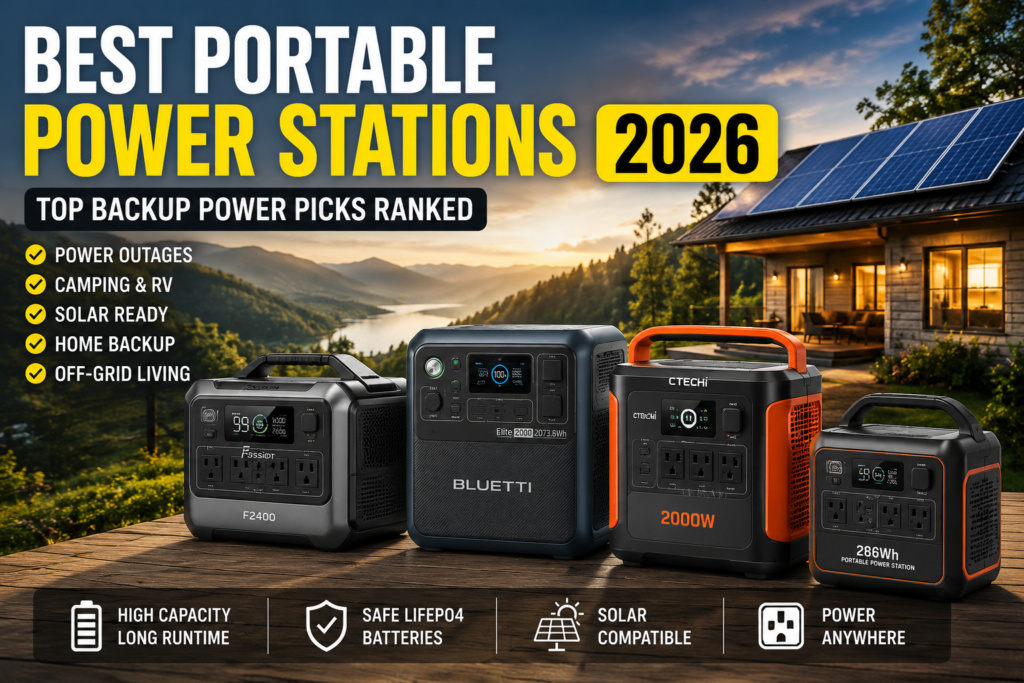
Best Portable Power Stations 2026: Top Backup Power Picks Ranked
Looking for the best portable power station in 2026? We compare portable battery generators for home backup, emergencies, camping, RVs, road trips, remote work, and solar-powered living.
Quick Answer: Which Portable Power Station Is Best?
The best portable power station depends on what you need to power. A small battery generator can be ideal for phones, laptops, lights, and short camping trips, while larger systems are better for refrigerators, medical equipment, appliances, RVs, and home emergency backup.
For buyers looking at the premium end of the market, BLUETTI offers several interesting options, including the APEX 300, Elite 300, and Charger 2. Amazon also offers a broad range of portable power stations at different price points.
Table of Contents
- What Is a Portable Power Station?
- How We Rank Portable Power Stations
- Best Portable Power Stations 2026
- BLUETTI APEX 300
- BLUETTI Elite 300
- BLUETTI Charger 2
- Amazon Portable Power Station Picks
- How Much Battery Capacity Do You Need?
- How Much Power Do You Need?
- Why LiFePO₄ Batteries Matter
- Solar Charging Explained
- UPS and Emergency Backup
- Best Power Stations for Camping
- Best Power Stations for RVs
- Best Power Stations for Home Backup
- Portable Power Station Buying Guide
- Common Buying Mistakes
- Frequently Asked Questions
What Is a Portable Power Station?
A portable power station is essentially a rechargeable battery system with built-in power electronics that allows you to run or charge electrical devices without being connected directly to a traditional wall outlet.
Unlike a conventional gasoline generator, a portable battery generator can operate without gasoline and produces no direct exhaust emissions while it is running. Depending on the model, it can be charged from a wall outlet, vehicle, solar panels, or a combination of charging sources.
Portable power stations have become increasingly useful for homeowners, campers, RV owners, travelers, remote workers, emergency-preparedness enthusiasts, and anyone who wants a backup source of electricity.
The important thing to understand is that portable power stations are not all the same. A compact 300Wh unit and a multi-kilowatt home backup system can both be called portable power stations, but their capabilities are dramatically different.
The Two Numbers You Should Never Ignore
When comparing a portable power station, pay close attention to:
- Watt-hours (Wh): how much energy the battery stores.
- Watts (W): how much electrical power the system can deliver at a given time.
A larger Wh rating generally means longer runtime, while a higher W rating allows the power station to operate more demanding appliances.
How We Rank the Best Portable Power Stations
A high battery capacity alone does not automatically make a power station the best choice. We look at the complete system and how it fits different real-world scenarios.
🔋 Battery Capacity
Higher Wh capacity generally means more stored energy and longer runtime.
⚡ AC Output
Higher continuous output allows the unit to operate more demanding appliances.
☀️ Solar Charging
Solar input can make a power station significantly more useful during extended outages and off-grid trips.
🔌 Ports
USB-C, USB-A, AC outlets, DC outputs and RV connectors determine what you can power simultaneously.
🛡️ Safety
Battery management, temperature protection and overload protection are critical for everyday use.
🚐 Portability
Weight, handles and wheels matter if you plan to move the system frequently.
Best Portable Power Stations 2026: Our Top Picks
There is no single power station that is perfect for every buyer. The right model depends on whether your priority is portability, emergency backup, RV use, large appliances, solar charging, or whole-home resilience.
BLUETTI APEX 300
The BLUETTI APEX 300 is designed for buyers who need considerably more capability than a small camping power station. BLUETTI lists the APEX 300 with 2,764.8Wh of battery capacity and 3,840W of output, along with 120V/240V capability and expandable battery options. :contentReference[oaicite:1]{index=1}
That makes it particularly interesting for emergency home backup, high-demand appliances, workshops, RV applications, and users who want a system that can be expanded rather than replaced as their energy requirements increase.
2,764.8Wh
3,840W
LiFePO₄
Home Backup
Why consider it: high output, large capacity, expandable architecture, and support for 120V/240V applications make the APEX 300 a much more serious backup system than compact portable batteries.
Check BLUETTI APEX 300 →BLUETTI Elite 300
The BLUETTI Elite 300 occupies an interesting position between a conventional portable power station and a larger home/RV backup battery. BLUETTI lists it at approximately 3,014Wh of capacity and 2,400W of AC output. :contentReference[oaicite:2]{index=2}
Its large battery capacity makes it particularly appealing for RV owners, camping setups, emergency preparedness, and homeowners who want substantial stored energy without moving directly into a much larger permanently installed battery system.
BLUETTI also highlights features such as RV compatibility, a 10 ms UPS function and app-based monitoring. :contentReference[oaicite:3]{index=3}
3,014Wh
2,400W
LiFePO₄
RV + Home
Why consider it: excellent stored energy for its category, strong AC output, RV-friendly functionality and a design intended to remain practical for mobile use.
Check BLUETTI Elite 300 →BLUETTI Charger 2
A portable power station is only as useful as your ability to recharge it. That’s where the BLUETTI Charger 2 becomes interesting.
BLUETTI describes Charger 2 as a dual alternator-and-solar charger capable of up to 1,200W of combined charging. It is designed to integrate with BLUETTI power stations and can also work with many third-party stations using compatible MC4 solar connections. :contentReference[oaicite:4]{index=4}
This can be particularly useful for road trips, RV travel, remote work, extended outages and off-grid applications where traditional wall charging is not always available.
More BLUETTI Options
If you’re comparing different BLUETTI systems, these additional links can be useful for exploring the manufacturer’s broader ecosystem and portable power products.
Portable Power Station Picks Available on Amazon
Amazon is useful for shoppers who want to compare portable power stations across different manufacturers, capacities and price ranges. The following products were already part of our original article and are being retained here.
🔋 286Wh Portable Power Station
A compact option for basic emergency power, electronics, lights, phones and small devices.
View on Amazon →⚡ FOSSiBOT F2400
A higher-capacity portable power station aimed at buyers who need more stored energy and stronger AC output.
Check on Amazon →☀️ BLUETTI Elite 200 V2
A popular BLUETTI configuration for emergency preparedness, camping, backup power and solar charging.
View on Amazon →🔌 CTECHi 2000W Portable Power Station
A higher-output portable battery option worth comparing for home backup and emergency applications.
View on Amazon →How Much Battery Capacity Do You Need?
Battery capacity is measured in watt-hours, or Wh. It represents the amount of energy stored in the battery.
For example, a theoretical 1,000Wh battery could provide approximately 100 watts for 10 hours under ideal conditions. Real-world runtime will be lower because of conversion losses, battery management, device efficiency and other factors.
| Capacity Class | Typical Use | Good For |
|---|---|---|
| Under 500Wh | Light portable power | Phones, lights, laptops, small electronics |
| 500–1,000Wh | General portable use | Camping, workstations, small appliances |
| 1,000–2,000Wh | Extended backup | Refrigerators, electronics, larger camping setups |
| 2,000Wh+ | Large backup systems | Home backup, RVs, demanding appliances |
How Much Power Output Do You Need?
Capacity is only half of the equation. You also need enough output power to start and operate your devices.
A refrigerator, microwave, coffee maker, space heater or power tool can require significantly more power than a smartphone or laptop. Some appliances also have a short startup surge that can be considerably higher than their normal operating consumption.
Don’t Buy Based on Watt-Hours Alone
A 2,000Wh power station with insufficient AC output may not be able to operate an appliance that a smaller-capacity but higher-output system can handle. Always check both Wh capacity and continuous/peak output.
Why LiFePO₄ Batteries Matter
Many modern premium portable power stations use LiFePO₄ (lithium iron phosphate) battery chemistry. It has become particularly popular in portable power because of its combination of durability, thermal stability and long cycle life.
For buyers who expect to use a power station frequently, battery chemistry deserves serious attention. A system that is used occasionally for emergencies has different requirements from one that is charged and discharged every day.
However, battery chemistry is only one part of the equation. Battery management, thermal management, inverter design, charging speed, warranty and overall product quality also matter.
Solar Charging: Is a Solar Generator Worth It?
A portable power station becomes considerably more versatile when it can be recharged from solar panels.
Solar charging can be particularly valuable during extended outages because it provides a method of replenishing the battery without relying entirely on the electrical grid.
The actual solar charging speed depends on the power station’s solar input limit, panel wattage, sunlight conditions, panel orientation, temperature and other factors.
For serious emergency preparedness, the best setup is often not simply the biggest battery. It is a combination of adequate battery capacity + sufficient inverter output + reliable solar input + efficient appliances.
UPS and Emergency Backup: What Should You Know?
Some portable power stations include UPS functionality that can automatically switch connected equipment to battery power when grid electricity fails.
This can be especially useful for Wi-Fi equipment, computers, networking hardware, security systems, workstations and other electronics where even a brief interruption can be inconvenient.
However, not every portable power station has the same transfer characteristics. If uninterrupted power is critical for your equipment, check the manufacturer’s UPS specifications before purchasing.
Best Portable Power Stations for Camping
Camping buyers usually prioritize portability, low noise, USB-C charging, solar compatibility and enough capacity for lights, phones, cameras, laptops and small appliances.
You generally don’t need a massive home backup battery for a weekend camping trip. A lighter unit may be much more convenient to transport.
For longer off-grid trips, however, additional capacity and solar charging become more important.
Best Portable Power Stations for RVs
RV owners have a different set of requirements. Power stations may need to support refrigerators, lighting, electronics, cooking equipment, entertainment systems and other equipment while traveling away from shore power.
Output ports and connector compatibility are particularly important. Some systems also provide dedicated RV-oriented outputs.
Larger systems such as the BLUETTI Elite 300 can be particularly interesting for this use case because BLUETTI specifically highlights RV functionality for the model. :contentReference[oaicite:5]{index=5}
Best Portable Power Stations for Home Backup
Home backup is where the difference between compact portable batteries and high-capacity power stations becomes most obvious.
If your goal is simply to keep phones, lights and a router running during a short outage, a compact system may be sufficient.
If you want to keep a refrigerator, medical equipment, workstation, networking equipment or multiple appliances running for longer periods, you should look at substantially larger systems.
For buyers seeking higher-output home backup, the BLUETTI APEX 300 is worth examining because its current specifications put it in a significantly more powerful category than typical compact portable power stations. :contentReference[oaicite:6]{index=6}
Portable Power Station Buying Guide: 10 Things to Check
- Battery capacity: Check Wh rather than judging a unit by physical size.
- Continuous AC output: Make sure it can handle the devices you actually plan to use.
- Surge capability: Important for appliances with high startup demand.
- Battery chemistry: LiFePO₄ is common in modern premium systems.
- Solar input: Higher solar input can shorten recharge times under good conditions.
- Charging speed: A large battery is less useful if it takes too long to recharge for your situation.
- Port selection: Look for the USB, AC and DC connections you actually need.
- UPS capability: Important if you want automatic backup for sensitive electronics.
- Weight and mobility: Wheels and handles can make a large difference with heavier units.
- Warranty and support: A battery system is a long-term purchase, so after-sales support matters.
Portable Power Station Comparison: What Type of Buyer Are You?
| Your Priority | What to Look For |
|---|---|
| Emergency electronics | Compact capacity + USB-C + AC output |
| Camping | Portability + solar charging + moderate capacity |
| RV | Large capacity + high output + RV compatibility |
| Home backup | High output + large capacity + expansion + UPS |
| Off-grid living | Large battery + high solar input + expandable storage |
| Road trips | Vehicle charging + portability + fast recharge |
More Energy & Home Power Guides
If you’re researching portable power because you’re planning a larger home energy project, these related Rebate Radar resources may also help:
Common Portable Power Station Buying Mistakes
1. Buying the biggest battery automatically
Bigger is not always better. A massive battery can be expensive, heavy and inconvenient if your real requirement is simply charging electronics during occasional camping trips.
2. Ignoring inverter output
A high Wh rating does not guarantee that the system can operate a high-wattage appliance.
3. Forgetting recharge time
During an extended outage, recharge speed becomes critical. Consider how quickly you can recharge from AC, solar or a vehicle.
4. Ignoring solar input
If you want true off-grid capability, solar input should be part of your buying decision from the beginning.
5. Buying without calculating actual loads
Make a list of the devices you want to run and estimate their wattage and expected runtime before choosing a battery.
Frequently Asked Questions About Portable Power Stations
What is the best portable power station in 2026?
There is no universal best model. The right choice depends on battery capacity, output power, portability, solar input, intended use and budget. Larger systems such as the BLUETTI APEX 300 are better suited to high-demand backup applications, while smaller units can be more practical for camping and electronics.
Are portable power stations worth buying?
They can be extremely useful for emergency preparedness, camping, RV travel, remote work and backup electricity. The value depends heavily on how often you use the system and what equipment you need to power.
How long will a portable power station run a refrigerator?
Runtime depends on the refrigerator’s actual energy consumption, battery capacity, inverter efficiency and operating conditions. A refrigerator that averages 60W over time will consume energy very differently from one that averages 150W.
Can a portable power station run a refrigerator during a blackout?
Yes, if the power station has sufficient continuous and surge output and enough battery capacity. Always check the refrigerator’s startup requirements and the power station’s specifications.
Can portable power stations be charged with solar panels?
Many models support solar charging. However, solar charging speed varies considerably between products, so check the maximum solar input and supported voltage/current range before purchasing panels.
Are LiFePO₄ power stations better?
LiFePO₄ batteries are popular because of their durability, thermal characteristics and long cycle-life potential. However, the complete power station—including its battery management system, inverter, thermal design, warranty and support—should be evaluated.
Can I use a portable power station while it is charging?
Many systems support simultaneous charging and power output, but the exact behavior depends on the model and operating mode. Check the manufacturer’s specifications before relying on this feature for critical equipment.
What size portable power station do I need for home backup?
It depends on which appliances you want to keep running. For basic electronics, a smaller system may be enough. For refrigerators, medical equipment, larger appliances or extended outages, look at higher-capacity systems with substantially higher AC output.
Can a portable power station replace a gasoline generator?
Not in every situation. Battery power stations are quiet, convenient and can be recharged using solar, but gasoline generators can provide long-duration power as long as fuel is available. The better choice depends on the application.
Can I take a portable power station camping?
Yes. Portable power stations are commonly used for camping, overlanding and RV travel. For frequent transport, weight and physical size should be considered just as carefully as battery capacity.
What is the difference between a power station and a solar generator?
The terms are often used interchangeably. A solar generator generally refers to a portable battery system that can be recharged using solar panels, while a portable power station can also be charged from AC power, a vehicle or other sources.
Final Verdict: Choosing the Best Portable Power Station in 2026
The best portable power station is not necessarily the one with the biggest battery or the highest price. It is the system that matches your actual electrical requirements.
For occasional camping and electronics, prioritize portability. For RV use, look for capacity, output and compatible connections. For emergency home backup, prioritize battery capacity, inverter output, UPS functionality and recharge options.
If you are considering a premium home-backup system, the BLUETTI APEX 300 stands out because of its combination of high output, substantial battery capacity and expansion potential. For buyers looking for a large portable system with RV and home applications, the BLUETTI Elite 300 is another option worth comparing. :contentReference[oaicite:7]{index=7}
Ultimately, the smartest purchase is the one that gives you enough capacity, enough output and enough recharge flexibility for the situations you actually expect to encounter.
Ready to Compare Portable Power Stations?
Compare the options above based on capacity, output, portability, solar charging and your intended use before choosing your next backup power system.