
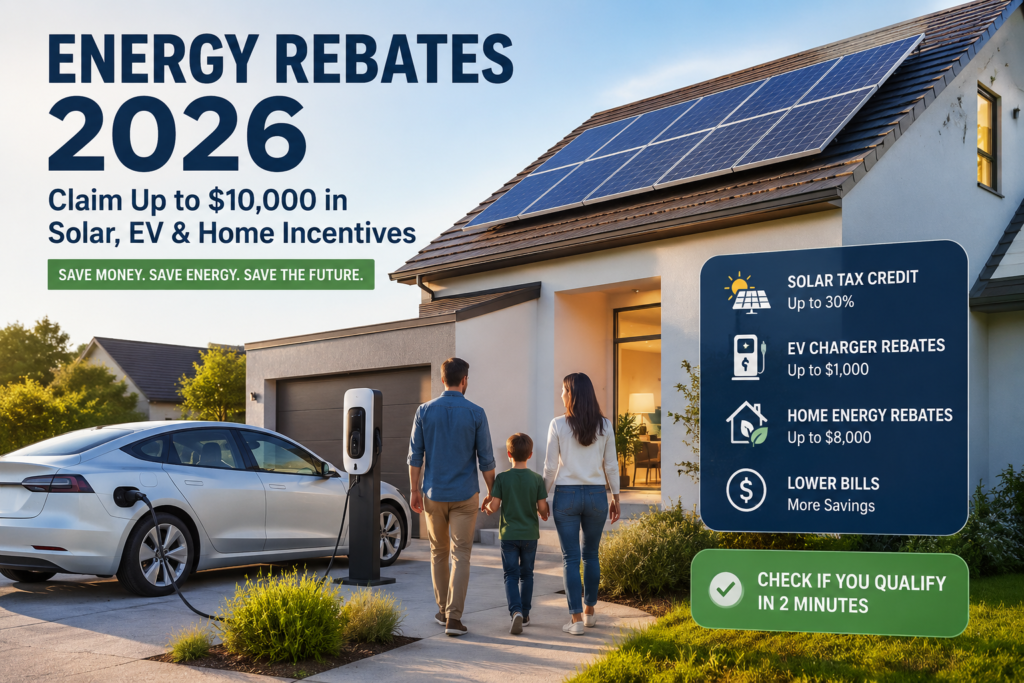
Energy Rebates 2026: Find Home Energy Rebates, Incentives & Savings
Looking for energy rebates 2026? Find out which federal, state, utility and local programs may help reduce the cost of solar, heat pumps, insulation, efficient appliances, batteries, EV charging and other home-energy upgrades.
⚠️ Important 2026 Energy Incentive Update
Federal residential energy tax incentives changed significantly for 2026. Some federal tax credits that previously applied to home solar, batteries and energy-efficiency improvements ended for new qualifying activity after 2025. Other federal programs, including the Department of Energy’s Home Energy Rebates, may still operate through participating states, territories or Tribes.
Do not assume an old 2024 or 2025 article is still accurate for 2026. Always verify the current program administrator, funding status, eligibility rules, installation deadline and application requirements before purchasing equipment.
💡 Energy Rebates 2026: Quick Answer
There is no single nationwide energy rebate that every homeowner automatically receives in 2026. The programs available to you can depend on your state, ZIP code, utility provider, household income, home type, equipment, project cost and installation date.
Some homeowners may qualify for state or utility rebates for energy-efficient upgrades, while others may find programs for heat pumps, insulation, appliances, batteries, EV charging or whole-home energy improvements.
Home Energy
Whole-home efficiency programs may help with insulation, air sealing and other improvements.
Heat Pumps
State and utility programs may offer incentives for qualifying heating and cooling equipment.
Solar
State, utility and local incentives may still exist even though the former federal residential clean-energy credit ended for new post-2025 expenditures.
EV Charging
Utility, state and local EV charging incentives can vary substantially by location.
What Are Energy Rebates?
An energy rebate is a financial incentive designed to encourage consumers to purchase or install qualifying energy-related equipment or make energy-efficiency improvements.
Unlike a tax credit, a rebate may be provided directly through a utility, state agency, local government, program administrator, manufacturer or participating contractor. The amount may be a fixed payment, a percentage of project cost, an equipment-specific incentive or an income-qualified benefit.
This distinction matters because the phrase “energy rebate” can describe very different programs. A utility rebate for a heat pump, a state incentive for solar and a federal tax credit are not the same type of benefit.
Rebate vs. Tax Credit vs. Utility Incentive
| Type | How It Usually Works | Who May Offer It |
|---|---|---|
| Rebate | Reduces project cost or provides a payment after qualifying activity. | State, utility, local or other program administrator. |
| Tax Credit | Claimed through the applicable federal or state tax system. | Federal or state government. |
| Utility Incentive | Available to customers who meet the utility’s equipment and program requirements. | Electric or gas utility. |
| Local Program | May support specific projects or neighborhoods. | City, county or regional organization. |
🏡 Federal Home Energy Rebates in 2026
One of the most important distinctions in 2026 is between federal residential tax credits and the Department of Energy’s Home Energy Rebates programs.
The Home Energy Rebates program is administered through participating states, territories and Tribes. Depending on the local program, rebates can support qualifying home-energy improvements such as insulation, air sealing, heating and cooling equipment, water heating, appliances and other upgrades.
HOMES
Whole-home energy upgrades may qualify under state-designed programs, with incentives based on program rules and energy savings.
HEEHR
Some participating programs can provide rebates for qualifying efficient appliances and electrification-related improvements.
Program availability, amounts and eligibility are determined locally. Do not assume that a national maximum applies to every homeowner.
🏡 Energy Rebate Categories to Check in 2026
The easiest way to find an energy rebate in 2026 is to start with the improvement you are considering. Different technologies can have completely different eligibility rules.
☀️ Solar Energy
Look for state, utility and local solar incentives, including rebates, performance incentives and other programs.
Solar Incentives Guide →🔥 Heat Pumps
Heat-pump rebates may depend on equipment efficiency, household income, utility territory and installation requirements.
Heat Pump Water Heater Rebates →🏠 Home Efficiency
Insulation, weatherization, air sealing and efficiency improvements may be covered by state or local programs.
Home Energy Rebates Calculator →🔋 Battery Storage
Battery incentives can depend on utility territory, enrollment, battery capacity, demand-response programs and funding.
Home Battery Incentives →⚡ EV Chargers
State and utility programs may still provide EV charging incentives even though the federal 30C credit ended after June 30, 2026.
EV Charger Rebates →🌡 Smart Thermostats
Utilities may offer rebates or promotional incentives for qualifying smart thermostats and energy-management equipment.
Smart Thermostat Rebates →🔎 Find Potential Energy Rebates
Start with your location, home type and planned upgrade. The right rebate may come from your state, utility or another local program rather than a nationwide incentive.
Open the Home Energy Rebates Calculator →How to Find Energy Rebates in Your Area
Searching for energy rebates near me is only the beginning. Your ZIP code and utility provider can make a major difference because many programs are geographically restricted.
This helps identify state, county, municipal and utility programs.
Two homes in the same state can have different utility rebate opportunities.
Solar, batteries, heat pumps, insulation and appliances all have different rules.
Some programs use household income or area median income to determine eligibility.
Some programs require pre-approval, reservations or participating contractors.
Compare the actual project cost after incentives rather than relying on an advertised maximum.
🇺🇸 Energy Rebates by State in 2026
State-specific research is essential when looking for energy rebates by state. Use the guides below to explore specific markets, then check the utility serving your property.
Where Do Energy Rebate Programs Come From?
| Program Source | Possible Examples | What to Check |
|---|---|---|
| Federal | Federal rebates or tax provisions that remain available. | Current federal law and effective dates. |
| State | Solar, electrification and efficiency incentives. | State eligibility and funding. |
| Utility | Heat pumps, batteries, EV chargers and efficiency. | Service territory and customer status. |
| Local | Municipal or regional programs. | Funding and application deadlines. |
Can You Stack Energy Rebates in 2026?
Sometimes. But never assume that multiple incentives can automatically be combined.
Different programs can have different rules for eligible costs, income, equipment, contractor requirements, application timing and interaction with other incentives. A rebate from a utility may also be treated differently from a state program or tax incentive.
⚠️ Energy Rebate Stacking Checklist
- Does the program permit other incentives on the same project?
- Does one rebate reduce the eligible cost used by another program?
- Is pre-approval required?
- Does the equipment need a specific efficiency rating?
- Must the contractor participate in the program?
- Are funds still available?
- Is there an application deadline?
- Is there an installation deadline?
💰 Do Energy Rebates Depend on Income?
Some home energy rebates use household income as part of their eligibility rules, while others are available more broadly. Income-qualified programs can sometimes provide different incentive amounts or eligibility pathways.
For that reason, do not assume that a program advertised as a “$10,000 rebate” means every household receives $10,000. Your actual benefit can depend on income, project type, equipment, energy savings, location and program funding.
🚫 10 Common Energy Rebate Mistakes
Some programs require approval or enrollment before installation.
Utility programs can be limited to specific service territories.
Equipment often has specific efficiency or certification requirements.
Energy incentives can change from one year to the next.
Applications, reservations and installations may have separate deadlines.
They are different mechanisms with different eligibility rules.
Advertised maximums are not necessarily the amount every household receives.
Some programs use household income to determine eligibility or incentive level.
Each program has its own rules about combining benefits.
Verify the actual program administrator and written eligibility requirements.
🔍 What Are People Searching for About Energy Rebates?
Homeowners often search for incentives using a combination of the upgrade, location and eligibility question. These phrases can help you find the most relevant guide on Rebate Radar.
Frequently Asked Questions About Energy Rebates 2026
What energy rebates are available in 2026?
Available programs vary by state, utility, household income, equipment and project type. Potential categories include home-energy efficiency, heat pumps, appliances, insulation, solar, batteries and EV charging. Always verify the current program before purchasing equipment.
Are there federal energy rebates in 2026?
Federal residential energy incentives changed substantially after legislation enacted in 2025. The former residential clean energy credit under Section 25D is no longer available for expenditures after December 31, 2025. However, the Department of Energy’s Home Energy Rebates programs can still operate through participating states, territories and Tribes.
Can homeowners really get $10,000 in energy rebates?
Some programs can provide incentives worth thousands of dollars, and certain Home Energy Rebates programs have much higher published maximums. However, there is no universal $10,000 payment for every U.S. homeowner. Actual eligibility and incentive amounts depend on the specific program.
Do energy rebates depend on income?
Some programs are income-qualified or provide different incentive levels based on household income. Other programs may be available without an income requirement.
How do I find energy rebates in my area?
Start with your ZIP code, state and utility provider. Then identify the upgrade you are considering and check the program administrator’s current eligibility, equipment and timing requirements.
Can I get a solar rebate in 2026?
Potentially. State, utility and local solar incentives may still exist, but the former federal Residential Clean Energy Credit is not available for new qualifying expenditures after December 31, 2025.
Are there heat pump rebates in 2026?
Heat pump incentives may still be available through state, utility and local programs. Eligibility can depend on the heat pump type, efficiency rating, property, income and program funding.
Are there EV charger rebates in 2026?
State, utility and local EV charger incentives may still be available. However, the federal Section 30C alternative fuel refueling property credit ended for property placed in service after June 30, 2026, so homeowners should not assume a federal charger tax credit is currently available.
Can I combine multiple energy rebates?
Sometimes. The answer depends on the rules of each program. Check whether incentives can be combined, whether one benefit changes the eligible project cost for another, and whether pre-approval is required.
Should I apply for a rebate before installing equipment?
If the program requires pre-approval, reservation or a participating contractor, applying after installation could make you ineligible. Always check the program rules before starting the project.
Explore More Rebate Radar Energy Guides
Use these guides to go deeper into specific rebate categories, states and calculators.
How to Get the Most From Energy Rebates in 2026
The smartest way to approach energy rebates 2026 is to start with your actual project rather than a headline promising a specific dollar amount.
Identify your ZIP code, utility provider, home type and planned upgrade. Then check whether a state, utility, local or federal program applies and whether the program requires pre-approval before you buy or install equipment.
Remember that the largest advertised incentive is not necessarily the amount you will receive. Eligibility, income, equipment specifications, project cost, energy savings, funding and deadlines can all affect the final benefit.
Rebate Radar brings these categories together through state-specific guides, calculators and technology-focused resources so homeowners can research potential incentives before making a major energy upgrade.
Start with the Home Energy Rebates Calculator and then verify the applicable program directly with the program administrator.
Check Potential Energy Rebates →Important Sources & Disclaimer
For federal tax-credit information, consult current IRS guidance. For Home Energy Rebates, check the U.S. Department of Energy and your state, territory or Tribal program administrator for current availability.
Disclaimer: Rebate Radar is an independent informational website and is not affiliated with or endorsed by any government agency, utility company, manufacturer, contractor or tax authority. Energy programs, funding levels, eligibility requirements, deadlines and tax rules can change. Information on this page is provided for general educational purposes and should not be considered tax, legal, financial or professional advice. Always verify current program information with the applicable government agency, utility or program administrator before purchasing equipment or beginning an installation. Affiliate links may appear on this website, and Rebate Radar may earn a commission from qualifying purchases at no additional cost to the customer.