
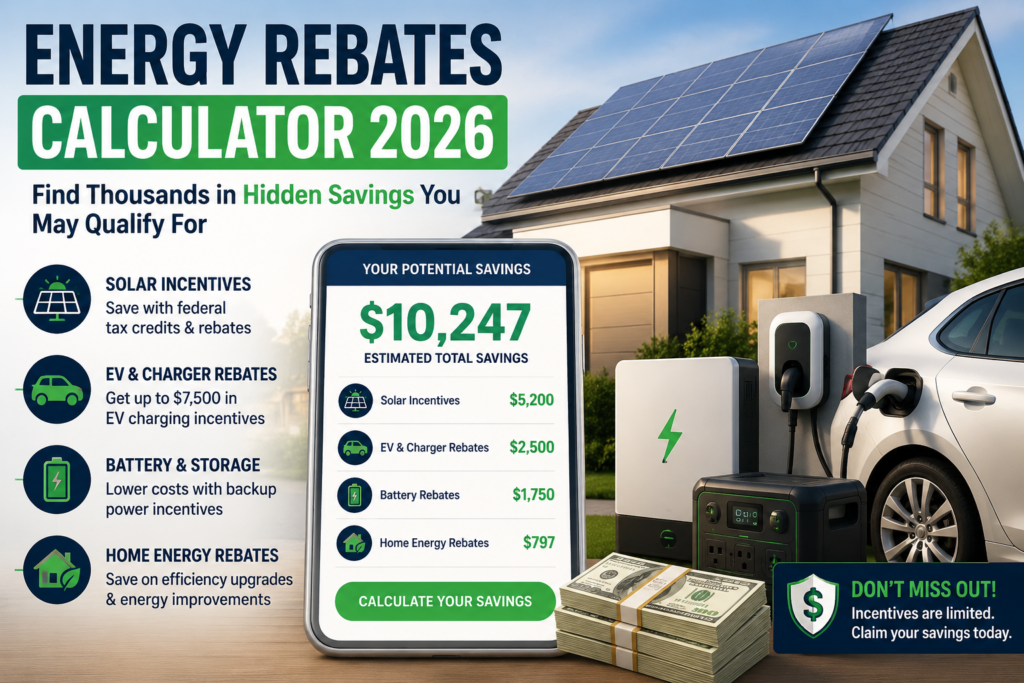
Energy Rebates Calculator 2026
Estimate potential home-energy savings, identify incentive categories worth researching, and discover which federal, state, utility, and local programs may be relevant to your project.
💰 Find Potential Energy Savings Before You Spend Money
Energy incentives can be difficult to understand because there is no single national rebate that applies to every homeowner. Programs may come from federal agencies, state governments, electric utilities, gas utilities, municipalities, or other local organizations.
This calculator is designed as a research and planning tool. It does not replace an official eligibility determination, tax advice, or a utility program application.
Discover
Identify the types of incentives that may be relevant to your project.
Estimate
Estimate a potential incentive range without pretending that every homeowner qualifies.
Localize
Your state and project type help determine which programs deserve further research.
🧮 Energy Savings Calculator
Enter a few details to generate a personalized incentive research report.
Your Personalized Energy Incentive Snapshot
📋 Potential Incentive Categories
🧭 How to Use the Energy Rebates Calculator
Choose your state
State and utility programs are often more important than broad national advertising. Start with your actual property location.
Select your upgrades
Choose the equipment you are actually considering rather than selecting everything. This makes your results more useful.
Enter the project cost
Use the contractor quote or a realistic planning estimate. The calculator uses this number to illustrate possible savings ranges.
After receiving your result, use the recommended state and technology guides to verify individual programs before signing contracts or purchasing equipment.
🔍 What Does This Calculator Actually Calculate?
This tool intentionally does not pretend that there is one universal “energy rebate” available to every homeowner.
Instead, it evaluates your answers and creates a research profile based on several major incentive categories.
| Category | What It May Include | What You Should Verify |
|---|---|---|
| Solar | State, utility and local solar programs | Utility territory, equipment, installation date and program funding |
| Battery | Utility storage programs and local incentives | Battery specifications, enrollment and program availability |
| EV Charging | Utility and local charging incentives | Location, charger, installation and program date |
| Heat Pumps | State, utility and home-energy programs | Efficiency rating, household income and equipment requirements |
| Insulation | Home efficiency and weatherization programs | Income, property type and installation requirements |
| Smart Home | Utility demand-response and efficiency programs | Participating utility and approved equipment |
🇺🇸 Federal Energy Incentives in 2026: What Changed?
Residential Clean Energy Credit — Section 25D
The Residential Clean Energy Credit previously covered qualifying solar electric property, battery storage, geothermal, small wind and other qualifying clean-energy property.
However, the IRS states that the credit is not available for property associated with expenditures made after December 31, 2025.
This means Rebate Radar should not tell a homeowner in 2026 that a newly purchased battery automatically receives the old 30% federal residential credit.
Energy Efficient Home Improvement Credit — Section 25C
The Energy Efficient Home Improvement Credit also has a termination date of December 31, 2025 for qualifying property placed in service after that date.
EV Charger Credit — Section 30C
The federal Alternative Fuel Vehicle Refueling Property Credit was extended under prior law but its termination was accelerated. For individuals, qualified residential charging property generally had to be placed in service by June 30, 2026 to potentially qualify under the federal credit.
📍 Why Your State and Utility Matter
The biggest limitation of a national rebate calculator is that energy incentives are not standardized across the country.
Two homeowners with identical houses and identical equipment can receive completely different incentive opportunities because they live in different utility territories.
State Programs
States may administer energy-efficiency, electrification, solar, battery, or transportation programs.
Utility Rebates
Electric and gas utilities may offer rebates, demand-response incentives, or equipment programs.
Local Programs
Cities, counties and local organizations can sometimes offer additional incentives.
Because programs change, Rebate Radar should be used as a starting point for research, not as proof that a homeowner qualifies.
🏠 Home Energy Rebates: What Homeowners Should Know
The federal Home Energy Rebates programs are different from the old residential tax credits. They are administered through participating states, territories and Tribes, and the exact products, income requirements, rebate amounts and application process can vary.
Depending on the program and location, homeowners may encounter incentives related to energy-efficiency improvements and electrification.
- Heat pumps
- Heat pump water heaters
- Electrical upgrades
- Insulation and air sealing
- Other qualifying efficiency improvements
- Whole-home energy improvements
Because state implementation differs, homeowners should verify whether their local program is currently open and whether the specific equipment qualifies.
Explore our broader Home Energy Rebates 2026 Guide for additional information.
☀️ Solar Rebates and Incentives
Solar remains one of the most searched home-energy topics in the United States. However, the phrase “solar rebate” can refer to several completely different incentive mechanisms.
- Utility rebates
- State incentives
- Performance-based incentives
- Local programs
- Tax credits from prior tax years
The correct program depends on where the property is located and when the project was completed.
Explore our state guides:
⚡ EV Charger Rebates in 2026
Home EV charging incentives can come from utilities, states, municipalities and, for qualifying installations completed before the federal deadline, the federal Alternative Fuel Vehicle Refueling Property Credit.
The federal residential credit was generally available at 30% of qualifying costs, up to $1,000 per charging port, for qualifying property placed in service through June 30, 2026.
For projects after that date, homeowners should not assume that the federal credit continues. Instead, check current state and utility programs.
See our complete EV Charger Rebates 2026 Guide.
🔋 Home Battery Rebates and Storage Incentives
Battery storage is another category where outdated online information can be misleading.
The federal Residential Clean Energy Credit previously included qualifying battery storage technology with a minimum capacity requirement. However, the IRS now states that the residential clean energy credit is unavailable for new expenditures after December 31, 2025.
That does not mean every battery incentive disappeared. State and utility programs may still exist, and some utilities use batteries as part of demand-response or grid-support programs.
For that reason, battery results from this calculator should be treated as a program research signal, not a guaranteed federal tax benefit.
Explore: Home Battery Incentives 2026 and Solar Battery vs. Solar Generator.
🌡️ Heat Pumps, HVAC and Energy Efficiency
Heat pumps and high-efficiency HVAC systems can be particularly important in states where heating and cooling represent a large share of household energy use.
Potential incentives may come from state programs, utility rebates, Home Energy Rebate programs, or other local initiatives.
Eligibility can depend on:
- Equipment efficiency rating
- Household income
- Property location
- Existing heating system
- Installer requirements
- Program funding
Before buying equipment, check the applicable program requirements rather than assuming that any high-efficiency product automatically qualifies.
🏠 Insulation, Air Sealing and Weatherization
Insulation is often overlooked because it is less visible than solar panels, batteries or EV chargers.
However, reducing unwanted heat transfer can lower heating and cooling demand and may be eligible for certain state, utility or Home Energy Rebate programs.
Homeowners should consider:
- Attic insulation
- Wall insulation
- Air sealing
- Duct improvements
- Weatherization
🧩 Can You Stack Energy Rebates?
Sometimes—but never assume that every incentive can simply be added together.
Different programs may have rules governing:
- Stacking
- Income qualification
- Equipment eligibility
- Project timing
- Rebate sequencing
- Utility participation
- Interaction with other incentives
🚨 10 Common Energy Rebate Mistakes
- Assuming an old federal credit is still active.
- Buying equipment before checking eligibility.
- Ignoring utility-specific programs.
- Assuming every state has the same incentives.
- Confusing a tax credit with a rebate.
- Ignoring income requirements.
- Missing application or reservation deadlines.
- Using equipment that does not meet program specifications.
- Assuming incentives can always be stacked.
- Trusting advertising without verifying the actual program administrator.
📚 Explore Energy Incentives by State
❓ Energy Rebates Calculator 2026 FAQ
Is the Energy Rebates Calculator accurate?
Does the calculator guarantee that I qualify for a rebate?
Can homeowners still get energy rebates in 2026?
Is the 30% federal solar tax credit still available for new 2026 projects?
Can batteries still receive incentives?
Can I get an EV charger incentive in 2026?
Should I buy equipment before applying for a rebate?
🚀 Start Your Energy Savings Research
Enter your information in the calculator above, identify the incentive categories that may apply to your project, and then verify the programs using the appropriate state, utility or program administrator.
The goal is simple: find the incentives first, then make the purchase decision.
🔗 More Rebate Radar Guides
- Home Energy Rebates 2026
- Solar Tax Credit Guide
- California Solar Rebates
- Colorado Solar Rebates
- Arizona Solar Rebates
- Texas Energy Incentives
- EV Charger Rebates
- Home Battery Incentives
- Best Portable Power Stations
- Best Solar Generators
- Best Home EV Chargers
- Solar Battery vs. Solar Generator
- Tesla Powerwall Alternatives
- Best Off-Grid Solar Kits