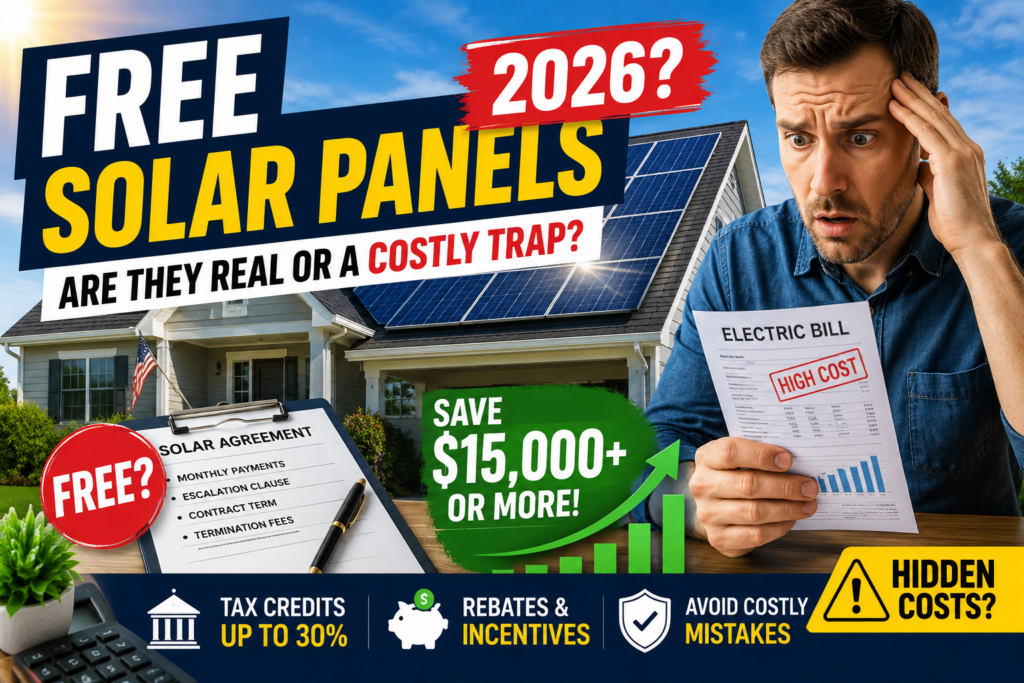
Free solar panels 2026 program explained showing residential solar installation, homeowner savings, solar lease contracts, and federal solar incentives.

Free Solar Panels 2026: Are They Real or a Costly Trap?

Free solar panels 2026 program explained showing residential solar installation, homeowner savings, solar lease contracts, and federal solar incentives.
Quick Answer: No, most free solar panels are not actually free. In 2026, many offers advertised as “free solar panels” are usually solar leases or power purchase agreements (PPAs). While homeowners can still save thousands on electricity bills, understanding the contract terms, tax credits, and available solar rebates is critical before signing.

Free Solar Panels 2026: Are They Real or a Costly Trap?

The promise sounds almost too good to be true. A company shows up and offers to install solar panels on your roof with little or no upfront payment. They advertise “free solar panels,” claim you can slash your electricity bill, and suggest you could save thousands over the life of the system.

But are free solar panels really free in 2026?

The answer is more complicated than most homeowners realize.

Across the United States, millions of homeowners are searching for ways to reduce energy costs as electricity prices continue climbing. Rising utility rates, growing interest in energy independence, and expanding federal incentives have made residential solar one of the hottest home improvement investments in America.

At the same time, solar marketing has become increasingly aggressive. Advertisements promising “free solar panels,” “zero-cost solar,” and “government-funded solar systems” appear everywhere on social media, search engines, television, and direct mail campaigns.

While some of these offers are legitimate, others can create confusion and unrealistic expectations. Understanding how these programs actually work can help homeowners avoid expensive mistakes and identify opportunities that may genuinely reduce long-term energy costs.


What Do Companies Mean When They Say “Free Solar Panels”?

In most situations, companies advertising free solar panels are not literally giving away a solar energy system at no cost.

Instead, they are usually referring to financing structures that eliminate or reduce the initial upfront payment required for installation.

The three most common solar ownership models include:

  • Purchasing the solar system outright
  • Solar lease agreements
  • Power Purchase Agreements (PPAs)

When homeowners purchase a solar system directly, they own the equipment and typically qualify for federal tax credits and many state-level incentives.

Under a lease arrangement, a third-party company owns the solar equipment while the homeowner pays a monthly fee to use it.

With a PPA, the homeowner pays for the electricity produced by the solar system rather than owning the equipment itself.

Most advertisements promoting “free solar panels” are actually promoting either leases or PPAs.

That distinction is important because ownership affects:

  • Long-term savings potential
  • Federal tax credit eligibility
  • Home resale value
  • Contract flexibility
  • Maintenance responsibilities
  • Future upgrade opportunities

Why Free Solar Panel Offers Became So Popular

The solar industry understands that the biggest obstacle preventing many homeowners from going solar is the upfront installation cost.

A typical residential solar system can cost thousands of dollars depending on:

  • System size
  • Location
  • Roof characteristics
  • Energy consumption
  • Equipment quality

Many households simply do not have the cash available to purchase a complete system outright.

By promoting “free solar panels,” companies remove the psychological barrier associated with a large upfront investment.

This marketing approach often attracts homeowners who might otherwise never consider solar energy.

In many cases, homeowners still save money compared to traditional utility rates. However, the amount of savings varies significantly based on contract terms and local electricity costs.


How the Federal Solar Tax Credit Impacts Solar Costs in 2026

One reason solar adoption continues to grow is the availability of federal incentives that reduce installation costs.

Many homeowners researching free solar panels eventually discover that the largest savings opportunities often come from tax credits rather than “free” offers.

The federal solar tax credit remains one of the most valuable incentives available for qualified residential solar installations.

For homeowners considering ownership, this incentive can dramatically reduce overall project costs and improve return on investment.

You can learn more about nationwide solar incentives in our guide:

Federal Solar Rebates 2026

Many homeowners combine federal incentives with state-level programs to maximize savings.


States Where Solar Incentives Can Increase Savings

The value of solar varies considerably depending on where you live.

Some states offer additional rebates, tax incentives, performance-based programs, and utility credits that can significantly improve the economics of residential solar installations.

Popular state-specific resources include:

Because utility rates, sunshine levels, and incentive programs vary from state to state, homeowners should always evaluate local opportunities before making a decision.


The Biggest Misconception About Free Solar Panels

The biggest misconception is believing that free solar panels mean free electricity forever.

In reality, many solar lease and PPA agreements still require ongoing monthly payments.

The goal is usually to provide electricity at a lower cost than the local utility company, not necessarily to eliminate energy expenses entirely.

Some contracts also contain annual escalation clauses that gradually increase payments over time.

This is one reason financial comparisons are so important before signing any agreement.

The best solar decision depends on your goals, budget, location, expected time in the home, and available incentives.

In the next section, we’ll examine the hidden costs many homeowners overlook, compare solar leases vs ownership, and reveal the warning signs that could turn a “free solar” offer into an expensive long-term commitment.


Hidden Costs of Free Solar Panels in 2026 Most Homeowners Never See Coming

One reason the phrase “free solar panels” generates millions of searches every year is simple: homeowners want lower electricity bills without spending tens of thousands of dollars upfront.

Unfortunately, many consumers discover the fine print only after signing a contract.

This doesn’t mean every solar lease or Power Purchase Agreement (PPA) is a bad deal. In fact, some homeowners save significant amounts of money. The problem is that many people focus only on the word “free” and fail to evaluate the long-term financial impact.

Understanding the hidden costs behind solar offers is one of the most important steps before agreeing to any installation.


Annual Escalation Clauses Can Increase Payments Every Year

One of the most common provisions found in solar lease agreements is called an escalation clause.

This clause allows the solar provider to increase your monthly payment by a fixed percentage every year.

At first glance, a payment of $95 or $120 per month may appear attractive compared to local utility rates.

However, if payments increase annually over a 20-year or 25-year contract, the total amount paid can become much larger than homeowners initially expect.

Before signing any agreement, always ask:

  • Will payments increase annually?
  • What is the escalation percentage?
  • How much will I pay over the full contract term?
  • How does this compare to projected utility costs?

Many homeowners focus only on year-one savings rather than evaluating the entire contract.


Who Actually Receives the Federal Solar Tax Credit?

This is one of the biggest misconceptions surrounding free solar panel offers.

When homeowners purchase a solar system directly, they may qualify for valuable federal incentives depending on eligibility requirements.

However, when a solar company owns the equipment through a lease or PPA, the company generally receives those incentives rather than the homeowner.

This distinction can dramatically affect long-term financial outcomes.

Many homeowners researching free solar panels eventually realize that ownership may provide larger lifetime savings than leasing.

You can learn more in our complete guide:

Federal Solar Rebates 2026


What Happens If You Sell Your Home?

One factor that receives surprisingly little attention is what happens when a homeowner decides to move.

Selling a home with owned solar panels is often relatively straightforward.

However, leased solar systems may introduce additional complications.

Potential buyers may need to:

  • Assume the lease agreement
  • Meet credit requirements
  • Accept remaining contract obligations
  • Review payment escalation terms
  • Transfer utility agreements

In competitive housing markets this may not be a major issue, but it can create delays during a property sale.

Before signing any solar agreement, homeowners should understand how transfers are handled.


Maintenance Responsibilities Explained

One advantage of solar leases is that maintenance responsibilities often remain with the provider.

If equipment fails, the company may be responsible for repairs or replacements depending on contract terms.

For some homeowners, this reduced responsibility is attractive.

On the other hand, homeowners who purchase solar systems outright generally maintain full control over equipment decisions and upgrades.

The choice often depends on individual preferences regarding ownership, risk tolerance, and long-term financial goals.


How Much Can Solar Actually Save?

The answer varies dramatically based on location.

Factors affecting solar savings include:

  • Local electricity rates
  • Sunlight exposure
  • Roof orientation
  • Utility net-metering policies
  • State incentives
  • System size
  • Household energy consumption

In high-electricity-cost states, solar savings can be substantial.

In lower-cost energy markets, payback periods may be longer.

This is why state-specific research remains critical before evaluating any offer.


Best States for Solar Savings in 2026

Some states continue to offer stronger financial opportunities for homeowners considering solar energy.

Popular state guides include:

These states often combine solar incentives, net-metering benefits, and favorable energy economics that improve return on investment.


Solar Lease vs Buying Solar Panels

Factor Solar Lease Own System
Upfront Cost Low or None Higher
Tax Credit Eligibility Usually No Usually Yes
Long-Term Savings Moderate Potentially Higher
Equipment Ownership Solar Company Homeowner
Maintenance Often Included Owner Responsibility

Neither option is automatically better for every homeowner.

The best choice depends on financial goals, available capital, expected time in the home, and local incentives.


How Home Energy Rebates Can Reduce Solar Costs

Many homeowners focus exclusively on solar-specific incentives and completely overlook broader home energy programs.

In some cases, combining energy-efficiency upgrades with solar installations can produce even greater overall savings.

Popular upgrades include:

  • Heat pumps
  • Smart thermostats
  • Insulation improvements
  • Energy-efficient windows
  • Battery storage systems

You can explore additional opportunities in our guide:

Home Energy Rebates 2026


The Real Question Homeowners Should Ask

Instead of asking, “Are free solar panels real?” the better question is:

“Which solar option delivers the highest lifetime savings for my specific situation?”

For some homeowners, a lease may provide immediate monthly savings with little upfront investment.

For others, purchasing a system and leveraging available incentives may generate dramatically greater returns over the next 20 to 30 years.

The smartest homeowners compare every option, review contract details carefully, calculate total lifetime costs, and avoid making decisions based solely on marketing claims.

In the next section, we’ll reveal the biggest solar scams of 2026, warning signs homeowners should never ignore, and the exact questions experts recommend asking before signing any solar agreement.


How to Verify Whether a Free Solar Offer Is Legitimate

One of the smartest things homeowners can do before signing any solar agreement is verify the company behind the offer.

The rapid growth of residential solar has attracted many reputable installers, but it has also created opportunities for aggressive sales tactics and misleading advertising.

Before agreeing to any installation, homeowners should carefully investigate:

  • Company reviews and ratings
  • Years in business
  • Licensing and certifications
  • Warranty coverage
  • Contract terms
  • Equipment manufacturers
  • Customer service reputation

A legitimate solar provider should be willing to explain every aspect of the agreement, including ownership structure, projected savings, maintenance responsibilities, and contract duration.

If a salesperson refuses to answer questions or pressures you to sign immediately, consider it a warning sign.


Questions Every Homeowner Should Ask Before Signing

Many expensive mistakes can be avoided simply by asking the right questions before agreeing to a solar proposal.

Solar contracts often last between 20 and 25 years, making them one of the longest financial commitments many homeowners ever sign.

Experts frequently recommend asking:

  • Who owns the solar panels?
  • What happens if I move?
  • Will my monthly payment increase?
  • Who receives available tax credits?
  • What maintenance is covered?
  • How is system performance guaranteed?
  • What happens if the company goes out of business?
  • Can I purchase the system later?

Clear answers to these questions can reveal whether an offer genuinely benefits the homeowner or primarily benefits the installer.


Why Utility Bills Matter More Than Solar Marketing Claims

Many advertisements focus heavily on solar equipment while ignoring the factor that ultimately matters most: electricity costs.

A solar system that generates significant savings in one state may produce very different results in another.

This is because utility rates vary dramatically throughout the United States.

Homeowners living in areas with high electricity prices often see stronger financial returns because every kilowatt-hour generated offsets expensive utility power.

This is one reason solar remains especially popular in states such as California, Texas, Arizona, New Jersey, and Colorado.

Before evaluating any solar offer, homeowners should compare projected solar costs against current utility expenses rather than relying solely on marketing promises.


Can Solar Increase Home Value?

Another factor frequently overlooked in solar discussions is property value.

Many buyers view energy-efficient homes as attractive because they offer lower operating costs and potential protection from future utility rate increases.

While real estate markets vary, owned solar systems may increase buyer interest compared with similar homes lacking energy improvements.

Additional upgrades often researched alongside solar include:

  • Battery storage systems
  • Heat pumps
  • Smart thermostats
  • Insulation improvements
  • Energy-efficient windows
  • Backup power solutions

These improvements can work together to reduce overall household energy consumption.


Why Battery Storage Is Becoming Part of the Solar Conversation

A growing number of homeowners searching for free solar panels eventually discover that electricity generation is only one piece of the puzzle.

Battery systems allow households to store excess electricity for later use.

This can provide several benefits:

  • Backup power during outages
  • Reduced grid dependence
  • Improved energy resilience
  • Better utilization of solar production
  • Potential savings during peak utility pricing periods

Interest in battery technology has increased significantly due to severe weather events, grid reliability concerns, and rising energy prices.

For homeowners exploring backup solutions, our guide on Best Home Batteries & Solar Generators 2026 covers some of the most popular options currently available.


How Energy Efficiency Can Deliver Faster Savings Than Solar

One surprising reality is that solar panels are not always the first upgrade homeowners should make.

In many cases, reducing energy consumption can generate faster returns than producing additional electricity.

Common examples include:

  • Air sealing and weatherization
  • Attic insulation upgrades
  • Heat pump installations
  • Smart thermostat deployment
  • High-efficiency HVAC systems
  • LED lighting conversions

Lowering overall energy consumption may reduce the size of solar system required, improving project economics and long-term savings.

Homeowners interested in broader incentive opportunities can explore:

Energy Rebates 2026

This guide covers multiple rebate categories beyond solar alone.


States With the Strongest Solar Interest in 2026

Search trends continue to show strong homeowner interest in solar incentives across several major markets.

These state-specific guides remain among the most useful resources for comparing opportunities:

Because solar economics depend heavily on local incentives, homeowners should always compare programs available within their own state before making a decision.


What Most Homeowners Discover After Researching Free Solar Panels

The vast majority of homeowners eventually reach the same conclusion:

Free solar panels are rarely free in the literal sense.

However, that does not automatically make them a bad deal.

For some households, lease agreements and PPAs provide immediate access to solar energy without large upfront costs.

For others, purchasing a system and utilizing available rebates may create significantly larger lifetime savings.

The key is understanding exactly what you’re signing and comparing all available options before making a long-term commitment.

In the next section, we’ll break down real-world examples, compare homeowner scenarios, and calculate when “free solar” actually saves money—and when it doesn’t.


Real-Life Solar Scenarios: When “Free Solar Panels” Make Sense—and When They Don’t

After researching solar incentives, tax credits, leases, and ownership options, most homeowners eventually ask the same question:

“Would free solar actually save money in my situation?”

The answer depends less on the advertisement and more on your specific circumstances.

Let’s look at a few common homeowner scenarios.

Scenario 1: High Electricity Bills + No Upfront Budget

A homeowner paying $250 to $400 per month for electricity may benefit from a solar lease or Power Purchase Agreement if the monthly solar payment is significantly lower than current utility costs.

In this case, reducing monthly expenses immediately may be more important than maximizing lifetime savings.

For some families, this makes solar leasing a reasonable option.

Scenario 2: Long-Term Homeowner With Available Capital

A homeowner planning to remain in the property for 15 to 30 years often achieves greater savings by purchasing a solar system outright or financing ownership.

Ownership typically provides:

  • Access to available tax incentives
  • Greater lifetime savings
  • Full control of the equipment
  • No lease transfer complications
  • Potentially higher property value

This is why many energy experts recommend comparing ownership costs before accepting a lease offer.

Scenario 3: Homeowners Concerned About Power Outages

For some households, lower utility bills are not the primary goal.

Their concern is reliability.

In areas prone to storms, grid failures, extreme heat, or natural disasters, combining solar with battery storage may provide valuable backup power during outages.

Many homeowners researching solar eventually explore:

Best Home Batteries & Solar Generators 2026

because energy independence often becomes just as important as energy savings.


Red Flags That Could Signal a Bad Solar Deal

Not every solar offer is created equal.

While many companies operate ethically, homeowners should remain cautious when encountering aggressive marketing claims.

Potential warning signs include:

  • Pressure to sign immediately
  • Promises that sound too good to be true
  • Unclear ownership terms
  • Missing performance guarantees
  • Lack of written documentation
  • Refusal to provide contract details
  • Claims of “government free solar programs” without explanation
  • Salespeople avoiding questions about total lifetime costs

Legitimate providers should welcome questions and provide transparent information about pricing, savings projections, warranties, and contract obligations.


The Biggest Mistake Homeowners Make Before Going Solar

Ironically, the biggest mistake often has nothing to do with solar panels.

Many homeowners never evaluate how much energy their home actually wastes.

Before investing in solar, experts frequently recommend improving efficiency first.

Reducing energy consumption may:

  • Lower electricity bills immediately
  • Reduce required solar system size
  • Improve return on investment
  • Increase indoor comfort
  • Unlock additional rebates

Popular improvements include insulation upgrades, smart thermostats, heat pumps, and efficient HVAC systems.

Many of these opportunities are covered in:

Energy Rebates 2026

which highlights broader energy-saving incentives available to homeowners.


Solar Trends Experts Are Watching in 2026

The residential energy market continues evolving rapidly.

Several trends are expected to influence homeowner decisions throughout 2026 and beyond:

  • Growing adoption of home battery systems
  • Increasing utility electricity rates
  • Expansion of smart energy management systems
  • More interest in backup power solutions
  • Improved solar panel efficiency
  • Greater demand for energy independence
  • Continued homeowner interest in rebates and incentives

As these trends develop, homeowners who understand available programs will likely be better positioned to reduce long-term energy costs.


Frequently Asked Questions About Free Solar Panels

Are free solar panels really free?

Usually not. Most offers refer to leases or Power Purchase Agreements where a third party owns the equipment and the homeowner makes ongoing payments.

Can I qualify for federal solar incentives?

Eligibility depends on multiple factors, including ownership structure and applicable program requirements.

Do solar panels eliminate my electric bill?

Not always. Savings vary depending on system size, electricity usage, utility rates, and local regulations.

Is buying solar better than leasing?

Neither option is universally better. The best choice depends on financial goals, budget, and expected time in the home.

Can solar increase home value?

In some markets, owned solar systems may make a property more attractive to buyers, although results vary by location.


Additional Solar Rebate Resources

Looking for opportunities in your state? Explore these detailed rebate guides:


Final Verdict: Are Free Solar Panels Worth It?

Free solar panels are not necessarily a scam, but they are rarely free in the way most homeowners imagine.

The term usually describes financing arrangements designed to reduce or eliminate upfront installation costs rather than provide solar equipment at no charge.

For some homeowners, these programs can deliver meaningful monthly savings and make solar accessible without a large initial investment.

For others, owning a solar system and leveraging available incentives may provide significantly greater financial benefits over the long run.

The smartest approach is simple:

  • Compare ownership vs leasing
  • Understand every contract term
  • Calculate total lifetime costs
  • Research available incentives
  • Evaluate energy-efficiency upgrades first
  • Avoid making decisions based solely on marketing claims

A well-informed homeowner is far more likely to find genuine savings than someone chasing the promise of “free” solar panels.

Scroll to Top