
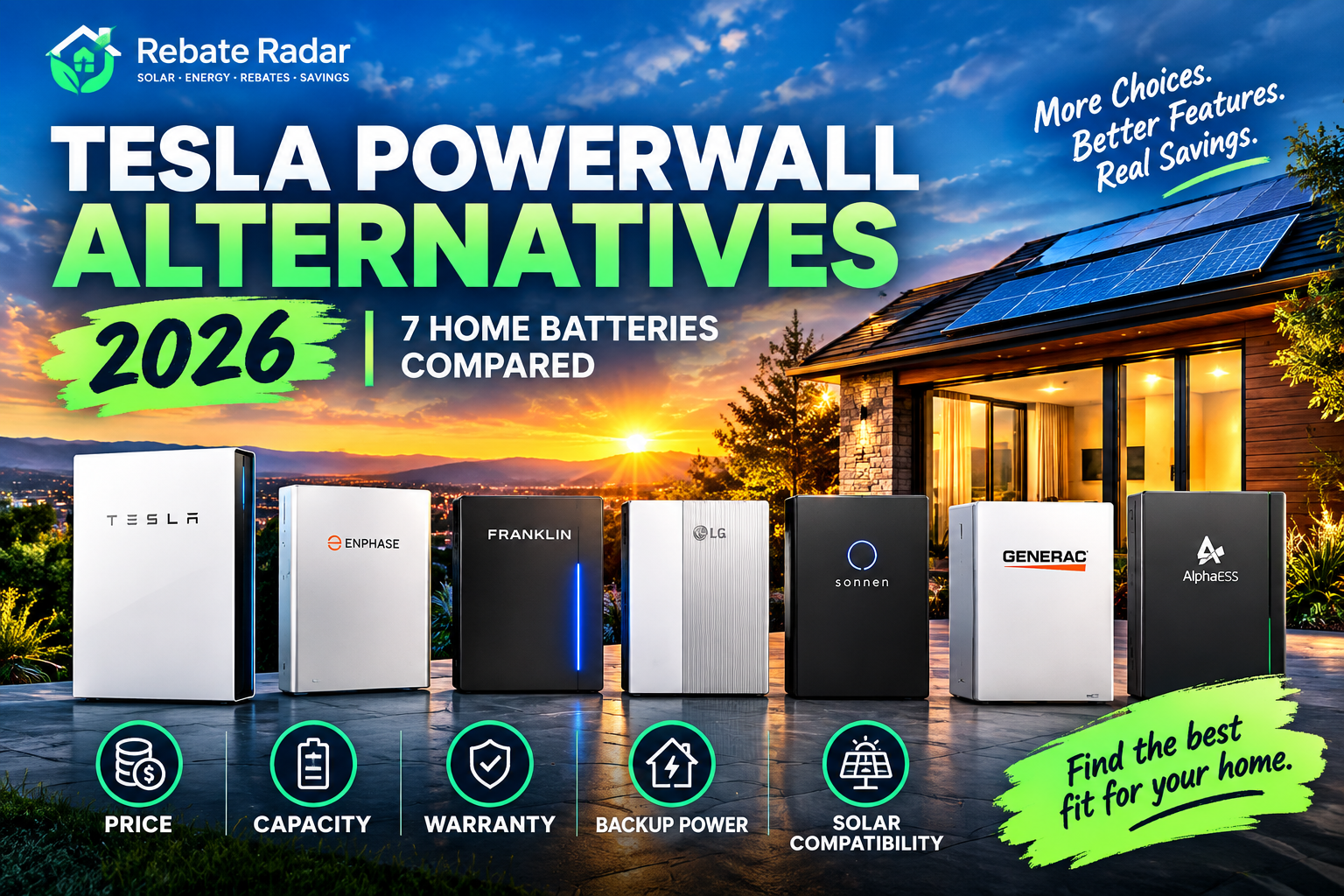
Tesla Powerwall Alternatives 2026: 7 Home Batteries Compared
Looking for a Tesla Powerwall alternative in 2026? Compare seven residential battery systems by usable capacity, power output, warranty, solar compatibility, scalability, backup architecture and the type of home each system may fit.
There is no single battery that is automatically right for every house. The important comparison is the complete energy-storage system: battery capacity, inverter power, electrical equipment, solar compatibility, backup loads, warranty, installer support and total installed cost.
Why Look for a Tesla Powerwall Alternative in 2026?
Tesla Powerwall has become one of the most recognizable names in home energy storage, but buying a battery is not the same as buying a television or appliance. A residential battery becomes part of the home’s electrical architecture, which means the equipment already installed at the property can be just as important as the battery’s headline capacity.
A homeowner with Enphase microinverters, for example, may approach storage differently from someone with a SolarEdge inverter. A household with a large central air-conditioning system may care about continuous and surge power differently from a homeowner primarily interested in keeping a refrigerator, internet equipment, lights and a few outlets operating during an outage.
Battery chemistry, inverter architecture, coupling method, load management, warranty terms and installer availability can all change the practical value of a system.
That is why this guide does not treat a battery’s price or capacity as the only deciding factor. Instead, it examines several major systems and explains what makes each one worth investigating in different installation scenarios.
If your first question is actually about the total cost of adding storage, continue to our Home Battery Backup Cost 2026 guide for a deeper look at equipment, installation and backup sizing.
Tesla Powerwall 3: The Benchmark for This Comparison
Before comparing Tesla Powerwall alternatives 2026 shoppers should first understand what Powerwall 3 actually offers. Tesla lists Powerwall 3 with 13.5 kWh of nominal battery energy and configurable maximum continuous output up to 11.5 kW for the applicable on-grid configuration.
Powerwall 3 is designed as an integrated energy-storage system rather than simply a battery cabinet. That distinction matters because the inverter and other system components influence how much power the system can deliver and how it interacts with solar and the home’s electrical service.
7 Tesla Powerwall Alternatives to Compare in 2026
The following table is a research starting point, not a universal ranking. These systems use different architectures, so capacity and power numbers should always be evaluated in the context of the complete installation.
| System | Capacity | Power | Architecture / focus | Warranty | Potential fit |
|---|---|---|---|---|---|
| FranklinWH aPower 2 | 15 kWh | 10 kW continuous | LFP / integrated energy ecosystem | 15 years / 60 MWh | High-output whole-home backup |
| Enphase IQ Battery 5P | 5.0 kWh usable | 3.84 kW continuous | AC-coupled / modular | 15 years / 6,000 cycles | Enphase solar systems |
| SolarEdge Home Battery 400V | Configuration dependent | System dependent | DC-coupled SolarEdge ecosystem | 10 years | Compatible SolarEdge installations |
| sonnenCore+ | 10–60 kWh system configurations | System dependent | Stackable energy storage | 10 years / 10,000 cycles | Large scalable storage |
| Generac PWRcell 2 | 9–18 kWh per cabinet | Up to 11.5 kW in specified configuration | Modular backup ecosystem | 10 years | Whole/partial-home backup |
| AlphaESS SMILE5 | 2.9–80 kWh configurations | Up to 5 kW AC | AC/DC/hybrid coupling | 5-year product / 10-year battery | Flexible modular storage |
| EcoFlow DELTA Pro Ultra | 6–90 kWh configurations | 7.2 kW per inverter | Expandable backup platform | Model-specific | Flexible home backup |
These figures should not be interpreted as an apples-to-apples performance ranking. Some products are designed around a particular inverter ecosystem, while others emphasize modularity or broader backup flexibility.
FranklinWH aPower 2
FranklinWH’s aPower 2 is one of the larger individual residential batteries in this comparison. The manufacturer lists 15 kWh of capacity and 10 kW of continuous output, giving the system a different profile from smaller modular batteries.
FranklinWH also positions the aPower 2 within a broader home-energy ecosystem that can integrate solar, grid electricity, generators and EV-related energy management. That means the system should be evaluated as an entire backup architecture rather than simply as a 15 kWh battery.
The higher output can be relevant to households with larger electrical loads, but actual whole-home capability depends on the home’s service, backup equipment, load profile and installation design.
Potential advantages
- 15 kWh capacity in one battery.
- 10 kW continuous output.
- LFP battery chemistry.
- 15-year warranty structure.
- Scalable system architecture.
Things to investigate
- Total installed cost can vary substantially.
- Installer availability differs by location.
- Warranty conditions should be read in full.
- Final backup capability depends on the complete system.
Worth investigating if: you are looking for a relatively high-capacity battery and want to compare substantial backup output against Powerwall 3.
Enphase IQ Battery 5P
The Enphase IQ Battery 5P takes a fundamentally modular approach. One unit provides 5.0 kWh of usable energy, while multiple batteries can be combined to create a larger storage system.
Enphase states that the 5P contains six embedded grid-forming microinverters and delivers 3.84 kW of continuous power. Its modular architecture can be particularly relevant to homes already using Enphase microinverters.
This is an important distinction when comparing Tesla Powerwall alternatives: the cheapest-looking battery is not necessarily the simplest system to integrate with an existing solar installation.
Potential advantages
- Modular 5 kWh building block.
- Integrated microinverter architecture.
- Strong ecosystem compatibility.
- 15-year limited warranty.
Things to investigate
- One unit has substantially less capacity than Powerwall 3.
- Multiple units increase total system cost.
- Backup requires the appropriate system controller configuration.
SolarEdge Home Battery 400V
SolarEdge Home Battery 400V is designed to operate within compatible SolarEdge residential systems. SolarEdge states that its DC-coupled architecture can achieve up to 94.5% efficiency and that up to three batteries can be connected per inverter in supported configurations.
This makes SolarEdge particularly interesting as a system-compatibility question. If the home already has SolarEdge equipment, the right comparison may involve keeping the existing ecosystem versus replacing or adding equipment from another manufacturer.
SolarEdge lists a 10-year warranty for the Home Battery 400V. Actual compatibility depends on the exact inverter, firmware, market and system configuration.
sonnenCore+
sonnenCore+ takes scalability much further than a single-battery comparison might suggest. sonnen states that the system can be configured in 10 kWh or 20 kWh increments and stacked up to three systems for a total capacity of up to 60 kWh.
That architecture can be relevant to larger homes or homeowners who want significantly more stored energy than one typical residential battery can provide.
sonnen also states that sonnenCore+ can work with new or existing solar systems and uses lithium iron phosphate battery technology.
Generac PWRcell 2
Generac PWRcell 2 is another example of why a battery should be evaluated as an entire system. Generac lists 9, 12, 15 and 18 kWh usable configurations for its battery cabinets, with a two-cabinet configuration reaching 36 kWh.
The inverter can provide up to 11.5 kW of maximum continuous power in the specified two-cabinet configuration. Generac also lists whole- and partial-home backup capability and integration with its broader generator ecosystem.
This can be relevant in areas where outages may last longer than a typical evening. A battery can provide immediate backup, while a compatible generator strategy can address a different duration of outage.
AlphaESS SMILE5
AlphaESS SMILE5 is useful to include in a Powerwall alternatives comparison because it demonstrates how much residential storage can vary in architecture. AlphaESS lists AC-coupled, DC-coupled and hybrid-coupled configurations, with multiple battery module options.
The manufacturer lists a maximum AC output of 5 kW and a broad capacity range depending on the selected battery modules and system configuration. AlphaESS also lists a five-year product warranty and 10-year battery warranty.
For buyers, the important detail is to identify exactly which SMILE5 configuration is included in the quotation. “SMILE5” by itself does not tell you the final storage capacity or complete system design.
EcoFlow DELTA Pro Ultra
EcoFlow DELTA Pro Ultra is not identical to a permanently wall-mounted battery such as Powerwall 3. It is better understood as an expandable home-backup platform that can be configured for larger residential loads.
EcoFlow lists configurations ranging from 6 kWh to as much as 90 kWh of battery capacity. A single inverter provides up to 7.2 kW of output, while multiple inverters can increase system output in supported configurations.
This architecture may appeal to homeowners who value flexibility or want a backup system that can occupy a different role from a traditional permanently installed solar battery.
kWh vs. kW: The Most Important Battery Numbers to Understand
One of the most common mistakes in home-battery shopping is treating kWh and kW as if they mean the same thing. They do not.
Energy capacity. This describes how much energy the battery can store. In general, more usable kWh can provide longer runtime for the same electrical load.
Power output. This describes how much power the system can deliver at a given moment. It affects how many appliances can operate simultaneously.
Imagine a battery with 13.5 kWh of usable energy. If a home were drawing a steady 1 kW of load, the theoretical energy duration would be around 13.5 hours before accounting for conversion losses, reserve settings and other system limitations.
If the same home were drawing 4 kW, the theoretical duration would be much shorter. Real-world runtime also changes continuously as appliances turn on and off.
This is why buying the biggest battery possible is not automatically the correct strategy. The system needs enough energy capacity for the desired runtime and enough power capability for the loads you want to operate.
How Much Battery Storage Does a Home Need?
The correct battery size depends on electricity consumption, desired outage duration, solar production, utility rates, backup loads and whether the homeowner wants essential-load or whole-home backup.
Essential-load backup
Essential-load backup typically prioritizes selected circuits. Depending on the household, those may include refrigerators, internet equipment, lighting, security equipment, garage doors and selected outlets.
Because the battery does not need to support every appliance, this strategy can require less capacity and power than whole-home backup.
Whole-home backup
Whole-home backup is more demanding because the system may need to support HVAC equipment, electric water heating, cooking appliances, pumps and other large loads.
The challenge is not simply storing enough energy. The inverter and electrical equipment must also be able to deliver sufficient power when several loads operate simultaneously.
For a detailed financial and installation-cost discussion, see: Home Battery Backup Cost 2026 .
Solar Compatibility Can Matter More Than Battery Price
A battery is not installed in isolation. It must communicate with and electrically integrate with the home’s solar and backup equipment.
Before requesting quotes, identify whether the property currently uses Tesla, Enphase, SolarEdge or another inverter architecture. If you already have solar installed, the existing equipment can influence which battery configurations are practical.
This is especially important for retrofit projects. A homeowner may see a low advertised battery price online and assume it is the cheapest option, only to discover that the complete installation requires additional inverters, controllers, disconnects, wiring or panel work.
AC-Coupled vs. DC-Coupled Home Batteries
The way a battery connects to a solar system can influence efficiency, equipment requirements and retrofit flexibility.
AC-coupled storage
In an AC-coupled configuration, the battery system connects on the AC side of the solar installation. This can be useful for certain retrofit situations because the existing solar inverter may remain part of the system.
DC-coupled storage
In a DC-coupled configuration, solar energy can move more directly between the solar generation equipment and battery before conversion to AC for household use.
The exact efficiency advantage depends on the complete equipment and operating conditions. Therefore, “AC vs. DC” should not be treated as a universal winner. The more useful question is which architecture works efficiently with the equipment already installed at your property.
How Much Do Tesla Powerwall Alternatives Cost in 2026?
Cost is one of the biggest questions behind the search for Tesla Powerwall alternatives 2026, but it is also one of the easiest areas to oversimplify.
A battery’s advertised equipment price is not necessarily the same as the price of a complete installed energy-storage system.
Current 2026 EnergySage marketplace data puts the typical cost of installing approximately 13.5 kWh of residential battery storage at about $15,647 before available incentives. Actual prices vary substantially by state, equipment, installation complexity and system size.
If you’re also considering solar panels, use our Solar Payback Calculator and review our Solar Panel Payback Period 2026 guide to evaluate the larger economics.
Do Tesla Powerwall Alternatives Qualify for a Federal Tax Credit in 2026?
This is one of the most important sections to verify before publishing a 2026 battery-cost calculation because many older solar articles still display the former federal 30% residential clean-energy credit.
The IRS currently states that the Residential Clean Energy Credit applied to qualifying property installed through December 31, 2025 and is not available for property placed in service after December 31, 2025.
This does not mean that every state, utility or local incentive has disappeared. Battery rebates, demand-response programs, utility incentives and virtual power plant programs are separate from the former federal residential credit and must be evaluated individually.
For broader incentive research, visit our Energy Rebates 2026 hub and Home Energy Rebates 2026 guide.
Battery owners may also want to investigate: Virtual Power Plant Incentives 2026 .
How Home Battery Warranties Really Work
A common mistake is to compare warranties only by the number of years printed in a product advertisement.
A battery warranty can contain several separate conditions, including:
- Warranty duration.
- Maximum number of cycles.
- Guaranteed energy throughput.
- Minimum retained capacity.
- Operating temperature requirements.
- Installation requirements.
- Restrictions based on operating mode.
For example, two batteries may both advertise a 10-year warranty while guaranteeing different levels of retained capacity or imposing different throughput conditions.
What Should You Compare Before Buying a Home Battery?
Ask how much energy is actually available for household use rather than comparing only nominal battery size.
Confirm how much power the system can continuously provide to the home.
Check whether the system can handle starting loads from air conditioners, pumps and other motor-driven equipment.
Confirm the battery works with the home’s existing or planned inverter architecture.
Compare years, cycles, throughput and retained capacity.
A technically impressive battery is much less useful if qualified local installation and service are difficult to obtain.
Compare equipment, labor, permits, electrical upgrades and commissioning.
7 Common Mistakes When Choosing a Powerwall Alternative
1. Choosing by kWh alone
A larger battery stores more energy, but capacity does not tell you how much power the system can deliver at one moment.
2. Ignoring the existing inverter
The home’s current solar architecture can dramatically influence the complexity and cost of a retrofit.
3. Assuming whole-home backup is automatic
Whole-home backup can require appropriate transfer equipment, service equipment, load management and sufficient inverter output.
4. Using an outdated 30% federal-credit calculation
Older articles may still calculate a new 2026 residential battery using the former federal Residential Clean Energy Credit. Verify current IRS guidance before using any incentive in a financial calculation.
5. Comparing equipment prices instead of installed prices
Installation labor, permitting and electrical modifications can materially change the final project price.
6. Forgetting how long the outage could last
A battery designed to cover an evening outage is a different project from a system intended to provide resilience during a multi-day outage.
7. Accepting the first quote without comparing the system design
Multiple quotes can reveal differences in battery size, inverter power, backup circuits, electrical work and warranty terms that are not obvious from the headline price.
Which Powerwall Alternatives Should You Compare for Different Homes?
Rather than declaring one universal winner, use your home’s existing equipment and energy goals to create a shortlist.
| Your situation | Systems worth investigating | Reason to compare them |
|---|---|---|
| Existing Enphase solar | Enphase IQ Battery 5P | Modular storage designed around the Enphase ecosystem. |
| Existing SolarEdge equipment | SolarEdge Home Battery 400V | Designed for compatible SolarEdge inverter architectures. |
| High-output backup requirements | FranklinWH aPower 2 / Generac PWRcell 2 | Both have configurations designed around substantial residential loads. |
| Very large scalable storage | sonnenCore+ | Stackable configurations can reach substantially higher total capacity. |
| Flexible modular storage | AlphaESS SMILE5 | Multiple module sizes and AC/DC/hybrid configurations. |
| Expandable backup platform | EcoFlow DELTA Pro Ultra | Flexible capacity and multi-inverter expansion options. |
The purpose of this table is to help narrow the research process. Your installer should still verify electrical compatibility, permitting, backup requirements and the manufacturer’s current installation rules.
More Rebate Radar Solar & Home Energy Guides
A home battery is only one part of the solar-and-energy equation. These related Rebate Radar guides can help you investigate the rest of the project.
- Home Battery Backup Cost 2026 — understand battery equipment, installation and backup costs.
- Solar Battery vs. Solar Generator — compare different backup approaches.
- Best Home Batteries & Solar Generators 2026 — explore the broader residential backup market.
- Best Solar Generators 2026 — explore portable and backup power alternatives.
- Best Portable Power Stations 2026 — compare smaller-scale backup systems.
- Solar Panel Payback Period 2026 — understand the economics of a solar investment.
- Solar Payback Calculator — estimate solar payback using your own assumptions.
- Solar Savings Calculator — estimate potential electricity-bill savings.
- Virtual Power Plant Incentives 2026 — learn how battery owners may participate in grid programs.
- Energy Rebates 2026 — explore broader home-energy incentives.
Frequently Asked Questions About Tesla Powerwall Alternatives
What are the main Tesla Powerwall alternatives in 2026?
Major residential systems worth comparing include FranklinWH aPower 2, Enphase IQ Battery 5P, SolarEdge Home Battery 400V, sonnenCore+, Generac PWRcell 2, AlphaESS SMILE5 and EcoFlow DELTA Pro Ultra. They use different architectures and are designed for different installation scenarios.
What is the best Tesla Powerwall alternative?
There is no universal answer for every home. The appropriate comparison depends on your existing solar equipment, desired backup loads, storage capacity, inverter power, budget, warranty requirements and local installer availability.
Is FranklinWH aPower 2 bigger than Powerwall 3?
In terms of stated battery capacity, FranklinWH aPower 2 is listed at 15 kWh, while Tesla Powerwall 3 is listed at 13.5 kWh. Power output and complete system architecture are separate considerations.
Is Enphase IQ Battery 5P a Powerwall alternative?
Yes. The IQ Battery 5P is a residential energy-storage system that can be used as part of an Enphase Energy System. Each unit provides 5.0 kWh of usable energy, and multiple units can be combined for a larger system.
How many kWh do I need for whole-home backup?
There is no single number for every home. The required capacity depends on electricity consumption, appliance loads, desired backup duration, solar production and whether the system is configured for whole-home or selected-circuit backup.
Can a home battery run an air conditioner?
Some systems can support air-conditioning equipment, but the answer depends on the air conditioner’s running and starting power, the battery inverter’s output, electrical configuration and load-management strategy.
Can I install a battery without solar panels?
Some residential battery systems can operate without rooftop solar and may charge from the electrical grid, depending on the equipment and local utility rules. However, battery-only backup does not provide the same solar-recharging capability during a prolonged grid outage.
Do Powerwall alternatives qualify for the federal 30% battery tax credit in 2026?
Homeowners should not automatically assume that a new residential battery installed in 2026 qualifies for the former federal 30% Residential Clean Energy Credit. Current IRS guidance states that the credit is not available for property placed in service after December 31, 2025. State and utility incentives are separate and should be evaluated individually.
How long do home batteries last?
Warranty periods vary by manufacturer and model. Many residential systems provide warranties around 10 years, while some products offer longer terms or additional cycle and throughput guarantees. The exact warranty document should be reviewed before purchase.
Is a bigger home battery always better?
No. A larger battery provides more stored energy but also costs more. The goal is to match usable capacity and power output to your household’s energy consumption, backup objectives and solar production.
Should I get multiple home battery quotes?
Comparing multiple quotes can help reveal differences in battery size, inverter power, backup circuits, electrical work, warranty terms and total installed price. Ask each installer to itemize the equipment and work included in the proposal.
What should I ask an installer before buying a home battery?
Ask for the usable capacity, continuous power, peak power, backup circuits, inverter architecture, solar compatibility, warranty terms, expected runtime, installation requirements, permitting costs and complete installed price.
Compare the Complete System — Not Just the Battery
The right Powerwall alternative depends on much more than a brand name. Compare usable capacity, continuous power, solar compatibility, warranty, scalability, installer support and the complete installed cost before making a decision.
Explore Home Battery Costs →Research & Source Notes
Rebate Radar uses manufacturer documentation and current industry research when developing this comparison. Specifications and pricing can change, so readers should verify the latest documentation before purchasing.
- Tesla — Powerwall 3 specifications and installation documentation.
- FranklinWH — aPower 2 product specifications and warranty information.
- Enphase — IQ Battery 5P specifications and warranty documentation.
- SolarEdge — Home Battery 400V specifications and warranty documentation.
- sonnen — sonnenCore+ specifications and warranty information.
- Generac — PWRcell 2 specifications and system documentation.
- AlphaESS — SMILE5 residential energy-storage specifications.
- EcoFlow — DELTA Pro Ultra residential backup specifications.
- EnergySage — 2026 residential battery pricing data.
- Internal Revenue Service — Residential Clean Energy Credit guidance.
Editorial disclosure: This article is provided for general educational purposes and is not tax, electrical, engineering or financial advice. Product availability, specifications, warranties, pricing and incentives may vary by location, configuration and date. Rebate Radar may earn commissions from qualifying affiliate purchases or referrals on some pages. Affiliate relationships do not determine how products are described or compared.