
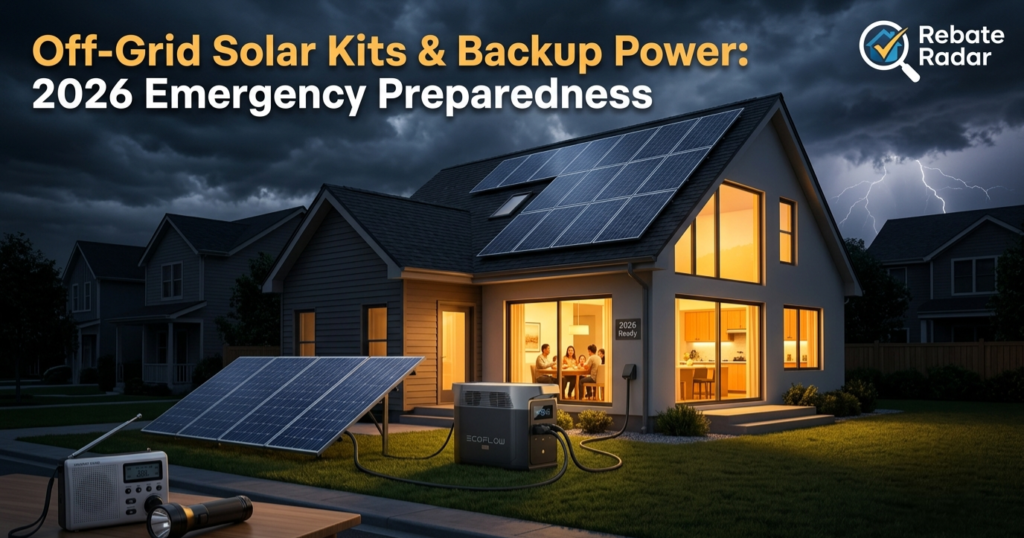
Off-Grid Solar Kits & Backup Power: The Ultimate 2026 Emergency Preparedness Guide
Build a smarter home backup system for blackouts, severe weather and grid disruptions. Learn how to choose solar panels, portable power stations, batteries, inverters and critical-load equipment without overspending or buying a system that cannot actually run what your household needs.
Updated September 2026 · Independent educational guide · Rebate Radar
What Does “Off-Grid Solar” Actually Mean in 2026?
The phrase off-grid solar is often used loosely. A homeowner may describe a portable battery with a foldable solar panel as an “off-grid system,” while another homeowner may mean a permanently installed solar array, battery bank and inverter capable of operating an entire house without utility power.
Those are very different systems. The most important question is not whether a product is marketed as “off-grid.” The real question is: what electrical loads must remain operational, for how long, and how will the system recharge?
For emergency preparedness, the most practical strategy for many homeowners is not attempting to disconnect from the utility entirely. Instead, it is creating a resilience system that keeps essential loads operating when the grid fails.
The smarter 2026 mindset
Think of solar backup as an energy-management system rather than simply a collection of panels and batteries. Your goal is to match generation, storage, inverter capacity and household demand so that the system performs predictably during an outage.
The 4 Main Types of Solar Backup Systems
Portable Power Station
A portable power station combines a battery, inverter and charging electronics in one enclosure. It is ideal for refrigerators, communications equipment, laptops, lighting, medical-support equipment and other moderate loads, depending on its output rating.
Solar Generator System
A solar generator generally means a battery-based power station paired with solar panels. During an outage, solar input can replenish the battery while the battery supplies electricity to connected loads.
Whole-Home Battery Backup
Permanently installed batteries can be connected to selected circuits or a home’s electrical system. These systems can provide much greater capacity and automation but require professional design and installation.
True Off-Grid Solar System
A true off-grid residence does not depend on the utility grid for normal operation. It generally requires substantially more engineering because the system must handle seasonal solar variation, battery cycling, peak loads, backup generation or additional energy sources, and long periods of poor weather.
How to Size an Off-Grid Solar Kit Correctly
The most common mistake buyers make is shopping by battery size alone. A battery advertised as “2,000 Wh” does not automatically tell you whether it can start your refrigerator, run a pump or power a high-wattage appliance.
You need to evaluate at least four variables: energy capacity, continuous output, surge output and recharge capability.
| Specification | What it means | Why it matters |
|---|---|---|
| Wh / kWh | Stored energy | Determines approximately how long the battery can supply loads. |
| Continuous watts | Maximum sustained electrical output | Determines which appliances can operate simultaneously. |
| Surge watts | Short-duration peak output | Important for motors, compressors, pumps and other starting loads. |
| Solar input | Maximum solar charging power | Determines how quickly the battery can recover during daylight. |
Start with your critical loads
Instead of trying to power every appliance in your home, create a critical-load list. During a serious outage, many households can remain functional by prioritizing refrigeration, communications, lighting, internet equipment, medical-support devices, security equipment and selected small appliances.
- Refrigerator or freezer
- Wi-Fi router and modem
- Mobile-phone charging
- LED lighting
- Security cameras and alarm equipment
- Medical-support equipment where applicable
- Small cooking appliances
- Garage-door opener
- Computer and essential work equipment
Do not assume every large appliance will work
Central air-conditioning, electric resistance heating, electric water heaters, well pumps and large compressors can require substantial power. Some may also create a significant startup surge. A portable battery should not be connected to loads exceeding its manufacturer specifications.
Battery Capacity vs. Power Output: The Difference Most Buyers Miss
Imagine two power stations with similar battery capacity. One may have a higher inverter output and therefore handle more demanding appliances. The other may store a similar amount of energy but have a lower output limit.
Capacity answers “how long?” Power output answers “what can I run right now?”
If a system contains approximately 2,000 Wh of usable energy and a connected load averages 200 watts, the theoretical runtime is roughly 10 hours before accounting for conversion losses, reserve capacity, temperature and other operating factors.
A useful planning formula
Approximate runtime = usable battery energy ÷ average load
Real-world runtime will normally be lower than a simple theoretical calculation because inverters consume energy, appliances cycle on and off, battery-management systems maintain reserves and operating conditions change.
How Much Battery Storage Do You Really Need?
There is no universal “correct” battery size. A weekend cabin, an apartment preparing for a short blackout and a rural home dependent on a well pump have completely different requirements.
| Use case | Typical objective | Design priority |
|---|---|---|
| Short outage | Keep communications, food and lighting operational | Portable battery + modest solar |
| 24-hour resilience | Maintain refrigeration and essential electronics | Larger battery + meaningful solar input |
| Multi-day outage | Recharge while continuing to operate loads | Battery + substantial solar generation |
| Off-grid residence | Operate independently year-round | Professional engineering and significant storage/generation |
For longer outages, battery size alone is not enough. Once the stored energy is depleted, you need a reliable way to replenish it. That is where solar input becomes critical.
Choosing Solar Panels for Emergency Backup
Solar panels are the energy-generation component of the system. Their job is not simply to “make electricity.” They must generate enough usable energy under real weather conditions to replenish the battery and support loads.
Panel ratings are normally based on laboratory conditions. Real-world production can be affected by cloud cover, temperature, shading, panel orientation, wiring, charge-controller limitations and the available solar resource.
Panel wattage
Higher rated wattage can increase potential charging power, but the battery system must be capable of accepting that input.
Portability
Folding panels are convenient for emergency kits, camping and temporary setups. Rigid rooftop arrays are better suited to permanent installations.
Weather exposure
Permanent outdoor equipment should be selected and installed according to manufacturer requirements for the local environment.
One of the most important questions before buying is whether the solar panel voltage, current and connector configuration are compatible with the battery system. Never assume that any panel can safely connect to any power station.
The Inverter Is the Heart of Your Backup System
Solar panels produce DC electricity. Most household appliances use AC electricity. The inverter performs the conversion and determines how much electrical power can be delivered to AC loads.
A quality system should be evaluated for continuous output, surge capability, waveform characteristics, efficiency, thermal management and protection features. For sensitive electronics, manufacturers often specify pure-sine-wave output.
Never size the system from the battery number alone
A large battery with an undersized inverter may still fail to operate an appliance with a high instantaneous demand. Conversely, a powerful inverter paired with a small battery can deliver high output for only a limited period.
A properly designed system balances watts + watt-hours + solar charging + household load priorities.
Critical-Load Planning: The Secret to Longer Backup Runtime
Emergency power becomes much more effective when you stop thinking about “running the house” and start thinking about “running the important parts of the house.”
During a blackout, you may not need to operate every television, gaming system, electric heater and decorative light. By concentrating available energy on essential loads, the same battery can provide considerably more useful resilience.
Tier 1 — Essential
Refrigeration, medical equipment, communication, emergency lighting and security.
Tier 2 — Important
Internet equipment, computers, fans, selected kitchen appliances and garage access.
Tier 3 — Optional
Entertainment, high-consumption appliances and loads that can easily wait until utility service returns.
Portable Power Station vs. Solar Generator vs. Home Battery
| Feature | Portable power station | Solar generator | Installed home battery |
|---|---|---|---|
| Mobility | Excellent | Good | Low |
| Solar recharge | Usually supported | Core feature | Usually supported through installed solar |
| Installation | Minimal | Minimal to moderate | Professional installation normally required |
| Whole-home potential | Limited | Depends on system | Highest |
| Best use | Portable emergency backup | Extended portable resilience | Automated home backup |
Best Backup Power Equipment Categories for 2026
Rather than choosing a product simply because an advertisement calls it “the best solar generator,” compare equipment according to your actual use case.
Large Portable Power Stations
High-capacity portable systems are designed for homeowners who need more stored energy and higher output without immediately installing a permanent whole-home battery. They can be useful for refrigerators, networking equipment, lighting and selected appliances during outages.
Before buying, compare usable capacity, continuous AC output, surge output, solar-input limits, expansion capability, battery chemistry, warranty and weight.
Check Current Amazon Option →Mid-Size LiFePO4 Power Stations
Mid-size LiFePO4 systems can be attractive for homeowners who want a balance between portability, storage and output. They can also serve as a flexible backup solution for electronics, refrigeration and selected appliances.
Look beyond advertised battery capacity. Check the inverter rating, charging speed, solar-input specification and whether the system supports expansion.
Compare a Current Option →Compact Backup Power Stations
Smaller systems can be valuable as a second layer of emergency preparedness. They are particularly useful for phones, laptops, routers, lights, cameras and other low-to-moderate loads.
A compact battery should not be judged against a whole-home battery. Its advantage is flexibility, portability and the ability to keep critical electronics operating without requiring permanent installation.
Emergency Solar and Generator Safety: What You Cannot Ignore
⚠️ Carbon monoxide is not a solar-battery problem — it is a generator problem
Battery-based power stations do not produce combustion exhaust while operating. Fuel-burning portable generators are fundamentally different and can produce deadly carbon monoxide.
The U.S. Consumer Product Safety Commission warns that portable generators must never be operated indoors, in garages, basements, sheds or near doors, windows or vents. A working carbon-monoxide alarm should be installed in the home. 1
Never backfeed a home through a normal wall outlet
Connecting a generator or inverter into a household receptacle to energize wiring through an improvised connection can create serious electrocution and fire hazards. Whole-home or selected-circuit backup should use equipment and installation methods designed for that purpose.
Respect battery safety
- Follow the manufacturer’s charging and operating limits.
- Keep equipment within its specified temperature range.
- Do not modify battery packs or electrical protection systems.
- Inspect cables and connectors for damage.
- Keep equipment dry unless specifically rated for outdoor/wet operation.
- Do not place heavy objects on portable battery equipment.
- Store equipment according to the manufacturer’s long-term storage instructions.
How to Build a Practical Emergency Energy Kit
Identify the outage scenarios
Decide whether you are preparing for a few hours, one day, several days or recurring outages. Your answer determines how much storage and solar generation makes sense.
Create your critical-load list
Write down the appliances and devices that genuinely need electricity. Separate them into essential, important and optional loads.
Estimate energy consumption
Determine approximate watts and expected operating hours. Remember that refrigerators and similar appliances cycle rather than operating continuously at maximum power.
Choose inverter capacity
Confirm that continuous and surge output can handle your highest-priority loads, especially appliances with motors or compressors.
Choose battery capacity
Size storage according to how long you want critical loads to operate before recharging.
Add solar recharge capacity
If you expect outages lasting more than a day, solar generation becomes increasingly important because the battery alone eventually runs down.
2026 Solar & Battery Incentives: What Homeowners Need to Know
One of the biggest sources of confusion in the solar market is the difference between federal tax credits, state rebates, utility incentives, local programs and financing promotions.
Marketing materials may continue to display older federal incentive information even though the rules changed. For 2026 planning, verify the current program directly with the IRS, your state energy agency and your electric utility.
| Program | 2026 status | What homeowners should do |
|---|---|---|
| Residential Clean Energy Credit — 25D | Not available for expenditures after December 31, 2025. | Do not assume a new 2026 installation qualifies for the former 30% federal credit. |
| Energy Efficient Home Improvement Credit — 25C | Ended for property placed in service after December 31, 2025. | Verify current alternatives instead of relying on older articles. |
| State solar incentives | Varies by state. | Check the specific state program, utility territory and eligibility rules. |
| Utility battery/VPP programs | Varies by utility and location. | Check enrollment requirements, compensation and battery-control terms. |
Important 2026 tax-credit correction
The IRS states that the Residential Clean Energy Credit applied to qualified property installed through December 31, 2025, and is not available for property placed in service after that date. Battery storage was among the qualifying technologies under the prior rules. 2
That does not mean every solar, battery or home-energy incentive disappeared. State, local, utility and other programs may still exist. Eligibility, funding, timing and stacking rules must be verified individually.
For a broader incentive search, explore our Energy Rebates 2026 Guide, Federal Solar Rebates 2026, Home Energy Rebates 2026 and Solar Rebate Eligibility Checker.
How to Calculate the Real Cost of an Off-Grid Solar System
Never evaluate a system solely by its sticker price. The economic comparison should include equipment, installation, wiring, permits where applicable, batteries, solar panels, accessories and any financing costs.
A better cost framework
Equipment cost
+ installation and electrical work
+ required accessories
+ financing costs, if applicable
− confirmed rebates or incentives
= estimated net project cost
Then compare that cost against the value you expect from backup power, avoided electricity purchases and other measurable benefits.
Emergency preparedness has value even when the system does not produce a traditional investment return. Keeping refrigeration operational, protecting communications and maintaining essential electrical equipment during an extended outage can be important. However, those benefits should not be exaggerated by a salesperson or treated as guaranteed financial savings.
How to Buy an Off-Grid Solar Kit Without Getting Ripped Off
The rapidly expanding backup-power market creates opportunities for consumers but also creates room for aggressive marketing. The safest approach is to compare technical specifications and total ownership cost rather than buying from the first advertisement promising “energy independence.”
- Compare at least three suitable systems before purchasing a large installation.
- Check the manufacturer’s warranty and service process.
- Verify the battery chemistry and usable capacity.
- Compare continuous and surge inverter output.
- Confirm solar-input limits and compatibility.
- Check expansion-battery compatibility.
- Review return policies and shipping restrictions.
- Calculate total system cost instead of focusing on monthly payments.
- Confirm whether professional electrical installation is required.
- Do not assume an advertised tax credit applies to your specific purchase.
Be especially careful with “government approved” language
A company can advertise a legitimate product while making an unrelated or misleading claim about government incentives. A product being sold online does not mean that the government has endorsed it, approved its price or guaranteed an incentive.
Off-Grid Solar vs. Gas Generator: Which Is Better?
| Factor | Solar + battery | Fuel generator |
|---|---|---|
| Fuel required during operation | No combustion fuel | Yes |
| Indoor operation | Battery systems may be designed for appropriate indoor locations according to manufacturer instructions | Never operate indoors |
| Noise | Generally quiet | Engine noise |
| Recharge | Solar, grid or supported charging sources | Fuel |
| Long-duration cloudy weather | Requires careful storage and recharge planning | Can operate while fuel is available |
| Maintenance | Battery/system maintenance and periodic inspection | Engine maintenance and fuel management |
Neither technology is automatically the winner for every household. Some emergency-preparedness plans use both: battery storage for quiet everyday backup and a properly installed fuel generator for unusually long outages.
Build a Layered Home Energy Strategy
The strongest emergency-preparedness systems are usually layered rather than dependent on one device.
Layer 1
Efficiency. Reduce unnecessary electrical consumption and prioritize efficient appliances and LED lighting.
Layer 2
Portable power. Keep a charged battery station available for communications, refrigeration and critical electronics.
Layer 3
Solar generation. Add enough solar capacity to replenish stored energy during prolonged outages.
Layer 4
Permanent backup. For larger homes or recurring outages, evaluate a professionally installed battery and critical-load panel.
Layer 5
Fuel backup. Some households may benefit from a properly installed generator for extended emergencies.
Layer 6
Emergency supplies. Power is only one part of resilience. Maintain water, food, communications, lighting and other emergency supplies.
Useful Rebate Radar Tools for Your Solar Project
Once you understand your energy requirements, use the appropriate calculator before committing to equipment or a long-term contract.
☀️ Solar Savings
Estimate potential electricity savings and compare different solar scenarios.
Solar Savings Calculator →📊 Payback
Explore the relationship between project cost and projected savings.
Solar Payback Calculator →⚡ Electricity Costs
Understand your current electricity spending before evaluating solar.
Electricity Cost Calculator →2026 Emergency Preparedness Checklist
A backup-power system should be tested before an emergency, not during one.
- Charge and test your portable batteries periodically.
- Inspect cables, adapters and connectors.
- Confirm solar panels can actually charge the battery.
- Test your refrigerator backup strategy.
- Keep phone charging cables with the emergency equipment.
- Maintain flashlights and rechargeable lighting.
- Keep a written list of critical loads.
- Know which circuits or outlets are connected to backup power.
- Never improvise electrical connections.
- Keep manufacturer manuals accessible.
- Review battery storage instructions periodically.
- If using a fuel generator, maintain it according to manufacturer requirements and operate it outdoors as directed.
Frequently Asked Questions About Off-Grid Solar Kits in 2026
What is the best off-grid solar kit for a home?
There is no single best system for every home. The right system depends on your critical loads, battery capacity, inverter output, desired outage duration, solar resource, portability requirements and budget.
Can a portable power station run a refrigerator?
Many portable power stations can operate refrigerators, but compatibility depends on the refrigerator’s running consumption, startup surge, battery capacity and inverter output. Always compare the appliance requirements with the manufacturer’s specifications.
How many solar panels do I need for emergency backup?
The answer depends on your battery capacity, desired recharge time, local sunlight and daily electrical consumption. More panels can increase charging potential, but the battery system must support the available solar input.
Is a solar generator the same thing as a gas generator?
No. “Solar generator” commonly refers to a battery-based system that stores electricity and can recharge from solar panels. A conventional generator burns fuel to produce electricity through an engine-driven alternator.
Can I run my whole house from a portable power station?
Sometimes only a limited set of household circuits can be powered, depending on the system and installation method. Whole-home operation requires careful evaluation of electrical loads, transfer equipment, inverter capacity and battery storage.
Are solar batteries still eligible for a federal 30% residential tax credit in 2026?
Do not assume so for a new 2026 installation. The IRS states that the Residential Clean Energy Credit under Section 25D is not available for property placed in service after December 31, 2025. State and utility incentives may have separate rules.
Is a $0-down solar or battery system actually free?
No. A $0-down offer generally describes the upfront payment, not the total economic cost. Financing, leases and power-purchase agreements can involve long-term payments or other contractual obligations.
Can solar power eliminate my electricity bill?
Not necessarily. Utility rules, fixed charges, time-of-use rates, net-metering policies, system size, household consumption and weather all affect the final bill. A solar system may substantially reduce electricity purchases without making every utility charge disappear.
Is off-grid solar worth it for emergency preparedness?
It can be valuable when reliability is a priority and the system is correctly sized. The economic value depends on outage frequency, equipment cost, electricity rates, expected system life and the value you place on maintaining essential power.
Final Verdict: Buy the System You Can Actually Use
The most expensive mistake in emergency preparedness is not necessarily buying the most expensive equipment. It is buying a system that does not match the home’s real electrical requirements.
A smaller, properly sized battery can be more useful than a huge system that cannot be recharged efficiently. A solar array that matches the battery’s charging capability can be more valuable than simply adding more panels. And a carefully planned critical-load strategy can extend backup time without requiring an enormous battery bank.
In 2026, the smartest approach is therefore simple: measure first, compare second, purchase third.
Ready to plan your solar backup system?
Start by understanding your current electricity costs, then evaluate available incentives and calculate your expected solar economics before choosing equipment.
Explore the Rebate Radar Solar Savings Calculator, Solar Payback Calculator, Energy Rebates 2026 Guide and Solar Rebate Eligibility Checker.
Authoritative Sources & Further Reading
For tax-credit questions, verify the current rules directly with the Internal Revenue Service (IRS). The IRS explains the termination of the Residential Clean Energy Credit for post-2025 property and provides the applicable Form 5695 guidance.
For generator carbon-monoxide safety, consult the U.S. Consumer Product Safety Commission (CPSC). Portable fuel-burning generators must never be operated inside homes, garages or other enclosed areas.
For product-specific electrical specifications, always consult the manufacturer’s current documentation, installation manual and warranty terms before purchasing or installing equipment.
Information in this guide is for educational purposes and should not be treated as tax, legal or electrical engineering advice. Incentives, utility programs, product specifications and regulations can change. Verify current requirements with the relevant government agency, utility, licensed contractor or qualified professional before making a purchase or installation decision.