
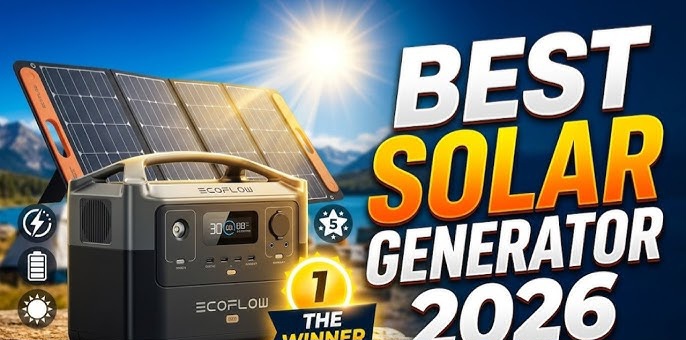
Best Solar Generators 2026: Top Portable Power Stations for Home Backup, Camping & RV
Looking for the best solar generator 2026? We compare portable power stations by battery capacity, AC output, LiFePO4 chemistry, solar charging, portability, emergency backup capability, and real-world use cases.
There is no single best solar generator for everyone. For home emergency backup, a larger 2,000Wh-class or expandable LiFePO4 power station is generally more practical than a compact camping unit. For travel, camping, and RV use, lighter 1,000Wh-class systems can provide a better balance between capacity and portability.
The most important specifications are Wh capacity, continuous AC output, surge capability, solar input, battery chemistry, UPS functionality, expansion options, weight, warranty, and price.
Why Are Solar Generators So Popular in 2026?
The phrase solar generator is commonly used to describe a portable power station that stores electricity in a rechargeable battery and can often be recharged using portable solar panels.
Unlike a conventional fuel generator, a battery-based power station does not burn gasoline while operating. It can therefore provide quiet backup electricity for many everyday loads, depending on its capacity and output rating.
That makes portable power stations attractive for homeowners preparing for blackouts, travelers, RV owners, campers, remote workers, and people looking for a quieter alternative to a conventional generator.
Home Backup
Keep refrigerators, routers, lights, phones, computers and other essential loads operating during short outages.
Camping
Power phones, lights, cameras, laptops, small coolers and other electronics away from traditional electrical outlets.
RV & Travel
Portable battery storage can provide convenient electricity for road trips, RV travel and off-grid adventures.
How to Choose the Best Solar Generator in 2026
The biggest mistake buyers make is choosing a power station based only on its advertised wattage. A better decision starts with understanding the relationship between capacity, power output, solar input and the appliances you actually need to run.
1. Battery Capacity: How Many Watt-Hours Do You Need?
Battery capacity is measured in watt-hours (Wh). In simple terms, a 2,000Wh battery stores substantially more energy than a 500Wh battery.
| Capacity | Best For | Typical Applications |
|---|---|---|
| 200–500Wh | Portable backup | Phones, tablets, lights, cameras, laptops |
| 500–1,000Wh | Camping & travel | Electronics, small appliances, routers, lights |
| 1,000–2,000Wh | Serious portable backup | Refrigerators, electronics, emergency loads |
| 2,000Wh+ | Home emergency backup | Larger appliances and longer runtime |
2. Continuous AC Output Matters More Than You Think
Battery capacity tells you how much energy is stored. AC output tells you how much power the unit can deliver at one time.
For example, a refrigerator may have a relatively modest running load but require additional power when its compressor starts. This is why both continuous output and surge capability matter.
- 600W–1,000W: electronics and lighter appliances
- 1,500W–2,000W: larger household loads and many common appliances
- 2,000W–3,000W+: stronger emergency backup capability
- Expandable systems: useful when you need substantially more stored energy
3. LiFePO4 vs. Older Lithium-Ion Batteries
Many of today’s leading portable power stations use LiFePO4, also known as lithium iron phosphate, battery chemistry.
The attraction is long cycle life, good thermal stability and durability compared with many older battery chemistries.
However, battery chemistry is only one part of the buying decision. Warranty, thermal management, charging performance, inverter quality, software, repair support and overall system design also matter.
4. Solar Input: The Feature That Makes It a “Solar Generator”
A portable power station can often be charged from a wall outlet, vehicle connection and compatible solar panels.
Solar input is particularly valuable during extended outages because it provides another way to replenish the battery without relying exclusively on the grid.
When comparing models, check the manufacturer’s maximum solar input and make sure the voltage and current requirements are compatible with the panels you intend to use.
5. UPS Functionality
If you want backup power for a desktop computer, router, networking equipment or other sensitive electronics, look for a model with a documented UPS or EPS transfer specification.
Not every portable power station behaves exactly like a dedicated home UPS, so the manufacturer’s specifications matter.
Best Solar Generators 2026: Our Top Picks
The models below represent different buying priorities rather than pretending that one product is perfect for everyone. Specifications and pricing can change, so verify the current configuration before purchasing.
🔋 FOSSiBOT F2400
A large-format portable power station designed for buyers who prioritize high output and roughly 2kWh-class storage without moving into a permanently installed home battery system.
Best for: emergency backup, refrigerators, larger appliances, workshops and users who want substantial portable capacity.
Check Current Price on Amazon →⚡ BLUETTI Elite 200 V2
A premium portable power station aimed at homeowners who want a large battery, strong AC output and long-term battery durability in a relatively compact package.
Best for: home emergency backup, remote work, appliances and users prioritizing battery longevity.
View Current Price on Amazon →☀️ 286Wh Portable Solar Generator
A compact option for buyers who need basic emergency charging without carrying a 40–60 lb high-capacity power station.
Best for: phones, laptops, lights, small electronics, road trips and lightweight emergency preparedness.
See Current Price →🚐 CTECHi 2000W Portable Power Station
A larger portable system designed for people who want more capacity and output than a compact camping battery while retaining a transportable form factor.
Best for: RV travel, camping, outdoor work, emergency backup and off-grid use.
Check Availability on Amazon →Solar Generator Comparison: Capacity vs. Power vs. Use Case
| Model | Approx. Capacity | AC Output Class | Battery | Best For |
|---|---|---|---|---|
| FOSSiBOT F2400 | 2,048Wh | 2,400W | LiFePO4 | Home backup |
| BLUETTI Elite 200 V2 | 2,073.6Wh | 2,600W | LiFePO4 | Premium backup |
| 286Wh Portable Unit | 286Wh | Compact class | Check current listing | Camping / electronics |
| CTECHi 2000W | 1,536Wh | 2,000W | LiFePO4 | RV / camping |
Best Solar Generator for Home Backup in 2026
If your primary goal is home emergency backup, capacity becomes much more important than portability.
A 300Wh battery can be excellent for keeping phones and communication equipment operating, but it is a very different product from a 2,000Wh expandable system.
For a home backup setup, start by identifying your essential loads.
- Refrigerator or freezer
- Wi-Fi router and modem
- Phones and computers
- Emergency lighting
- CPAP or other essential low-power equipment
- Small fans
- Television or entertainment equipment
- Selected kitchen appliances
⚠️ Don’t confuse portable backup with whole-home backup
A portable power station can be extremely useful during an outage, but that does not automatically mean it can power an entire house.
Whole-home backup generally requires substantially more stored energy, adequate inverter capacity, appropriate electrical integration and, in many cases, professional installation.
For larger permanent systems, see our related guide: Home Battery Storage Guide.
Best Solar Generator for Camping, RVs & Off-Grid Travel
The best portable power station for camping is usually not the biggest one available.
Weight, handles, solar charging, USB-C output, noise, portability and usable capacity can matter more than maximum wattage.
Weekend Camping
Look for approximately 300–1,000Wh depending on how many devices and appliances you intend to operate.
RV Travel
A 1,000–2,000Wh system can offer a useful balance between stored energy and portability.
Off-Grid Living
Prioritize expandable battery capacity, high solar input, multiple charging methods and service support.
How Long Will a Solar Generator Run Your Appliances?
Runtime depends on three things: battery capacity, appliance power consumption and system efficiency.
A simple estimate is:
Runtime ≈ Battery Capacity (Wh) × Efficiency ÷ Appliance Power (W)
Actual runtime will vary because inverter losses, battery reserve, temperature and appliance cycling all affect real-world performance.
⚡ Simple Solar Generator Runtime Estimator
Use this quick estimate to understand the relationship between battery capacity and appliance power. It is an estimate—not a manufacturer runtime guarantee.
How Fast Can a Solar Generator Recharge With Solar Panels?
Solar recharge time depends on the station’s maximum solar input, the panel array, sunlight conditions, temperature, shading, panel orientation and charging losses.
For example, a station capable of accepting 1,000W of solar input cannot necessarily receive 1,000W continuously throughout an entire day. Real-world solar production changes hour by hour.
This is why buyers should look beyond the phrase “solar generator” and compare the actual solar input specification.
- Maximum solar input in watts
- Supported solar voltage range
- Maximum solar current
- MPPT charge controller
- Panel compatibility
- Ability to combine multiple panels
Portable Power Station vs. Gas Generator
| Feature | Battery Solar Generator | Traditional Gas Generator |
|---|---|---|
| Fuel | Electricity / solar | Gasoline or other fuel |
| Operating Noise | Generally very quiet | Generally much louder |
| Tailpipe Emissions | None during battery operation | Produces exhaust |
| Indoor Operation | Follow manufacturer safety instructions | Never operate fuel generators indoors |
| Solar Recharge | Yes, when supported | No |
| Long-Duration High Load | Limited by battery capacity | Limited by fuel supply |
Do Solar Generators Qualify for a Federal Tax Credit in 2026?
This is an area where online solar content can become misleading.
A portable power station is not automatically eligible for a federal residential clean-energy tax credit merely because it accepts solar charging.
The IRS states that the Residential Clean Energy Credit previously covered qualifying solar electric property and qualifying battery storage technology with a capacity of at least 3 kWh. However, the IRS currently states that the credit is not available for qualifying property placed in service after December 31, 2025.
Therefore, homeowners researching solar generator tax credits 2026 should verify the current rules rather than relying on older articles that still advertise a blanket 30% credit.
For historical eligibility information and official guidance, consult the IRS directly: IRS Residential Clean Energy Credit .
10 Mistakes to Avoid When Buying a Solar Generator
- Buying based only on wattage. Capacity and output are different specifications.
- Ignoring battery chemistry. LiFePO4 is now common in higher-end portable systems.
- Forgetting surge requirements. Motors and compressors can draw more power during startup.
- Ignoring weight. A 2,000Wh station can be difficult to move frequently.
- Buying incompatible solar panels. Check voltage and current requirements.
- Ignoring solar input limits. More panel wattage does not necessarily mean faster charging if the station is capped.
- Assuming every station is a UPS. Verify the manufacturer’s transfer specification.
- Ignoring warranty and support. Battery systems are long-term purchases.
- Assuming “solar generator” means whole-home backup. Portable and permanently installed systems are different categories.
- Assuming a tax credit applies automatically. Verify the current IRS rules before counting an incentive as part of your savings.
Which Solar Generator Should You Buy?
| If You Need… | Look For… | Ideal Category |
|---|---|---|
| Phone & laptop backup | 300–500Wh | Compact power station |
| Camping | 500–1,000Wh | Portable LiFePO4 station |
| RV travel | 1,000–2,000Wh | High-output portable station |
| Refrigerator during outages | 1,500–2,000Wh+ | High-output emergency backup |
| Long-duration home backup | Expandable multi-kWh system | Home battery / expandable power station |
| Whole-home backup | Permanent electrical integration | Professional home energy system |
Explore More Solar, Battery & Energy Guides
If you are comparing portable power stations with a larger home energy strategy, these guides can help you continue your research:
Frequently Asked Questions About Solar Generators 2026
What is the best solar generator in 2026?
The best option depends on the intended use. Larger 2,000Wh-class LiFePO4 power stations are better suited to serious emergency backup, while smaller systems are generally more convenient for camping and travel.
What is the best portable power station for home backup?
Look for a model with at least roughly 1,000–2,000Wh of capacity, strong continuous AC output, adequate surge capability, solar charging and, when needed, expandable battery capacity.
Can a solar generator run a refrigerator?
Many larger portable power stations can run a refrigerator, but runtime depends on the refrigerator’s actual energy consumption, compressor cycling, battery capacity and inverter efficiency.
How many watts do I need for a refrigerator?
There is no single number for every refrigerator. Check the appliance’s rated power and startup requirements. A power station should have enough continuous and surge output for the specific appliance.
Are LiFePO4 solar generators better?
LiFePO4 batteries are attractive because of their long cycle life and thermal characteristics. However, the complete power station should be evaluated rather than battery chemistry alone.
Can I charge a portable power station with solar panels?
Yes, many portable power stations accept solar charging. Always verify the supported voltage, current, connector and maximum solar input before connecting a panel.
Can a solar generator power an entire house?
Some large expandable systems can provide substantial home backup, but a small portable power station cannot continuously power an entire home. Whole-home systems require much more capacity and may require electrical integration by a qualified professional.
Can solar generators replace gas generators?
For some use cases, yes. Battery power stations are particularly attractive for quiet, short-duration backup, electronics, camping and indoor environments where fuel combustion is inappropriate. Gas generators may remain useful for prolonged high-power loads when fuel is available.
Do solar generators qualify for the 30% federal tax credit in 2026?
Do not assume they do. The federal Residential Clean Energy Credit rules changed, and the IRS currently states that the credit is unavailable for qualifying property placed in service after December 31, 2025. Verify current IRS guidance before purchasing based on an expected tax benefit.
What size solar generator should I buy for emergencies?
For basic communications and electronics, a few hundred watt-hours may be enough. For refrigerators and more substantial emergency loads, consider 1,000–2,000Wh or more, depending on the required runtime and appliance load.
🏆 Final Verdict: Are Solar Generators Worth It in 2026?
For many households, a modern portable power station can be an excellent emergency-preparedness investment.
The strongest systems combine LiFePO4 battery technology, substantial watt-hour capacity, high AC output, solar charging, fast recharge capability and expandable storage.
The right choice ultimately depends on what you are trying to power.
If you need a lightweight camping battery, prioritize portability. If you need refrigerator backup during blackouts, prioritize capacity and surge output. If you want long-duration home backup, look at expandable systems and permanent home-energy solutions.
And if you are buying because of a supposed “2026 solar generator tax credit”, verify the incentive first. A tax benefit should never be assumed simply because a product has a solar input.
This article is for general informational and educational purposes. Product specifications, pricing, availability, warranties and compatibility can change. We recommend checking the manufacturer’s current specifications before purchasing.
Some links on this page are affiliate links. If you purchase through an affiliate link, we may receive a commission at no additional cost to you. Affiliate relationships do not determine our editorial criteria.
Rebate Radar is an independent informational publisher and is not affiliated with the IRS, U.S. Department of Energy, any state government, or any utility unless specifically stated.
Tax information is presented for general educational purposes only and is not tax, legal or financial advice. Always verify current requirements with the appropriate government source or a qualified professional.
Last research update: August 2026.