
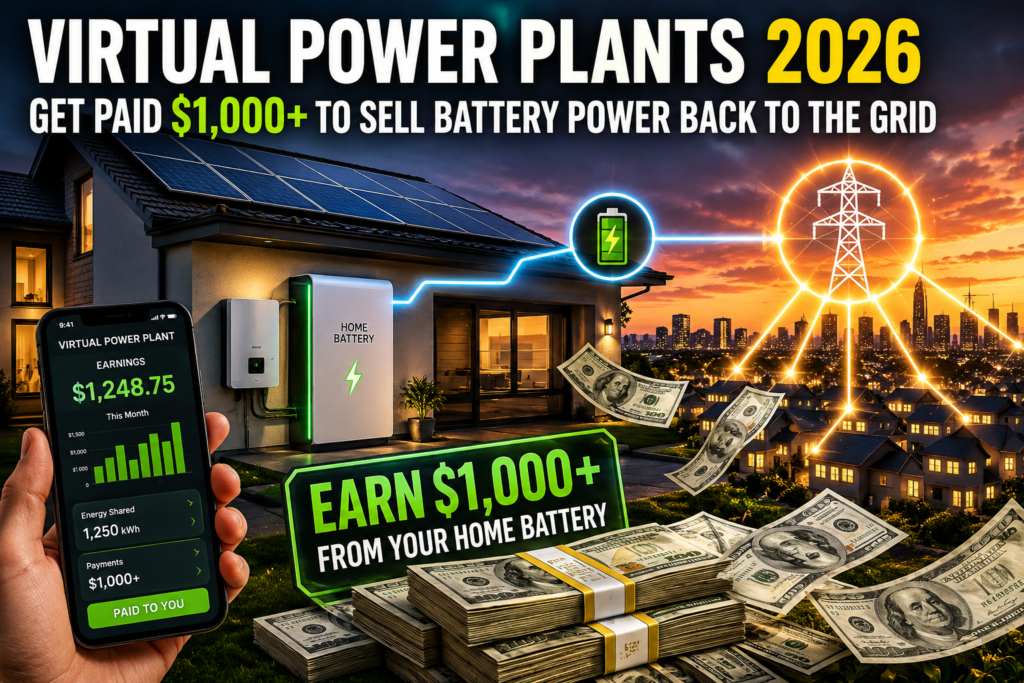
Virtual Power Plants 2026: How Home Batteries Can Earn Grid Incentives
A complete guide to virtual power plants (VPPs), home battery VPP programs, battery demand response, compensation models, enrollment requirements, battery cycling, backup reserves, V2G, V2H and the economics of participating in a virtual power plant in 2026.
VPP income is real — but there is no universal $1,000 payment.
Virtual power plant compensation depends on the specific utility, aggregator, battery, service territory, enrollment status, event rules and payment structure. Treat advertised maximums as program-specific figures, not guaranteed national earnings.
Imagine your home battery not only protecting your house during a power outage, but also becoming part of a much larger network of batteries, electric vehicles, solar systems and flexible loads that can help the electric grid during periods of high demand.
That is the basic idea behind a virtual power plant.
Instead of building one enormous traditional power plant, a VPP coordinates thousands or even millions of smaller energy resources through software. Those resources can include residential batteries, rooftop solar, EV chargers, electric water heaters, smart thermostats, commercial loads and other distributed energy resources.
For homeowners, the interesting part is simple: if your equipment is eligible for a local program, you may receive compensation for allowing a utility, aggregator or VPP platform to control or coordinate part of its operation.
That compensation can take different forms, including bill credits, enrollment incentives, seasonal payments, capacity payments or performance-based compensation.
What Is a Virtual Power Plant?
A virtual power plant (VPP) is a coordinated network of distributed energy resources that can collectively provide grid services similar to those traditionally supplied by a power plant.
Think of a VPP as a networked energy system.
One residential battery may be relatively small compared with a utility-scale power plant. But thousands of batteries can collectively represent a substantial amount of flexible capacity.
The VPP platform coordinates those individual devices so that their combined response can help reduce peak demand, shift electricity use, discharge stored energy or provide other grid services.
The homeowner does not normally operate a giant power plant. Instead, the homeowner’s equipment becomes one component of a larger distributed network.
The U.S. Department of Energy describes VPPs as aggregations of distributed energy resources such as customer-sited batteries, rooftop solar, electric vehicles and chargers, smart buildings and flexible loads. 1
How Does a Virtual Power Plant Work?
The process is easier to understand when broken into four stages.
Your home has an energy resource
This might be a home battery, solar-plus-storage system, EV charger, electric water heater, smart thermostat or another controllable device.
The equipment connects to a control platform
The utility, aggregator or VPP provider uses software to communicate with participating devices according to the program’s technical rules and customer agreement.
The grid reaches a period when flexibility has value
This could occur during a high-demand period, a system reliability event, a demand-response event or another situation defined by the program.
Participating resources respond
Depending on the program, batteries may discharge, EV charging may be shifted, thermostats may adjust or other flexible resources may change their electricity use.
Home Battery VPP Programs: Why Batteries Are So Important
Residential batteries are particularly useful VPP resources because they can often both store electricity and discharge it later.
That makes a battery fundamentally different from a device such as a smart thermostat, where the VPP primarily changes electricity consumption.
Energy Storage
A battery can store electricity and make that stored energy available during a later grid event, subject to its state of charge and program rules.
Peak Demand Support
Battery discharge can help reduce the amount of electricity a participating home draws from the grid during certain high-demand periods.
Solar + Storage
Solar-plus-storage systems can potentially combine solar self-consumption, backup power and participation in grid programs.
If you’re comparing a stationary home battery with portable equipment, see our detailed Solar Battery vs Solar Generator 2026 guide.
For a broader look at battery incentives and federal policy changes, continue to our Home Battery Tax Credit 2026 guide and our Solar Tax Credit 2026 resource.
What Types of Devices Can Participate in a VPP?
VPPs are not limited to batteries. The technology is broader than residential energy storage.
| Resource | How it can provide flexibility | Why it matters |
|---|---|---|
| 🔋 Home battery | Charge or discharge according to program instructions. | Can provide substantial dispatchable energy capacity. |
| ☀️ Solar + storage | Store solar energy and coordinate discharge or charging. | Combines renewable generation with flexible storage. |
| 🚗 EV / EV charger | Shift charging or, where supported, discharge energy back to a home or grid. | EV batteries can represent significant stored energy. |
| 🌡️ Smart thermostat | Temporarily adjust heating or cooling demand. | Can reduce peak electricity consumption. |
| 💧 Electric water heater | Shift heating to different times. | Thermal storage can provide flexibility without a traditional battery. |
| 🏢 Commercial loads | Reduce, shift or control electricity consumption. | Large loads can provide significant demand-response capacity. |
DOE’s VPP materials specifically identify batteries, EVs and chargers, smart buildings, electric water heaters and other flexible loads as potential distributed energy resources. 2
How Do VPP Programs Pay Homeowners?
One of the biggest misconceptions about VPPs is that every program simply pays a fixed amount per kilowatt-hour.
In reality, compensation can be structured in several different ways.
Enrollment Incentive
A program may offer an incentive for enrolling or remaining enrolled, depending on its specific terms.
Seasonal Payment
Some programs may provide compensation associated with a defined season or period of grid stress.
Performance Payment
Compensation may depend on the amount of energy or capacity delivered during qualifying events.
Bill Credits
Some programs can compensate participants through credits applied to the electricity bill.
Capacity-Based Value
A program may value the amount of flexible capacity a participant makes available rather than only actual energy delivered.
Mixed Compensation
Some structures can combine multiple payment mechanisms or incentives.
Is Joining a Virtual Power Plant Worth It?
The answer depends on your battery economics, your electricity rate, the local program and how much control you are willing to give the VPP operator.
✓ VPP participation can be attractive when…
- You already own a compatible battery.
- The program has meaningful compensation.
- You have a clear backup reserve policy.
- The manufacturer supports the operating mode.
- The program has reasonable event frequency.
- You value the additional grid-service revenue.
⚠ Be more cautious when…
- You are buying a battery solely for VPP income.
- The advertised compensation is a maximum rather than a guaranteed amount.
- The program frequently dispatches the battery.
- The agreement limits your ability to control the system.
- Battery warranty conditions are unclear.
- The program can change compensation or enrollment conditions.
The best way to evaluate a VPP is to treat it as one component of total battery value.
🔢 A Better Way to Calculate VPP Economics
Instead of asking “How much can I make from a VPP?”, ask: “How much additional value does this program create after considering the battery’s cost, operating requirements and other benefits?”
This is intentionally a simplified framework. Actual program economics can be more complicated and may include capacity payments, performance rules, utility rate impacts and battery operating constraints.
Illustrative example: Suppose a hypothetical program paid $20 for an annual enrollment component plus $10 per qualifying event for 20 events. That would produce $220 in illustrative program value before considering other factors.
That does not mean $220 is a typical VPP payment. It simply demonstrates why homeowners should calculate the actual compensation formula for the program available at their address.
Does VPP Participation Degrade Your Battery Faster?
This is one of the most important questions to ask before enrolling.
The answer is not simply “yes” or “no.” Battery aging depends on factors including chemistry, temperature, state of charge, depth of discharge, charging behavior, calendar age and cycling.
Battery Chemistry
Different battery chemistries and manufacturers have different performance and cycle-life characteristics.
Depth of Discharge
Repeatedly using a large percentage of available capacity can impose a different cycling burden than shallow cycling.
Temperature
Operating temperature can influence battery performance and long-term aging characteristics.
What should you check before joining?
- Battery manufacturer’s warranty terms.
- Whether VPP participation is explicitly supported.
- Maximum or expected cycling requirements.
- Minimum state-of-charge requirements.
- Backup reserve requirements.
- How the program handles abnormal operating conditions.
How to Enroll in a VPP in 2026
The enrollment process varies considerably. Some programs are utility-led, while others involve battery manufacturers, aggregators or third-party VPP platforms.
Identify your utility
Start with the electricity provider serving your exact address. A VPP available in one utility territory may not be available in the neighboring territory.
Identify your exact battery
Model number matters. Compatibility can depend on the battery, inverter, gateway, firmware and control platform.
Check whether enrollment is open
Programs can have enrollment windows, capacity limits, waitlists or geographic restrictions.
Read the compensation schedule
Determine whether compensation is guaranteed, performance-based, capacity-based, seasonal or dependent on other conditions.
Review battery reserve requirements
Find out how much energy the program can dispatch and how much must remain available for your home.
Review privacy and withdrawal terms
Understand data permissions, contract duration, opt-out procedures and what happens if you leave the program.
VPP Eligibility Requirements: What Usually Matters?
There is no single national VPP eligibility test for every homeowner. Requirements are established by individual programs.
| Requirement | What to verify |
|---|---|
| Utility territory | Is your address served by the participating utility? |
| Battery model | Is the exact battery and inverter configuration approved? |
| Communication | Does the system have the required internet, gateway or control connection? |
| State of charge | Are there minimum or maximum battery reserve requirements? |
| Interconnection | Does the system need specific interconnection approval? |
| Enrollment status | Is the program currently accepting new participants? |
| Compensation | How exactly is the participant paid? |
🔎 Continue Your Battery & Energy Research
A VPP is only one part of the residential energy-storage decision. These related Rebate Radar resources can help you evaluate the complete picture.
VPP vs Other Ways a Home Battery Can Create Value
| Battery benefit | Main purpose | Depends on local program? |
|---|---|---|
| Backup power | Keep selected household loads running during an outage. | Mostly system design and installation dependent. |
| Solar self-consumption | Use stored solar energy later. | Depends on system and electricity-rate structure. |
| Time-of-use optimization | Shift some consumption away from expensive periods. | Yes, utility rate structure matters. |
| VPP participation | Provide grid flexibility in exchange for program compensation. | Yes — strongly. |
| Demand response | Reduce or shift electricity use during grid events. | Yes — strongly. |
This is why a battery should generally be evaluated as a multi-purpose energy asset rather than as a VPP income machine alone.
🚗 V2G and V2H: Are Electric Vehicles the Next VPP Battery?
Virtual power plants are expanding beyond stationary batteries. Electric vehicles can potentially become distributed energy resources when paired with compatible bidirectional charging technology.
V2H — Vehicle to Home
A compatible EV can potentially supply electricity to the home through a bidirectional charging system during appropriate operating conditions.
V2G — Vehicle to Grid
A compatible EV and charger can potentially exchange electricity with the grid where the necessary utility and technical framework exists.
Smart Charging
Even without exporting energy, shifting EV charging to different times can provide grid flexibility.
However, owning an EV does not automatically make a household V2G-ready. Vehicle compatibility, charger hardware, utility rules, interconnection requirements and program availability all matter.
DOE’s VPP work includes EV charging and bidirectional-storage applications as part of the broader distributed-energy ecosystem. 3
For EV-related incentives and charging programs, see our EV Charger Rebates 2026 guide.
Can a Homeowner Really Earn $1,000+ From a VPP?
Potentially, a specific program could offer substantial compensation under particular conditions. But the phrase “earn $1,000+ from your battery” should never be interpreted as a guaranteed national VPP payment.
A program could advertise a maximum annual value that requires a particular battery size, a certain number of events, continued enrollment, performance during events or other conditions.
The DOE has emphasized that VPP deployment and compensation frameworks remain fragmented across jurisdictions. 4
Top 10 VPP Mistakes Homeowners Should Avoid
01. Chasing the headline payment
Maximum advertised compensation is not necessarily the amount you will receive.
02. Buying a battery solely for VPP income
Programs can change, close enrollment or modify compensation.
03. Ignoring backup reserves
Understand how much capacity can be dispatched during an event.
04. Ignoring battery warranty terms
Verify that the intended operating mode is supported.
05. Assuming every utility offers the same program
VPP availability varies substantially by service territory.
06. Ignoring enrollment limits
Some programs may cap participation or operate specific enrollment windows.
07. Forgetting rate-plan economics
Battery value can depend heavily on the underlying electricity rate.
08. Ignoring data permissions
Understand what energy data the platform collects and how it is used.
09. Assuming V2G means every EV can export power
Vehicle, charger, utility and regulatory compatibility are all important.
10. Comparing programs using someone else’s experience
Your utility, battery and contract can produce a completely different result.
🔐 VPP Data Privacy & Cybersecurity
VPP participation requires communication between your energy equipment and a software platform. That makes data privacy part of the financial and technical decision.
Energy Data
Understand what consumption, production and battery information is collected.
Third-Party Sharing
Review whether information can be shared with utilities, aggregators or other providers.
Withdrawal
Understand what happens to your account and data if you leave the program.
Before enrollment, read the provider’s privacy policy, customer agreement and data permissions rather than assuming every VPP platform follows the same model.
✅ 2026 VPP Readiness Checklist
- ☐ I know which utility serves my property.
- ☐ I confirmed that a VPP or demand-response program is available in my area.
- ☐ I confirmed my exact battery model is eligible.
- ☐ I understand how the program calculates compensation.
- ☐ I know how often my battery may be dispatched.
- ☐ I understand the required backup reserve.
- ☐ I reviewed the manufacturer’s warranty.
- ☐ I understand the contract duration and withdrawal rules.
- ☐ I reviewed the privacy and data-sharing terms.
- ☐ I would still consider the battery worthwhile without VPP income.
Frequently Asked Questions About Virtual Power Plants
Can I join a VPP without solar panels?
Yes, some programs can support standalone batteries or other distributed energy resources. Solar is not universally required. Eligibility depends on the specific program, utility, hardware and participation rules.
Can a Powerwall participate in a VPP?
Some battery platforms participate in utility or aggregator programs, but eligibility depends on the specific program, service territory, hardware configuration and enrollment availability. Do not assume that a particular battery is eligible everywhere.
Can portable power stations participate in VPP programs?
Not automatically. A portable power station would need to meet the program’s communication, control, technical and grid-interconnection requirements. Battery capacity alone does not establish VPP eligibility.
Does a VPP drain my battery?
A VPP event can cause a participating battery to charge or discharge according to the program’s rules. The amount of energy used depends on the specific event and operating limits.
Will I still have backup power during a VPP event?
That depends on the program. Some programs establish minimum reserve levels or other operating constraints, but homeowners should verify the exact backup provisions before enrolling.
Does VPP participation reduce battery life?
Additional cycling can contribute to battery wear, but the practical effect depends on chemistry, depth of discharge, temperature, operating conditions and the manufacturer’s specifications.
Are VPP payments taxable?
Tax treatment can depend on how compensation is structured and the homeowner’s circumstances. Bill credits, rebates and direct payments may not necessarily receive identical treatment. Consult a qualified tax professional for advice about your specific situation.
Can an EV participate in a virtual power plant?
Potentially. EVs can participate through smart charging, and some vehicles and charging systems support bidirectional power flows. Actual V2H or V2G participation requires compatible equipment and a program that supports it.
Are VPP programs available in every state?
No single VPP program covers every U.S. household. Availability varies by utility, state policy, aggregator, technology and market structure.
Should I buy a battery specifically to join a VPP?
Usually, the safer approach is to evaluate the battery’s complete value first: backup power, solar self-consumption, rate management and other benefits. Treat VPP compensation as an additional potential value stream rather than the sole justification for the purchase.
Explore More Rebate Radar Energy Guides
Final Verdict: Are Virtual Power Plants Worth It in 2026?
For the right homeowner, a virtual power plant can transform a home battery from a device used primarily for backup and solar self-consumption into a resource that can also participate in grid services.
But the smartest way to approach a VPP is not to start with the question, “How much money will I make?”
Start with: “What does this program actually require, what does it actually pay, and does the battery still make financial sense for my household?”
The best candidates are often homeowners who already have a compatible battery, understand their utility’s rate structure, value backup power and can treat VPP compensation as an additional benefit rather than the entire investment thesis.
VPPs are becoming an increasingly important part of the distributed-energy landscape. DOE’s recent VPP work highlights the potential for batteries, EVs, smart appliances and other distributed resources to provide grid flexibility at significant scale. 5
Explore Virtual Power Plant Incentives 2026 →Research & Methodology
This guide focuses on the structure and economics of virtual power plants rather than promising a specific payment to every homeowner. VPP availability, compensation, hardware compatibility, event requirements and utility rules can change throughout the year.
For current program decisions, verify information with the utility, VPP administrator, battery manufacturer or aggregator serving your property. DOE’s current VPP materials provide useful national context on distributed energy resources, VPP deployment and grid services. 6
Important: Rebate Radar provides educational information and calculators for research purposes. VPP programs, compensation structures, eligibility requirements, utility rules, battery compatibility, warranties, tax treatment and enrollment availability can change. Nothing on this page guarantees eligibility, savings or income. Verify current program terms with the relevant utility, program administrator, manufacturer or qualified professional before purchasing equipment or enrolling in a VPP.