
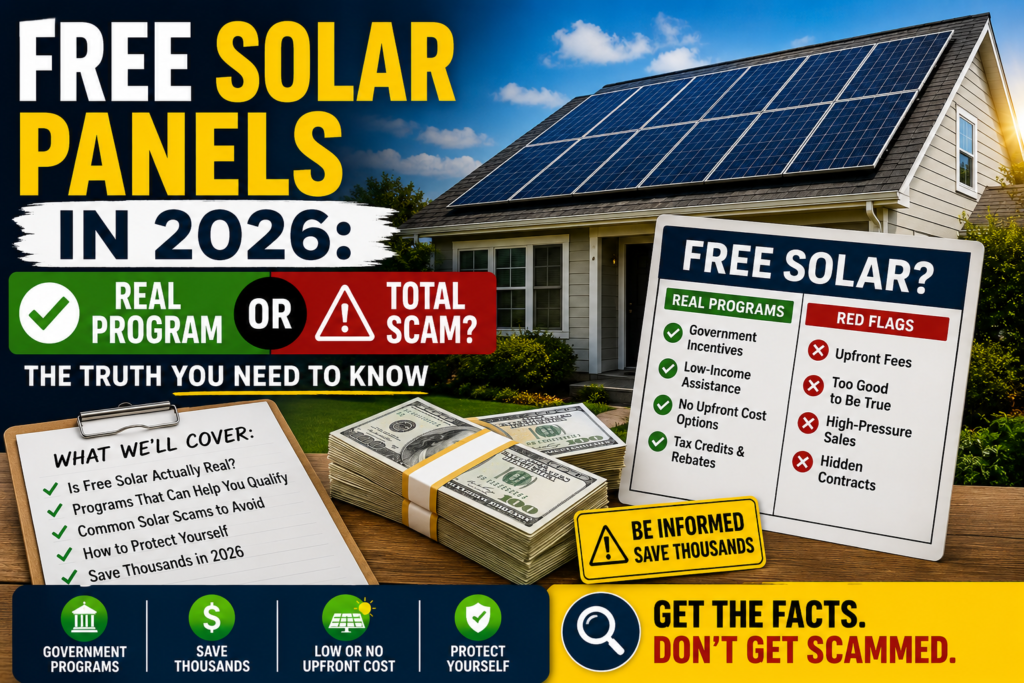
The Truth About “Free Solar Panels” in 2026: Government Program, Zero-Down Deal or Solar Sales Trap?
Seeing an ad promising “100% free solar panels,” “government-paid solar,” or “$0 electricity bills” for your ZIP code? Before you enter your phone number or sign a contract, understand what these offers actually mean, how PPAs and solar leases work, what federal incentives really do, and the warning signs that can turn a “free solar” offer into an expensive long-term commitment.
Be especially cautious with advertisements claiming that the government has selected your ZIP code for “100% free solar,” that your utility company has already approved you, or that you must act immediately to receive a limited government benefit. The FTC warns consumers about solar offers that falsely claim government or utility affiliation and about unexpected requests for personal information.
🔍 The short answer
There is no general federal program that simply sends homeowners free solar panels and installs them on their roofs.
A legitimate solar company can offer a $0-down financing structure, a lease, or a Power Purchase Agreement. Those products may reduce the amount of cash you need on installation day, but they do not make the solar system economically free.
The key question is therefore not “Are the panels free?” but: Who owns the system, who pays for it, what will I pay over time, and what happens when I sell my house?
Does the U.S. government actually give homeowners free solar panels?
This is where the marketing language needs to be separated from the actual government program structure.
The U.S. Department of Energy states that the federal government does not offer a program that installs free residential solar systems in homeowners’ houses, nor does the federal government require solar companies to give panels away for free.
That distinction matters because a legitimate incentive and a “government-paid free solar” advertisement are two completely different things.
Government incentives can reduce the economics of an eligible project. They do not automatically transform a private solar contract into a government-funded free installation.
The old 30% federal solar credit is not a blanket 2026 benefit
This is one of the biggest problems with older “free solar” articles still circulating online.
The IRS currently states that the Residential Clean Energy Credit under Section 25D was 30% for qualifying property installed from 2022 through December 31, 2025, and that the credit is not available for property placed in service after December 31, 2025.
Ask for the exact federal rule supporting the claim and verify it through current IRS guidance before including it in your financial calculation.
| Program | 2026 status | What consumers should know |
|---|---|---|
| Residential Clean Energy Credit — 25D | ENDED FOR NEW POST-2025 PROPERTY | The IRS says the credit is not available for qualifying property placed in service after December 31, 2025. |
| Energy Efficient Home Improvement Credit — 25C | ENDED AFTER 2025 | The IRS says qualifying property placed in service after December 31, 2025 does not qualify. |
| State / Utility Programs | VARIES | Availability depends on state, utility territory, project, funding and current program rules. |
| Local Incentives | VARIES | Cities, counties and local agencies may operate separate programs. |
If a homeowner had a qualifying project under the applicable rules for an earlier tax year, tax-credit carryforward questions can be different. The IRS notes that unused residential clean-energy credit can potentially be carried forward when applicable.
That is very different from saying that a new 2026 installation automatically receives the former 30% credit.
What does “free solar” actually mean in most advertisements?
The word “free” is often being used to describe the amount of money required today, not the total economic obligation created by the contract.
That distinction is extremely important.
$0 down
You may not pay a large installation deposit, but you can still make monthly payments or pay for solar electricity under a long-term agreement.
Lease
A solar company or financing provider may own the equipment while you make scheduled payments for the right to use it.
PPA
Instead of buying the electricity system, you purchase electricity generated by a third-party-owned solar system according to the contract.
None of these structures should automatically be called a scam simply because they have $0 upfront costs. They are legitimate financial structures in the solar market when accurately represented and properly contracted.
The problem begins when an advertisement hides the financial structure behind government-sounding language such as “government free solar,” “your utility selected you,” or “the government pays 100%.”
PPA vs. solar lease vs. solar loan: what is the difference?
One of the most important things a homeowner can do is identify exactly which financial structure is being offered.
| Structure | Who generally owns the system? | How you typically pay | Main question |
|---|---|---|---|
| Cash purchase | Homeowner | Upfront payment | What is the total installed price? |
| Solar loan | Usually homeowner | Loan payments | What is the APR and total repayment? |
| Solar lease | Generally third-party provider | Scheduled lease payments | What happens at the end of the lease? |
| PPA | Generally third-party provider | Payment based on electricity generated/contract terms | What is the price per kWh and escalation structure? |
⚡ Power Purchase Agreement
Under a PPA, a third party generally owns the solar equipment and sells the homeowner electricity under the agreement.
The homeowner should understand the contracted price per kilowatt-hour, any escalation mechanism, contract duration, production assumptions, utility bill treatment and what happens when the property is sold.
🏠 Solar Lease
Under a lease, the homeowner generally pays for the right to use equipment owned by the provider.
Pay close attention to monthly payments, annual increases, maintenance responsibilities, contract length, transfer rules, buyout provisions and end-of-term options.
12 warning signs of a questionable “free solar” advertisement
One red flag does not automatically prove fraud. Several red flags together should make you stop, investigate and avoid signing anything under pressure.
“The government selected your ZIP code.”
Ask for the exact government agency, program name and official program page. Do not rely on an advertisement’s branding.
“You were pre-approved.”
Ask what exactly you were approved for and who made the determination.
“You will never receive another electric bill.”
Solar production, utility tariffs, fixed utility charges, financing and contract terms can all affect what you actually pay.
“Sign today or the government program disappears.”
High-pressure sales tactics are a major warning sign. Legitimate providers should allow time to review a contract.
“We are calling from your utility.”
Verify independently using the phone number on your utility bill, not the number supplied by the caller.
The ad never explains who owns the system.
Ownership is one of the first questions you should ask.
The salesperson focuses only on the monthly payment.
Ask for the total economic obligation, not just the monthly number.
The contract is presented on a tablet without time to read it.
Stop. Request the complete contract and take time to review it.
The company refuses to provide licensing information.
Verify the contractor and installer independently before signing.
You are asked for sensitive personal information immediately.
Unexpected social-media lead forms can be designed to generate sales leads or collect information. Know who receives your data.
The advertisement promises a specific government rebate without naming the program.
A legitimate incentive should be identifiable and independently verifiable.
The salesperson says “don’t worry about the contract.”
The contract is exactly where you should look for escalation clauses, payment obligations and transfer requirements.
What to check before signing a solar contract
Never evaluate a solar offer solely from the advertisement. Evaluate the actual written agreement.
What happens if you sell your house with leased solar or a PPA?
This is one of the most overlooked parts of “$0-down solar.”
If the homeowner owns the system outright, the solar equipment can generally be part of the property transaction. But when a third party owns the system under a lease or PPA, the contract may contain specific procedures for transferring, buying out or terminating the agreement.
That does not automatically make the agreement bad. It simply means that the homeowner needs to understand the contract before accepting a long-term obligation.
“If I sell this house in five years, exactly what happens to this solar agreement, and who pays the cost of transferring or buying it out?”
Why “$0 down” does not mean “$0 cost”
Imagine an advertisement saying: “Get solar installed today with no money down.”
That statement may be technically true while still leaving out the most important financial information.
Look beyond the first payment
Compare the monthly payment, contract duration, escalation rate, financing charges and total expected payments.
Compare against your current bill
Solar economics should account for the utility bill that remains after installation, not simply compare a solar payment with today’s total electric bill.
Consider future electricity prices carefully
Sales estimates may include assumptions about future utility rates. Ask what assumptions were used and compare multiple scenarios.
Separate savings from incentives
A tax incentive, rebate, utility credit and electricity savings are different economic concepts. Don’t count the same benefit twice.
🧮 Don’t guess. Run the numbers.
Estimate potential solar savings, project economics and payback before accepting a sales pitch.
Open Solar Savings Calculator →Why “check your ZIP code” forms deserve extra attention
Not every ZIP-code solar form is fraudulent. Many are legitimate lead-generation tools used by solar companies and marketing networks.
But a consumer should understand what happens after submitting the form.
A form asking for your name, ZIP code, phone number, email and home information may be designed to determine whether you are a potential sales lead.
Before submitting personal information, look for a privacy policy, identify the company receiving the information and determine whether the form is operated by the company actually installing the system or by a marketing intermediary.
Check the actual domain name and independently navigate to the agency’s official website rather than trusting a logo, seal, map or government- sounding headline inside an advertisement.
15 questions to ask the solar salesperson
- Who legally owns the solar system?
- Is this a purchase, loan, lease or PPA?
- What is the total contract value?
- What is the monthly payment?
- Does the payment increase over time?
- What is the annual escalation percentage?
- What is the expected annual solar production?
- What happens if production is lower than projected?
- Who pays for repairs?
- Who is responsible for roof work?
- What happens if I sell my house?
- Can I buy out the contract?
- What happens at the end of the contract?
- Which specific government or utility program is being referenced?
- Where can I independently verify that program?
How to recognize a legitimate solar offer
The goal of consumer protection is not to tell homeowners that every solar company is dishonest. The goal is to make sure the customer understands exactly what they are purchasing.
Clear contract
The provider explains ownership, pricing, warranties and cancellation terms before asking you to sign.
Verifiable company
You can independently verify the business, installer credentials and applicable licenses.
No artificial urgency
You are allowed to compare quotes and review the contract before making a decision.
The safest way to evaluate a “free solar” offer
Save the advertisement
Take a screenshot of the claim, company name, URL and promises.
Identify the actual company
Determine whether the advertiser is the installer, a lender, a lead generator or another intermediary.
Verify the incentive
Find the official government or utility program independently.
Get multiple quotes
Compare more than one provider instead of accepting the first offer.
Read the contract
Review the actual financial obligation rather than the advertisement.
Calculate the economics
Compare total cost, remaining utility bills and expected savings.
Continue your solar research
Solar Tax Credit 2026
Understand the current federal status before relying on old tax-credit information.
Read the guide →Solar Payback Calculator
Estimate how long a solar project could take to recover its cost.
Calculate payback →Free solar panels 2026 — frequently asked questions
Does the government give homeowners free solar panels in 2026?
There is no general federal program that simply provides and installs free residential solar systems for homeowners. Government incentives can exist, but they should not be confused with a government-funded free-panel giveaway.
Are “free solar panels” advertisements always scams?
Not necessarily every $0-down solar offer is fraudulent. A lease, PPA or financing arrangement can legitimately require little or no upfront cash. The consumer should determine who owns the system, who pays for it and what the complete contract requires.
Is the 30% federal solar tax credit available for new 2026 systems?
The IRS states that the Residential Clean Energy Credit is not available for qualifying property placed in service after December 31, 2025. Do not assume a new 2026 installation qualifies for the former 30% credit.
What is a PPA?
A Power Purchase Agreement is a contract in which a third party generally owns the solar system and sells electricity generated by the system to the customer under agreed contract terms.
What is a solar lease?
A solar lease generally allows a homeowner to use a solar system owned by a third party in exchange for scheduled payments.
Can a PPA or lease be legitimate?
Yes. These are established solar financing structures. The concern is whether the salesperson accurately describes the contract, pricing, ownership, savings assumptions and obligations.
How do I know if a solar ad is really from the government?
Do not trust logos or government-sounding language in an advertisement. Independently navigate to the relevant agency’s official website and verify the program there.
Can solar eliminate my electricity bill completely?
Do not assume it will. Solar production varies, utility rate structures differ and many customers continue to have utility charges even after installing solar.
What should I do if a salesperson pressures me to sign today?
Stop and take time to review the agreement. Get competing quotes, verify the provider and independently verify any government or utility incentive being advertised.
Where can I report a suspected solar scam?
Consumers can report suspected fraud or deceptive practices to the Federal Trade Commission through its official complaint resources.
☀️ Don’t buy “free solar.” Buy clarity.
The smartest solar decision starts by separating the advertisement from the contract, the incentive from the financing, and the promise from the actual numbers.
🔎 Find Solar Incentives by State →Official sources used for this guide
- IRS — Residential Clean Energy Credit
- IRS — Energy Credit Changes / OBBB FAQs
- FTC — How to Avoid Solar and Clean Energy Scams
- FTC — Solar Energy Is Rising in Popularity. So Are the Scams.
- U.S. Department of Energy — Free Solar Panels? Don’t Get Burned.
- U.S. Department of Energy — Homeowner’s Guide to Solar
⚠️ The Hidden Financial Traps of “Zero-Down” Solar Contracts
According to publicly archived consumer protection reports and independent energy market evaluations, there are three massive financial friction points that every homeowner must understand before signing a 25-year structural agreement.
Trap 1: The Price Escalator Clause
When an aggressive sales agent presents a PPA or lease, they focus entirely on the first-year energy rate, showing you how it beats your local utility’s current price. What they frequently hide in the fine print is a compounding mechanism called a price escalator clause.
This clause legally locks your solar electricity rate into an annual compound increase—typically ranging from 1.9% to 3.5% every single year. While marketing teams claim this merely balances inflation, the mathematical reality over a 25-year horizon is staggering. A bill that starts at $150 will climb to over $260 per month by year fifteen, completely independent of your actual home energy consumption.
Trap 2: Forfeiting Your Right to the 30% Federal Tax Credit
This is the single most lucrative aspect of the entire residential solar landscape. As we detailed in our Solar Tax Credit 2026 guide, Section 25D of the Internal Revenue Code explicitly grants a massive 30% direct credit to the legal owner of the deployed clean energy hardware.
Because a solar lease firm retains full legal ownership of the inverters and modules bolted to your roof, they claim the $4,500 to $9,000 tax credit from the federal government to fuel their corporate balance sheets. They harvest this public incentive immediately, while you receive absolutely zero tax relief on your annual IRS filings.
Trap 3: The Real Estate Nightmare (UCC-1 Liens)
What happens if you decide to sell your property before your 25-year contract expires? When a solar firm deploys a zero-down asset on your roof, they file a public financing statement known as a UCC-1 fixture filing against your property records. This acts as a legal cloud on your home’s title.
If you wish to sell your house, you are contractually forced to execute a full early termination buyout if the buyer refuses to assume your lease and pass the solar company’s credit check. Based on the age of the system, this penalty fee frequently ranges from $12,000 to over $25,000, requiring you to sacrifice a massive portion of your home equity just to clear the title for closing.
💡 Strategic Alternatives to Achieve Non-Contractual Energy Independence
If your primary goal is to shield your household budget from rising utility bills without exposing yourself to the risks of a 25-year corporate contract, you have excellent alternative routes. By focusing on internal home automation and localized backup preparedness, you can drive down your monthly power obligations cleanly.
Here are two highly rated independent hardware options designed to optimize your residential setup safely without signing away your roof rights:
Smart Energy Management: Next-Gen Eco Smart Thermostat
The most immediate method to reduce a high electricity bill does not require installing massive rooftop arrays—it requires stopping energy waste at the source. Public utility data shows that heating and cooling systems account for over 50% of the total energy draw in an average American home.
Integrating a dedicated smart thermostat allows you to automate your indoor climate control based on your active daily schedule, cutting out heating or cooling waste while your home is empty.
View Smart Thermostat on AmazonComplete Power Security: Premium Home Backup Battery System
For homeowners whose main priority is securing their family against unexpected regional blackouts, seasonal brownouts, and grid instability, a dedicated home backup battery system is an excellent independent strategy.
These high-capacity consumer storage systems operate silently and safely indoors. Best of all, this infrastructure belongs entirely to you. There are no corporate approvals required, no monthly price escalators, and absolutely no UCC-1 fixture filings attached to your deed.
View Backup Battery on Amazon🔎 How to Find Legitimate Solar Relief in 2026
If the aggressive social media ads are pushing deceptive contracts, how do you actually find real financial relief for transitioning to renewable energy? The key is ignoring third-party marketing agencies entirely and consulting verified, state-level incentive databases.
True financial incentives do exist, but they operate locally rather than federally. Depending on your exact zip code and utility provider, you may qualify for incredibly lucrative programs, including municipal utility rebates, property tax exemptions, and Solar Renewable Energy Certificates (SRECs). These local programs are designed to reward homeowners who purchase and own their systems outright, without requiring you to lease your roof to a corporate entity.
Navigating these local laws can be complex, as incentives change frequently based on state budgets and grid demands. To bypass the marketing noise and identify the actual, verified public incentives currently active in your specific area, we highly recommend using a dedicated zip-code analysis tool.
Verify Your Local Eligibility
Stop guessing and avoid the sales pitches. Check exactly which state-level tax credits, local rebates, and net-metering programs apply to your specific property this year using our independent evaluation tool.
Access the 2026 Eligibility Checker Here📌 Frequently Asked Questions (The Truth About Free Solar)
To clear up the massive amount of misinformation spreading across social media this year, we have compiled the definitive answers to the most common questions regarding government solar programs.
Do you really get a direct check from the government for going solar?
No. The federal government does not issue direct cash checks for installing solar panels. Instead, the IRS offers the Residential Clean Energy Credit (Section 25D), which allows you to deduct 30% of your system’s total cost from your federal income tax liability. You must have active tax liability and legally own the system to claim this credit.
Can I easily transfer a solar lease or PPA if I sell my house?
It is often very difficult. While standard PPAs technically allow transfers, the new homebuyer must formally agree to take over the multi-decade contract and pass a stringent credit check. Many buyers refuse to inherit these escalating payments, forcing the seller to pay a massive early termination fee—often exceeding $15,000—just to clear the UCC-1 title lien before closing.
Are “Zero-Down” solar panel programs a legal scam?
They are not a legal scam, but the marketing is highly deceptive. The contracts themselves are legally binding business agreements. However, social media ads frequently misrepresent these expensive, 25-year structural leases as “free government programs,” burying the compounding price escalators and the loss of federal tax credits deep within the fine print.
What happens if the third-party solar company goes bankrupt?
Your contract is typically sold to a new servicing company. If you sign a 25-year PPA and the original installation company goes out of business, your contract (and the lien on your house) is considered a financial asset. It will be bundled and sold to another corporation or debt servicer. You will still be legally obligated to make your monthly payments, often with severely degraded customer service and maintenance support.
Final Verdict: Protect Your Home Equity
The push toward residential renewable energy is a net positive for both long-term grid stability and environmental sustainability, but how you finance that transition matters immensely. Do not let high-pressure sales tactics, artificial countdown timers, or slick YouTube advertisements rush you into signing a multi-decade structural lien against your most valuable financial asset.
If you want to lower your energy bills safely, focus on consumer-owned efficiency upgrades, thoroughly research localized state rebates, and always ensure that you maintain full legal and financial ownership of any infrastructure attached to your roof.