
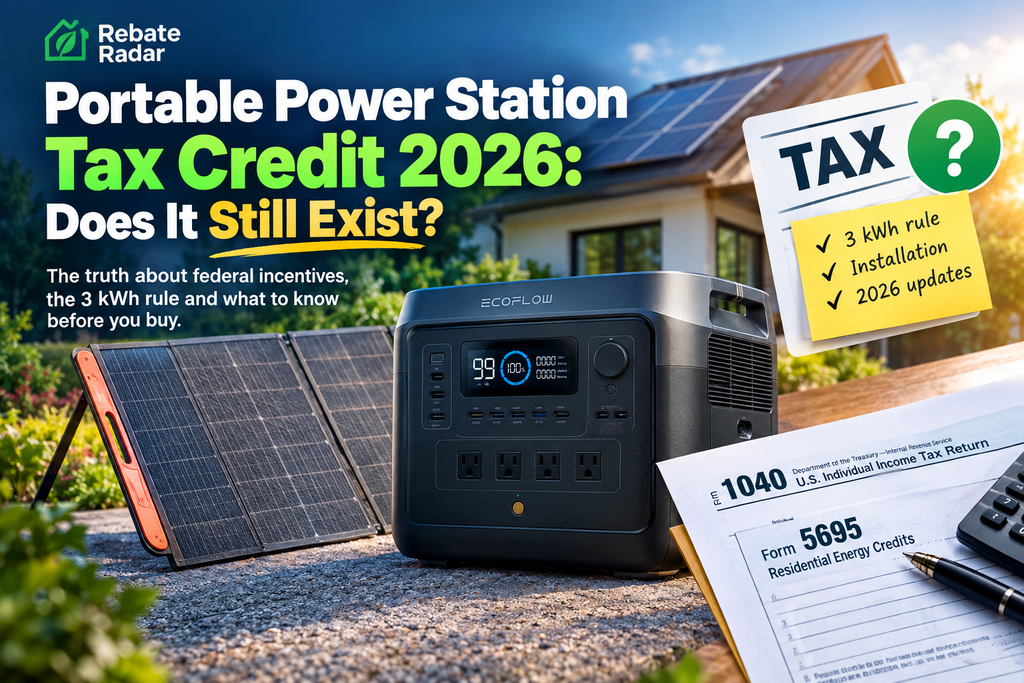
Portable Power Station Tax Credit 2026: Does It Still Exist?
Can an EcoFlow, Jackery, Bluetti, Anker or other portable power station qualify for a federal tax credit in 2026? Here’s what changed, what the old 30% battery credit covered, and what buyers should know now.
Is there a 30% federal portable power station tax credit in 2026?
No — not under the former residential Clean Energy Credit.
The federal Residential Clean Energy Credit under IRC Section 25D was available for qualifying residential battery storage, including storage with at least 3 kWh of capacity, but the IRS now states that the credit is not available for expenditures made after December 31, 2025.
Important: This page has been updated to reflect the IRS’s current 2026 information. Tax rules can change and individual eligibility depends on facts not covered by a general article. Always verify the applicable tax year and requirements with the IRS or a qualified tax professional.
What You’ll Learn
Portable power stations have evolved far beyond small camping batteries. Today’s high-capacity systems can store several kilowatt-hours of electricity, deliver substantial inverter output and provide backup power for refrigerators, internet equipment, lights, electronics and other household loads.
That growth has created a huge amount of interest around one search query: portable power station tax credit 2026. Buyers want to know whether a $2,000–$5,000 EcoFlow, Bluetti, Jackery, Anker or similar system can reduce their federal tax bill.
The confusion comes partly from older articles that were written when the federal Residential Clean Energy Credit was still available. Battery storage became an eligible category under Section 25D, and the IRS specified a minimum capacity of 3 kilowatt-hours. But the law changed before 2026.
This guide separates the historical rules from the current 2026 situation, so you can understand exactly what the old 30% credit covered and why you should be careful with websites that still advertise it as a current portable power station rebate.
The former 30% residential battery tax credit ended for new 2026 expenditures
The IRS states that the Residential Clean Energy Credit equals 30% of qualifying costs for eligible property installed during the applicable period from 2022 through December 31, 2025. The IRS also states that the credit is not available for property placed in service after December 31, 2025.
That means the question is no longer simply “Does my battery have 3 kWh?” For a new purchase in 2026, the first question is whether the federal residential credit is available at all. Under the current IRS guidance, the former §25D residential credit does not apply to expenditures made after the 2025 deadline.
The key distinction
Qualifying battery storage could potentially fall under the 30% Residential Clean Energy Credit if all applicable requirements were satisfied.
The former §25D residential credit is not available under the current IRS guidance for expenditures after December 31, 2025.
What Was the 30% Battery Tax Credit?
Before the 2026 termination, Section 25D provided a Residential Clean Energy Credit for qualifying residential clean-energy property. Battery storage technology was added as an eligible expenditure beginning in 2023.
The credit generally equaled 30% of qualifying costs during the applicable period. Unlike some energy-efficiency credits, the Residential Clean Energy Credit did not have the same type of annual dollar cap for battery storage.
The important point for battery shoppers was the capacity requirement: the IRS specified that qualifying battery storage technology had to have a capacity of at least 3 kilowatt-hours.
The 3 kWh rule was real — but it was not a permanent 2026 credit
This distinction is extremely important. The IRS’s 2025 Form 5695 instructions asked whether qualified battery storage technology had a capacity of at least 3 kWh. If the answer was no, the battery-storage credit could not be claimed under that form for that tax year. That historical requirement should not be confused with a new 2026 federal rebate.
Watts vs. Watt-Hours: The Battery Specification That Matters
Even though the former federal battery credit has ended for new 2026 expenditures, understanding battery specifications remains essential when comparing portable power stations.
Watts = Power Output
Watts describe how much electrical power the inverter can deliver at a given moment. This helps determine which appliances the system can operate simultaneously.
Watt-Hours = Stored Energy
Watt-hours describe how much energy the battery can store. More usable capacity generally means more potential runtime for a given electrical load.
Did Portable Power Stations Qualify Under the Former 25D Rules?
This is where the internet has become especially confusing. The IRS language referred to battery storage technology installed in connection with a qualifying home and having at least 3 kWh of capacity. It did not create a consumer-facing list saying “EcoFlow qualifies” or “Jackery qualifies.”
Therefore, brand name alone was never the correct test. The relevant questions involved the property, its capacity, its installation and the applicable tax year.
A better way to evaluate a battery
EcoFlow, Bluetti, Jackery & Anker: Does Brand Determine Tax Eligibility?
No. A brand name by itself does not establish federal tax eligibility. Capacity, installation, use, tax year and the applicable law matter much more than whether the unit carries an EcoFlow, Bluetti, Jackery, Anker, Zendure or another logo.
| Brand / Category | What to Check | 2026 Federal §25D Status |
|---|---|---|
| EcoFlow | Capacity, installation and exact tax year | Not available for new post-2025 expenditures |
| Bluetti | Capacity, installation and exact tax year | Not available for new post-2025 expenditures |
| Jackery | Capacity, installation and exact tax year | Not available for new post-2025 expenditures |
| Anker SOLIX | Capacity, installation and exact tax year | Not available for new post-2025 expenditures |
| Other battery brands | Evaluate the same factors | Not available under former §25D for new post-2025 expenditures |
This table describes the federal §25D status for new 2026 expenditures. It does not mean these products are ineligible for every possible state, utility, commercial or other incentive.
What the 3 kWh Rule Meant Under the Former Credit
The 3 kWh threshold is still frequently quoted online because it was an actual IRS requirement for qualifying battery storage under §25D.
Historical example
Suppose a qualifying residential battery-storage system had a capacity of 3.5 kWh and met all other applicable requirements during a year when §25D was available.
This is a historical illustration of the former 30% calculation. It should not be interpreted as a new 2026 federal credit.
What About Expansion Batteries and Modular Systems?
Many portable power stations can be expanded by adding external battery modules. This is useful for backup planning because it can increase total stored energy.
However, buyers should not assume that simply plugging together two consumer products automatically creates a tax-qualified system. Under the former §25D rules, the IRS required qualifying battery storage technology to meet the applicable capacity and residential installation requirements. The exact tax treatment of a particular configuration can depend on the facts.
Treat expansion capacity as an equipment-selection question first—not as proof of a federal tax credit. If a seller claims that adding an expansion battery automatically creates a 30% federal credit in 2026, ask for the specific current IRS authority supporting that claim.
Does a Portable Power Station Need to Be Connected to the Home?
Installation matters because the former residential credit was designed around qualifying energy property installed in connection with a qualifying home. A portable battery sitting in an RV, boat or camping site should not simply be treated as residential clean-energy property because it happens to have a large battery.
Camping / RV use
Do not assume mobile recreational use qualifies as residential energy property.
Home backup
A properly designed home backup installation is a different configuration and should be evaluated under the applicable rules.
2026 reality
Even proper home installation does not revive the expired §25D federal residential credit for a new 2026 expenditure.
Do Solar Panels Change the Tax-Credit Situation?
Solar panels and batteries were both categories of qualifying property under the former Residential Clean Energy Credit, subject to their respective requirements and the applicable tax year.
But adding solar panels to a new 2026 residential project does not restore the old §25D credit. The IRS’s current guidance states that the residential clean energy credit is not available for expenditures made after December 31, 2025.
Important distinction
Solar + battery can still be an excellent energy system for other reasons—energy production, backup power, electricity management and potential state or utility programs—but don’t build a 2026 purchase around an assumption that the former 30% residential federal credit is still available.
What About Section 48E in 2026?
Some articles have begun pointing consumers toward Section 48E after the expiration of §25D. This requires careful explanation.
The Clean Electricity Investment Credit under §48E is a separate federal investment tax credit for qualifying clean-electricity facilities and energy-storage technology. The IRS describes it as a tech-neutral credit with a base amount and potential increases under specific requirements.
Do not confuse §48E with the old homeowner battery credit
Section 48E is not simply a replacement 30% consumer rebate for someone buying a portable power station for a house. Eligibility depends on the structure of the investment, the taxpayer, the facility and other statutory requirements.
If a website tells consumers that “Section 48E means your EcoFlow or Bluetti gets 30% back in 2026,” treat that claim cautiously and ask for the specific tax authority supporting the individual transaction.
State & Utility Rebates May Still Be Worth Investigating
The end of the federal residential §25D credit does not automatically mean that every battery incentive disappeared. States, utilities and local programs can have their own rules, eligibility requirements and funding structures.
Incentives can have income, location, equipment, installation, utility-territory or funding restrictions. Always verify the current program directly before purchasing equipment.
How to Evaluate a Portable Power Station in 2026
Without relying on an outdated federal tax-credit headline, buyers should evaluate the actual value of the system.
Comparing portable battery backup systems?
Portable power stations can still be useful in 2026 for emergency backup, camping, mobile work, outages and home energy resilience. Just make your purchase decision based on the equipment’s specifications, warranty and total value—not on an outdated federal 30% credit claim.
Affiliate disclosure: Rebate Radar may earn a commission from qualifying purchases through certain affiliate links, at no additional cost to you. Affiliate relationships do not determine our editorial conclusions.
Explore Battery Backup Options →Continue Your Home Energy Research
If you’re researching portable power stations, batteries, solar and home backup, these related Rebate Radar guides can help you compare the bigger picture.
7 Portable Power Station Tax-Credit Mistakes to Avoid in 2026
Portable Power Station Tax Credit 2026 — FAQ
Is there a federal 30% portable power station tax credit in 2026?
Not under the former Residential Clean Energy Credit. The IRS states that the §25D credit is not available for expenditures made after December 31, 2025.
Did batteries previously qualify for a 30% federal tax credit?
Yes. Qualifying battery storage technology was an eligible expenditure under §25D during the applicable years before the credit’s termination.
What was the 3 kWh battery tax-credit rule?
Under the former Residential Clean Energy Credit rules, battery storage technology had to have a capacity of at least 3 kilowatt-hours to qualify as battery storage technology for the credit.
Does a 3 kWh EcoFlow qualify for a federal credit in 2026?
A 3 kWh capacity does not by itself create a new 2026 §25D credit. The former residential credit is not available for expenditures made after December 31, 2025.
Does Bluetti qualify for a 30% tax credit in 2026?
There is no general 30% §25D residential credit for a new 2026 Bluetti purchase under the current IRS guidance. Specific state, utility or other incentive programs may have different rules.
Does Jackery qualify for a federal tax credit in 2026?
A Jackery purchase does not automatically qualify for the former 30% residential credit in 2026. The §25D residential credit ended for expenditures after December 31, 2025.
Can I still claim a 2025 battery tax credit when filing in 2026?
Potentially, if the qualifying expenditure was made under the applicable 2025 rules and all requirements were satisfied. The IRS says the credit is claimed for the tax year in which the property was installed, rather than simply when it was purchased.
Is Section 48E the new 30% home battery credit?
No. Section 48E is a separate Clean Electricity Investment Credit with its own eligibility requirements for qualifying facilities and investments. It should not be treated as an automatic replacement for the residential §25D credit.
Are there still battery rebates in 2026?
Some state, utility and local programs may still provide incentives for energy storage or related equipment. Availability varies by location and program.
Should I buy a portable power station because of a tax-credit advertisement?
No purchase should be based solely on an advertised tax credit. Verify the current government rules, the tax year, equipment specifications and any state or utility incentive before buying.
Don’t Buy a Battery Based on an Outdated Tax-Credit Claim
Portable power stations can still be valuable home-backup equipment in 2026. But the former 30% federal Residential Clean Energy Credit under §25D is no longer available for new expenditures after December 31, 2025.
The old 3 kWh rule was real, but it belonged to the former credit. Today’s buyer should instead compare battery capacity, output, warranty, installation, solar compatibility, utility programs and total cost.
Check current federal rules, investigate your state and utility incentives, and get the full installed price in writing.
More Rebate Radar Guides
Official Sources & 2026 Verification
Because tax law changes can make older energy articles misleading, Rebate Radar recommends verifying the applicable tax year against current IRS guidance before claiming any federal incentive.
- Internal Revenue Service: Residential Clean Energy Credit — current §25D status, eligible property and battery-storage requirements.
- Internal Revenue Service: Form 5695 and instructions for residential energy credits.
- Internal Revenue Service: FAQs regarding the One Big Beautiful Bill Act and the accelerated termination of §25D.
- Internal Revenue Service: Clean Electricity Investment Credit (§48E) information.
Editorial methodology: This article distinguishes current 2026 federal rules from historical 2025 rules. Product names are used for informational comparison only and do not imply IRS approval or tax eligibility.
Tax disclaimer: This article is for general educational purposes and is not tax, legal, financial, accounting or electrical advice. Federal and state tax laws, utility programs and equipment eligibility can change. Individual tax treatment depends on your circumstances. Consult a qualified tax professional and verify current IRS guidance before claiming any credit or incentive.
© 2026 Rebate Radar. All rights reserved.