
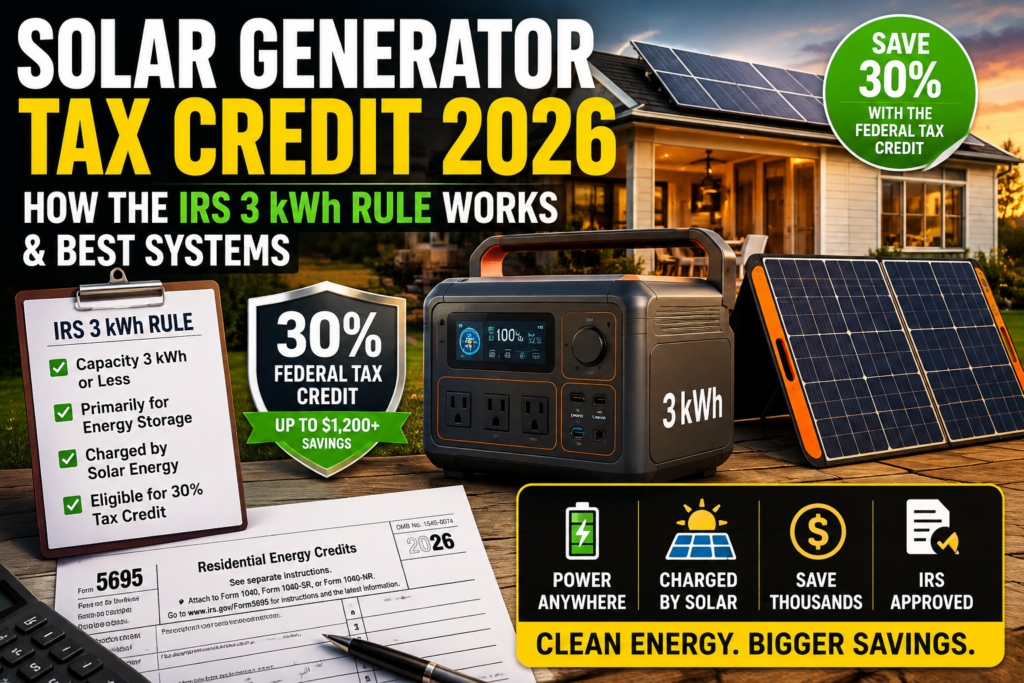
Solar Generator Tax Credit 2026: What the IRS 3 kWh Rule Really Means
A current guide to the federal Residential Clean Energy Credit, battery-storage eligibility, the 3 kWh threshold, Form 5695, portable power stations, documentation, and what changed for property placed in service during 2026.
⚡ Executive Summary: The 2026 Rules at a Glance
The most important distinction is between the eligibility rules that applied to Residential Clean Energy Credit property and the current availability of that credit in 2026.
- §25D is no longer a new 2026 residential credit. The IRS says the Residential Clean Energy Credit is not available for property placed in service after December 31, 2025.
- The 3 kWh battery threshold is real. IRS Form 5695 instructions state that qualified battery storage technology must have a capacity of at least 3 kilowatt-hours.
- Buying a product is not the same as placing it in service. The federal residential credit is tied to the tax year in which qualifying property is installed/placed in service.
- A portable power station is not automatically a qualifying battery-storage system. Product marketing language such as “solar generator” does not by itself establish federal tax eligibility.
- 2026 buyers should investigate state, utility and local programs. Federal §25D status does not eliminate other potential incentives, rebates, demand-response programs or battery programs.
Use these related tools and guides to evaluate the broader economics of solar, battery storage and home energy upgrades.
What Changed for the Solar Generator Tax Credit in 2026?
A large amount of online content still describes the Residential Clean Energy Credit as a continuing 30% federal benefit through the early 2030s. That description reflects the law before the 2025 legislative changes and is no longer an accurate description of the federal residential rule for new property placed in service in 2026.
The IRS now states that the Residential Clean Energy Credit applies to qualifying property installed from 2022 through December 31, 2025, and that the credit is not available for property placed in service after December 31, 2025.
If you purchase a portable power station, battery system or solar equipment during 2026, you should not assume that §25D provides a 30% federal credit. Instead, investigate the currently available state, utility, local and other applicable incentive programs and verify federal treatment with a qualified tax professional.
The IRS 3 kWh Rule: Why Battery Capacity Matters
Battery storage technology was added as a qualifying expenditure under the Residential Clean Energy Credit beginning in 2023. The IRS instructions for Form 5695 specify that qualified battery storage technology must have a capacity of at least 3 kilowatt-hours.
This threshold is important because it separates a qualifying battery-storage requirement from the much broader consumer category of portable electronics and backup devices. However, meeting the 3 kWh threshold does not by itself create a 2026 federal tax credit. The timing rules for §25D must also be satisfied.
“3 kWh” is an eligibility specification for qualifying battery storage under §25D. It should not be interpreted as “any 3 kWh portable power station automatically receives a 30% federal credit in 2026.”
Solar Generator vs. Home Battery: Are They the Same Thing?
One of the biggest problems with the phrase “solar generator tax credit” is that “solar generator” is primarily a consumer-market term. It can describe everything from a small portable power station to a large modular battery system connected to a home.
Portable Power Station
A battery-powered device with an inverter, outlets, charging electronics and sometimes solar-input capability. Federal tax treatment cannot be determined solely from the marketing name or watt-hour rating.
Qualified Battery Storage Technology
For purposes of §25D, the IRS specifically addresses battery storage technology with a minimum capacity of 3 kWh. Other requirements, timing rules and residential-use conditions also matter.
Therefore, homeowners should retain manufacturer specifications, invoices and installation documentation and should avoid relying on an Amazon listing, retailer description or manufacturer advertisement as the final authority for tax eligibility.
How the 30% Residential Clean Energy Credit Worked
For qualifying property installed during the years in which §25D applied, the Residential Clean Energy Credit generally equaled 30% of qualifying costs. The IRS identified qualifying categories including solar electric property, solar water heating, small wind energy property, geothermal heat pump property, fuel cells and battery storage technology.
| Example | Qualifying Cost | Historical 30% Calculation | Important 2026 Note |
|---|---|---|---|
| Qualifying battery storage | $3,000 | $900 | Do not apply this calculation automatically to new 2026 property. |
| Qualifying solar electric property | $10,000 | $3,000 | Historical §25D example; timing rules are critical. |
| Qualifying battery + solar property | $15,000 | $4,500 | Historical illustration only, not a promise of a 2026 federal credit. |
These calculations illustrate how the 30% rate operated under the applicable §25D rules. They are not an estimate of a federal credit available for a new 2026 installation.
Battery Storage Eligibility: The Full Checklist
The 3 kWh requirement is only one part of the analysis. A more useful way to evaluate a potential claim is to examine the entire eligibility chain.
Identify the exact equipment
Record the manufacturer, model number, battery capacity, inverter specifications, expansion modules and whether the system is designed for residential energy storage.
Verify the battery capacity
Under the IRS instructions, qualifying battery storage technology must have a capacity of at least 3 kWh.
Determine when the property was placed in service
The timing of installation/placement in service matters. A purchase date alone does not establish the tax year in which the residential credit is claimed.
Determine whether the residence qualifies
The IRS rules address qualifying residences located in the United States and used as a residence by the taxpayer.
Separate federal and non-federal incentives
State, utility, local and demand-response incentives should be evaluated separately from federal income-tax credits.
Keep supporting documentation
Preserve receipts, product specifications, installation records and other documentation that supports the equipment and the timing of the expenditure.
Form 5695: How the Residential Energy Credit Was Reported
Form 5695, Residential Energy Credits, is the IRS form associated with residential clean-energy credits. For a qualifying year, taxpayers use the applicable form and instructions for that tax year rather than relying on an older version.
Residential Clean Energy Credit
The form identifies qualifying solar electric, solar water heating, small wind, geothermal, battery storage and fuel-cell expenditures as applicable to the tax year.
Lines 5a & 5b
IRS instructions state that battery storage technology must have a capacity of at least 3 kWh to be included as qualified battery storage technology.
IRS forms and instructions can change by tax year. If a taxpayer is preparing a return involving qualifying property placed in service in an earlier year, the applicable year’s Form 5695 and instructions should be used.
Documentation You Should Keep for a Battery Storage Purchase
The IRS recommends retaining purchase receipts and installation records because supporting documentation may be needed to substantiate a credit if the return is examined.
Itemized Invoice
Keep the invoice showing the exact model, purchase date, quantity and amount paid.
Manufacturer Documentation
Save the manufacturer’s technical specifications showing the battery’s rated capacity and configuration.
Installation Records
Retain installation invoices, contractor documentation and dates when applicable.
Tax Return Records
Keep copies of the applicable tax forms and calculations supporting the claim for the relevant tax year.
What Should You NOT Assume Qualifies?
| Purchase | Automatic Federal Credit? | Why? |
|---|---|---|
| Small portable power station | No automatic eligibility | Product name alone does not establish §25D qualification. |
| 3+ kWh battery system | Not automatically in 2026 | 3 kWh is a battery-storage eligibility specification, but §25D timing rules also apply. |
| Solar panel kit | Not automatically in 2026 | Federal residential credit availability depends on the applicable tax-year rules. |
| Generator powered by gasoline | No | It is not the same category as qualifying clean-energy property under §25D. |
| Used battery system | Generally no under §25D | The IRS states that used previously owned clean-energy property is not eligible. |
If the Federal 30% Credit Is Gone for New 2026 Property, What Should Homeowners Check?
The end of the federal residential §25D credit for new post-2025 property does not mean that every battery, solar or energy-storage project has no financial incentive. The correct strategy in 2026 is to look beyond one federal tax-credit percentage.
State-Level Incentives
Some states may offer tax benefits, rebates, grants, performance programs or other clean-energy incentives. Eligibility varies significantly by state.
Utility Battery Rebates
Electric utilities may offer battery incentives, demand-response programs or compensation for allowing storage to participate in grid services.
Virtual Power Plants
A battery can potentially generate value by participating in a utility or aggregator program that coordinates distributed energy resources.
City & Municipal Programs
Local programs may exist independently of federal tax credits and can have their own eligibility requirements, funding limits and application deadlines.
Could a Battery Still Make Financial Sense in 2026?
Yes. A battery’s economics do not depend exclusively on a federal tax credit. Depending on location and utility structure, homeowners may evaluate backup-power value, time-of-use bill savings, demand-response payments, VPP compensation, solar self-consumption and resilience.
🔋 Think Beyond the Tax Credit
A battery can have multiple potential value streams:
- Backup power during grid outages
- Solar energy shifting from daytime to evening
- Potential time-of-use bill optimization
- Potential utility demand-response participation
- Potential Virtual Power Plant compensation
- Reduced reliance on grid electricity during selected periods
Learn more in our dedicated Virtual Power Plants 2026 guide .
Common Battery & Solar Generator Configurations
Consumers often compare systems by total watt-hours, inverter output and expandability. These are useful technical metrics, but they should not be confused with federal tax eligibility.
1–2 kWh Power Station
Useful for electronics, refrigeration and selected emergency loads, but below the 3 kWh battery-storage threshold specified by the historical §25D rules.
3–5 kWh System
Provides substantially more energy storage and reaches the historical 3 kWh threshold, although that threshold alone does not create a new 2026 federal credit.
5–10+ kWh
Better suited to longer outages and larger critical-load strategies, especially when paired with solar generation or home energy management.
Home Battery System
Permanently installed storage can support larger electrical loads and may interact with utility programs, solar systems and home energy-management equipment.
Solar + Battery: Evaluate the Entire Energy System
A battery should not be evaluated in isolation. For many homeowners, the important question is how solar generation, battery capacity, electricity rates, household consumption and utility rules interact.
| Factor | Why It Matters |
|---|---|
| Annual electricity usage | Determines how much energy the household actually consumes. |
| Electricity rate | Higher electricity costs can change the potential value of solar and storage. |
| Time-of-use pricing | Battery charging and discharging may be more valuable when rates vary by time. |
| Solar production | Determines how much excess solar energy could potentially be stored. |
| Battery usable capacity | Determines how much energy can actually be shifted or used during an outage. |
| Utility program | VPP and demand-response programs can create additional potential value. |
| Upfront project cost | Determines the amount of capital that must be recovered through savings and incentives. |
You can compare the broader project economics using the Solar Savings Calculator 2026 and Solar Payback Calculator 2026 .
Check State & Local Solar Incentives in 2026
Because federal §25D is no longer available for new post-2025 residential property, state and utility research becomes even more important for 2026 projects.
Solar Incentives by State
Start with your state to identify potential incentive categories and programs.
Check Solar Incentives by State →Solar Rebate Eligibility
Explore the factors that can affect whether a homeowner may qualify for an incentive.
Check Solar Rebate Eligibility →Home Energy Savings
Compare solar, battery, heat pump, EV and efficiency opportunities in one workflow.
Calculate Home Energy Savings →Portable Power Station Tax Credit
Review the broader federal-tax discussion surrounding portable power stations and battery storage.
Read the Guide →Frequently Asked Questions About Solar Generator Tax Credits in 2026
Is there a 30% federal solar generator tax credit for new purchases in 2026?
Is the 3 kWh battery rule real?
Does a 3,000 Wh portable power station automatically qualify?
Can renters ever qualify for residential clean-energy credits?
Does buying two separate 2 kWh batteries equal 4 kWh for the IRS threshold?
Can I still receive state or utility battery incentives in 2026?
Does the IRS require Form 5695?
What records should I keep?
🔋 The 2026 Strategy Is Different
The biggest mistake is searching for a “30% solar generator tax credit” without checking the tax year. In 2026, homeowners should evaluate the full picture: federal status, state incentives, utility rebates, VPP programs, electricity rates, battery economics and actual project payback.
Check Solar Incentives by State →Explore More Rebate Radar Energy Resources
Sources & Methodology
This article is based primarily on current Internal Revenue Service guidance and the applicable IRS Form 5695 instructions. Federal tax rules can change, and tax treatment depends on the taxpayer’s facts, the equipment and the tax year.