
Smart Thermostat Rebates 2026: What Homeowners Can Actually Get
Discover how utility rebates, energy-efficiency programs and qualifying discounts can reduce the cost of a smart thermostat — and what to check before you buy.
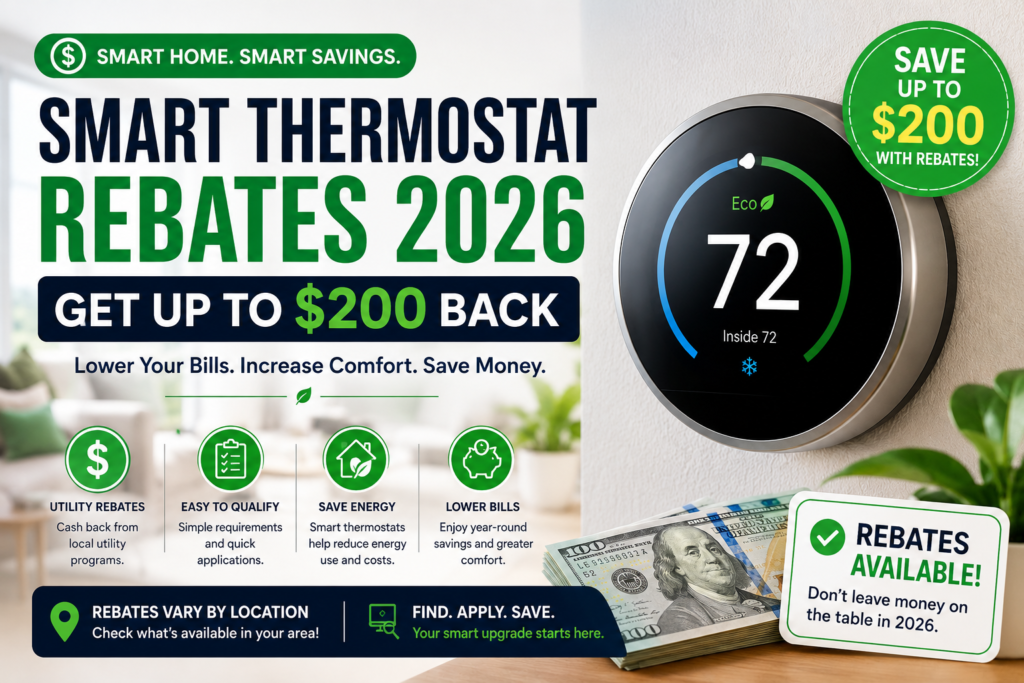
Smart thermostat rebates in 2026 are generally location-dependent. Your available incentive can depend on your ZIP code, utility, thermostat model, HVAC system, purchase method and program rules. The safest strategy is to identify the rebate first, verify the exact qualifying product second, and purchase third.
Looking for smart thermostat rebates in 2026? You may be able to reduce the cost of a new ENERGY STAR certified thermostat through a utility rebate, local energy-efficiency program, point-of-sale discount, or another incentive available in your area. The important part is knowing where to look and understanding the requirements before you buy.
Smart thermostats are one of the simplest ways to modernize the way a home controls heating and cooling. Instead of manually changing the thermostat throughout the day, a smart model can use schedules, temperature sensors, occupancy information, remote controls and other features to help manage the home’s heating and cooling system.
That matters because heating and cooling can represent a substantial portion of household energy use. According to ENERGY STAR’s smart thermostat guidance , almost half of the average American household’s annual energy bill is associated with heating and cooling.
The thermostat itself is not a major electricity consumer. Its value comes from controlling equipment that can consume much more energy, including furnaces, central air conditioners and heat pumps. That is also why utilities may have an incentive to encourage customers to install qualifying smart thermostats.
How Do Smart Thermostat Rebates Work?
Unlike a traditional product coupon, an energy rebate is usually tied to a specific efficiency program. The organization providing the incentive may be your electric utility, natural gas utility, municipal utility, state energy agency, or another program administrator.
The amount you can receive can vary significantly. Some programs offer a fixed dollar rebate after you purchase and install an eligible thermostat. Others provide an immediate discount when you purchase through an approved marketplace or participating contractor.
ENERGY STAR’s current Rebate Finder lists smart thermostat incentives from participating utilities and energy-efficiency programs.
Important: There is no single nationwide smart thermostat rebate that every homeowner automatically receives. Your ZIP code, utility provider, thermostat model, home heating system and program rules can all affect whether you qualify.
3 Ways You May Save on a Smart Thermostat
Utility Rebates
Your electric or natural gas utility may offer a direct rebate for purchasing and installing an eligible smart thermostat.
Point-of-Sale Discounts
Some programs reduce the purchase price immediately through an approved retailer, utility marketplace or participating contractor.
Energy-Efficiency Programs
Smart thermostats may also be included in broader HVAC, demand-response or home-energy efficiency programs.
Utility Rebates
Utility rebates are one of the most common ways homeowners can save money on a smart thermostat in 2026. Your electricity or natural gas provider may offer an incentive because smarter temperature control can help reduce energy consumption and, in some programs, support broader demand-management goals.
Some utilities offer a traditional rebate where you purchase the thermostat first and submit an application afterward. Others offer a point-of-sale discount that reduces the price before you complete the purchase.
Point-of-Sale Discounts
A point-of-sale discount can be particularly attractive because you may not have to wait for a reimbursement check or electronic payment. Instead, the discount is applied during the purchase through an approved utility marketplace, retailer, contractor or distributor.
A product being marketed as a “smart thermostat” does not automatically mean it qualifies for every utility incentive. Programs can specify particular models, efficiency certifications, installation conditions, customer types or account requirements.
Why ENERGY STAR Matters When Choosing a Smart Thermostat
One of the best places to begin your research is ENERGY STAR. The organization maintains information about certified smart thermostats and provides tools for finding available rebates.
ENERGY STAR explains that certified smart thermostats can include features such as learning capabilities, occupancy sensors and remote temperature control.
Before buying a thermostat simply because it has a rebate attached to it, compare the model’s features with your existing HVAC equipment. Compatibility is one of the most important considerations.
Before You Buy, Check These Five Things
- Your utility: Confirm which company supplies electricity or natural gas to your property.
- Your ZIP code: Incentives can vary between neighboring utility territories.
- The exact thermostat model: Verify the model number rather than assuming every product from the same brand qualifies.
- HVAC compatibility: Make sure the thermostat works with your furnace, air conditioner, heat pump or other heating and cooling equipment.
- Application requirements: Check deadlines, purchase requirements, installation dates and documentation requirements before submitting your rebate claim.
Are Smart Thermostats Eligible for a Federal Tax Credit in 2026?
This is an important distinction when researching smart thermostat incentives. A utility rebate and a federal tax credit are not the same thing.
The federal Energy Efficient Home Improvement Credit previously covered certain qualifying home improvements, but the IRS states that the credit applies to qualifying property placed in service before December 31, 2025. Therefore, homeowners should not assume that buying a smart thermostat in 2026 automatically creates a new federal tax credit.
For current federal tax information, homeowners should consult the IRS Energy Efficient Home Improvement Credit guidance before relying on any tax-credit claim.
Rebate vs. tax credit: A utility rebate may reduce the purchase or installation cost directly, while a tax credit is claimed through the federal or state tax system when applicable law allows it.
How Much Can You Save With a Smart Thermostat Rebate?
There is no universal rebate amount for 2026. The actual savings depend on where you live and which utility or energy-efficiency program serves your property.
Current ENERGY STAR listings demonstrate how wide the range can be. Some participating programs advertise incentives around $40 to $50, while others list $75, $100, $200 or more depending on the customer, thermostat and program requirements.
That means a homeowner should not focus only on the advertised maximum. A better approach is to determine the incentive available at the property address and then compare the eligible thermostat’s purchase price with the rebate or discount.
Example: If an eligible thermostat costs $150 and your utility offers a $75 rebate, the effective equipment cost could be reduced to $75 before considering installation or other costs.
Where to Find Smart Thermostat Rebates in Your Area
The easiest starting point is your utility company’s website. Search for terms such as “smart thermostat rebate,” “thermostat incentive,” “energy efficiency rebates,” or “HVAC rebates.”
You can also use the ENERGY STAR Rebate Finder and filter for smart thermostats.
If you are researching several energy upgrades at the same time, our Energy Rebates 2026 guide can help you explore other categories of incentives.
Homeowners considering a broader energy-efficiency project can also review our Home Energy Rebates 2026 guide .
Who Qualifies for Smart Thermostat Rebates in 2026?
Smart thermostat rebate requirements can be surprisingly specific. Two homeowners living in the same city may not qualify for the same incentive if they receive electricity from different utilities or purchase different thermostat models.
In many cases, eligibility can depend on your utility account, service address, equipment type, thermostat model, purchase date, installation date or participation in a specific energy-efficiency program.
Some incentives are available to homeowners, while others may also be available to renters with permission from the property owner. Certain programs may have additional requirements for customers using specific heating and cooling equipment.
Check Your Utility Before Buying
One of the easiest mistakes to make is purchasing a smart thermostat first and searching for a rebate afterward. That can create a problem if the program requires you to purchase from an approved retailer, use a participating contractor, register the thermostat or apply before installation.
Start by identifying the electric or natural gas utility connected to your home. Then search the utility’s official website for its current thermostat incentive or energy-efficiency program.
You can also compare available programs through the ENERGY STAR Rebate Finder .
How to Apply for a Smart Thermostat Rebate
Identify your utility
Find the electricity or natural gas provider associated with the property.
Find the current incentive
Look for smart thermostat rebates, energy-efficiency incentives or qualifying HVAC programs.
Verify the exact model
Check the exact thermostat model or SKU when the program provides an eligibility list.
Read purchase requirements
Confirm whether the program requires an approved retailer, marketplace or participating contractor.
Install according to the rules
Follow applicable installation requirements and retain documentation.
Submit the application
Provide the requested information before the program deadline.
Keep your records
Save receipts, confirmation emails, model numbers and other documentation until the rebate has been processed.
What Can Cause a Smart Thermostat Rebate to Be Denied?
A rebate application can be rejected for reasons that have nothing to do with whether the thermostat is actually energy efficient. The program administrator generally has to verify that the purchase satisfies its published requirements.
Ineligible Model
The exact thermostat model may not appear on the program’s eligible product list.
Wrong Purchase Date
The purchase may fall outside the program’s qualifying dates.
Missing Documentation
Required proof of purchase, installation records or other documentation may not have been submitted.
Utility Eligibility
The applicant’s utility account or service address may not meet the program requirements.
Before purchasing: Always check the current terms of the specific rebate program. Incentive amounts, eligible products, deadlines and participating retailers can change during the year.
Can a Smart Thermostat Help Lower Energy Bills?
The potential savings come from better control of heating and cooling, rather than from the thermostat itself consuming substantially less electricity.
Smart thermostats can automate schedules, adjust temperatures when occupants are away and allow homeowners to control the thermostat remotely. Depending on the home, HVAC equipment, climate and behavior, those features may help reduce unnecessary heating and cooling.
However, there is no single guaranteed dollar amount that every household will save. A homeowner with an already optimized schedule may see a different result from someone who frequently leaves heating or air conditioning running when nobody is home.
This is why a rebate can be useful even when the energy savings alone are difficult to predict. Reducing the initial purchase cost lowers the amount a homeowner has to spend to make the upgrade.
Smart Thermostat Buying Tips Before You Claim a Rebate
A rebate should not be the only factor in choosing a thermostat. The best product is one that works with your HVAC system and provides features you will actually use.
Check HVAC Compatibility
Before buying, verify whether the thermostat supports your specific heating and cooling configuration. Some systems require a common wire or “C-wire,” while others can operate using alternative installation methods.
Compatibility can also depend on whether your home uses a conventional furnace and air conditioner, a heat pump, electric heating, dual-fuel equipment or another configuration.
Look at Remote Control and Scheduling Features
If you travel frequently or want to manage your home’s temperature while away, remote access can be useful. Scheduling features can also make it easier to avoid heating or cooling an empty home.
Consider Installation Requirements
Before purchasing, determine whether the installation requires a professional technician, additional wiring, an adapter or another component. An apparently inexpensive thermostat can become more expensive if installation requirements are overlooked.
Smart Thermostat Products Worth Comparing
If your utility offers a rebate, you may want to compare eligible thermostat options before purchasing. The following Amazon links are provided as convenient product-shopping options.
Always verify the current rebate eligibility of the exact model with your utility before purchasing.
Smart Thermostat Option
A smart thermostat can be worth considering when you want remote temperature control, scheduling and easier management of your home’s heating and cooling system.
Check compatibility with your HVAC equipment and verify whether the exact model qualifies for your local rebate before buying.
Affiliate disclosure: This is a paid affiliate link. As an Amazon Associate I earn from qualifying purchases.
Another Smart Thermostat Option
Comparing more than one model can help you find the right combination of compatibility, features and price.
Before purchasing, confirm that the thermostat works with your HVAC system and check your utility’s current list of qualifying products.
Affiliate disclosure: This is a paid affiliate link. As an Amazon Associate I earn from qualifying purchases.
Don’t Buy a Thermostat Solely Because It Has a Rebate
A $100 rebate may look attractive, but a rebate does not automatically make a product the best choice for your home.
Consider the total cost, compatibility, installation requirements, warranty, features and expected usefulness. A cheaper thermostat that does not work correctly with your HVAC system is not a good bargain, even if it technically carries an incentive.
Likewise, homeowners should be cautious with advertisements claiming that every household can automatically receive a large energy rebate. Energy incentives are generally dependent on specific program rules, and the available amount can change by location.
Smart Thermostat Rebates vs. Other Home Energy Incentives
A smart thermostat is only one possible energy-efficiency upgrade. Depending on where you live, your utility may offer additional incentives for heat pumps, water heaters, insulation, HVAC equipment, EV charging or other improvements.
If you are researching several upgrades at once, visit our Home Energy Rebates 2026 guide to explore other categories.
You can also use our Energy Rebates 2026 resource to continue researching available energy incentives.
How to Maximize Your Smart Thermostat Savings in 2026
A smart thermostat can be a relatively small home upgrade, but the potential savings can become more significant when you combine an available utility rebate, state incentive or other energy-efficiency program with the long-term benefits of better heating and cooling control.
Before buying a thermostat, however, it is worth looking beyond the sticker price. The best financial outcome usually comes from understanding which incentive programs are available in your area, whether your utility participates, whether the specific thermostat qualifies and whether there are installation or enrollment requirements.
Smart Thermostat Savings Strategy
- Check your electric or gas utility’s current incentive programs.
- Search the ENERGY STAR Rebate Finder .
- Confirm that the exact thermostat model qualifies.
- Check whether income, property or customer requirements apply.
- Look for purchase-date and installation-date restrictions.
- Save your receipt and proof of purchase.
- Keep installation documentation when required.
- Submit the rebate application before the deadline.
- Keep copies of your application and supporting documents.
Smart Thermostats Are Only One Part of Home Energy Efficiency
If your goal is to reduce household energy costs, a thermostat should be viewed as one component of a larger efficiency strategy. Heating, cooling, water heating, insulation, appliances, solar generation, batteries and electric vehicle charging can all affect household energy consumption.
Homeowners considering multiple upgrades may want to review our Home Energy Rebates 2026 guide to understand how broader home-energy programs work.
You can also use our Home Energy Rebates Calculator to explore potential savings from qualifying improvements.
These resources are particularly useful for homeowners who are planning several upgrades rather than making a single purchase.
Consider the Full Cost of an Energy Upgrade
A rebate can reduce the upfront cost of an energy-efficient product, but the rebate should not be the only factor in the purchasing decision. Homeowners should consider the purchase price, installation cost, compatibility, expected lifespan, energy savings, maintenance requirements and available incentives.
This is especially important when comparing a smart thermostat with larger energy projects. A thermostat may cost considerably less than a major HVAC upgrade, while the potential savings and incentive structure can be very different.
Homeowners considering a heat-pump water heater, for example, can compare available incentives in our Heat Pump Water Heater Rebates 2026 guide .
Don’t Confuse a Rebate With a Tax Credit
Another important distinction is the difference between a rebate and a tax credit. A rebate generally reduces the cost of an eligible purchase or installation, while a tax credit generally affects a taxpayer’s federal or state tax liability.
The rules, eligibility requirements and timing can be completely different. That means homeowners should not automatically assume that an advertised incentive is equivalent to a tax credit.
If you are researching multiple energy incentives, our guide to Solar Tax Credits vs. Solar Rebates explains the broader distinction.
Homeowners interested specifically in federal solar incentives can also explore our Solar Tax Credit 2026 guide .
What to Do After Installing a Smart Thermostat
Getting the thermostat installed is not necessarily the end of the process. If the incentive requires enrollment, documentation or participation in a utility program, make sure those steps are completed.
It is also useful to monitor your household’s energy consumption after the installation. A smart thermostat can provide scheduling and temperature-management features, but the actual savings depend on how the system is configured and how the household uses heating and cooling.
Avoid making aggressive temperature changes solely because an app displays an estimated savings figure. Actual results can vary based on weather, insulation, HVAC efficiency, household behavior and local energy prices.
Other Energy Upgrades Worth Researching
Once you have evaluated smart thermostat incentives, you may discover that other technologies can also qualify for programs or provide meaningful energy savings.
Homeowners considering electric transportation can review our EV Charger Rebates 2026 guide to learn more about incentives associated with home charging equipment.
If you are comparing charging equipment before purchasing, our Best Home EV Chargers 2026 guide provides another useful resource.
Homeowners interested in backup power can also research Home Battery Tax Credit 2026 and compare different battery technologies before making a major investment.
Explore More 2026 Energy Incentives
Continue researching solar, home energy upgrades, EV charging, batteries and other potential energy-saving opportunities with Rebate Radar.
The Smartest Order of Operations
Find the rebate first, verify the eligible product second, and purchase the thermostat third. That simple order can help prevent homeowners from buying a product that does not qualify for their local incentive.
If you are researching multiple home-energy upgrades, start with our Home Energy Rebates 2026 guide and then explore the specific incentive categories that apply to your project.
The Bottom Line for Smart Thermostat Rebates in 2026
Smart thermostat rebates can make an otherwise relatively simple home efficiency upgrade more affordable, but the value of a particular offer depends on the homeowner, location, utility and qualifying equipment.
The smartest approach is to research the incentive before purchasing, confirm the exact eligibility requirements, keep all required documentation and compare the total cost of the upgrade with the potential long-term energy savings.
Rebate programs can change, expire or introduce new requirements, so homeowners should always verify current terms with the relevant utility, state program administrator or other official program source before making a purchase or installation decision.
Pingback: Electricity Cost Calculator 2026 – See What Appliances Cost