
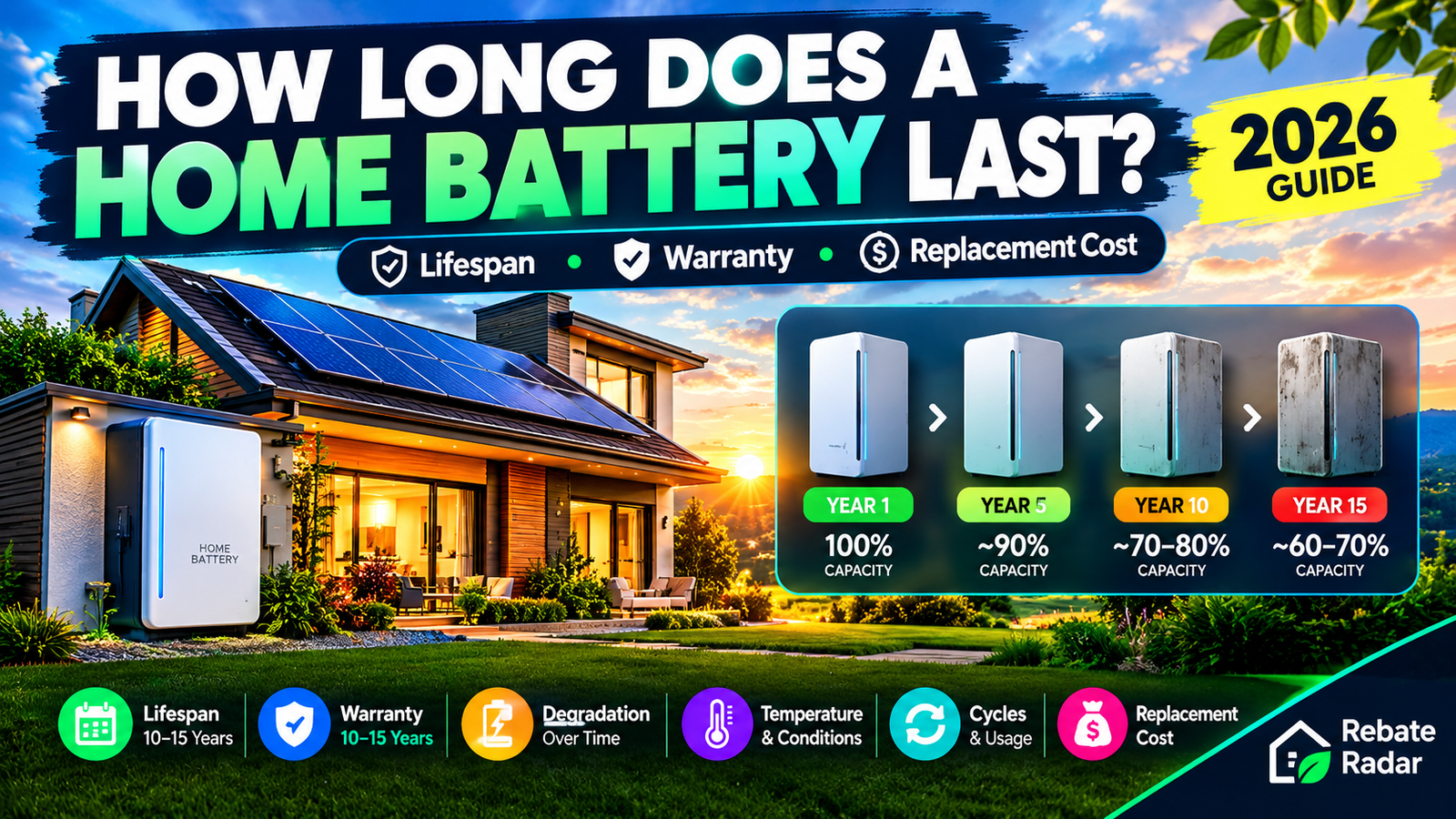
So, how long does a home battery actually last?
A modern residential battery is commonly planned around a roughly 10–15 year service life, but there is no universal expiration date that applies to every system. A battery normally does not go from “good” to “dead” on a specific birthday. Instead, usable capacity gradually declines as the battery experiences charging and discharging cycles, temperature exposure, calendar aging and normal chemical wear.
The most useful question is therefore not simply “When will my battery die?” but rather “How much usable capacity will my battery retain, and what does the manufacturer guarantee?”
Home battery storage has moved from a niche technology to a mainstream option for homeowners who want backup power, greater control over electricity use, or a way to store solar energy for later. But one question comes up almost immediately before making a purchase:
That question sounds simple, but it has several different answers. A battery can have a calendar life, a specified number of cycles, a manufacturer warranty, and a guaranteed minimum capacity at the end of that warranty period. Those are related, but they are not identical.
For example, a battery may continue operating after its warranty period while holding less usable energy than it did when new. Likewise, a battery that is heavily cycled every day can experience a different aging pattern from one used mainly during occasional outages.
This guide explains the factors that matter in plain English so you can evaluate battery systems more intelligently before signing an installation contract.
How Long Do Home Batteries Last?
For planning purposes, homeowners commonly encounter residential battery systems designed and warranted around a 10–15 year timeframe. Actual service life varies by model, operating conditions, chemistry, cycling behavior, installation environment and manufacturer warranty terms.
It is important not to interpret “10–15 years” as a guaranteed failure date. Battery degradation is generally gradual. The system may remain functional after the warranty period, but its usable storage capacity may be lower than when it was installed.
A useful planning range for many residential battery systems.
Aging usually means progressively less usable storage rather than instant failure.
Cycles, temperature and battery chemistry all matter.
Battery Lifespan vs. Battery Warranty
One of the biggest mistakes homeowners make is treating the warranty period as the exact life expectancy of the battery.
A warranty is a contractual promise subject to specific terms. It may specify a number of years, a maximum amount of energy throughput, a number of cycles, a minimum retained capacity, or a combination of those conditions.
A battery’s actual useful life can therefore be different from its warranty length. Always read the specific warranty for the exact model you are considering rather than assuming every residential battery has identical coverage.
Think of battery aging like this
New battery: maximum usable capacity according to the manufacturer’s specifications.
Mid-life battery: still useful, but with some natural capacity loss.
Older battery: potentially reduced runtime and less stored energy, depending on the model and operating history.
Replacement point: determined by economics, performance, warranty terms and the homeowner’s needs—not simply by reaching a particular birthday.
What Is Home Battery Degradation?
Battery degradation is the gradual reduction in the amount of energy a battery can store and deliver compared with its original condition.
This happens because rechargeable batteries undergo chemical and physical changes as they charge and discharge. The exact mechanism varies according to battery chemistry, cell design, operating temperature, charging behavior and other factors.
The important practical point is that degradation is usually gradual. A battery does not necessarily become useless the moment it reaches the end of a warranty period.
Why degradation matters
Imagine a battery originally designed to provide a certain amount of usable energy. Years later, it may still function normally but provide less usable energy during an outage.
That means homeowners should evaluate batteries using more than just the advertised capacity. Look at:
- Usable capacity
- Power output
- Warranty duration
- Guaranteed end-of-warranty capacity, when specified
- Throughput or cycle terms
- Operating temperature range
- Installation requirements
- Expected replacement economics
How Charging Cycles Affect Battery Life
A battery cycle generally refers to the process of using stored energy and then replenishing it. Manufacturers may define cycles differently in their technical documentation, so homeowners should not assume that every “cycle” means exactly the same thing across brands.
If a battery is cycled frequently, it may experience more cumulative wear than a battery that is rarely used. But cycle count is only one part of the equation.
Can produce substantial cumulative energy throughput over many years.
An outage-focused battery may cycle less often depending on the household.
How deeply the battery is discharged can influence aging and usable energy.
Does Battery Chemistry Affect Lifespan?
Yes. Battery chemistry is one of the factors that can influence durability, performance, thermal behavior, energy density and expected cycle life.
Modern residential storage systems use different lithium-based chemistries and system architectures. One chemistry frequently encountered in newer stationary storage products is lithium iron phosphate (LFP).
LFP is often discussed in residential storage because of its characteristics around cycle durability and thermal stability, but homeowners should not assume that the chemistry alone determines which battery will last the longest.
The better question is the complete system
Compare the chemistry, usable capacity, power output, warranty, thermal management, installation requirements, software, service network and manufacturer support together. A battery is not just a box of cells—it is a complete energy-storage system.
How Long Is a Home Battery Warranty?
Many residential battery products are sold with warranties measured in years, but the exact terms vary significantly between manufacturers and models.
Some warranties combine a time period with performance conditions. Others may incorporate energy throughput, cycling limits or minimum retained capacity. This is why a simple statement such as “10-year warranty” does not tell you everything.
Before buying, ask these warranty questions
- How many years is the warranty?
- Is there a throughput or cycle limit?
- Is minimum retained capacity guaranteed?
- What happens if capacity falls below the warranty threshold?
- Does the warranty cover labor?
- Who performs warranty service?
- What happens if the manufacturer changes its business model?
- Are software or connectivity requirements part of the warranty?
- Are extreme temperatures excluded or restricted?
- What installation conditions are required?
Does Heat Shorten Home Battery Life?
Temperature is an important consideration for battery storage. Excessive heat can affect battery performance and aging, which is why manufacturers specify operating and installation temperature requirements.
This matters especially in hot climates. A homeowner in Arizona, Texas, Florida or another warm region should pay attention to where the battery will be installed and how the system manages heat.
Installation location matters
Depending on the product, batteries may be installed indoors, outdoors, in garages, utility areas or other approved locations. The exact requirements vary by manufacturer and local electrical/building rules.
Never choose an installation location based only on convenience or aesthetics. Follow the manufacturer’s installation requirements and use a qualified installer familiar with residential energy-storage systems.
Battery Lifespan vs. Backup Runtime: They’re Not the Same
This distinction is extremely important.
When someone asks, “How long does a home battery last?”, they might mean two completely different things.
Meaning #1: Years
How many years the physical battery system can remain useful before replacement becomes necessary or economically sensible.
Meaning #2: Hours
How many hours the battery can power selected household loads during a specific outage.
Runtime depends on usable battery capacity, the electrical load being powered, system efficiency, weather, operating conditions and whether the battery can recharge from solar or the grid.
How Long Does a Solar Battery Last?
A solar battery is still a home battery, so the same fundamental aging principles apply. The presence of solar panels does not automatically make a battery last longer or shorter.
What solar can change is how the battery is used. A solar-plus-storage system may charge during the day and discharge at night, depending on the configuration and electricity plan. Some systems may also prioritize backup reserves.
If you’re comparing the economics of a battery installation, don’t evaluate the battery in isolation. Consider the relationship between solar production, household consumption, electricity rates, export compensation, battery capacity and backup requirements.
Related Rebate Radar guides
→ Home Battery Backup Cost 2026
→ Home Battery vs Generator 2026
Looking at Portable or Modular Battery Backup?
Not every homeowner needs a permanently installed whole-home battery. Depending on the situation, a portable or modular power station can be useful for selected appliances, electronics, emergency loads, camping, temporary backup or other applications.
One company readers may encounter while researching portable and battery backup equipment is BLUETTI. Product suitability depends on the specific model, required output, usable capacity, transfer setup and intended loads.
Affiliate disclosure: This is an affiliate link. Rebate Radar may earn a commission if you make a qualifying purchase through the link, at no additional cost to you.
Explore BLUETTI Backup Power Options →Product availability, specifications, pricing and warranties can change. Verify current details directly before purchasing.
How Long Does a Tesla Powerwall Last?
Tesla Powerwall is one of the best-known residential battery systems, but the same principle applies here: homeowners should look at the manufacturer’s current specifications and warranty rather than assume a universal expiration date.
When comparing Powerwall with alternatives, evaluate usable capacity, continuous power, backup configuration, warranty, installation requirements, software features and total installed cost.
For a broader comparison of residential battery options, see our guide: Tesla Powerwall Alternatives 2026: Home Batteries Compared .
How Much Does It Cost to Replace a Home Battery?
There is no single national replacement price that applies to every home battery. Replacement cost depends on the battery model, capacity, power electronics, labor, permitting, electrical work, site conditions and whether other components need to be replaced at the same time.
The replacement decision can also be different from the original installation decision. A homeowner may have an existing inverter, wiring, disconnects or other equipment that can potentially remain in service, while another installation may require substantial electrical work.
A replacement quote can include:
- New battery hardware
- Labor
- Electrical modifications
- Permitting and inspection
- Removal or disposal of old equipment
- Inverter or power electronics
- Communications equipment
- Commissioning and software configuration
Because costs vary so much, the safest approach is to obtain a current itemized quote rather than use a generic internet estimate as your personal budget.
Does the 30% Federal Battery Tax Credit Still Exist in 2026?
Do not automatically assume that a new home battery installed in 2026 qualifies for the former 30% federal Residential Clean Energy Credit.
Federal law changed the termination date for the Residential Clean Energy Credit under Section 25D. The IRS states that the credit is not allowed for expenditures made after December 31, 2025. Battery storage had previously been an eligible category beginning in 2023, subject to the applicable requirements.
This is particularly important because older solar articles, calculators and sales pages can still display the former 30% figure. Readers should verify tax information using current IRS guidance rather than relying on an old article or an installer’s outdated calculator.
What About State and Utility Battery Incentives?
Federal tax credits are only one part of the incentive landscape. States, utilities and local programs may offer rebates, demand-response payments, storage incentives or other programs.
However, these programs can have highly specific eligibility requirements. Some may require enrollment in a utility program, specific equipment, an approved installer, income qualification, a particular service territory or participation in grid-support programs.
That is why Rebate Radar does not recommend assuming that an incentive exists simply because a battery is marketed as “eligible for rebates.”
Before counting an incentive in your budget, verify:
- Current program status
- Application deadline
- Utility territory
- Eligible equipment
- Income requirements, if any
- Installation requirements
- Whether funds are still available
- Whether the program is a rebate, tax credit, bill credit or other incentive
How to Make a Home Battery Last Longer
You cannot completely stop battery aging, but good system design and proper operation can help avoid unnecessary stress.
🌡️ Manage Temperature
Follow the manufacturer’s temperature and installation requirements.
⚡ Use Proper Settings
Use manufacturer-approved operating modes and reserve settings.
🔧 Maintain the System
Keep firmware, monitoring and maintenance requirements current.
📋 Follow the Warranty
Operate and install the system according to manufacturer requirements.
Avoid making modifications to battery equipment yourself. Residential energy-storage systems involve high electrical energy and potentially hazardous conditions. Installation, service and repairs should be performed according to applicable codes and manufacturer instructions by appropriately qualified professionals.
Is a Home Battery Worth It If It Eventually Needs Replacement?
This is where the economics become more interesting than the simple lifespan question.
A battery can provide value through backup power, solar self-consumption, time-of-use electricity management, participation in certain utility programs and other applications. The value depends heavily on where you live and how the system is operated.
For a homeowner whose primary goal is emergency backup, the value may come from keeping refrigerators, medical equipment, internet equipment, lights or selected circuits running during outages.
For another homeowner, the financial case may depend more heavily on electricity rates, solar production and the difference between buying electricity from the grid and using stored energy.
Think in total cost of ownership
Instead of asking only “How much is the battery?”, consider:
- Purchase price
- Installation
- Financing costs
- Expected useful service period
- Warranty coverage
- Electricity savings or other benefits
- Backup value
- Potential replacement cost
- Available incentives
Home Battery Buying Checklist for 2026
If you’re comparing batteries right now, don’t let the largest capacity number on the product page make the decision for you.
| What to Compare | Why It Matters |
|---|---|
| Usable Capacity | Determines how much energy is actually available to your loads. |
| Power Output | Determines what appliances and loads can operate simultaneously. |
| Warranty | Shows the manufacturer’s contractual coverage and conditions. |
| Capacity Guarantee | Can be more informative than simply knowing the warranty duration. |
| Installation | Site conditions and electrical work can substantially affect total cost. |
| Service Network | A battery is a long-term system, so support matters after installation. |
10 Questions to Ask Before Signing a Battery Contract
- What is the exact battery model?
- What is the usable—not just nominal—capacity?
- What is the continuous power output?
- What does the warranty guarantee at the end of the warranty period?
- Is there a throughput or cycle limitation?
- Where will the battery be installed?
- How will the system perform during an outage?
- Can solar recharge the battery during an extended outage?
- What parts and labor are covered by warranty?
- What is the estimated future replacement cost?
Common Home Battery Mistakes to Avoid
1. Looking only at capacity
A larger battery is not automatically the best battery. Power output, warranty, usable capacity and system compatibility matter too.
2. Assuming every battery lasts exactly 15 years
Lifespan varies. Treat general ranges as planning information, not a guarantee for a specific product.
3. Ignoring installation conditions
Temperature, location and electrical requirements can affect system performance and installation cost.
4. Using an old tax-credit calculator
Federal clean-energy incentives changed. Always verify current rules before including an incentive in your financial calculations.
5. Forgetting future replacement
A battery is a long-term asset. Your financial comparison should account for what happens when the original system reaches the end of its useful economic life.
Continue Your Home Battery Research
Rebate Radar’s battery-storage guides cover different parts of the buying decision. Start with the question that matters most to you:
Frequently Asked Questions
How long does a home battery last?
Many residential batteries are planned around a roughly 10–15 year service timeframe, but actual lifespan depends on the model, chemistry, operating conditions, cycling and warranty terms.
How long does a solar battery last?
Solar batteries generally experience gradual capacity degradation. A commonly used planning range is around 10–15 years for many residential systems, but the exact expectation should come from the specific manufacturer’s specifications and warranty.
Do home batteries suddenly stop working after 10 years?
Not necessarily. Battery aging is generally gradual. A system can continue operating after a warranty period, although its usable capacity and performance may be reduced.
What causes home battery degradation?
Battery degradation can be affected by chemistry, charging and discharging behavior, temperature, calendar aging, cycle count and other operating conditions.
Does heat shorten battery life?
Temperature can affect battery performance and aging. Follow the manufacturer’s approved installation and operating temperature requirements, especially in hot climates.
How many cycles does a home battery last?
There is no single cycle number that applies to every home battery. Manufacturers may define cycle and throughput limits differently, so compare the exact warranty and technical documentation for the model you are considering.
How much does it cost to replace a home battery?
Replacement cost varies by battery, capacity, labor, electrical work, permitting and site conditions. A current itemized quote is more reliable than a generic national estimate.
Can a home battery last 20 years?
Some systems may remain operational beyond their original warranty period, but homeowners should not assume a 20-year service life or a particular retained capacity without manufacturer-specific evidence.
Is battery lifespan the same as backup runtime?
No. Lifespan refers to how many years the battery remains useful. Runtime refers to how long it can power selected loads during a particular outage.
Does the federal 30% battery tax credit apply to new batteries installed in 2026?
The federal Residential Clean Energy Credit under Section 25D was terminated for expenditures made after December 31, 2025. Always verify current IRS guidance before assuming a federal credit applies.
The Bottom Line
A home battery should be viewed as a long-term energy system rather than a product that simply “expires” on a specific date.
For many residential systems, a 10–15 year planning horizon is reasonable, but actual performance depends on the battery model, chemistry, cycling, temperature, installation conditions and warranty terms.
If you’re considering a battery in 2026, focus on usable capacity, power output, degradation, warranty coverage, installation cost and total cost of ownership—not just the advertised number of kilowatt-hours.
Sources & Verification
Rebate Radar recommends verifying tax, incentive, warranty and technical information against current primary sources before making a purchase or financial decision.
Pingback: EcoFlow DELTA Pro Ultra Vs Tesla Powerwall 3 (2026 Cost & Specs)