
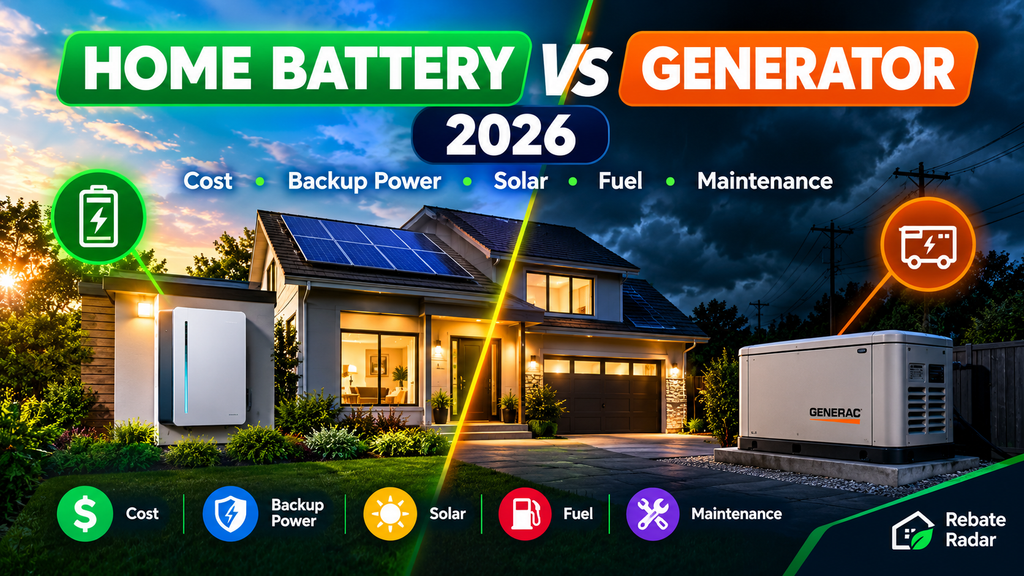
Home Battery or Generator: What Is the Difference?
A home battery stores electricity and can automatically supply your home when the grid fails. When paired with solar, it can recharge during the day and provide stored electricity at night or during an extended outage.
A generator produces electricity by burning fuel such as natural gas, propane or gasoline. Standby generators can start automatically during an outage, while portable generators generally require manual setup.
The important distinction is simple: a battery is primarily an energy-storage system, while a generator is an electricity-producing machine. Neither is automatically right for every household. The better fit depends on your outage pattern, electrical loads, solar plans, budget and tolerance for fuel and maintenance.
Home Battery vs Generator 2026: Why This Comparison Matters
A power outage can turn a normal evening into a serious inconvenience surprisingly fast. Refrigerators stop cooling, internet equipment goes offline, medical equipment may need emergency power, heating and cooling can become unavailable, and sump pumps or well pumps may stop operating.
That is why homeowners increasingly compare two very different backup technologies: home batteries and fuel-powered generators. Both can provide backup electricity, but they solve the problem in fundamentally different ways.
Energy storage systems can automatically disconnect from the grid and provide electricity to selected household circuits. The U.S. Department of Energy describes solar-plus-storage as a resilience technology because properly configured systems can continue supplying power after grid service is interrupted. 2
Generators, meanwhile, create electricity using an internal combustion engine. They can provide substantial power for long periods as long as the generator has an adequate fuel supply and is operated safely.
The decision therefore should not simply be based on which technology looks newer. You should compare capacity, power output, runtime, installation requirements, fuel availability, maintenance, noise, solar compatibility and total cost.
💰 Home Battery vs Generator Cost in 2026
Upfront prices vary substantially by system size, installation complexity, electrical upgrades and local labor. Treat the figures below as planning ranges, not quotes.
One of the biggest differences between a battery and a generator is the way the cost is structured.
A battery installation can involve the battery itself, inverter or integrated power electronics, backup gateway or transfer equipment, electrical work, permits and, in some cases, a critical-loads panel or additional service equipment.
EnergySage’s 2026 marketplace data puts a typical 13.5 kWh home battery at roughly $15,647 installed before incentives. Its published data also shows that whole-home backup can require multiple batteries and substantially higher installation costs. 3
| Backup Option | Typical Planning Range | What Changes the Price? |
|---|---|---|
| Portable generator | Hundreds to several thousand dollars | Output, fuel type, transfer equipment and accessories |
| Standby generator | Several thousand to $15,000+ | Generator size, fuel connection, electrical work and installation |
| Home battery | Often around $10,000–$20,000+ | Battery capacity, inverter, backup panel, installation and brand |
| Whole-home battery backup | Often $20,000–$40,000+ | Number of batteries, peak loads, HVAC, electrical service and controls |
For context, EnergySage’s current 2026 comparison places gas or propane generators at roughly $500–$5,000 for portable units and approximately $7,000–$15,000 for whole-home standby systems, while solar-plus-storage systems can run substantially higher upfront. 4
Do not compare a $1,000 portable generator directly with a $15,000 battery and conclude that one is automatically cheaper. They may provide dramatically different levels of automation, electrical output, runtime, noise, solar integration and whole-home coverage.
🔌 How Does a Home Battery Work During a Power Outage?
A home battery stores electrical energy for later use. Under normal conditions, the system can charge from the electrical grid, solar panels or both, depending on the equipment and configuration.
When the utility grid fails, properly configured backup equipment detects the outage and isolates the home from the grid. The battery then supplies electricity to the backup circuits.
This grid isolation is important. A normal grid-connected solar system is generally designed to shut down when utility power is lost. Solar panels alone therefore do not automatically mean that a home will have electricity during an outage.
The Department of Energy specifically notes that solar panels generally require properly configured inverters and energy storage to provide electricity independently during a grid outage. 5
What happens when the sun comes back?
With a properly designed solar-plus-storage system, solar production can recharge the battery during daylight hours while the home consumes electricity. This creates a potentially powerful advantage during long outages: the system can replenish its stored energy without waiting for a fuel delivery.
However, solar generation depends on weather, panel orientation, shading, system size and available sunlight. A battery is not an unlimited energy source.
⚙️ How Does a Generator Work?
A generator converts fuel energy into electricity through an engine and generator assembly. Depending on the equipment, fuel may include gasoline, propane or natural gas.
A portable generator generally needs to be positioned safely outdoors and connected to selected equipment or a properly installed transfer mechanism. A standby generator can be permanently installed and configured to start automatically when the utility supply fails.
The major advantage is straightforward: if the generator has enough fuel and is properly sized, it can continue producing electricity for as long as the fuel supply allows.
⏱️ How Long Can a Battery or Generator Run?
Runtime is one of the most misunderstood parts of home backup power.
Battery Runtime Depends on Energy Consumption
Battery capacity is normally expressed in kilowatt-hours (kWh). Your home consumes energy over time, so runtime depends on both battery capacity and the amount of power you use.
A simplified estimate is:
For example, suppose a battery provides approximately 12 kWh of usable energy and your backed-up circuits average 0.8 kW. A simplified calculation would be:
Real-world runtime can be different because batteries have reserve settings, conversion losses, temperature effects, load changes and other system limitations.
Generator Runtime Depends on Fuel
A generator’s runtime depends on its fuel tank or fuel supply, electrical load, engine efficiency and fuel type.
A standby generator connected to a large propane or natural-gas supply can operate for extended periods, assuming the fuel infrastructure remains available.
That makes generators particularly useful for households that prioritize long-duration, high-power backup and have reliable fuel access.
☀️ Solar + Battery vs Generator
This is where the comparison becomes more interesting.
A generator is primarily an emergency electricity source. A solar-plus-battery system can perform several jobs: storing solar energy, providing backup power, shifting energy use and potentially reducing grid electricity consumption.
🔋 Solar + Battery
- Can store solar energy
- Can provide backup during outages
- No gasoline or propane deliveries required for solar charging
- Can operate quietly
- May provide additional value outside emergencies
- Can potentially recharge during daylight during a prolonged outage
⚡ Generator
- Produces electricity on demand
- Can provide high continuous output
- Long runtime is possible with sufficient fuel
- Can be useful for large loads
- Standby systems can start automatically
- Does not depend on sunlight
The DOE notes that storage paired with solar can make solar-generated electricity available during outages, while traditional fuel generators depend on fuel supplies. 6
🏠 Whole-Home Backup vs Essential-Loads Backup
One of the smartest ways to control backup-system cost is deciding what actually needs to stay powered.
Essential Loads
An essential-load system might prioritize:
- Refrigerator and freezer
- Internet modem and router
- Lighting
- Security systems
- Garage door opener
- Selected outlets
- Well pump
- Medical equipment where applicable
Because the backed-up load is smaller, the battery may need less capacity and the generator may need less output.
Whole-Home Backup
Whole-home backup attempts to keep substantially more of the home’s electrical system operational, potentially including heating, cooling, electric water heating, kitchen appliances and other large loads.
That can dramatically increase the required power capacity.
For batteries, whole-home backup may require multiple battery units, load management or both. EnergySage currently estimates whole-home battery installations in the tens of thousands of dollars, depending on the configuration. 7
For generators, whole-home backup requires selecting an output rating capable of handling the home’s expected loads, including the startup demands of motors and compressors.
🛠️ Fuel, Maintenance & Long-Term Ownership
Purchase price is only part of the cost of backup power.
Battery Maintenance
Home batteries generally do not require fuel deliveries or routine engine oil changes. Their electronics and battery-management systems continuously monitor operation.
That does not mean batteries are maintenance-free in every practical sense. Installations should be inspected according to manufacturer recommendations, and owners should understand warranty conditions, operating temperatures and system alerts.
Generator Maintenance
Generators have engines and therefore require mechanical maintenance. Depending on the model and manufacturer, maintenance can include oil changes, filters, spark plugs, battery checks, fuel-system inspection and periodic testing.
Fuel storage can also become a consideration with portable gasoline generators. Fuel degradation and storage safety should be taken seriously.
A generator that has not been maintained may fail precisely when it is needed.
🔇 Noise, Emissions & Safety
For many homeowners, this is one of the biggest practical differences.
🔋 Battery
A battery system produces electricity without an internal combustion engine running during the outage. That means no engine exhaust and substantially less operational noise.
⚡ Generator
A fuel-burning generator produces exhaust and engine noise while operating. Proper placement and ventilation are essential.
🚨 Generator Safety Is Not Optional
The U.S. Consumer Product Safety Commission warns that carbon monoxide from portable generators can kill within minutes. Portable generators should never be operated inside a home, garage, basement, crawlspace or shed. CPSC recommends operating them outside and at least 20 feet away from the house, with exhaust directed away from the building. 8
Always follow the manufacturer’s installation and operating instructions and use working carbon-monoxide alarms in the home.
📐 How to Size a Home Battery or Generator
Don’t size your backup system from the square footage of your house alone.
Step 1: Make a Critical-Loads List
Write down the equipment you want to keep running during an outage.
Step 2: Find Running Watts
Determine the approximate continuous electrical demand of each appliance.
Step 3: Identify Startup Loads
Refrigerators, pumps, air conditioners and other motor-driven equipment can require more power during startup than during normal operation.
Step 4: Decide How Long You Want Backup
A two-hour outage requires a different system than a two-day outage.
Step 5: Consider Solar or Fuel Availability
If you have solar panels, determine how much energy they can realistically generate. If you’re considering a generator, determine how fuel will be stored or supplied during a prolonged emergency.
Example Battery Sizing
Suppose your critical loads consume an average of 600 watts and you want approximately 20 hours of backup.
That does not mean you should automatically buy exactly a 12 kWh battery. You would still need to account for usable capacity, inverter efficiency, reserve settings, peak loads and system losses.
💰 Home Battery Tax Credit in 2026: Important Update
Be careful with older articles claiming that every homeowner can still deduct 30% of a new battery installation in 2026.
The federal Residential Clean Energy Credit under Section 25D previously provided a 30% credit for qualifying residential clean-energy property, including battery storage beginning in 2023.
However, the current IRS guidance states that the Residential Clean Energy Credit applies to qualifying property installed from 2022 through December 31, 2025. The credit is not available for property placed in service after December 31, 2025. 9
The IRS also explains that simply paying for equipment before the deadline does not make an installation completed after the deadline eligible. For purposes of the credit, installation completion matters under the applicable rules. 10
Do not automatically subtract 30% from a 2026 battery quote. Instead, investigate current state, utility and local incentives, and verify eligibility directly with the relevant program administrator or tax professional.
This distinction is particularly important for Rebate Radar readers because many search results and older solar websites still contain information written under the previous federal incentive rules.
🏛️ State, Utility & Local Battery Incentives
The end of the federal residential credit does not necessarily mean that every battery incentive disappeared. State and utility programs operate independently and can have their own eligibility rules, funding limits, application windows and technology requirements.
Potential sources of savings may include:
- State energy-storage incentives
- Utility battery rebates
- Demand-response programs
- Virtual power plant programs
- Time-of-use bill optimization
- Local resilience programs
- Solar incentives that interact with storage
Because these programs change frequently, homeowners should verify the current program rules before using an incentive in their purchase calculation.
For broader energy incentive research, see our Energy Rebates 2026 guide and our Virtual Power Plant Incentives 2026 guide .
📊 Total Cost of Ownership: Don’t Look Only at the Sticker Price
A generator may have a lower initial purchase price, but it can also have ongoing fuel and maintenance expenses.
A battery generally has a higher upfront installation cost, but it does not require fuel deliveries during an outage. When combined with solar, it can also serve a purpose outside emergency events.
EnergySage’s 2026 analysis illustrates this distinction: its published comparison estimates that a solar-plus-storage system can have a substantially different long-term cost profile than a propane generator once fuel and replacement costs are included. Those figures are modeling estimates, not guarantees for an individual household. 11
| Cost Factor | Battery | Generator |
|---|---|---|
| Upfront equipment | Higher | Often lower |
| Fuel | No fuel | Required |
| Engine maintenance | No engine | Required |
| Solar integration | Excellent | Limited |
| Long outages | Best with solar | Depends on fuel |
| Noise | Very low | Engine noise |
🔋 Why Homeowners Choose Batteries
- Quiet operation
- No gasoline or propane required during operation
- Excellent integration with rooftop solar
- Automatic backup can be extremely fast
- Can provide value outside outages
- Can support energy-management strategies
- No combustion exhaust from the battery itself
⚡ Why Homeowners Choose Generators
- Lower upfront cost is possible
- High-power output is available
- Excellent for long outages when fuel is available
- Natural gas or propane can provide extended fuel supply
- Standby units can start automatically
- Can support large household loads
- Does not depend on sunshine
🚫 8 Common Backup-Power Buying Mistakes
A cheaper system may provide far less usable backup power.
Motors and compressors can require significantly more power at startup.
Grid-connected solar generally shuts down unless properly configured for backup operation.
A generator is only useful if its fuel supply remains available.
A critical-load strategy can reduce unnecessary equipment costs.
Federal §25D rules changed; verify current incentives.
Electrical upgrades and permitting can materially change the final quote.
Generators need mechanical maintenance and fuel management.
🧭 How to Choose Your Backup System
Instead of asking which technology is universally better, match the system to your specific backup requirements.
A Battery May Fit Your Priorities If…
- You already have or plan to install solar.
- You want quiet backup power.
- You dislike fuel storage and deliveries.
- You want backup power plus energy-management functionality.
- Your main goal is essential-load backup.
- You experience frequent shorter outages.
A Generator May Fit Your Priorities If…
- You need substantial electrical output.
- You regularly experience long outages.
- You have dependable natural-gas or propane access.
- You need to support large loads such as central air conditioning.
- You want a dedicated emergency-only power source.
- Your priority is minimizing initial equipment cost.
A Hybrid Approach Can Also Make Sense
Some homeowners use both technologies. A battery can provide quiet, immediate backup for critical loads, while a generator can provide additional long-duration power when the battery becomes depleted.
The correct architecture depends on the equipment, electrical service, transfer controls, local codes and professional system design.
📝 What to Ask Before Signing a Backup-Power Quote
- What is the total installed price?
- How many kWh of usable battery capacity am I getting?
- What is the continuous power output?
- What is the peak or surge output?
- Which circuits are backed up?
- Can the system support my HVAC or well pump?
- Can solar recharge the battery during an outage?
- What happens if the outage lasts several days?
- What are the warranty terms?
- What maintenance is required?
- Are permits included?
- Are electrical-panel upgrades included?
- What incentives are actually available in my location?
- What happens when the battery reaches its reserve limit?
🔎 Continue Your Home Energy Research
If you’re comparing backup technologies, these Rebate Radar guides can help you go deeper into batteries, generators, solar economics and incentives.
❓ Home Battery vs Generator 2026 FAQ
Is a home battery better than a generator in 2026?
There is no single answer for every household. Batteries offer quiet operation, solar integration and no fuel requirement during operation, while generators can provide high output for extended periods as long as fuel is available. Your outage pattern, loads, budget and solar plans determine which system fits your needs.
How much does a home battery cost in 2026?
EnergySage’s 2026 marketplace data puts a typical 13.5 kWh home battery at about $15,647 installed before incentives. Actual quotes can be substantially higher or lower depending on capacity, installation, electrical upgrades and location.
How much does a generator cost in 2026?
Generator pricing varies enormously. Portable units can cost hundreds to several thousand dollars, while professionally installed standby systems can reach the high thousands or more. Fuel type, output and installation requirements all affect the final price.
Can a solar battery power my house during an outage?
Yes, if the solar-plus-storage system is properly configured for backup operation. The battery can supply electricity to backed-up circuits, while solar may recharge the system during daylight depending on the system design and weather.
Can solar panels alone work during a power outage?
Generally, a standard grid-connected solar system shuts down when grid power is lost. Backup operation requires appropriately configured power electronics and storage or another approved backup architecture.
How long can a home battery last during an outage?
Runtime depends on usable battery capacity and household consumption. A battery can last many hours or potentially days when only essential loads are powered, especially when solar can recharge it during daylight.
Can a generator run longer than a battery?
It can, depending on the fuel supply. A generator can continue producing electricity as long as it has fuel and is operated within its design limits. A battery’s stored energy is finite, although solar can potentially recharge a solar-plus-storage system.
Does a home battery need fuel?
No. A battery does not require gasoline, propane or natural gas to discharge stored electricity. It does require electricity to recharge, which may come from solar, the grid or another compatible source.
Does a generator need maintenance?
Yes. Engine-powered generators require periodic maintenance such as oil and filter service and other manufacturer-specified inspections. Keeping the generator ready before an emergency is an important part of ownership.
Is there still a 30% federal battery tax credit in 2026?
The federal Residential Clean Energy Credit under Section 25D is not available for qualified property placed in service after December 31, 2025. Homeowners should not automatically apply the former 30% credit to a 2026 battery purchase.
Can a battery and generator be used together?
Yes. Some backup architectures combine energy storage with a generator, but the equipment must be designed and installed for compatible operation. A qualified installer should determine the appropriate transfer, control and load-management configuration.
What should I back up during a power outage?
Common priority loads include refrigeration, lighting, internet equipment, security systems, pumps and medical equipment where applicable. Larger loads such as central air conditioning, electric water heaters and electric ranges may require substantially more backup capacity.
The Bottom Line
The home battery vs generator decision in 2026 is less about finding one universal winner and more about matching the technology to the way your home actually uses electricity.
A battery can be especially attractive when quiet operation, solar integration, low operational maintenance and energy independence matter. A generator can be particularly useful when high output and long-duration operation with a reliable fuel supply are the priority.
Before buying, calculate your critical loads, estimate the outage duration you actually need to cover, compare installed quotes and verify incentives using current official sources.
Don’t buy backup power based on the equipment alone. Buy it based on the outage you are trying to survive.
📚 Sources & Further Reading
- U.S. Department of Energy — Solar and Resilience Basics
- U.S. Department of Energy — Homeowner’s Guide to Solar
- U.S. Energy Information Administration — Energy Storage
- Internal Revenue Service — Residential Clean Energy Credit
- Internal Revenue Service — Energy Credit Legislative Changes
- U.S. Consumer Product Safety Commission — Generator & Carbon Monoxide Safety
- EnergySage — Home Battery Backup vs Generators, updated 2026
- EnergySage — Solar Battery Cost, updated 2026
Rebate Radar researches public government, utility and industry sources to help homeowners understand energy incentives and technologies. Prices and program rules can change, so verify current eligibility, installation requirements and pricing before making a purchase.
Pingback: EcoFlow DELTA Pro Ultra Vs Tesla Powerwall 3 (2026 Cost & Specs)