
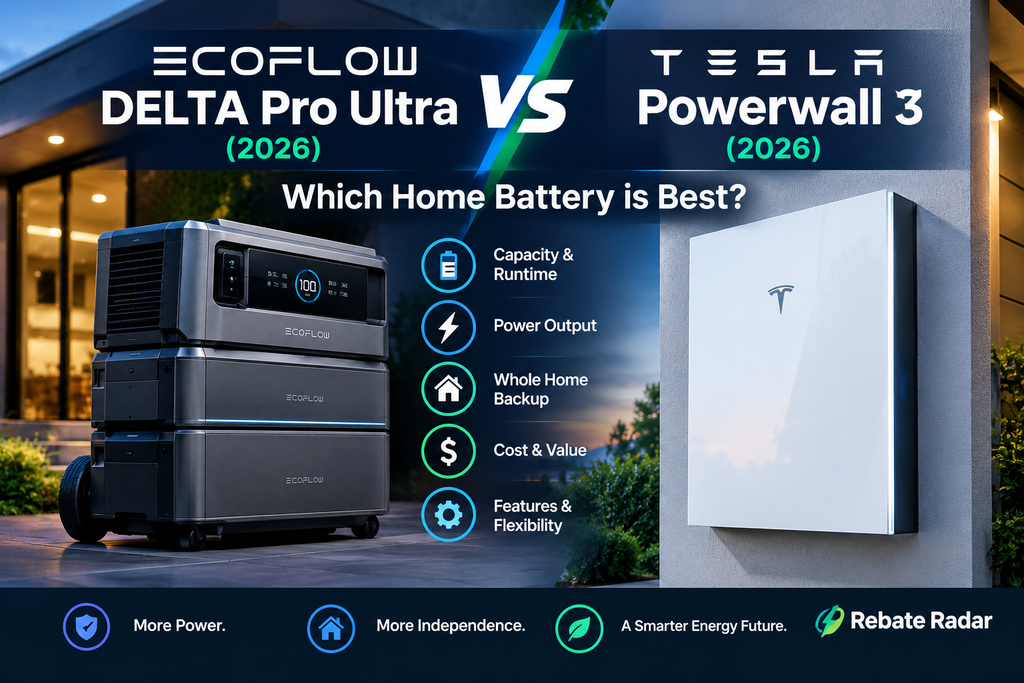
EcoFlow DELTA Pro Ultra vs Tesla Powerwall 3 (2026): Which Home Battery Is Best?
Compare capacity, continuous power, solar integration, expansion, installation approach, outage backup, operating flexibility and real-world buying considerations before choosing a home battery system.
If you are searching for the EcoFlow DELTA Pro Ultra vs Tesla Powerwall 3, the most important thing to understand is that these products are not simply two versions of the same battery. They represent different approaches to residential energy storage.
The EcoFlow DELTA Pro Ultra is built around a modular power-station architecture that can scale from a relatively compact battery system into a much larger backup installation. Tesla Powerwall 3 takes a different approach: it is a permanently installed residential energy storage system with its own integrated inverter and controls.
That distinction matters. A homeowner looking for emergency backup during occasional outages may value portability, modular expansion and multiple charging options. Another homeowner may want a clean, hardwired installation integrated with rooftop solar, utility service and automated energy management.
So instead of reducing the comparison to a simple brand-versus-brand answer, this guide examines the architecture, usable capacity, continuous output, solar integration, expansion, installation, generator compatibility, outage strategy, warranties, costs and purchase considerations that actually affect the decision.
How to read this comparison
The specifications in this article are based primarily on current manufacturer documentation and published technical information. Rebate Radar does not represent manufacturer laboratory testing as independent testing performed by our team.
Where specifications can vary by configuration, firmware, market, installation method or local electrical requirements, the article identifies that distinction rather than treating one number as universal.
1. EcoFlow DELTA Pro Ultra vs Tesla Powerwall 3: Quick Answer
There is no single configuration that is automatically right for every home. The more useful question is what kind of backup system you are trying to build.
EcoFlow DELTA Pro Ultra
EcoFlow’s architecture emphasizes modular storage, high AC output, multiple charging methods and expansion. A single battery provides 6.144 kWh of nominal capacity and 7.2 kW of continuous AC output. The system can scale substantially when additional battery and inverter components are added.
Check EcoFlow Price →Tesla Powerwall 3
Powerwall 3 is designed as a permanent residential energy storage system. It includes an integrated inverter and system controller, supports solar integration and can provide up to 11.5 kW of continuous power in the configuration documented by Tesla.
For an installed Powerwall project, the equipment price is only one part of the final cost. Electrical work, permits, service equipment and installation requirements can materially change the project total.
Want the EcoFlow system featured in this comparison?
If the modular DELTA Pro Ultra architecture fits your backup strategy, you can check the current product configuration and availability through our shopping link.
EF ECOFLOW DELTA Pro Ultra + Extra Battery 12 kWh-class configuration · Expandable home backup platform Check Current Price →2. EcoFlow DELTA Pro Ultra vs Powerwall 3 Specs
The table below focuses on characteristics that directly affect home backup performance. It is important not to compare battery capacity alone. A system with more stored energy is not necessarily able to operate every large appliance if its inverter cannot deliver the required power.
| Specification | EcoFlow DELTA Pro Ultra | Tesla Powerwall 3 | Why It Matters |
|---|---|---|---|
| Battery capacity | 6.144 kWh per battery | 13.5 kWh | Determines how much energy is stored before recharge. |
| Battery chemistry | LFP | Lithium-ion system; confirm exact configuration documentation for your market | Chemistry affects cycle behavior, thermal characteristics and warranty considerations. |
| Continuous AC output | 7.2 kW per inverter | Up to 11.5 kW continuous | Determines how many appliances can operate simultaneously. |
| System expansion | Up to 90 kWh system capacity with multiple batteries/inverters | Powerwall 3 supports additional storage through expansion units | Expansion determines how easily the system can grow. |
| Solar integration | Up to 5.6 kW solar input per inverter according to EcoFlow specifications | Integrated solar inverter with multiple MPPT inputs | Important when solar panels are part of the project. |
| Backup architecture | Portable/modular or integrated through compatible home-backup equipment | Permanent residential installation | Changes installation requirements and system flexibility. |
| 240V operation | Yes | Yes | Important for many central HVAC, well pump and large-appliance loads. |
| Warranty | Depends on EcoFlow product configuration and applicable warranty terms | 10-year Tesla Powerwall warranty | Warranty terms matter as much as headline battery capacity. |
3. Three Home Backup Systems Worth Comparing
If you arrived here while actively shopping, you may not want to compare only two products. Different homeowners have dramatically different requirements for capacity, portability, solar input, installation and budget.
EcoFlow DELTA Pro Ultra
A modular high-capacity platform designed around expandable home backup and multiple charging sources.
Check EcoFlow →Anker SOLIX F3800
Another expandable home-energy option worth comparing when evaluating large portable or semi-integrated backup systems.
Check Anker SOLIX F3800 →Jackery HomePower 3600 Plus
A smaller-format backup approach that can make sense for households looking for a battery-and-solar-package configuration rather than a large permanent battery wall.
Check Jackery HomePower 3600 Plus →Installed Battery Quotes
For a permanent whole-home battery, compare local installation costs, electrical work and system configuration rather than looking only at equipment prices.
Compare Local Quotes →4. Battery Capacity: 6 kWh vs 13.5 kWh
Battery capacity is measured in kilowatt-hours, or kWh. It represents the amount of energy the battery can store, although the energy available to household loads depends on system configuration, conversion losses, reserve settings and other operating conditions.
EcoFlow DELTA Pro Ultra starts with a 6.144 kWh battery module. EcoFlow states that the system can be expanded to a much larger storage bank with additional battery units.
Powerwall 3 has a nominal capacity of 13.5 kWh. Tesla also offers Powerwall 3 Expansion units that add additional storage capacity.
Why capacity alone does not determine backup time
Suppose a home is consuming 2 kW continuously. A theoretical 10 kWh battery would provide roughly five hours before accounting for conversion losses, reserve settings and other system behavior.
But a home rarely consumes exactly 2 kW continuously. Refrigerators cycle. HVAC systems turn on and off. Pumps start with a surge. Cooking loads can create large temporary increases.
That is why battery sizing should consider both:
- Energy capacity: how many kWh are stored.
- Power output: how many kW the inverter can deliver at once.
- Surge capability: whether motors and compressors can start.
- Critical loads: which circuits remain powered during an outage.
5. Continuous Power and Heavy Appliances
This is one of the most important differences between shopping for a portable power station and shopping for a residential battery.
A battery can have substantial stored energy but still be unable to operate a particular appliance if the inverter does not provide enough instantaneous or continuous power.
EcoFlow DELTA Pro Ultra power architecture
EcoFlow specifies 7.2 kW of continuous AC output for a single DELTA Pro Ultra inverter. The company states that multiple inverter units can increase total system output to as much as 21.6 kW.
That gives the EcoFlow platform considerable flexibility for homes where simultaneous loads are important.
Tesla Powerwall 3 power architecture
Tesla’s current technical documentation specifies Powerwall 3 with up to 11.5 kW of continuous output in the applicable configuration, along with a published motor-start specification of 185 A LRA.
This is significant for equipment such as HVAC compressors because starting a motor can require considerably more instantaneous power than running it after startup.
Do not assume that a published LRA or surge specification means every air conditioner, heat pump, well pump or compressor will start successfully in every installation. Actual starting behavior depends on the appliance, wiring, voltage, temperature, motor characteristics, soft-start equipment and inverter configuration.
6. Solar Integration: EcoFlow vs Powerwall 3
If you already have rooftop solar, or you plan to install solar at the same time as the battery, the inverter architecture becomes extremely important.
Powerwall 3’s integrated solar inverter
Powerwall 3 combines battery storage with an integrated solar inverter and system controller. Tesla publishes a solar-to-grid efficiency of 97.5% and multiple MPPT solar inputs in its current documentation.
The practical advantage is system integration: instead of building a battery around several independent inverter components, the Powerwall 3 architecture places important conversion and control functions into the system itself.
EcoFlow’s multi-source approach
EcoFlow positions DELTA Pro Ultra as a multi-source backup platform that can accept energy from solar, the grid, generators and other compatible charging sources.
EcoFlow specifies up to 5.6 kW of solar input for one inverter and higher total solar input when multiple inverter units are configured.
That architecture can be particularly interesting for homeowners who value flexibility or want a system capable of adapting to several energy sources.
7. Can You Use These Batteries Without Solar?
Yes, battery storage does not inherently require rooftop solar. A home battery can be charged from the grid and then discharged during an outage or, where the utility tariff makes it worthwhile, used for time-of-use load shifting.
However, a battery without solar has an important limitation during a long outage: once the stored energy is depleted, the battery cannot create additional energy by itself.
Solar changes that equation because the solar array can potentially recharge the battery during daylight hours while the grid is unavailable.
For homeowners considering battery storage without solar, the key questions are outage frequency, typical outage duration, critical loads, utility rate structure and whether a future solar installation is planned.
Not sure a permanent Powerwall-style installation is what you need?
A modular system can be attractive when portability, expansion or multiple charging sources matter more than a traditional wall-mounted battery installation.
8. Installation: This Is Where the Price Can Change Dramatically
A common mistake is comparing a battery’s online equipment price with the total installed cost of a Powerwall-class system. They are not necessarily comparable numbers.
A permanently installed residential battery may require electrical design, permits, inspection, utility coordination, backup switching equipment, conduit, breakers, service-panel work and labor.
This is why a local quote is much more useful than assuming a single national installation number applies to every house.
Get Local Battery Installation Estimates
If you’re considering a Powerwall 3 or another permanently installed home battery, compare local quotes so you can see how equipment, labor and installation requirements affect your actual project price.
9. Generator Integration and Long Outages
A battery and a generator solve different parts of the resilience problem. A battery provides stored electricity immediately and can operate without combustion, fuel storage or generator noise. A generator, however, can continue supplying energy for much longer as long as fuel is available.
EcoFlow specifically markets DELTA Pro Ultra as a multi-source backup platform and supports compatible generator charging.
For a Powerwall 3 installation, generator integration must be designed according to Tesla’s equipment, local electrical rules and the specific generator and transfer architecture. Do not assume a portable generator can simply be connected to a permanently installed battery.
The most resilient architecture may use multiple energy sources
For homeowners facing multi-day outages, a robust design can combine:
- Solar panels for daytime energy production.
- Battery storage for nighttime and short-term backup.
- A generator for prolonged low-solar conditions.
- Load management to prioritize essential appliances.
10. LFP and Battery Longevity
Lithium iron phosphate, commonly called LFP or LiFePO4, has become important in residential energy storage because of its cycle-life, thermal and material characteristics.
However, battery chemistry alone should not be used to predict the exact number of years a system will last. Real-world longevity depends on temperature, charging behavior, depth of discharge, cycling frequency, battery management, installation conditions and warranty terms.
Warranty is often more useful than a generic cycle-life claim
When comparing products, look for the manufacturer’s actual warranty conditions. Tesla’s current Powerwall warranty documentation specifies a 10-year limited warranty and describes energy-retention conditions, including 70% capacity at 10 years for specified applications.
For EcoFlow, always check the warranty that applies to the exact DELTA Pro Ultra components and market configuration being purchased.
11. Expansion: EcoFlow’s Modular Approach vs Powerwall Expansion
Expansion is one of the most interesting differences in this comparison. EcoFlow designed DELTA Pro Ultra around a modular architecture in which additional batteries and inverter units can increase storage and output.
Tesla also supports expansion with Powerwall 3 Expansion units. Tesla documentation states that each Powerwall 3 Expansion provides an additional 13.5 kWh of energy storage and that the expansion unit does not contain its own inverter.
The practical takeaway is simple: Do not compare expansion based only on the number of kWh.
You should also compare how the additional storage interacts with inverter capacity, backup switching, solar production and the loads you actually intend to operate.
12. Which System Makes More Sense for Different Outage Scenarios?
Scenario A: Short outages of two to four hours
For a short outage, a moderate battery bank may be sufficient if the household focuses on essential loads such as refrigeration, lighting, Wi-Fi, medical equipment where appropriate and selected outlets. A huge battery may be unnecessary if the homeowner can reduce demand during the outage.
Scenario B: Overnight outage
Overnight backup requires considerably more stored energy if you want to maintain HVAC, cooking, water heating and other large loads. Load prioritization becomes extremely valuable.
Scenario C: Multi-day outage
For multi-day outages, storage capacity alone may not be enough. Solar recharge or another generation source becomes increasingly important. This is where the distinction between a battery and an energy system becomes obvious.
Looking for a smaller solar-backup setup?
Not every household needs a large whole-home battery installation. If your goal is emergency power for selected devices, a smaller battery-and-solar configuration may be a different category of purchase.
Jackery HomePower 3600 Plus + 2×200W Solar Panels 3,584 Wh capacity · 3,600 W AC output · solar panel package Check Jackery →13. Whole-Home Backup vs Essential-Loads Backup
The phrase “whole-home backup” can be misleading because every home has a different electrical load. A battery can theoretically connect to the entire home’s electrical system while still being limited by its inverter output and stored energy.
For example, a home may have a central air conditioner, electric water heater, electric range, pool equipment, EV charger and well pump. If multiple large loads operate simultaneously, the instantaneous demand can become very high.
An essential-load strategy might instead prioritize:
- Refrigerator and freezer
- Lighting
- Internet equipment
- Selected outlets
- Security equipment
- Garage door opener
- Medical equipment where appropriate
- Heating or cooling under a defined load strategy
The correct battery size therefore depends on what you actually want to keep running, not simply on the square footage of the house.
14. EcoFlow DELTA Pro Ultra vs Powerwall 3 Cost
Cost comparisons are difficult because the two products can be sold through different channels and installed in very different ways. An online modular battery purchase is not directly equivalent to a turnkey, permitted, utility-connected residential battery installation.
Think in four cost layers
- Battery hardware: the batteries themselves.
- Power electronics: inverters, controllers and related components.
- Electrical installation: wiring, breakers, transfer equipment, panels and labor.
- Soft costs: permits, engineering, inspections, utility coordination and other project requirements.
That is why homeowners should compare the complete installed proposal, not just the product headline.
15. What to Ask Before Buying a Home Battery
Before accepting a quote or ordering a system, ask for these details in writing.
16. Can a Home Battery Actually Save Money?
It can, but savings are highly dependent on the electricity tariff and how the battery is operated. Battery storage can create economic value through several mechanisms.
Time-of-use shifting
If electricity is cheaper at certain hours and more expensive during others, a battery may charge during lower-cost periods and discharge during higher-cost periods.
Solar self-consumption
A solar system may generate electricity during the day when the home does not need all of it. A battery can store some of that energy for later use.
Demand management
Some customers have tariffs where reducing demand during specific periods can have financial value.
Virtual power plants
Some utilities and energy programs compensate participating customers for allowing batteries to support grid operations. Availability and payment structures vary by location.
None of these mechanisms should be treated as guaranteed savings. The correct calculation requires the homeowner’s actual tariff, solar-production profile, battery efficiency, cycling limits and program rules.
17. What About the Federal Battery Tax Credit in 2026?
Do not automatically assume that a new home battery installed in 2026 qualifies for the former 30% federal Residential Clean Energy Credit. The IRS states that the Section 25D Residential Clean Energy Credit will not be allowed for expenditures made after December 31, 2025.
Older articles and product pages may still describe standalone battery storage as eligible for a 30% federal residential credit because that was the rule under the earlier version of Section 25D. That historical information should not be confused with the current 2026 rule.
State, local and utility incentives can be different. Programs may have their own eligibility rules, funding limits and expiration dates. Before assuming an incentive will reduce your purchase price, verify the current program directly.
Compare Local Battery Quotes Before You Buy
Equipment is only part of the equation. Local installation costs, electrical upgrades and project requirements can change the economics of a home battery substantially.
18. What About Other Tesla Powerwall Alternatives?
Powerwall 3 is only one approach to residential energy storage. EcoFlow, Anker and Jackery represent different product categories and installation philosophies.
If you are comparing several systems, focus on these questions:
- How much usable energy do I actually need?
- How much continuous power do my appliances require?
- Do I need 120V, 240V or both?
- Do I need permanent whole-home backup?
- Will I install solar now or later?
- Do I need generator integration?
- How much portability matters to me?
- What does the complete installation cost?
- What does the warranty actually guarantee?
19. Which System Fits Which Home?
| Priority | System Characteristics to Look For | Relevant Option |
|---|---|---|
| Large modular backup | Expandable capacity and high AC output | EcoFlow DELTA Pro Ultra |
| Permanent solar + battery installation | Integrated inverter and residential controls | Tesla Powerwall 3 |
| Expandable alternative | Large-format modular battery architecture | Anker SOLIX F3800 |
| Smaller solar-backup package | Battery plus portable solar configuration | Jackery HomePower 3600 Plus package |
| Comparing installed project costs | Local installers and multiple proposals | EnergySage quote comparison |
Ready to compare your options?
Use the links below according to the type of system you’re actually shopping for. Product links are affiliate links and may generate a commission for Rebate Radar at no additional cost to you.
20. Frequently Asked Questions
Is EcoFlow DELTA Pro Ultra better than Tesla Powerwall 3?
They are designed for different use cases. DELTA Pro Ultra emphasizes modularity, multiple charging sources and scalable backup output. Powerwall 3 emphasizes permanent residential installation, integrated inverter functionality and solar integration. The appropriate choice depends on the home’s loads, solar system, installation requirements and backup goals.
How much storage does the EcoFlow DELTA Pro Ultra have?
EcoFlow specifies 6.144 kWh for a single DELTA Pro Ultra battery module. The system can be expanded substantially with additional battery and inverter components, with EcoFlow documenting system capacity up to 90 kWh.
How much storage does Tesla Powerwall 3 have?
Tesla specifies 13.5 kWh of nominal battery energy for Powerwall 3. Tesla also supports Powerwall 3 Expansion units for additional energy storage.
Can EcoFlow DELTA Pro Ultra run a whole house?
It can support many residential loads, but whether one unit can operate an entire home depends on the home’s simultaneous power demand, appliance starting requirements and the electrical configuration. EcoFlow specifies 7.2 kW continuous AC output for a single inverter and higher output when multiple inverter units are configured.
Can Powerwall 3 run central air conditioning?
Powerwall 3 is designed to provide high continuous output and Tesla publishes motor-start capability. However, whether a particular HVAC system starts successfully depends on the compressor, starting current, configuration and electrical installation.
Can a home battery work without solar panels?
Yes. A battery can charge from the electrical grid and provide backup during an outage. Without solar or another generation source, however, a battery cannot continuously recharge itself during a prolonged grid outage.
Does Powerwall 3 include a solar inverter?
Yes. Powerwall 3 is designed with an integrated solar inverter and system controller. Tesla’s current documentation also lists multiple MPPT solar inputs and a published solar-to-grid efficiency figure.
Can EcoFlow DELTA Pro Ultra be expanded?
Yes. EcoFlow’s architecture supports expansion with additional battery and inverter units. The company’s published specifications describe system capacity up to 90 kWh and system output up to 21.6 kW.
Does a new home battery installed in 2026 get the 30% federal credit?
Do not assume that it does. The IRS states that the Residential Clean Energy Credit under Section 25D is not allowed for expenditures made after December 31, 2025. State and utility incentives are separate and must be verified individually.
Should I compare multiple installation quotes?
Yes. For a permanently installed home battery, the equipment price is only part of the project. Electrical work, permitting, backup equipment, panel modifications and local requirements can materially change the final cost.
What is more important: kWh or kW?
Both matter. kWh describes stored energy and therefore influences runtime. kW describes power delivery and determines how many appliances can operate simultaneously. Surge capability can also matter when starting motors and compressors.
How long does a home battery last?
Battery lifespan depends on chemistry, operating temperature, cycling, depth of discharge, system design and warranty terms. Instead of relying on a generic “15-year” claim, compare the manufacturer’s warranty, capacity-retention conditions and expected operating profile.
21. How Rebate Radar Evaluates Home Batteries
Our comparison framework focuses on information that can materially change a homeowner’s purchasing decision rather than simply repeating marketing specifications.
- Capacity: nominal and expansion storage.
- Power: continuous AC output and published motor-start information.
- Solar integration: inverter architecture, PV input and MPPT configuration.
- Installation: portable versus permanent residential architecture.
- Resilience: backup loads, recharge strategy and long-outage considerations.
- Economics: equipment, installation, tariffs and available incentives.
- Warranty: duration, capacity retention and operating limitations.
- Practicality: expansion, portability, monitoring and future system flexibility.
Sources reviewed
Technical specifications are checked against manufacturer documentation from EcoFlow and Tesla. Federal tax-credit information is checked against current IRS guidance. Local installation pricing and incentive availability should always be verified for the homeowner’s location before purchase.
22. Related Rebate Radar Guides
Tesla Powerwall Alternatives 2026
Explore additional residential battery architectures and alternatives.
Read the Powerwall Alternatives Guide →How Many Home Batteries Do I Need?
Learn how household consumption, critical loads and backup duration affect battery sizing.
Calculate Battery Needs →Home Battery Backup Without Solar
Understand how standalone battery storage works when rooftop solar is not installed.
Read the Backup Guide →Home Battery vs Generator
Compare stored electricity, fuel-based backup and long-duration outage strategies.
Battery vs Generator →How Long Does a Home Battery Last?
Understand warranty periods, cycling and long-term battery degradation.
Read Battery Lifespan Guide →Home Solar Battery Cost 2026
Compare battery capacity, installation costs and home energy storage economics.
Read the Battery Cost Guide →Final Takeaway: EcoFlow DELTA Pro Ultra vs Tesla Powerwall 3
The most useful way to compare these systems is not to ask which brand is universally “best.” Ask which architecture matches the home.
EcoFlow DELTA Pro Ultra is particularly interesting for homeowners who prioritize modular expansion, multiple charging sources, high AC output and a flexible backup architecture.
Tesla Powerwall 3 is particularly relevant to homeowners seeking a permanent residential battery with an integrated inverter, solar integration and a dedicated home-energy ecosystem.
For smaller backup needs, the Jackery HomePower 3600 Plus offers another product category to investigate, while the Anker SOLIX F3800 provides another expandable system to compare.
And if you are considering a permanently installed system, comparing multiple local project quotes can be just as important as choosing the battery itself.
Pingback: Anker SOLIX Vs Jackery 2000 Plus (2026 Modular Backup Review)