
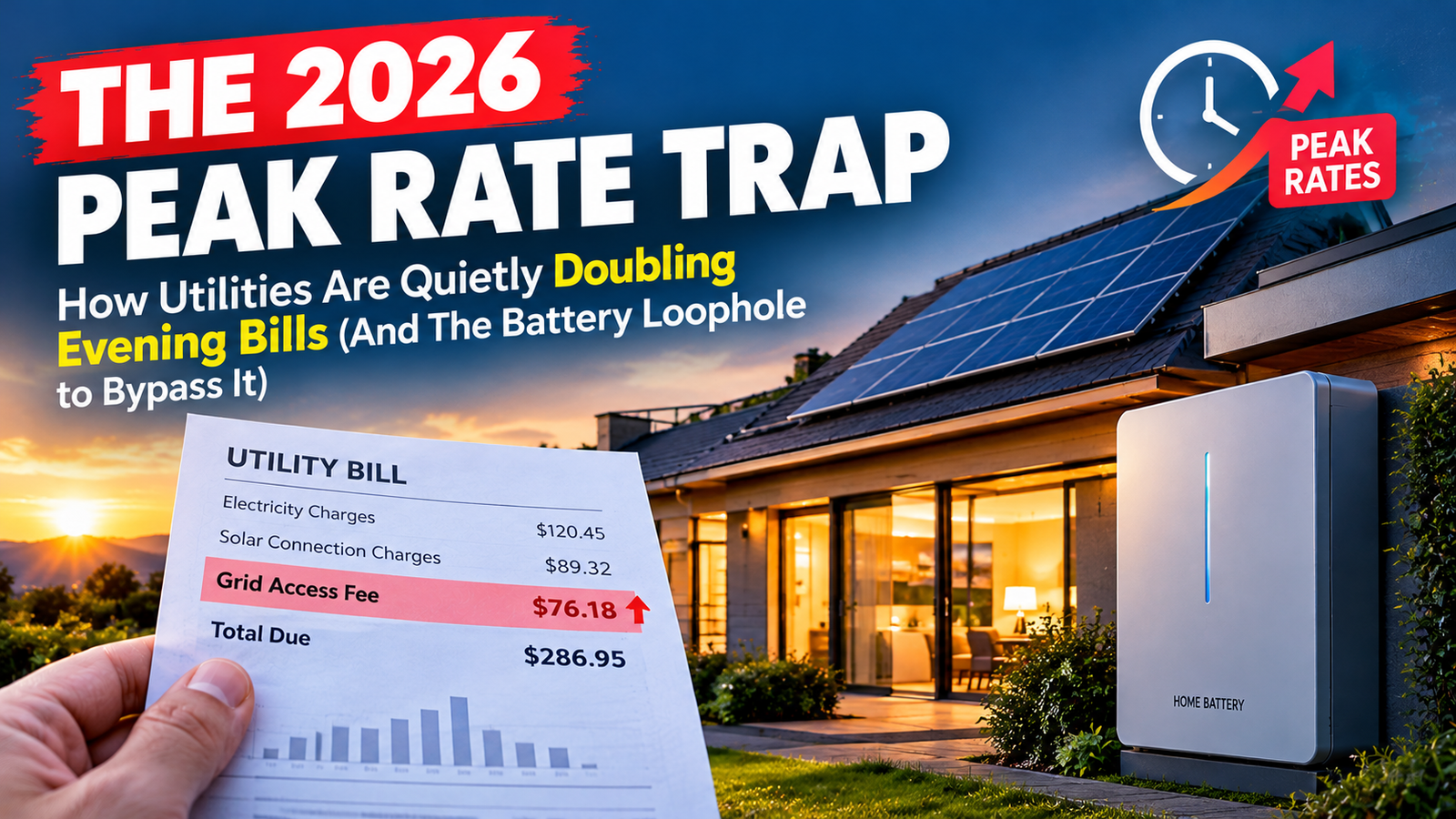
The 2026 “Peak Rate” Trap: How to Cut Expensive Evening Electricity Costs
Time-of-use rates can make the time you use electricity almost as important as how much you use. Learn how peak pricing works, when a home battery can help, and how to calculate whether the numbers make sense for your household.
Your electricity bill may depend on more than the number of kilowatt-hours your home consumes. If your utility uses time-of-use pricing, running an electric vehicle charger, dryer, oven, or air conditioner during a designated peak period may cost more than using the same equipment during off-peak hours.
That is why some homeowners are exploring peak shaving with a home battery. Instead of buying as much electricity from the grid during expensive periods, a battery can supply some of the home’s demand using energy stored earlier. Homes with solar panels may also be able to store surplus daytime production for use later in the evening.
But there is an important distinction: a battery does not automatically eliminate peak rates, utility bills, demand charges, or fixed monthly fees. The actual savings depend on your rate plan, when your household uses electricity, the battery’s usable capacity and power output, its charging source, and the utility’s rules.
1. What Are Peak Electricity Rates in 2026?
Peak electricity rates are higher prices charged during certain periods when electricity demand or the cost of supplying power is elevated. Utilities that offer time-based pricing divide the day into periods, which may include peak, shoulder, and off-peak hours.
For example, a hypothetical utility might charge 12 cents per kWh overnight and 36 cents per kWh during a summer evening peak period. Under that plan, the same 10 kWh of consumption would cost $1.20 off-peak or $3.60 during peak hours, before other bill components and taxes.
Those numbers are an illustration, not a universal 2026 utility tariff. Actual prices, time windows, seasons, and eligibility rules vary by utility, state, customer type, and rate plan. Always check your own tariff before making a purchase decision.
Higher-priced periods
Often scheduled around late-afternoon or evening demand, but the exact window is utility-specific. Some plans also have seasonal or critical-peak periods.
Lower-priced periods
May occur overnight or at other times when electricity is cheaper under the tariff. A battery can sometimes charge during these periods and discharge later.
The U.S. Energy Information Administration explains that electricity demand is often highest in the afternoon and early evening, but many customers pay rates based on seasonal averages rather than daily time-of-use prices. That means not every household is exposed to a peak-rate premium.
Start by looking at your latest bill or utility account for phrases such as:
- Time-of-use, time-of-day, or time-based pricing
- Peak, off-peak, and shoulder rates
- Critical peak pricing or event-based rates
- Demand charges or maximum demand
- Electric vehicle or overnight charging rates
If none of these appears, your utility may still have a time-based option available, but do not assume that switching plans will save money. Compare the full rate schedule against your actual hourly consumption first.
2. Why Evening Electricity Can Cost More
Residential electricity demand often rises when people return home, switch on lights, cook dinner, run appliances, adjust heating or cooling, and charge vehicles. Depending on the region and season, that concentration of demand can contribute to higher system costs.
Time-of-use tariffs are designed to encourage customers to move some consumption away from more expensive periods. A household that can run a dishwasher later at night, charge an EV overnight, or precool a home before an afternoon peak may reduce its exposure to high-priced electricity without purchasing a battery.
There is no single nationwide “2026 peak-rate trap.” Electricity prices are shaped by local tariffs, fuel and generation costs, grid investment, regulation, weather, and regional supply conditions. The EIA reports national and regional electricity-price data, but your utility’s published rate schedule is the source to use when calculating your own bill.
Which household loads deserve attention first?
- EV charging: Often a flexible load that can be scheduled outside peak hours if your vehicle and charger support it.
- Air conditioning: May account for substantial use during hot weather. Thermostat scheduling can sometimes shift part of the load.
- Electric water heating: A compatible water heater may be scheduled to heat during lower-cost periods while maintaining safe operating settings.
- Laundry and dishwashing: These tasks can often be delayed, depending on household routines and equipment.
- Cooking and lighting: Usually harder to shift completely, but efficient equipment and practical changes can help reduce overall consumption.
3. TOU Rates, Demand Charges, and Fixed Fees: Know the Difference
These terms are sometimes confused, but they measure different things. Understanding the difference helps you avoid buying equipment that cannot solve the specific problem on your bill.
| Bill component | How it works | What may help |
|---|---|---|
| Time-of-use energy rate | You pay different per-kWh prices during designated time periods. | Shift flexible loads or use stored energy during expensive periods. |
| Demand charge | Where applicable, a charge may depend on the highest measured power demand during a defined interval. | Reduce coincident peaks, if the tariff and equipment support effective demand management. |
| Fixed monthly customer charge | A set charge for service or account connection, usually independent of energy use. | A battery generally does not eliminate this charge. |
| Minimum bill | The bill may not fall below a specified amount, even if usage charges are low. | Review the tariff; lowering consumption may not reduce the bill below the minimum. |
| Solar export compensation | The utility credits electricity exported by a solar system according to its applicable rules. | Self-consumption or storage may improve value when export credits are lower than the price of electricity later purchased. |
A battery is not a universal solution for every line item. For example, storing electricity overnight and using it at 7 p.m. may reduce peak-period energy purchases, but a fixed customer charge can remain unchanged. Likewise, a demand charge can only be reduced if the battery reliably lowers the relevant measured demand during the billing interval.
For more background on fixed charges, solar economics, and the different fees that can affect rooftop-solar savings, read our guide to the 2026 solar grid access fee and battery strategy.
4. How a Home Battery Can Reduce Peak Electricity Purchases
Peak shaving means reducing how much electricity a home draws from the grid during a high-cost or high-demand period. A battery can do this by supplying part of the home’s load from stored energy.
Strategy A: Charge off-peak, discharge during peak
If your tariff has a clear difference between off-peak and peak prices, a compatible battery may charge when electricity is cheaper and supply some of the home later. The potential benefit depends on the price spread and on how much energy remains available after conversion losses.
For example, suppose your off-peak energy price is $0.12/kWh and your peak energy price is $0.36/kWh. The theoretical difference is $0.24 per kWh delivered during peak. If the battery uses 1 kWh from the grid to deliver less than 1 kWh to your appliances, however, the true savings are lower than the simple price difference suggests.
Strategy B: Store surplus solar energy
During the day, rooftop panels may produce more electricity than the home immediately consumes. Depending on the system configuration, battery, and utility rules, some of that surplus can be stored and used after sunset.
This strategy can be particularly useful when the value of exported solar electricity is lower than the retail price of electricity later purchased from the grid. It is not automatically profitable: equipment cost, conversion losses, battery degradation, export credits, and the home’s usage pattern all matter.
Read our guide to 2026 net-metering changes and solar batteries for more on why export compensation can influence the value of storing solar energy.
Strategy C: Reduce selected loads without a whole-home system
Some portable power stations can supply selected devices, such as networking equipment, lights, computers, or certain small appliances. Depending on their output, transfer arrangements, and manufacturer instructions, some may also support limited backup applications.
Do not assume that a portable power station can safely power an entire home, connect directly to a household panel, or automatically participate in utility-rate optimization. Whole-home integration can require compatible equipment, approved transfer hardware, permits, and a qualified electrician. Never backfeed a home circuit through an ordinary outlet.
5. Peak Shaving Savings Calculator: Estimate the Potential
Use this simple estimator to explore whether a price difference could justify shifting some electricity use. Enter your own tariff values from your utility bill. This tool is illustrative only; it does not use live utility rates or predict a guaranteed financial return.
Estimate your daily peak-rate savings
Use the same currency throughout. Enter energy prices in dollars per kWh and the amount of energy you expect the battery to deliver to your home during peak hours.
Estimated daily energy-cost difference
$0.00Estimated monthly amount: $0.00
Estimated annual amount: $0.00
Illustrative estimate only. Actual savings may differ.
How to interpret the result: The estimate compares the avoided peak-period energy cost with the cost of buying enough off-peak energy to deliver the stated amount after the entered efficiency loss. It assumes the battery can charge and discharge at the right times and that the prices stay the same.
It does not include the purchase price, installation, financing, maintenance, degradation, demand charges, fixed charges, taxes, solar export credits, or the value of backup power. It is therefore not a payback calculator. A positive daily figure does not prove that buying a battery will be profitable over its lifetime.
6. How Much Battery Capacity Do You Need?
Battery sizing should begin with the load you want to cover, not with the largest capacity you can afford. A battery’s capacity, measured in kilowatt-hours (kWh), tells you how much energy it can store. Its power rating, measured in watts or kilowatts (W/kW), tells you how much power it can deliver at a given moment.
Capacity: kWh
Determines how long the battery can supply a given load. A 2 kWh usable battery could theoretically supply a 500 W load for about four hours before losses and other limits.
Output: W or kW
Determines which devices can run simultaneously. A device with a large startup surge may exceed the power station’s limit even when the battery has plenty of stored energy.
A simple sizing example
Imagine your home uses an average of 1.2 kW during a four-hour peak window. The energy needed is approximately:
That is the approximate energy delivered to the loads, not necessarily the battery’s required nameplate capacity. You must account for usable capacity, conversion losses, reserve settings, and the manufacturer’s operating limits.
If your goal is to reduce peak grid purchases, examine your hourly usage data if your utility provides it. A daily or monthly total on the bill cannot reveal exactly how much energy you use during the peak window.
For more detailed planning, see how many home batteries you may need in 2026, and compare the assumptions against your own household’s load profile.
Check both continuous output and surge output
Air conditioners, pumps, refrigerators, and other motor-driven equipment can draw more power at startup than during normal operation. Confirm the equipment’s running and startup requirements against the power station’s specifications. Do not assume that a published peak wattage can be sustained continuously.
Also check whether the battery offers the voltage and outlets you need. A portable power station with standard 120 V outlets is not automatically suitable for a 240 V appliance, a hardwired HVAC system, or whole-home backup.
7. Portable Power Stations to Compare in 2026
The following products are options to research if you are considering a portable power station for selected loads, outdoor use, or limited backup. They are not interchangeable with a professionally designed whole-home battery installation, and their suitability for peak shaving depends on how they can be charged, scheduled, and connected to your equipment.
Jackery Explorer 2000 v2 with 2 × 200W Solar Panels
This bundle is listed with approximately 2,042 Wh of battery capacity and 2,200 W AC output, along with LiFePO4 battery chemistry and USB-C PD charging. The included panels may help recharge the unit when solar conditions and setup permit.
Consider it for: selected electronics, smaller appliances within its limits, camping, and emergency power. Verify usable capacity, solar input limits, charging time, warranty, and supported transfer options before purchasing.
Check Jackery on AmazonAnker SOLIX S2000 Portable Power Station with Power Strip
The supplied product details list a 2,010 Wh LiFePO4 battery and 1,500 W output. This capacity class may suit selected devices, but the output rating is a critical limit when several appliances run at the same time.
Consider it for: essential electronics and compatible small loads. Before buying, check whether the included power strip matches your intended setup, how solar charging works, and which devices can run within the unit’s continuous and surge limits.
Check Anker SOLIX on AmazonEcoFlow DELTA Pro Ultra with Extra Battery
The supplied listing describes a system with approximately 12 kWh of storage, 7,200 W AC output at 120/240 V, and expansion capability. This is a different scale from a typical 2 kWh portable power station and may be worth comparing for larger backup needs.
Consider it for: households researching higher-capacity backup and compatible system expansion. Confirm exactly what the bundle includes, supported configurations, required transfer equipment, installation requirements, and compatibility with the loads you intend to supply.
Check EcoFlow DELTA Pro UltraAffiliate disclosure: Rebate Radar may earn a commission from qualifying purchases made through the links above, at no additional cost to you. Product specifications, bundle contents, availability, and prices can change. Verify the current manufacturer and retailer information before purchasing. These are options to compare, not a claim that every product has been independently tested.
Which option makes the most sense?
| Your main goal | What to prioritize | Important limitation |
|---|---|---|
| Power a few essential devices | Capacity, outlets, weight, and continuous output | Not a substitute for whole-home wiring integration |
| Recharge with portable solar panels | Solar input wattage, voltage range, connectors, and panel compatibility | Actual solar production changes with weather, shade, angle, and season |
| Run larger household loads | Higher output, usable capacity, 120/240 V compatibility, and transfer equipment | Installation and circuit compatibility must be verified |
| Reduce peak-rate purchases | Scheduling, charge/discharge control, round-trip efficiency, and rate-plan economics | A large battery alone does not guarantee savings |
8. Solar Panels, Net Metering, and Peak Rates
Solar panels and batteries can work together, but their economics depend on the utility’s compensation rules. Under some arrangements, exporting surplus electricity earns a credit that is close to the retail price. Under others, exports may be credited at a different rate or under a separate tariff.
If the credit for exported solar electricity is lower than the cost of buying electricity later, using a battery to store some surplus production may improve the value of that energy. If exports are compensated generously, the financial benefit of storing every available kWh may be smaller.
The right comparison is not simply “solar versus battery.” It is the value of using solar immediately, exporting it, storing it, or buying electricity later under your actual tariff.
Three questions to ask before adding storage
- What do I receive for exported solar? Check the current tariff, not an old sales estimate.
- What do I pay during peak hours? Compare the actual peak energy rate with off-peak prices and other charges.
- When does my solar system produce surplus energy? Compare production timing with the home’s demand and the battery’s ability to charge and discharge.
Our guide to 2026 net-metering changes and solar battery economics explores why utility compensation rules can change the value of stored energy.
If you’re still comparing the cost of solar installation, storage, and electricity purchases, use the solar rebate and incentive calculator by state as a starting point, then verify any program details with the administering agency.
What about the federal battery tax credit?
Do not assume that a newly installed residential battery automatically qualifies for the former 30% federal Residential Clean Energy Credit in 2026. IRS guidance states that Section 25D does not apply to expenditures made after December 31, 2025. The timing rules and facts of a particular project matter, so confirm your situation with the IRS guidance or a qualified tax professional.
Read our separate guide to the residential solar battery tax credit in 2026 before including a federal incentive in your purchase calculations. State, utility, or other programs may have different rules and eligibility requirements; verify them independently.
9. Seven Common Peak-Shaving Mistakes to Avoid
1. Assuming every utility has peak pricing
Some customers pay a flat energy rate or a seasonal average rate. Check your tariff before investing in equipment specifically for peak shaving.
2. Using the wrong peak window
Peak periods vary by utility and may change by season or weekday. A schedule based on another household’s rate plan may not work for yours.
3. Comparing peak price with off-peak price but ignoring losses
A battery consumes energy while charging and loses some energy during storage and conversion. Use round-trip efficiency in your estimate rather than assuming every purchased kWh is delivered to your appliances.
4. Buying capacity without checking power output
A large kWh rating does not mean a battery can run every appliance. Check continuous output, surge capability, voltage, and the combined load of devices operating simultaneously.
5. Expecting a battery to erase fixed charges
Fixed monthly charges and minimum bills may remain even if you buy less energy from the grid. Read the bill’s individual components.
6. Ignoring the full cost of ownership
Equipment costs, installation, financing, warranty, battery degradation, replacement risk, and lost solar export credits can change the economics substantially. Calculate potential savings before deciding whether the purchase is worthwhile.
7. Treating backup power and savings as the same benefit
Backup power can be valuable during an outage, but its value is different from bill savings. Consider both goals separately, especially if your home has medical equipment, refrigeration needs, or other critical loads.
10. A Practical Checklist Before You Buy
Use this list before committing to a portable power station or a permanently installed battery system.
- Confirm whether your current utility plan has time-of-use rates or demand charges.
- Download the latest tariff and identify peak and off-peak hours.
- Review hourly smart-meter data if available.
- Estimate how many kWh you actually use during the peak window.
- Check whether you can shift flexible loads without purchasing a battery.
- Calculate potential savings using realistic prices and battery efficiency.
- Compare those savings with equipment, installation, financing, and maintenance costs.
- Check battery capacity, continuous output, surge capability, and required voltage.
- Confirm the solar input and charging method if you plan to use solar panels.
- Verify warranty terms, usable capacity, expansion options, and product support.
- Check local electrical codes and use qualified professionals for home wiring integration.
- Verify any tax credit or utility incentive directly with the relevant agency.
Frequently Asked Questions
1. Are U.S. utilities doubling evening electricity rates in 2026?
Not across the country. Some utility plans have substantially higher peak-period prices than off-peak prices, but rates and schedules vary. Check the tariff offered by your specific provider before assuming your bill will rise by a particular percentage.
2. What does “peak shaving” mean for a home?
Peak shaving means reducing the amount of electricity drawn from the grid during a period of high demand or high prices. It can involve shifting flexible loads or using a compatible battery to supply some of the home’s demand.
3. Can a home battery eliminate peak electricity rates?
No. A battery may reduce the amount of grid electricity you buy during peak periods, but it does not change the utility’s published rate. Savings depend on the energy delivered, charging cost, efficiency, and tariff.
4. Can I charge a battery at night and use it in the evening?
Potentially, if the battery and its controls support the schedule and your utility plan makes off-peak charging economical. Compare the delivered energy cost after conversion losses with the peak price.
5. Is a portable power station enough for whole-home backup?
Usually, a portable unit is intended for selected loads within its capacity and output limits. Whole-home backup may require a larger compatible system, transfer equipment, and professional installation. Check manufacturer specifications and local requirements.
6. Will a battery remove the fixed monthly charge on my electric bill?
Generally, no. A fixed customer charge or minimum bill may remain regardless of how little electricity you buy. Read your utility’s tariff to see which charges can actually change with usage.
7. Does adding a battery always save money with rooftop solar?
No. The result depends on solar export compensation, retail rates, the timing of household demand, battery losses, equipment costs, and the amount of surplus solar available to store.
8. What battery size should I choose for peak shaving?
Start with the number of kWh your home uses during the peak window. Then consider usable capacity, round-trip efficiency, reserve settings, and the battery’s power output. A larger battery is not automatically more economical.
9. Are residential batteries eligible for the 30% federal tax credit in 2026?
The IRS states that the Residential Clean Energy Credit under Section 25D is not available for expenditures made after December 31, 2025. Check official IRS guidance for project-specific timing questions and confirm other potential incentives with their administrators.
10. What is the first step before buying a battery?
Obtain your utility’s current rate schedule and determine whether you pay different prices by time of day. Then use actual usage data to estimate how much energy a battery could shift and compare the potential savings with the full cost.
Sources and Further Reading
This guide explains general electricity-rate concepts. Your utility tariff and the applicable government rules control your actual costs and eligibility.
- U.S. Energy Information Administration — Electricity prices and factors affecting prices
- U.S. Energy Information Administration — Utility rate, tariff, and demand-charge data
- Internal Revenue Service — Instructions for Form 5695
- Internal Revenue Service — Residential Clean Energy Credit
Editorial note: Rebate Radar provides general educational information, not individualized financial, tax, electrical-engineering, or legal advice. Utility tariffs, product specifications, incentives, and eligibility can change. Verify current details with your utility, the product manufacturer, and the relevant government agency before making a decision.