
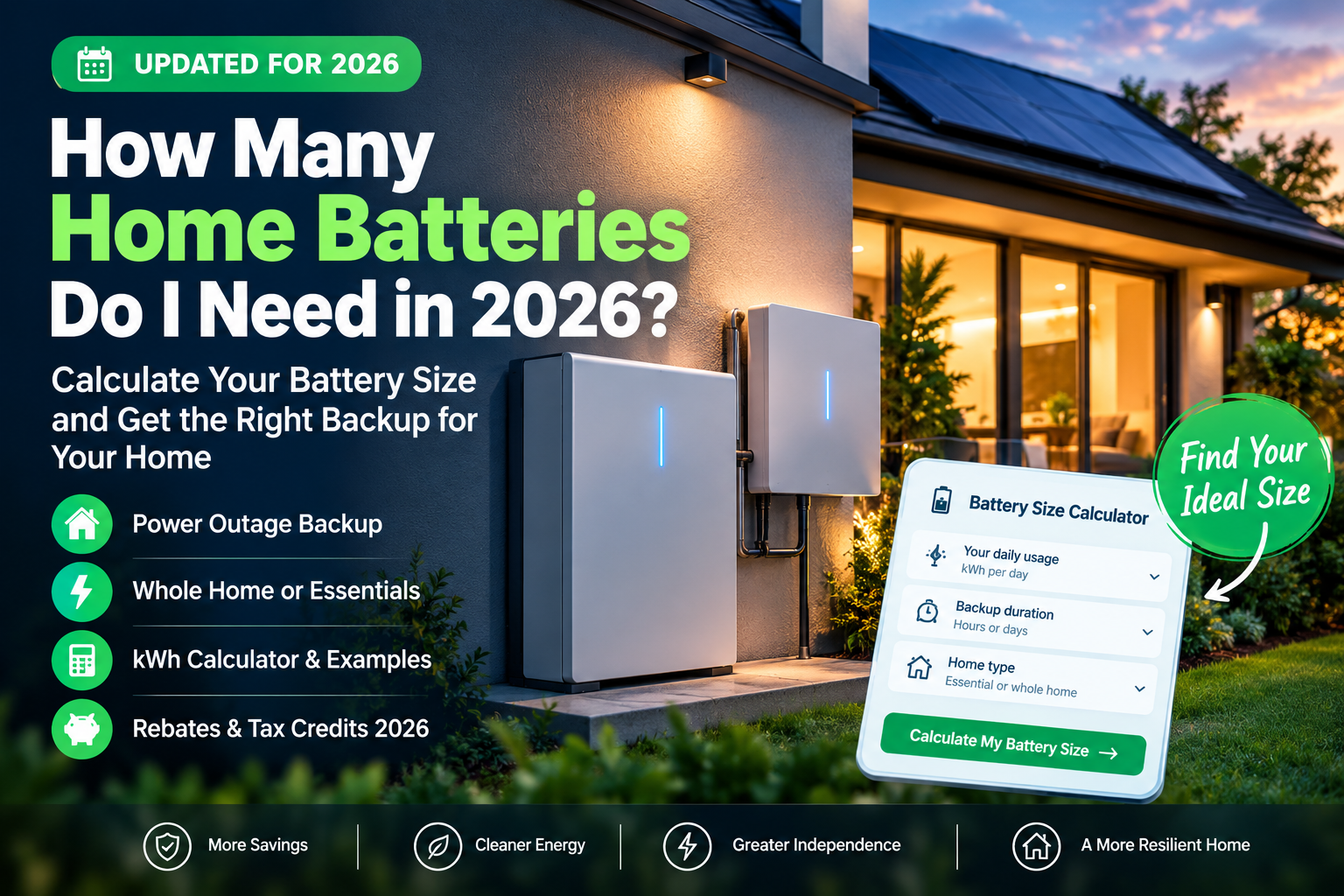
How Many Home Batteries Do I Need in 2026? Calculate Your Battery Size
Wondering how many home batteries you need to keep your house running during a power outage? Learn how to estimate the right battery capacity in kWh, compare essential-load and whole-home backup, and understand how battery power, usable capacity and backup duration work together.
Quick Answer: How Many Home Batteries Do You Need?
There is no single number of batteries that works for every house. The correct battery size depends primarily on how much electricity your home uses, which appliances you want to keep running, how long you want backup power to last, and how much usable energy and power each battery can provide.
A small backup system may be designed around essential loads such as a refrigerator, lights, internet equipment, medical equipment or selected outlets. A larger system can be designed to support substantially more of the home, including higher-energy appliances.
The most useful starting point is not the number of batteries. It is the amount of usable energy you need in kilowatt-hours (kWh) and the amount of power you need in kilowatts (kW) at any one moment.
Home Battery Sizing Formula
A practical first estimate is:
You then adjust that estimate for usable battery capacity, reserve settings, inverter/system losses and the specific operating limits of the equipment.
How many kWh will the appliances you actually want to operate consume?
Do you need several hours, overnight backup, 24 hours or longer?
Compare usable kWh rather than only the battery’s advertised nominal capacity.
The battery also needs enough kW to handle your appliances running simultaneously.
What You’ll Learn in This Guide
- How battery sizing works in kWh
- kW vs. kWh: the difference that matters
- Essential loads vs. whole-home backup
- 24-hour and 48-hour sizing examples
- How to calculate the number of batteries
- How solar changes battery sizing
- Can a home battery work without solar?
- Common battery-sizing mistakes
- How battery size affects cost
- What changed with federal battery tax credits
- Frequently asked questions
Why Battery Size Matters More Than the Number of Batteries
When homeowners search for how many home batteries they need, the natural instinct is to ask whether they need one battery, two batteries or several batteries. But that question is actually one step too early.
Home batteries are energy-storage systems, and their capacity is generally expressed in kilowatt-hours (kWh). Their ability to deliver electricity at a particular moment is generally expressed in kilowatts (kW).
That distinction is critical. The U.S. Department of Energy explains that energy capacity describes how much energy a storage system can hold, while power capacity describes how much power it can deliver at a given time. Storage also involves losses during charging, conversion and discharge, so a battery’s nameplate capacity should not automatically be treated as the amount of electricity available to your home.
In other words, a battery can have enough energy capacity for a particular backup period but still need adequate power output to start or operate multiple appliances at the same time.
How Many kWh of Battery Storage Does a Home Need?
The first calculation is your required energy storage. If the appliances you intend to operate during an outage consume an average of 1.5 kWh per hour, running those loads continuously for 10 hours would require approximately 15 kWh of delivered energy before accounting for system losses and operating reserves.
A simple planning equation is:
However, real homes do not normally consume a perfectly constant amount of electricity every hour. Refrigerators cycle on and off. Air conditioners can create large loads. Cooking may create short periods of high demand. Lighting and electronics may vary throughout the day.
That is why using your actual electricity usage and identifying the loads you want backed up can produce a much more useful estimate than simply dividing a monthly utility bill by 30.
Example: A Smaller Essential-Loads Backup
Imagine a homeowner wants to back up a refrigerator, internet equipment, several LED lights, phone chargers and a few selected outlets. The household estimates that those essential loads would consume approximately 8 kWh over the intended backup period.
The homeowner would then compare that requirement against the usable capacity of the battery system, not simply its advertised nominal capacity.
Example: A Larger Whole-Home Backup
A home that wants to maintain air conditioning, electric cooking, refrigeration, lighting, electronics, pumps and other major loads during an outage can have dramatically higher energy and power requirements.
In that situation, the correct solution may involve multiple battery modules, load management, a larger inverter system or a combination of technologies.
kW vs. kWh: The Battery-Sizing Difference Many Homeowners Miss
Think of kWh as the size of the fuel tank and kW as the rate at which electricity can be delivered. The analogy is not perfect, but it makes the distinction easier to understand.
This is why asking only “How many batteries do I need?” can produce a misleading answer. A system must be evaluated for both energy capacity and power capability.
Essential Loads vs. Whole-Home Backup
One of the biggest decisions in battery sizing is deciding what you actually want the battery to power during an outage.
Option 1: Essential-Loads Backup
Essential-load backup focuses on the appliances and circuits that matter most. Depending on the home and electrical configuration, these might include:
- Refrigerator and freezer
- Wi-Fi router and networking equipment
- Lighting
- Televisions and computers
- Phone and device charging
- Selected kitchen appliances
- Medical equipment where appropriate
- Security systems
- Garage door equipment
- Selected outlets
Because fewer circuits are being supported, an essential-load system can require less energy storage and lower power output than a whole-home system.
Option 2: Whole-Home Backup
Whole-home backup aims to maintain a much larger portion of the property’s electrical demand. This can include high-energy loads such as air conditioning, electric water heating, induction cooking, well pumps, pool equipment or other major appliances.
Whole-home backup does not automatically mean every appliance can run indefinitely. The system still has finite energy capacity, and high-power appliances can drain the stored energy faster.
How Many Batteries Do I Need for 24 Hours?
A 24-hour backup requirement sounds straightforward, but the actual battery size depends on what the home consumes during those 24 hours.
Consider an illustrative example where the selected backup loads average the equivalent of 12 kWh of energy during the intended 24-hour period.
The homeowner would compare that requirement with the battery system’s usable capacity and account for conversion losses, reserve settings and other system limitations.
If the usable capacity of the chosen battery system is lower than the required amount, additional storage may be necessary. If the battery has substantially more usable capacity, the homeowner may have additional reserve.
How Many Batteries Do I Need for 48 Hours?
A 48-hour outage generally requires more stored energy than a 24-hour outage if the same loads are being operated.
If the same illustrative backup loads required 12 kWh for the first 24 hours and the homeowner expected similar consumption during the second 24 hours, the basic energy requirement would be approximately 24 kWh before accounting for system losses and other real-world factors.
This does not mean that every 48-hour outage requires exactly twice as many physical battery units. Solar generation during the outage, load reduction, generator integration, battery recharge capability and weather can all change the result.
How to Calculate the Number of Home Batteries You Need
Once you estimate the required usable energy, the next step is to compare that number with the usable capacity of the battery system.
Basic planning formula
Number of batteries ≈ Required usable storage ÷ Usable capacity per battery
Always round up to the next practical system configuration and verify the manufacturer’s approved expansion options.
For example, suppose your planning requirement is approximately 20 kWh and a particular battery configuration provides 10 kWh of usable capacity. The mathematical starting point would be two battery units.
But this is only an energy calculation. You would still need to confirm that the combined inverter and battery system can deliver enough power for your expected loads.
Why You Should Not Size a System From kWh Alone
Imagine a home has a large air conditioner with substantial startup and running requirements. A battery may have enough total stored energy to operate it for some period, but the inverter and battery system must also be capable of delivering the required power.
This is one reason professional battery design looks at load profiles, electrical panels, circuits, inverter ratings and equipment compatibility instead of simply multiplying the number of batteries by a published capacity.
Illustrative Home Battery Size Scenarios
The following examples are planning illustrations, not universal recommendations. Actual consumption varies substantially by household, climate, HVAC use, appliances and backup strategy.
| Backup Goal | Typical Strategy | Main Sizing Question |
|---|---|---|
| Overnight backup | Essential loads | How much energy is needed until grid power returns? |
| 24-hour backup | Essential or selected whole-home loads | What is the expected daily outage load? |
| 48-hour backup | Larger storage + load management | Can the system conserve energy and recharge? |
| Whole-home resilience | Larger battery + appropriate inverter/load controls | Can the system handle both energy and peak power requirements? |
How Solar Changes Home Battery Sizing
A battery paired with solar can operate differently from a battery that is charged only from the electrical grid.
Solar can recharge storage when sunlight is available, allowing the system to use stored energy after sunset or during periods when grid electricity is unavailable. The Department of Energy describes this as one of the important advantages of combining solar generation and energy storage. 2
However, solar does not guarantee that a battery will remain full during a prolonged outage. Cloud cover, storms, shading, seasonal production, panel size, household demand and battery state of charge all matter.
Solar + Battery Is a System, Not Just Two Separate Products
A properly designed system considers the relationship between solar generation, battery capacity, inverter power, household loads and the electrical grid.
For example, installing a very large battery without enough solar generation to recharge it may not provide the expected resilience during a multi-day outage. Conversely, having substantial solar production without enough storage may leave excess daytime generation unused when the grid is unavailable, depending on the system configuration.
This is why battery sizing should consider both how much energy you need and how quickly your system can replenish that energy.
If you’re comparing storage technologies, see our detailed guide to Tesla Powerwall alternatives in 2026 .
Can a Home Battery Work Without Solar?
Yes. A home battery can be configured in systems that do not include rooftop solar, depending on the battery, inverter, electrical configuration and local requirements.
A battery without solar can charge from the grid and then provide backup power when the grid goes down, subject to the system’s configuration and operating rules.
This can be particularly relevant for homeowners who want backup power but are not ready to install solar panels.
We explain this configuration in greater detail in our dedicated guide: Home Battery Backup Without Solar 2026 .
Remember the difference
A battery provides stored energy. Solar can provide a source of electricity for recharging or direct use when sunlight is available. A generator can provide another source of energy using fuel. These are different technologies and should not be treated as interchangeable.
How to Estimate Your Home’s Backup Electricity Use
One of the easiest ways to improve battery sizing is to stop thinking about the entire house and make a list of the equipment you actually need during an outage.
- Write down the appliances and circuits you want backed up.
- Estimate how many watts each appliance uses while operating.
- Estimate how many hours each appliance will operate during the backup period.
- Multiply watts by hours and convert watt-hours to kilowatt-hours.
- Add the energy requirements of the selected loads.
- Allow for system losses, reserves and real-world operating conditions.
- Check the peak power requirements separately.
The calculation becomes particularly important for appliances that cycle. A refrigerator, for example, does not necessarily draw its maximum running power continuously for 24 hours. Air conditioning can behave similarly, although its total consumption can become substantial depending on climate, thermostat settings, insulation and equipment efficiency.
Don’t Forget Startup and Surge Requirements
Some motor-driven equipment can require a higher amount of power when starting than when already running. Depending on the equipment and inverter architecture, startup requirements can affect whether a battery system can operate that load reliably.
This is another reason that a simple “total kWh” calculation is useful for an initial estimate but should not be treated as a final electrical design.
10 Common Home Battery Sizing Mistakes
-
Buying based only on the number of batteries.
The correct system starts with energy and power requirements. -
Confusing kW with kWh.
One describes power and the other describes energy capacity. -
Using the entire monthly electricity bill as the only input.
A bill is useful, but outage backup may involve only a subset of household loads. -
Ignoring air conditioning.
HVAC can dramatically change both energy consumption and peak power requirements. -
Ignoring electric water heating.
Electric water heaters can be significant loads. -
Assuming nominal battery capacity equals usable capacity.
Always review the manufacturer’s specifications and operating limits. -
Forgetting recharge time.
A system intended for repeated or prolonged outages needs a realistic way to replenish stored energy. -
Assuming solar will always recharge the battery quickly.
Weather and household demand can significantly affect solar availability. -
Ignoring electrical-system compatibility.
Battery systems may require specific inverter, panel, transfer equipment or installation configurations. -
Choosing a system before deciding what you actually need backed up.
Defining essential loads first can make the sizing exercise much more precise.
How Battery Size Affects Home Battery Cost
Larger storage systems generally require more equipment, installation capacity and electrical infrastructure, but battery cost is not simply a matter of multiplying a single advertised price by the number of units.
A complete installation can involve battery modules, inverters or integrated power electronics, wiring, disconnects, mounting equipment, electrical-panel work, labor, permitting and other project-specific requirements.
For a broader discussion of pricing, see: Home Battery Backup Cost 2026 .
If you’re comparing a battery against a traditional standby generator, our Home Battery vs. Generator 2026 guide covers backup duration, maintenance, fuel, solar charging and other differences.
How Long Will a Home Battery Last?
Battery capacity is only one part of the ownership equation. Homeowners should also consider degradation, warranty terms, operating conditions and the expected number of cycles.
Battery performance can change over time. The exact rate depends on the chemistry, system design, operating temperature, usage patterns, cycling and manufacturer specifications.
For a deeper explanation of degradation and replacement considerations, read: How Long Does a Home Battery Last in 2026?
How Many Powerwalls or Similar Batteries Do I Need?
The same sizing principles apply whether you are evaluating a Tesla Powerwall or another residential storage system.
Instead of beginning with a brand name, compare:
- Usable energy capacity
- Continuous power output
- Surge or startup capability where applicable
- Solar compatibility
- Grid-charging capability
- Backup configuration
- Scalability
- Warranty terms
- Installation requirements
- Monitoring and control features
This lets you compare systems on characteristics that actually affect your backup requirements rather than choosing solely by the number of units.
For a broader product-category comparison, visit: Tesla Powerwall Alternatives 2026 .
Is There a Federal Home Battery Tax Credit in 2026?
This is an area where older articles can be misleading, so it is important to verify the current IRS rules.
The IRS currently states that the Residential Clean Energy Credit was 30% of qualifying costs for eligible property installed from 2022 through December 31, 2025. The IRS also states that the credit is not available for property placed in service after December 31, 2025.
Battery storage technology was included as qualified clean-energy property beginning in 2023, with a minimum capacity requirement of 3 kWh under the applicable rules. But that does not mean a new residential battery installed in 2026 automatically receives the former 30% federal residential credit.
The IRS’s current guidance on the changes to Section 25D should be checked before making a purchase or relying on older tax-credit articles.
Can You Still Find Battery Rebates in 2026?
Federal tax credits are only one category of incentive. Depending on where you live, battery storage may be connected to state programs, utility incentives, demand-response programs, virtual power plant programs or other local energy initiatives.
Availability, funding, income requirements, equipment eligibility and installation rules can vary substantially by state and utility.
Start with our main Energy Rebates 2026 guide and then check the current program administrator before making a purchase.
You can also explore our Virtual Power Plant Incentives 2026 guide if you are interested in programs that may compensate participating customers for allowing distributed batteries to support the grid.
Step-by-Step: How to Size Your Battery Backup
Choose your backup goal
Decide whether you want overnight, 24-hour, 48-hour or longer backup.
List your loads
Identify the appliances and circuits that need electricity during an outage.
Estimate kWh
Estimate the energy consumption of your selected loads during the backup period.
Check power
Make sure the inverter and battery system can handle simultaneous and startup loads.
Review usable capacity
Compare your energy requirement with usable rather than just nominal battery capacity.
Get a professional design
Confirm electrical compatibility, permits, equipment and final system sizing.
Home Battery Sizing Checklist
Before buying a battery system, make sure you can answer these questions:
- ✅ What appliances must remain powered?
- ✅ How many hours of backup do I want?
- ✅ What is my estimated outage energy requirement in kWh?
- ✅ What is the battery’s usable capacity?
- ✅ What is the continuous power output?
- ✅ Can the system handle startup loads?
- ✅ Will I charge from solar, the grid or both?
- ✅ How quickly can solar recharge the battery?
- ✅ What happens if the outage lasts multiple days?
- ✅ What are the current state, utility and local incentives?
More Home Battery Guides From Rebate Radar
If you’re researching home energy storage, these related guides can help you compare the next part of the decision:
Frequently Asked Questions About Home Battery Sizing
How many home batteries do I need for a typical house?
There is no universal number. The correct quantity depends on your backup loads, required duration, usable battery capacity, power output and system design. A small essential-load system may require much less storage than a whole-home system.
How many kWh battery do I need to run my house?
Start by estimating the electricity consumed by the loads you want backed up during the desired outage period. Then compare that energy requirement with the usable kWh capacity of the battery system and account for losses and operating reserves.
How many batteries do I need for 24-hour backup?
The answer depends on the kWh consumed by your backup loads over 24 hours. Essential-load backup can require substantially less energy than running high-demand whole-home appliances.
How many batteries do I need for 48 hours?
A 48-hour backup generally requires more stored energy than a 24-hour backup if the same loads are maintained. Solar recharge, load reduction and other energy sources can change the final requirement.
Is a 10 kWh home battery enough?
It can be enough for certain essential-load applications, but it may not be enough for a larger whole-home load profile or a prolonged outage. Always compare the usable capacity with your actual expected consumption.
Is 20 kWh enough to power a house?
It depends on the home’s electricity demand and the duration of the outage. Twenty kWh can represent a substantial amount of stored energy for selected loads, but high-demand appliances can consume it much faster.
Can a home battery work without solar panels?
Yes. Some residential battery systems can charge from the electrical grid and provide backup power without rooftop solar. System compatibility and local electrical requirements should be verified before installation.
Is kW or kWh more important when sizing a battery?
Both matter. kWh relates to how much energy the battery can store, while kW relates to how much power the system can deliver at a given time. A complete design needs to consider both.
Can solar panels recharge a home battery during an outage?
Depending on the system configuration, solar can recharge storage during an outage. Actual recharge performance depends on solar production, battery state of charge, system controls, weather and household consumption.
Is there a federal 30% battery tax credit in 2026?
The former Residential Clean Energy Credit under Section 25D is not available for qualifying property placed in service after December 31, 2025, according to current IRS guidance. State, utility and local incentives may have separate rules and should be checked independently.
Should I buy one large battery or several smaller batteries?
The answer depends on the available equipment, electrical design, desired capacity, power requirements, installation configuration and expansion options. Compare the complete system rather than only the individual battery units.
Should I have a professional size my home battery system?
Yes. Online calculations are useful for planning, but final battery sizing should account for the home’s electrical system, load requirements, inverter characteristics, local rules and the manufacturer’s installation requirements.
Don’t Start With “How Many Batteries?”
Start with the amount of electricity you actually need. Estimate your backup loads, determine your required kWh, check your power requirements, and then compare battery systems based on usable capacity and real-world performance.
Explore Home Battery Costs →About This Guide
This Rebate Radar guide was developed as an educational resource for U.S. homeowners researching residential battery storage, backup power, solar integration and energy incentives.
The guide focuses on transparent battery-sizing principles rather than recommending a specific manufacturer or installation company. Product specifications, utility programs, installation requirements and incentives can change, so readers should verify current information with the manufacturer, utility, program administrator and qualified professionals before purchasing equipment.
Last reviewed for 2026: September 2026
Sources & Verification
Key federal information in this article should be verified against current government guidance, particularly because energy tax-credit rules changed after 2025.
Disclaimer: This content is for general educational and informational purposes only. Battery sizing, electrical installation, tax treatment, rebates and utility programs can depend on individual circumstances and may change over time. Rebate Radar does not provide tax, legal or electrical engineering advice. Consult a qualified electrician, solar/storage professional, tax professional or the applicable government or utility program administrator before making a purchase or claiming an incentive.
Pingback: EcoFlow DELTA Pro Ultra Vs Tesla Powerwall 3 (2026 Cost & Specs)
Pingback: Residential Solar Battery Tax Credit 2026: How To Claim Your Savings
Pingback: Anker SOLIX Vs Jackery 2000 Plus (2026 Modular Backup Review)