
How Many Solar Panels Do I Need for a 2,000 Sq Ft House? 2026 Calculator
Wondering how many solar panels you need for a 2,000 square foot home? The answer depends on much more than home size. Use our interactive calculator to estimate your solar system size, panel count, roof space, annual energy production and more — then learn exactly what factors can change the result.
A home’s square footage is useful for establishing a starting point, but it does not directly determine how much electricity the household uses. Two homes with exactly 2,000 square feet can have dramatically different electricity consumption because of climate, insulation, air conditioning, heating, appliances, occupants, electric vehicles, pools, water heating and other loads.
The most reliable starting point is your actual electricity usage in kilowatt-hours (kWh), followed by your location, solar resource, panel wattage, roof orientation, shading and desired percentage of electricity offset.
If you searched how many solar panels do I need for a 2000 sq ft house, you probably want a number you can actually use. This guide is designed to give you that number as a planning estimate while also explaining why the number can change once a real solar professional models your property.
You will find a calculator near the beginning of this guide, followed by detailed explanations of the math, examples for different electricity usage levels, panel wattages, roof space, climate, shading, batteries, EV charging, electric heating, off-grid systems, and common mistakes.
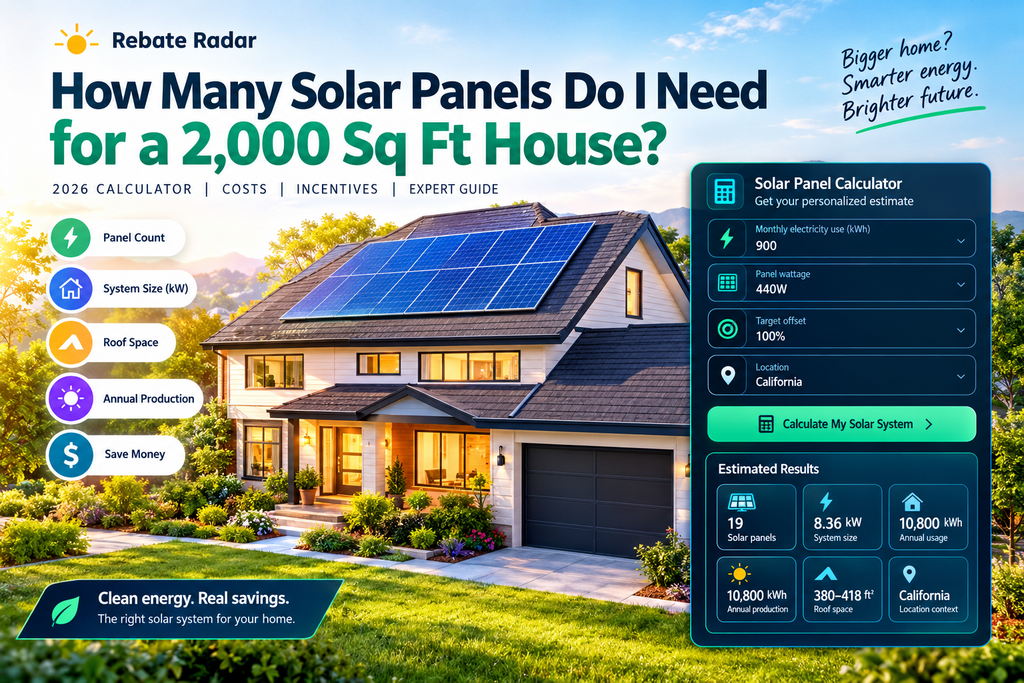
2,000 Sq Ft Solar Panel Calculator
Enter your electricity usage, panel wattage and a planning production factor to estimate the solar system size and number of panels your home may need.
How Many Solar Panels Does a 2,000 Sq Ft House Need?
A reasonable planning range for a 2,000 square foot home can be somewhere around 15 to 25 modern residential solar panels, but that range should never be treated as a universal answer.
For example, a household using relatively little electricity might reach its target with fewer high-wattage panels. Another 2,000 sq ft household with central air conditioning, electric heating, an electric water heater, a pool and an EV could need substantially more solar capacity.
Panel wattage also matters. Twenty 400-watt panels represent an 8 kW DC array. Twenty 450-watt panels represent a 9 kW DC array. The physical number of panels changed, but the system’s nameplate capacity changed too.
| Example system | Panel wattage | Panel count | DC capacity |
|---|---|---|---|
| Smaller array | 400W | 15 | 6.0 kW |
| Medium array | 440W | 18 | 7.92 kW |
| Typical planning example | 440W | 20 | 8.8 kW |
| Larger array | 450W | 24 | 10.8 kW |
These are examples rather than recommendations. Your actual system should be sized from electricity consumption and expected solar production rather than from square footage alone.
Why a 2,000 Sq Ft House Does Not Automatically Need a Certain Number of Panels
🏠 Same square footage, different energy use
Imagine two homes that both measure exactly 2,000 square feet. Home A may have gas heating, efficient appliances, moderate air conditioning and two occupants. Home B may have electric resistance heating, multiple air-conditioning units, an EV, a pool pump and four occupants.
The floor area is identical, but the electricity requirement can be completely different.
☀️ Same energy use, different solar production
Now imagine two homes with the same annual electricity consumption. If one has excellent solar exposure and the other has heavy shade, the system size needed to produce the same annual energy can differ.
Roof orientation, tilt, shading, weather and system losses all matter.
What matters more than square footage?
- Annual electricity consumption: your kWh usage is the most useful starting point.
- Location: solar resource varies across the country.
- Roof orientation: the direction and tilt of the roof affect production.
- Shading: trees, neighboring structures and roof obstructions can reduce output.
- Panel wattage: higher-wattage panels can produce more nameplate capacity per panel.
- System losses: real systems do not convert every unit of sunlight into usable electricity.
- Future electricity use: an EV, heat pump or electric water heater can change your future demand.
- Utility goals: some homeowners want partial offset while others target near-total annual offset.
How to Calculate How Many Solar Panels You Need
The basic concept is straightforward: estimate how much electricity your household needs, estimate how much energy a solar system can produce in your location, determine the system capacity required, and then divide that capacity by the wattage of the panels you plan to use.
A simplified planning formula
Annual electricity use = monthly kWh × 12
Target solar production = annual use × desired offset
Approximate system size = target production ÷ production factor ÷ 1,000
Panel count = system size × 1,000 ÷ panel wattage
The production factor in this simplified calculator is intentionally presented as a planning assumption rather than as a location-specific prediction. A professional production model can account for much more detailed information.
NREL’s PVWatts tool, for example, estimates the electrical output of grid-connected photovoltaic systems using inputs such as location, system size and array orientation. More detailed modeling can account for additional losses and system characteristics. 3
How Much Electricity Does a 2,000 Sq Ft Home Use?
There is no universal electricity bill for a 2,000 sq ft house. Electricity consumption depends on climate, household behavior, insulation, appliances and heating and cooling equipment.
As a national reference point, the U.S. Energy Information Administration reported average residential electricity consumption of about 865 kWh per month in 2024. That is a useful benchmark, not a target for every 2,000-square-foot home. 4
| Monthly usage | Annual usage | What it may indicate |
|---|---|---|
| 500 kWh | 6,000 kWh | Relatively low electricity consumption |
| 750 kWh | 9,000 kWh | Moderate household usage |
| 900 kWh | 10,800 kWh | Useful planning example |
| 1,200 kWh | 14,400 kWh | Higher electricity consumption |
| 1,500 kWh | 18,000 kWh | High-energy household |
If you have access to a full year of electricity bills, calculate the total kWh used during those 12 months. This is generally more informative than trying to infer electricity demand from the home’s square footage.
What if your electricity use changes throughout the year?
That is normal. Air conditioning can create summer peaks, while electric heating can create winter peaks. A monthly average is useful for a high-level annual estimate, but a serious solar design should look at the monthly profile too.
How Many 400W, 420W, 440W or 450W Solar Panels Do You Need?
Panel wattage determines how much nameplate capacity each panel adds to the system. If the required system size is 8.8 kW, the panel count changes depending on whether you choose 400W, 440W or 450W modules.
| Panel wattage | Panels for ~8 kW | Panels for ~9 kW | Panels for ~10 kW |
|---|---|---|---|
| 400W | 20 | 23 | 25 |
| 420W | 20 | 22 | 24 |
| 440W | 19 | 21 | 23 |
| 450W | 18 | 20 | 23 |
Higher wattage does not automatically mean that a panel is better for every roof. Physical dimensions, efficiency, inverter design, warranty, available roof area, price and installer availability can all matter.
Solar Panel Examples for a 2,000 Sq Ft House
The following examples illustrate how the answer changes when electricity consumption changes. They are not universal system recommendations.
Example 1: Lower electricity use
Suppose the household uses 600 kWh per month, or 7,200 kWh annually. With an appropriate production assumption and 440W panels, the resulting system could require significantly fewer panels than a high-energy household.
This is why starting with the electricity bill is more useful than simply saying “2,000 square feet equals X panels.”
Example 2: Moderate electricity use
Suppose the household uses 900 kWh per month, or 10,800 kWh annually. A planning model might place the system somewhere around the mid-single-digit to high-single-digit kW range depending on the solar resource and desired offset.
Example 3: High electricity use
Suppose the home consumes 1,500 kWh per month, or 18,000 kWh annually. The required solar capacity can become substantially larger.
This is common when several large electric loads operate together.
Example 4: Future electrification
A homeowner may currently use 800 kWh per month but plans to purchase an EV and replace gas appliances with electric equipment.
Designing only around today’s consumption could understate future electricity needs.
How Much Roof Space Do Solar Panels Need?
Once you know the number of panels, the next question is whether your roof can physically accommodate them. Residential panels vary in dimensions, so a simple square-foot estimate should be treated as approximate.
As a planning exercise, you can estimate roughly 18–22 square feet per panel depending on the module dimensions and installation layout. Additional space may be required for setbacks, roof access, equipment, obstructions and design constraints.
| Panel count | Approx. panel surface area at 18 ft² | Approx. panel surface area at 22 ft² |
|---|---|---|
| 15 panels | 270 ft² | 330 ft² |
| 18 panels | 324 ft² | 396 ft² |
| 20 panels | 360 ft² | 440 ft² |
| 24 panels | 432 ft² | 528 ft² |
The usable roof area can be considerably smaller than the home’s total roof area. Dormers, vents, chimneys, skylights, roof edges, setbacks and shaded sections can all reduce the practical installation area.
Does the State You Live In Change How Many Solar Panels You Need?
Yes. Location matters, but “California needs X panels” or “Texas needs Y panels” is too simplistic to be a reliable sizing rule.
Solar production varies with available sunlight, weather, orientation, shading, system design and other factors. Even two homes in the same city can have different production if one roof has extensive shading and the other has an unobstructed solar exposure.
For that reason, our calculator lets you select a state for context but does not pretend that state selection alone can produce an engineering- quality result.
For a more detailed location estimate
NREL’s PVWatts is designed to estimate the electricity production of photovoltaic systems using location and system characteristics. A location-specific model can be much more informative than a generic nationwide production assumption. 5
Explore California-specific solar incentive information.
See Texas solar incentive and rebate information.
Explore Arizona solar incentives and rebate programs.
Review Florida solar rebate and incentive information.
Explore Pennsylvania solar incentives and programs.
Check Georgia solar incentive information.
How AC, EVs, Pools and Appliances Affect Solar Panel Sizing
One of the biggest mistakes homeowners make is treating electricity consumption as if it were determined by floor area. In reality, some electrical loads can dramatically change annual and peak electricity use.
❄️ Air conditioning
Air conditioning can be one of the largest electricity loads in a home, especially in hot climates. A 2,000 sq ft home with multiple cooling zones may have very different electricity consumption from a similarly sized home in a mild climate.
🚗 Electric vehicle
EV charging adds electricity demand that may not appear in historical bills if the homeowner recently purchased the vehicle. If an EV is part of your future plans, consider including its expected energy consumption in the long-term solar design.
🏊 Pool equipment
Pool pumps can operate for many hours, making them an important load in some households. Pool heating can add another significant source of electricity consumption.
🔥 Electric heating
Electric resistance heating, heat pumps and other electric heating systems can substantially affect winter electricity consumption. Future electrification should be considered when planning a solar system.
Other loads worth reviewing
- Electric water heaters
- Heat pumps
- Well pumps
- Large refrigerators and freezers
- Electric dryers
- Electric ovens and ranges
- Home offices and computer equipment
- Workshops and power tools
- Hot tubs
- Pool pumps and heaters
- Guest houses and detached buildings
How Many Solar Panels Do You Need With a Battery?
Adding a battery does not automatically mean you need a certain number of additional solar panels. The battery stores electricity; the solar array produces electricity.
The correct solar-plus-storage design depends on your energy consumption, desired backup duration, battery capacity, battery power rating, solar production and utility rules.
A battery can be useful for storing excess solar production for later use, supporting selected loads during an outage or changing when energy is consumed. However, battery capacity and solar-panel capacity solve different parts of the system-design problem.
Continue the battery-sizing research
If you are also trying to determine your battery requirements, see:
→ How Many Home Batteries Do I Need in 2026?
You can also compare: home battery backup cost, home batteries vs generators, and home battery backup without solar .
How Many Solar Panels Do You Need to Run a 2,000 Sq Ft House Off-Grid?
Off-grid solar sizing is a different problem from ordinary grid-connected solar sizing.
A grid-connected homeowner can often use the utility grid when solar production is insufficient. An off-grid property needs enough generation, battery storage and backup planning to remain functional through periods when solar production is low.
That means an off-grid system may need more solar capacity and substantially more storage than a system designed primarily to offset annual grid electricity consumption.
Off-grid sizing should consider:
- Daily energy consumption
- Peak electrical loads
- Seasonal solar production
- Battery capacity
- Battery usable depth of discharge
- Inverter continuous power
- Inverter surge capability
- Generator or other backup options
- Critical loads
- Weather variability
For a basic grid-connected planning estimate, however, the calculator above can help you understand the relationship between electricity consumption, panel wattage and system capacity.
How Many Solar Panels Do I Need for 1,000 kWh per Month?
If your home uses 1,000 kWh every month, that represents approximately 12,000 kWh of annual electricity consumption.
The required solar capacity depends on how much annual production your location can generate from each installed kW. Therefore, the same 12,000 kWh annual demand can require different system sizes in different locations or on roofs with different shading and orientations.
Once you estimate the required DC system size, divide that capacity by your chosen panel wattage. For example, an 8.8 kW system would require approximately 20 panels rated at 440W.
How Many Solar Panels Do I Need to Power My Whole House?
If your goal is to offset essentially all of your annual electricity use, enter 100% as your target offset and use your actual annual kWh.
If you want only partial offset because of roof limitations, budget or other reasons, select a lower target such as 50%, 75% or 90%.
“Whole house” also has a different meaning during a power outage. Producing enough annual solar energy to offset your utility consumption does not necessarily mean the system can power every appliance simultaneously during an outage. Backup power depends on the inverter, battery and electrical configuration.
How Many 400W Solar Panels Do I Need for a 2,000 Sq Ft House?
If a hypothetical solar design required 8 kW of DC capacity, 400W panels would require 20 modules:
8,000 watts ÷ 400 watts = 20 panels
If the same system used 440W panels:
8,000 watts ÷ 440 watts ≈ 18.2 → 19 panels
The higher-wattage panels reduce the number of individual modules needed, but the final design still depends on the actual production requirement and the physical characteristics of the roof.
Does Solar Panel Efficiency Matter for a 2,000 Sq Ft Home?
Yes, especially when roof space is limited.
Panel efficiency describes how effectively a panel converts available sunlight into electricity under specified test conditions. Higher efficiency can allow a system to produce more electricity from a given physical roof area, although efficiency should not be confused with the entire system’s real-world production.
Two panels can have similar wattage but different physical dimensions, efficiency and performance characteristics. That’s why a final installer design should evaluate the actual roof rather than relying only on a panel-count calculator.
When higher power-density panels can be useful
- Small or irregular roofs
- Homes with limited south-facing or otherwise favorable roof area
- Roofs with multiple obstructions
- Homeowners trying to maximize production within a fixed footprint
- Projects where future electricity demand is expected to increase
How Roof Orientation and Shading Affect Your Solar Panel Count
A solar calculator can estimate system size, but roof conditions determine how effectively that system can operate at your property.
Trees, chimneys, neighboring buildings, roof structures and other obstructions can reduce sunlight reaching the panels. The effect can also vary by time of day and season.
Orientation and tilt matter because they influence how sunlight reaches the modules. A roof that looks large enough on paper may therefore be less useful than a smaller roof section with better solar exposure.
Should You Size Solar for Future Electricity Use?
Potentially, yes. Solar systems can remain in service for many years, so today’s electricity bill may not represent tomorrow’s household.
Consider whether you plan to purchase an electric vehicle, install a heat pump, replace a gas water heater with an electric model, add a pool or hot tub, convert a garage into living space, or otherwise increase electricity consumption.
A homeowner who ignores those future loads could install a system that appears adequate today but provides a smaller percentage of electricity offset later.
Current-use sizing
Uses historical electricity consumption to estimate the system needed for today’s household.
Future-use sizing
Adds reasonable expected loads so the system is designed around a longer-term electricity profile.
Are There Solar Tax Credits or Rebates for a 2,000 Sq Ft Home?
Incentives can affect the economics of a solar project, but they should be researched separately from the physical question of how many panels you need.
One important 2026 distinction is the federal Residential Clean Energy Credit under §25D. The IRS states that the 30% credit applied to qualifying clean-energy property installed from 2022 through December 31, 2025, and that the credit is not available for property placed in service after December 31, 2025. 6
The IRS also explains that legislation accelerated the termination of §25D for expenditures after December 31, 2025. 7
That does not mean every solar incentive disappeared. State, utility, local and other programs can have different rules, eligibility requirements and expiration dates.
Explore the broader 2026 energy rebate landscape.
Explore solar incentives by state.
Explore eligibility-related solar incentive information.
Read the dedicated 2026 federal solar tax-credit update.
How Many Panels Should You Install If You Want the Best Payback?
The largest possible solar array is not automatically the best financial design for every household.
The economics can depend on system cost, electricity rates, financing, incentives, utility compensation rules, electricity consumption, solar production and how much of your solar generation you can actually use or receive credit for.
That means “maximum panels” and “optimal financial design” are not necessarily the same thing.
Once you have a preliminary system size, use the solar panel payback period guide and solar payback calculator to examine the financial side separately.
10 Common Mistakes When Calculating Solar Panels for a 2,000 Sq Ft House
1Using square footage as the only input
Square footage is not electricity consumption. Start with actual kWh whenever possible.
2Ignoring air conditioning
Cooling demand can materially change electricity consumption, particularly in hot climates.
3Ignoring future EV charging
A new EV can change your electricity profile substantially.
4Assuming every panel produces its rated wattage all day
Panel wattage is a nameplate rating under standardized test conditions, not a guarantee of continuous real-world output.
5Ignoring shading
Roof shading can reduce production and complicate system design.
6Confusing kW and kWh
kW describes power capacity. kWh describes energy consumed or produced over time.
7Assuming 100% offset is always necessary
A homeowner may intentionally choose partial offset based on budget, roof space or utility economics.
8Forgetting roof setbacks
The total roof area is not automatically usable installation area.
9Using an outdated tax-credit assumption
Federal incentive rules changed, so 2026 content should not blindly repeat older 30% federal-credit claims. Always verify current rules.
10Treating an online calculator as an engineering design
A calculator is excellent for planning and education, but a final system requires property-specific design and professional review.
How Rebate Radar Calculates Solar Panel Requirements
We designed this guide around a simple principle: a useful solar calculator should explain its assumptions instead of presenting a mysterious number.
What we use
- Monthly electricity consumption in kWh
- Annualized electricity consumption
- Desired solar offset
- Panel nameplate wattage
- A simplified production factor for planning
- Approximate panel surface area
- Location context
What we verify
For general energy-use context, we reference U.S. Energy Information Administration data. For photovoltaic production methodology, we use National Renewable Energy Laboratory resources as a reference point. For federal incentive information, we prioritize IRS material.
What this calculator can tell you
- A reasonable preliminary panel-count range
- An approximate system size in kW
- How panel wattage changes the number of modules
- How electricity consumption changes system size
- A rough estimate of panel surface area
What this calculator cannot tell you
- Exact annual production at your roof
- Exact shading losses
- Structural roof capacity
- Final electrical design
- Utility interconnection approval
- Final project cost
- Your exact savings or payback period
- Guaranteed battery backup performance
Related Solar Calculators, Rebates and Battery Guides
If you are researching solar for a 2,000 sq ft home, these related guides can help you move from basic sizing to production, incentives, economics and battery planning.
Calculate home battery capacity and backup requirements.
Estimate potential solar savings using your electricity profile.
Explore the relationship between system cost, savings and payback.
Estimate household energy costs and electricity consumption.
Explore electricity consumption and estimated energy costs.
Understand the factors that influence solar payback.
Continue researching home energy storage options.
Compare the broader home battery market.
How Many Solar Panels Do I Need for a 2,000 Sq Ft House? FAQ
How many solar panels does a 2,000 sq ft house need?
A 2,000 sq ft house might use roughly 15–25 modern solar panels as a broad planning range, but the actual number depends primarily on electricity consumption, solar production, panel wattage, roof conditions and the desired percentage of electricity offset.
How many solar panels do I need for a 2,000 sq ft house with 100% solar offset?
Start with your annual electricity consumption, then estimate the solar system capacity needed to produce approximately that amount of energy. Divide the required system capacity by your panel wattage to estimate the number of panels.
How many 400 watt solar panels do I need for a 2,000 sq ft house?
The answer depends on the required system capacity. For example, an 8 kW system would contain 20 panels rated at 400W. Your actual required system may be smaller or larger depending on electricity use and solar production.
How many 450 watt solar panels do I need for a 2,000 sq ft home?
If a hypothetical system required 9 kW of DC capacity, 20 panels rated at 450W would provide 9 kW of nameplate capacity. The required system size should be calculated first rather than choosing a panel count from square footage.
Does a bigger house always need more solar panels?
Not necessarily. Larger homes can use more electricity, but actual consumption depends on appliances, heating and cooling, occupants, insulation, climate and lifestyle. A smaller home with high electricity usage can need more solar than a larger energy-efficient home.
How many solar panels do I need for 1,000 kWh per month?
A home using 1,000 kWh per month uses approximately 12,000 kWh per year. The panel count depends on the solar production available at the property and the wattage of the panels selected.
Can I calculate solar panels from my electricity bill?
Yes. Your electricity bill’s kWh usage is one of the most useful inputs for preliminary solar sizing. A full 12-month history is particularly helpful because electricity consumption often varies by season.
Does my state affect how many solar panels I need?
Yes, location can affect solar production. However, state alone is not precise enough to determine panel count. Roof orientation, shading, weather, system losses and the specific location all matter.
How much roof space do 20 solar panels need?
A rough planning estimate might be around 360–440 square feet of panel surface area if each panel occupies approximately 18–22 square feet. Actual panel dimensions, setbacks and roof layout can change the usable installation area.
Can solar panels power my whole house?
A properly sized grid-connected solar system can potentially generate enough annual electricity to offset a large portion or all of a home’s annual consumption, depending on the property and utility arrangement. Powering every appliance during a grid outage is a different question and may require battery storage and appropriate backup equipment.
Do I need a battery with solar panels?
Not necessarily. Some homeowners use grid-connected solar without batteries. Others add batteries for backup, energy shifting or other reasons. Whether storage makes sense depends on the home’s goals, utility structure and economics.
Does the federal solar tax credit still cover solar panels in 2026?
The IRS states that the Residential Clean Energy Credit under §25D was available for qualifying property installed through December 31, 2025, and is not available for property placed in service after that date. State and local incentives can have separate rules, so current programs should be checked individually.
Is this solar panel calculator an exact quote?
No. It is an educational planning calculator. A final solar system should be designed using property-specific production analysis, electrical requirements, roof conditions, utility requirements and applicable professional review.
Now You Know How Many Solar Panels a 2,000 Sq Ft House May Need
The biggest takeaway is simple: square footage is only the starting point. Your electricity consumption, location, solar resource, roof conditions, panel wattage and future energy needs ultimately determine the system size.
Start with your actual kWh consumption, run the calculator above, compare different panel wattages and then take the preliminary result to a qualified solar professional for a property-specific design.
The goal is not to install the most panels possible. The goal is to design a solar system that makes sense for your home, electricity use, roof and long-term energy goals.
Sources Behind This Guide
National Renewable Energy Laboratory (NREL): PVWatts and NREL photovoltaic modeling resources are used as references for understanding location-based solar production, system size, orientation and production estimates.
U.S. Energy Information Administration (EIA): Residential electricity consumption and energy-use statistics provide national context for household electricity demand.
Internal Revenue Service (IRS): Federal residential clean-energy incentive information is checked against IRS guidance rather than relying on older solar articles.
Rebate Radar methodology: This article combines those public references with transparent calculations intended for consumer education and preliminary planning. Assumptions are disclosed so readers can understand what the calculator is doing instead of receiving an unexplained number.
Important Disclaimer
Rebate Radar provides general educational information about solar energy, home electricity consumption, rebates, incentives and residential energy technologies. The calculator and examples on this page are intended for preliminary planning and educational purposes only.
Results are not engineering designs, electrical plans, structural assessments, utility approvals, financial advice, tax advice, legal advice or guarantees of solar production or savings.
Actual solar production can vary because of location, weather, orientation, tilt, shading, equipment, system losses, roof conditions, maintenance and other factors. Incentive programs and utility rules can also change.
Before purchasing or installing a solar system, verify current incentives with the applicable government or utility source and obtain a property-specific assessment from a qualified solar professional.