
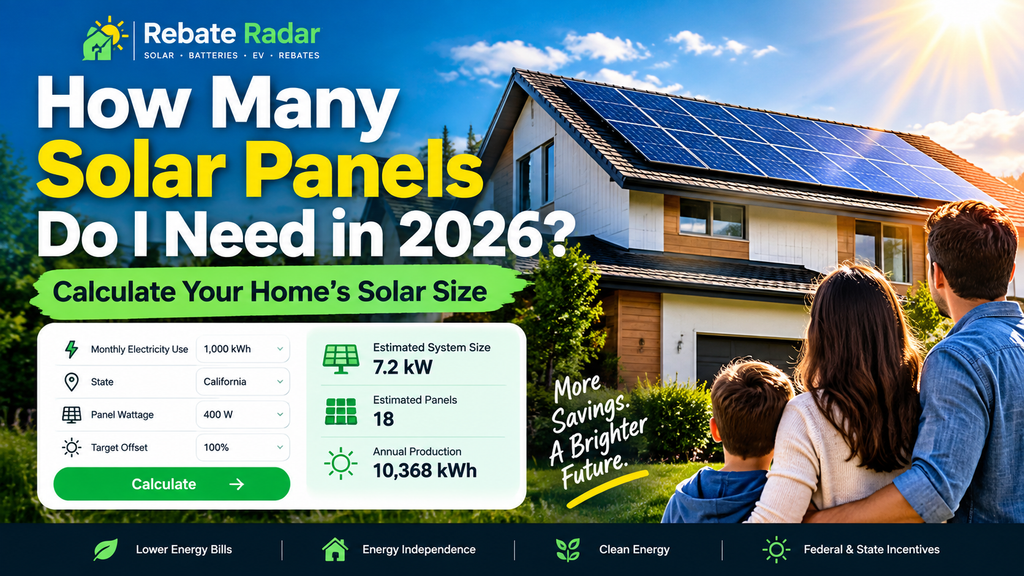
How Many Solar Panels Do I Need in 2026? Calculate Your Home’s Solar Size
Wondering how many solar panels do I need to power your home? This complete 2026 guide shows you how to estimate the number of panels, total solar system size, roof space, energy production and backup requirements using your electricity usage, panel wattage and solar conditions.
*Illustrative industry benchmark. Your actual panel count depends on electricity use, solar production, panel wattage, roof conditions and system design.
☀️ How Many Solar Panels Do I Need? Use the 2026 Calculator
Enter your electricity usage, desired solar offset, panel wattage and a planning-level solar production factor. The calculator estimates your annual energy requirement, approximate system size, number of panels and roof area.
How Many Solar Panels Do I Need?
If you are asking how many solar panels do I need, the most useful place to start is not the size of your house. It is your electricity consumption.
A solar system is designed around energy production. Your utility bill tells you approximately how much electricity your household consumes, while your location, roof orientation, shading and equipment determine how much electricity a solar array can produce.
That is why two houses with exactly the same square footage can require completely different solar systems. A 2,000-square-foot home with gas heating, gas water heating and relatively low electricity consumption could need fewer panels than a 1,300-square-foot home with electric heating, an electric water heater, an EV, a pool and heavy air-conditioning use.
The calculator above provides a transparent planning estimate. It is intentionally simple enough to understand while still accounting for the factors that matter most: electricity usage, desired solar offset, panel wattage and a production factor.
What Determines How Many Solar Panels Your Home Needs?
There are several important variables behind solar panel sizing. Understanding them will help you interpret the calculator result instead of treating the number as a guaranteed installation specification.
1. Your electricity consumption
Your annual electricity consumption is usually the most important starting point. If your utility bills show that you use 900 kWh per month, that is approximately 10,800 kWh per year.
If you use 1,500 kWh per month, your annual consumption is approximately 18,000 kWh. Naturally, the second home needs substantially more solar production if the goal is a similar percentage of annual electricity offset.
The best source for this number is your actual utility history. Twelve months of consumption is preferable because electricity demand often changes by season.
2. Solar resource
Solar panels do not produce the same amount of electricity everywhere. A system in a sunny location can produce more annual electricity per installed kilowatt than an otherwise identical system in a location with less solar resource.
Roof orientation, tilt, shading, weather, temperature, system losses and other site conditions also influence production.
3. Panel wattage
A 450-watt panel and a 400-watt panel are physically different pieces of equipment, but the higher-wattage panel can produce more power under the same rated conditions. Consequently, fewer high-wattage panels may be needed to reach the same total system capacity.
For example, a 10-kW array requires approximately 25 panels at 400W each, but only about 23 panels at 440W each if the equipment can be configured to reach the desired DC capacity.
4. Your desired solar offset
Not every homeowner needs or wants a system designed to offset 100% of annual electricity consumption.
Some households may target 50%, 75% or another percentage because of roof limitations, budget, utility rules, financing considerations or future plans.
5. Future electricity consumption
Your current electricity bill may not represent your future electricity needs.
If you are planning to purchase an EV, replace gas appliances with electric models, add a heat pump, install a pool or significantly increase air-conditioning use, it may be useful to consider those future loads when evaluating system size.
The Simple Solar Panel Sizing Formula
At a planning level, the calculation can be expressed using a few straightforward steps.
The production factor used by the calculator is intentionally presented as a planning assumption rather than a claim about the user’s exact property. Professional solar modeling can incorporate location, system losses, module characteristics, orientation, tilt and other factors.
How Many Solar Panels Do I Need to Power My House?
The answer depends on how much electricity your house consumes.
For example, suppose a household uses 1,000 kWh per month. That is approximately 12,000 kWh annually. A solar system intended to offset roughly 100% of that annual usage would need to be sized to produce approximately that amount of electricity under the property’s solar conditions.
A different home consuming 500 kWh per month would need approximately half the annual energy production, all else being equal.
This is why searching for a universal answer such as “every house needs 20 panels” is misleading. Panel count is the result of an energy calculation, not simply a property-size calculation.
How Many Solar Panels Do I Need for 1,000 kWh per Month?
A household consuming approximately 1,000 kWh per month uses around 12,000 kWh annually.
The exact number of panels depends on the site’s production and panel wattage.
| Panel wattage | Example panels for 10 kW | Approx. DC capacity |
|---|---|---|
| 400W | 25 | 10.0 kW |
| 420W | 24 | 10.08 kW |
| 440W | 23 | 10.12 kW |
| 450W | 23 | 10.35 kW |
These examples demonstrate why panel count alone is not enough. Two installations can contain different numbers of panels while having similar total system capacity.
How Many Solar Panels Do I Need for a 2,000 kWh Monthly Electricity Bill?
A household consuming 2,000 kWh per month uses approximately 24,000 kWh per year. That is a significant electricity load, so the required solar system can be substantially larger than the system for a household consuming 700 or 800 kWh per month.
High electricity consumption can come from multiple sources, including large homes, electric heating, electric water heating, central air conditioning, pools, workshops, EV charging and other high-energy appliances.
For a home with very high consumption, roof area can become an important constraint. The homeowner may need to consider higher-wattage modules, additional roof surfaces, ground-mounted solar or a lower annual offset.
How Many Solar Panels Do I Need for a 2,000 Square Foot House?
Square footage is useful context, but it is not a reliable standalone solar sizing method.
A 2,000-square-foot house can have dramatically different energy consumption depending on its climate, insulation, appliances, heating system, cooling system, number of occupants and lifestyle.
Instead of asking only how many panels a 2,000-square-foot house needs, ask:
- How many kWh does the home use each month?
- How much electricity is used annually?
- Which appliances create the largest loads?
- Will electricity consumption increase in the future?
- How much usable roof space is available?
- How much shade reaches the roof?
- What percentage of annual consumption should solar offset?
How Many Solar Panels Do I Need by State?
Solar panel sizing is sometimes presented as a state-by-state calculation, but state boundaries are too broad to produce a precise panel count by themselves.
Two properties in the same state can have different solar production because of local weather, orientation, roof pitch, shading, system design and other site-specific factors.
Your state is still useful for understanding incentives, utility programs, electricity prices and general solar conditions.
For state-specific incentive research, see our:
How Many Watts of Solar Do I Need?
Another way to think about the question is in terms of system capacity rather than panel count.
Solar systems are commonly described in kilowatts of DC capacity. A system containing 20 panels rated at 440W each has a nominal DC module capacity of approximately 8.8 kW.
Thirty 440W panels would have approximately 13.2 kW of module capacity.
| Number of panels | 400W panels | 440W panels | 450W panels |
|---|---|---|---|
| 10 | 4.0 kW | 4.4 kW | 4.5 kW |
| 15 | 6.0 kW | 6.6 kW | 6.75 kW |
| 20 | 8.0 kW | 8.8 kW | 9.0 kW |
| 25 | 10.0 kW | 11.0 kW | 11.25 kW |
| 30 | 12.0 kW | 13.2 kW | 13.5 kW |
| 40 | 16.0 kW | 17.6 kW | 18.0 kW |
How Many 400-Watt Solar Panels Do I Need?
The number of 400-watt panels depends on the total system capacity required.
For example, a 6-kW system would require approximately 15 panels at 400W each. An 8-kW system would require approximately 20 panels, while a 10-kW system would require approximately 25 panels.
These are capacity calculations rather than production guarantees. The amount of electricity the array actually generates depends on site conditions and system design.
How Many 440-Watt Solar Panels Do I Need?
At 440 watts per panel, a 10-kW array would require approximately 23 panels because 23 × 440W equals 10.12 kW.
A 12-kW array would require approximately 28 panels because 28 × 440W equals 12.32 kW.
Higher-wattage modules can be useful where roof space is limited because the same total capacity can sometimes be achieved with fewer panels.
How Many Solar Panels Do I Need for 10,000 kWh per Year?
A household using 10,000 kWh per year needs a solar system capable of producing approximately 10,000 kWh annually if the goal is roughly 100% annual offset.
The number of panels then depends on how much annual energy each installed kilowatt can produce at the property.
For example, if a planning model indicates that a certain system configuration can produce the required annual energy with approximately 7 kW of installed capacity, 16 panels at 440W would provide approximately 7.04 kW of DC module capacity.
A professional site-specific model should replace this simplified example before equipment is purchased.
How Many Solar Panels Do I Need for 15,000 kWh per Year?
A household consuming 15,000 kWh annually has a significantly larger energy requirement than the 10,000-kWh example.
The same basic calculation applies: determine the desired annual solar production, estimate the required system capacity using site-specific production assumptions, and then divide the system capacity by panel wattage.
What If I Do Not Know My Monthly Electricity Usage?
If you do not know your monthly kWh consumption, check your utility bill or online utility account first. Many electricity providers show current usage as well as historical monthly consumption.
If no historical data is available, you can build a rough estimate from your major electrical loads. This should be treated as a preliminary estimate rather than a substitute for actual utility data.
Major household loads that can affect solar sizing
- Central air conditioning
- Heat pumps
- Electric resistance heating
- Electric water heaters
- Clothes dryers
- Electric ranges and ovens
- Refrigerators and freezers
- Swimming pool pumps
- Well pumps
- EV charging
- Home offices and electronics
- Workshops and power tools
The most useful approach is to estimate each major load and then compare the result with actual utility consumption once data becomes available.
Do Appliances Change How Many Solar Panels I Need?
Yes. Appliances can materially change household electricity consumption.
However, appliances should generally be treated as a way to understand electricity demand rather than as the sole basis for a final solar design.
For example, adding an EV can substantially increase annual electricity consumption. Switching from gas heating to an electric heat pump can also change seasonal electricity demand. Similarly, an electric water heater or pool equipment can add meaningful consumption.
If you are planning one of these upgrades, consider future electricity use instead of designing the solar array only around today’s bill.
Solar Panels for an EV
An EV can increase household electricity consumption enough to affect solar system sizing.
The additional solar required depends on how many miles are driven, vehicle efficiency, charging habits and electricity usage.
If your current home uses 10,000 kWh annually and EV charging adds another 3,000 kWh per year, the solar system would need to account for approximately 13,000 kWh of annual demand if the goal is to offset both uses.
That is why a solar system should be evaluated against expected future electricity consumption rather than only today’s bill.
Solar Panels for a Heat Pump
Heat pumps can alter household electricity demand because they use electricity for heating and cooling.
The impact varies substantially by climate, building efficiency, equipment efficiency, thermostat settings and existing heating system.
If you are replacing another heating source with a heat pump, review your expected annual electricity consumption before finalizing solar system size.
Solar Panels for an Electric Water Heater
Electric water heating is another load that can affect household electricity consumption.
The actual impact depends on household size, hot-water usage, equipment efficiency and operating settings.
If your home is transitioning from gas to electric water heating, it may be useful to include that future electricity demand in your solar planning.
Solar Panels for a Pool
Swimming pools can require substantial electricity depending on pump size, operating schedule, heating equipment and climate.
A pool pump operates for many hours, so even moderate electrical demand can accumulate over a year.
If you have a pool or plan to add one, include the expected annual electricity consumption when determining your desired solar offset.
How Much Roof Space Do Solar Panels Need?
Panel count is only half of the physical planning question. The other half is whether your roof has enough usable space.
A rough planning assumption is approximately 18–22 square feet per residential panel, although actual panel dimensions vary by manufacturer and model.
That means 20 panels might require roughly 360–440 square feet of panel area before considering setbacks, access pathways, roof geometry and other installation requirements.
Usable roof area can be reduced by chimneys, vents, skylights, dormers, roof edges, shading and required access areas.
Does Roof Orientation Matter?
Yes. Roof orientation can affect solar production.
The ideal configuration depends on geographic location and the specific site. A professional design can model different roof planes, tilt angles and orientations to estimate production.
A roof with excellent usable area but significant shading may perform differently from a smaller, unobstructed roof.
Does Shading Change the Number of Solar Panels I Need?
Yes. Shade can reduce the electricity produced by a solar array.
Trees, neighboring buildings, chimneys and other structures can affect different parts of a roof at different times of day and throughout the year.
This is one reason an address-level solar production model is more useful than a generic “panels by state” chart.
Solar Panel Efficiency vs. Panel Wattage
Panel wattage and efficiency are related but are not identical concepts.
Wattage describes the rated electrical output under specified test conditions. Efficiency describes how effectively a panel converts incoming sunlight into electricity relative to its surface area.
For homeowners with limited roof space, higher-power or higher-efficiency panels can potentially help fit more system capacity into the available area.
However, the highest-rated panel is not automatically the best choice for every property. Equipment cost, warranty, availability, installer design and roof constraints also matter.
Solar Panels With a Battery vs. Solar Panels Without a Battery
Solar panels and batteries solve different problems.
Solar panels generate electricity. A battery stores electricity for later use.
If your primary goal is reducing annual grid electricity consumption, the solar array is generally sized around annual energy production.
If your goal includes backup during outages, battery sizing becomes a separate calculation based on the loads you want to operate and how long you want them to run.
For more information, see our guide: How Many Home Batteries Do I Need in 2026?
Solar + Battery Is Not the Same as Solar Sizing Alone
A homeowner may have enough solar panels to offset annual electricity consumption but still need additional battery capacity for nighttime usage or extended outages.
Conversely, a battery can provide backup without increasing the number of solar panels, although the system’s charging strategy and available energy production become important.
Think of solar capacity and battery capacity as two separate but connected design questions.
How Many Solar Panels Do I Need for Off-Grid Power?
Off-grid solar sizing is more complicated than ordinary grid-connected solar sizing.
An off-grid system has to consider not only annual energy consumption but also daily energy demand, battery storage, inverter capacity, seasonal production, backup generation and periods of unfavorable weather.
A system that produces enough electricity over an entire year may still be inadequate for an off-grid home during several consecutive low-production days.
For that reason, off-grid sizing should be treated as an engineering exercise rather than a simple panel-count calculation.
How Many Solar Panels Do I Need for Whole-House Power?
“Whole-house solar” does not automatically mean every appliance can operate simultaneously without limits.
Solar panel capacity is measured as energy-producing equipment, while the home’s instantaneous electrical demand is measured in power.
Large loads such as HVAC compressors, electric ranges, water heaters and EV chargers can create high instantaneous demand. The inverter, electrical service and system architecture must be capable of handling the relevant loads.
If backup operation is also required, the battery and inverter configuration becomes especially important.
Solar Panel Production: Why the Number of Panels Is Not Enough
Two systems with the same number of panels can produce different amounts of electricity.
Production depends on panel wattage, location, orientation, tilt, shading, weather, temperature, system losses and other design characteristics.
That is why professional tools such as NREL’s PVWatts are useful for moving from a generic estimate to a location-specific production model.
Using a Solar Calculator by State
A solar calculator can be useful for comparing scenarios, but a state dropdown should not be mistaken for an engineering model.
The calculator on this page uses the selected state as contextual information while allowing the user to choose a production factor separately. This makes the calculation transparent instead of hiding assumptions behind a state name.
For more detailed state incentive research, visit our: Solar Rebate Incentive Calculator by State.
How Much Does a Home Solar System Cost?
The cost of a solar installation depends on system size, equipment, labor, roof complexity, electrical work, location, financing and other factors.
A larger solar system generally requires more equipment and installation work, but price per watt can vary significantly between projects.
Instead of multiplying panel count by a generic online panel price, homeowners should compare complete installed-system proposals.
A quote should clearly identify system capacity, equipment, estimated annual production, warranties, installation scope and any assumptions that affect the price.
Solar Payback Period
Solar payback depends on the installed cost, electricity prices, solar production, utility compensation rules, financing and available incentives.
The same solar system can have different economics in different locations because electricity rates and compensation structures vary.
You can explore this topic further in our: Solar Panel Payback Period 2026 guide.
You can also use the: Solar Payback Calculator for additional planning.
Solar Incentives and Tax Credits in 2026
Solar incentives are another important part of the purchasing decision, but homeowners should verify current rules rather than relying on older articles that still describe previous federal incentives.
The federal Residential Clean Energy Credit under Section 25D applied to qualifying property placed in service through December 31, 2025. The rules changed for property placed in service after that date, so a 2026 solar purchase should not automatically be assumed to qualify for the former 30% residential credit.
State, utility and local programs can still differ by location and program year, so incentive eligibility should be verified before making a purchase.
For additional research, see: Solar Tax Credit 2026, Federal Solar Rebates 2026, and Solar Rebate Eligibility Checker 2026.
Common Solar Panel Sizing Mistakes
Mistake #1: Using house size as the main calculation
Square footage can provide context, but electricity consumption is much more useful for sizing.
Mistake #2: Assuming every state needs the same number of panels
Solar production varies by location and property characteristics.
Mistake #3: Ignoring future electricity consumption
An EV, heat pump, electric water heater or pool can significantly change future electricity demand.
Mistake #4: Looking only at panel wattage
Panel wattage matters, but annual production depends on more than the nameplate rating.
Mistake #5: Ignoring roof space
A theoretical system size is not useful if the property cannot physically accommodate the required array.
Mistake #6: Treating a calculator result as an engineering design
A calculator is a planning tool. Final system design requires property-specific information.
How to Calculate Your Solar System Step by Step
- Find your average monthly electricity consumption. Use actual utility data when possible.
- Multiply monthly usage by 12. This gives approximate annual electricity consumption.
- Choose your desired solar offset. Consider whether you want to offset 50%, 75%, 100% or another percentage.
- Estimate site-specific solar production. Use a reputable solar modeling tool or professional design.
- Determine approximate system capacity. Convert annual energy needs into the required solar system size.
- Select a panel wattage. Compare the number of panels required at different wattages.
- Check roof space. Confirm that the usable roof area can accommodate the array.
- Account for shading and orientation. These can materially affect production.
- Consider future loads. Include planned EVs, heat pumps and other electrical upgrades.
- Compare complete installation proposals. Look beyond panel count alone.
How Many Solar Panels Should I Buy?
Do not begin the purchasing decision with a panel count alone.
Begin with your electricity consumption and the amount of annual energy you want solar to offset. Then determine how much production the property can realistically support.
Once the required system capacity is understood, panel wattage becomes useful for determining the number of modules.
For example, a homeowner might discover that approximately 9 kW of DC capacity is appropriate for a particular planning scenario. That could be approximately 23 panels at 400W, 22 panels at 420W, 21 panels at 440W or 20 panels at 450W, depending on the final equipment configuration.
The important number is not simply “21 panels.” It is the complete system’s ability to meet the home’s energy and electrical requirements.
What Our Solar Panel Calculator Can and Cannot Tell You
Frequently Asked Questions About How Many Solar Panels I Need
How many solar panels do I need to power my house?
The number depends on your annual electricity consumption, local solar production, panel wattage and desired solar offset. There is no universal panel count for every home.
How many solar panels do I need for a 2,000 square foot house?
Square footage alone cannot determine panel count. A 2,000-square-foot home can have very different electricity consumption depending on heating, cooling, appliances, occupants and climate.
How many solar panels do I need for 1,000 kWh per month?
A home using 1,000 kWh monthly consumes approximately 12,000 kWh annually. The required panel count depends on local solar production and panel wattage.
How many 400 watt solar panels do I need?
It depends on the desired system capacity. A 10-kW system would require approximately 25 panels rated at 400W each.
How many 440 watt solar panels do I need?
A 10-kW system would require approximately 23 panels rated at 440W, providing about 10.12 kW of nominal DC module capacity.
Does a bigger house need more solar panels?
Not necessarily. Electricity consumption is generally more useful than square footage for determining solar energy requirements.
Do I need fewer solar panels in a sunny state?
Potentially, for the same annual electricity requirement and panel configuration, a site with stronger solar production may require less installed capacity. However, state alone is not enough to determine the exact number.
How much roof space do solar panels need?
A rough planning estimate is around 18–22 square feet per residential panel, but actual panel dimensions and installation requirements vary.
Do I need more solar panels if I have an EV?
An EV can increase annual electricity consumption. If you want solar to offset that additional charging energy, the extra electricity demand should be included in system sizing.
Do solar batteries change how many solar panels I need?
A battery primarily changes how electricity is stored and used over time. Solar panel sizing and battery sizing are related but separate calculations.
Can solar panels power my whole house?
A properly designed solar system can supply a substantial portion or potentially all of a home’s annual electricity demand, depending on system size and site conditions. Whole-home backup during outages requires additional inverter and battery considerations.
Can I calculate solar panel size without a solar installer?
You can create a preliminary estimate yourself using electricity usage and production assumptions. A final system should be based on property-specific production modeling and professional design.
Related Rebate Radar Solar & Energy Calculators
How Rebate Radar Calculates Solar Panel Estimates
This guide is designed to explain the underlying calculation rather than present a black-box number. The calculator starts with electricity consumption, applies the desired solar offset and uses an explicit production factor to estimate the approximate system capacity and panel count.
For more advanced production estimates, tools such as NREL’s PVWatts can incorporate location and system characteristics including system size, orientation, tilt and system losses.
Residential electricity consumption varies substantially between households, so actual utility data is preferred whenever available.
What We Verify
Rebate Radar’s energy guides are designed around primary or established sources where practical, including government and research resources. Solar production methodology is informed by NREL resources, residential electricity-use information is informed by U.S. Energy Information Administration data, and federal incentive discussions are checked against IRS guidance.
What This Guide Is For
This page is intended for homeowners, renters researching solar, property owners, EV owners and anyone trying to understand how solar system sizing works before requesting quotes.
What This Guide Is Not
This page is not an engineering report, installation quote, structural assessment, electrical design, utility interconnection application or guarantee of annual solar production.
Last reviewed: September 2026. Solar incentives, utility programs, equipment pricing and electricity rates can change. Verify current rules and project-specific assumptions before making a purchase or financial decision.
Ready to Find Out How Many Solar Panels You May Need?
Start with your real electricity consumption, choose your target solar offset and compare different panel wattages using the calculator above. Then use a site-specific solar production model to refine the estimate before comparing installation proposals.
Calculate My Solar Size ↑This guide uses established solar-energy and residential-energy resources for methodology and context, including the National Renewable Energy Laboratory’s PVWatts resources, U.S. Energy Information Administration residential electricity data, and Internal Revenue Service guidance for federal residential clean-energy tax-credit information.
Disclaimer: Solar production estimates are illustrative unless generated from a property-specific model. Actual results vary according to location, roof orientation, tilt, shading, weather, equipment, system losses, utility requirements and other factors. Incentive eligibility depends on the applicable program rules and taxpayer/project circumstances. Rebate Radar does not provide legal, tax, engineering or financial advice.