
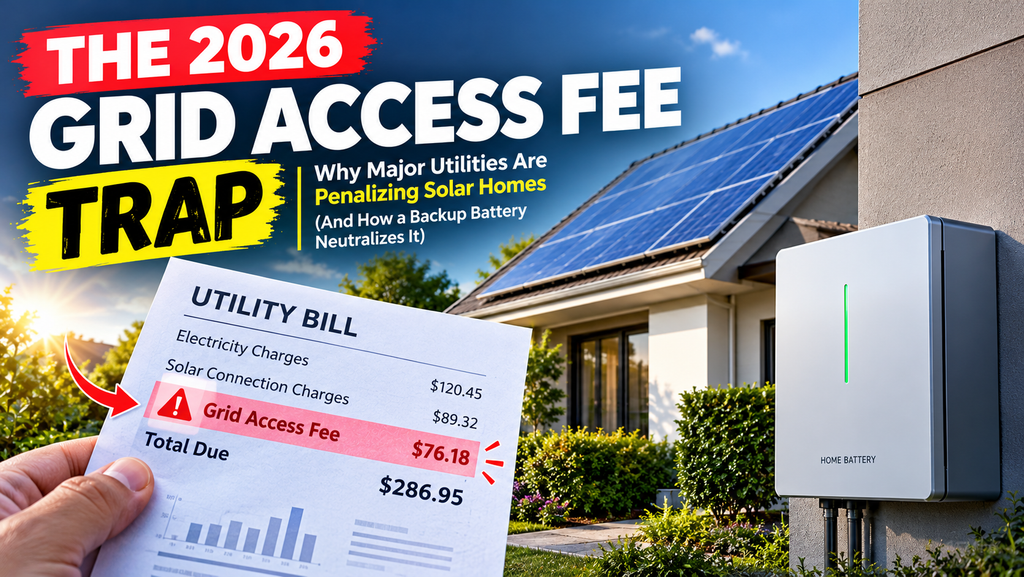
Solar Grid Access Fee 2026: The “Grid Access Fee” Trap and Why a Battery Can Change the Math
Rooftop solar can dramatically reduce the electricity you buy from a utility—but a solar home does not automatically stop paying for the grid. In 2026, fixed charges, minimum bills, changing export compensation and new rate structures are becoming a bigger part of the solar equation.
The short answer
There is no single nationwide “solar grid access fee” that every U.S. utility charges in 2026. What homeowners are seeing instead is a mixture of fixed monthly charges, minimum bills, customer charges, interconnection charges and changes to how exported solar electricity is credited.
Those costs can make a solar-only system less attractive in some markets because solar panels produce most of their electricity during the day while many homes consume more electricity in the evening.
A battery can sometimes improve the economics by allowing a homeowner to use more of their own solar energy instead of exporting it. But a battery does not automatically eliminate a utility’s fixed charge. The real benefit depends on your utility tariff, export rate, time-of-use schedule, battery cost and household consumption.
What is a “solar grid access fee” in 2026?
The phrase solar grid access fee sounds like one specific charge appearing on every solar homeowner’s electricity bill. It is not.
Different utilities and regulators use different names and structures. You may encounter terms such as customer charge, base charge, minimum bill, fixed charge, grid access charge, distribution charge, service charge, interconnection fee, or base services charge.
These charges exist because a homeowner can dramatically reduce the amount of electricity purchased from the grid without disconnecting from the grid itself. The utility still maintains poles, transformers, wires, meters, substations, billing systems, emergency infrastructure and other equipment needed to provide service.
That creates a basic policy question: if a solar customer buys very little electricity, how should that customer contribute to the fixed cost of maintaining the electric system?
Utilities and regulators answer that question differently. Some costs remain embedded in the per-kWh rate. Others are recovered through fixed monthly charges. Some markets also change the compensation paid for excess solar exported to the grid.
This distinction matters when evaluating headlines about a utility penalty for solar panels. A homeowner should not assume that every new charge is targeted specifically at solar customers. Instead, look at the actual tariff and determine which charges your solar production can offset and which charges remain.
Why is the solar bill changing in 2026?
The economics of rooftop solar have evolved considerably. In the early years of residential solar, many homeowners evaluated a system primarily by comparing the price of electricity from the utility with the amount of electricity their panels could produce.
That calculation is now incomplete.
The more useful question is: What is each kilowatt-hour of solar electricity worth at the exact moment it is produced?
If your home is using electricity at noon, solar energy can directly replace electricity you would otherwise purchase from the utility. That is usually straightforward.
But if your panels produce 8 kWh of excess energy at 1 p.m. and your household needs 6 kWh at 8 p.m., the value of those two periods may not be the same.
Depending on the utility’s tariff, the 8 kWh exported during the afternoon may receive a credit that is lower than the retail price you would have paid for electricity later in the evening.
This is one reason solar-plus-storage has become more important in certain markets. Instead of immediately exporting every excess kWh, the battery can store some of that energy and make it available later.
Fixed charges
Some utility costs are collected regardless of how many kWh you buy. Solar generally does not eliminate these charges.
Export compensation
Excess solar sent to the grid may be credited differently from electricity purchased from the grid.
Time-of-use rates
Electricity can cost more during certain hours. A battery can shift solar energy into higher-value periods.
The result is a major change in how homeowners should evaluate solar. A system that produces plenty of energy may still have disappointing savings if a large percentage of that energy is exported at a relatively low credit while the homeowner continues purchasing expensive evening electricity.
Florida: the “grid access fee” conversation is especially important
Florida is one of the most interesting states for this discussion because it has a large residential solar market, significant electricity demand and utility tariffs that illustrate the difference between energy charges and fixed customer costs.
For example, Florida Power & Light currently states that its residential net-metering customers are subject to a $30 minimum base bill. FPL explains that the minimum base bill helps ensure customers contribute to fixed system costs such as poles, transformers and wires.
That is an important example because it shows exactly why saying “solar eliminates your electric bill” can be misleading. Solar may substantially reduce the energy component of a bill without making the customer completely independent of the utility.
Florida’s broader statutory framework also requires utilities to maintain standardized interconnection and net-metering programs for qualifying customer-owned renewable generation. The exact economics still depend on the applicable utility tariff and the customer’s situation.
FPL also has specific requirements for customer-owned battery systems. Its published guidance distinguishes behind-the-meter battery storage from renewable generation and states that battery systems installed as emergency backup without renewable generation can operate differently from systems that remain continuously interconnected with the utility.
That means homeowners should not simply assume that adding a battery to a solar system is an informal plug-and- play upgrade. Interconnection, equipment certification and export settings can matter.
If you’re researching Florida solar incentives as part of a larger project, our Florida Solar Rebates 2026 guide can help you separate state-level incentives from utility-specific economics.
California shows why fixed charges and batteries are becoming more important
California provides another useful example because the state has been redesigning residential electricity pricing while simultaneously changing the economics of rooftop solar.
The California Public Utilities Commission explains that its investor-owned utilities are implementing a Base Services Charge that recovers certain fixed costs of providing electric service. The charge is not presented by the CPUC as a solar-only penalty; instead, it shifts part of the cost recovery from volumetric electricity rates into a separate fixed line item.
For standard residential customers, the CPUC’s published structure has used a higher fixed charge than the discounted amounts available to qualifying CARE and FERA customers.
At the same time, California’s Net Billing Tariff changed the value of exporting excess rooftop solar. The CPUC specifically explains that the newer tariff was designed to better align compensation for excess generation with the value that generation provides and to encourage customers to pair solar with batteries.
This combination is important.
A homeowner can have a fixed monthly charge that remains even after installing solar while also facing a lower economic value for certain exported kWh. In that environment, increasing self-consumption can become more important than simply installing enough panels to maximize annual production.
The new solar question is no longer simply “How much electricity can my roof produce?” It is “How much of that electricity can my household use at the highest-value time?”
Rebate Radar analysis of 2026 residential solar economicsThis is also why a battery should not be marketed as a magic device that “beats the utility.” Its value comes from changing the timing of electricity consumption.
The real problem: solar production and household consumption rarely match perfectly
Consider a typical household with solar panels on a sunny day.
At 11 a.m., the panels may produce more electricity than the home needs. The excess goes to the grid. At 7 p.m., the sun is gone, the air conditioner may still be running, the kitchen may be active, and the household may be charging an electric vehicle.
Without storage, the homeowner can end up in a cycle of exporting inexpensive daytime electricity and purchasing electricity later when it has greater value.
With a battery, some of that daytime surplus can be shifted into the evening.
| Scenario | Daytime | Evening | Potential result |
|---|---|---|---|
| Solar only | Excess solar exported | Grid electricity purchased | More dependence on export-credit rules |
| Solar + battery | Solar charges battery | Battery supplies household loads | Higher self-consumption potential |
| Battery without solar | Battery can charge from grid | Battery discharges later | Potential TOU arbitrage or backup value |
The battery therefore addresses a different problem than the fixed utility charge itself. It can improve the value of your energy strategy even when the charge remains on the bill.
How a backup battery can reduce the impact of changing solar economics
The phrase “avoid solar fees with battery” is popular online, but it needs a reality check. A battery does not normally make a utility charge disappear.
What it can do is reduce the amount of electricity your household needs to purchase from the grid, especially during expensive periods or after the sun goes down.
That distinction is critical.
Suppose a utility charges a fixed monthly amount of $30. Installing a battery does not necessarily turn that $30 into $0.
But if the battery allows the homeowner to reduce expensive evening purchases by $45 per month, the battery could still improve the overall economics of the home energy system.
The question is therefore not: “Does the battery remove the fee?”
The better question is: “Does the battery create enough additional value to justify its cost after the utility’s fixed charges and export rules are included?”
Higher self-consumption
More of your solar production can potentially be used inside the home rather than exported immediately.
Peak-hour shifting
Stored energy can potentially be used when utility electricity is more expensive under time-of-use rates.
Backup power
A battery can provide resilience during qualifying outages when installed and configured appropriately.
These benefits can exist simultaneously, which is why the economics of home energy storage backup should not be reduced to one simple “fee avoidance” calculation.
Why a battery does NOT automatically neutralize a grid access fee
This is one of the most important sections of the entire article.
A homeowner should be skeptical of any solar salesperson or online calculator that promises a battery will completely eliminate utility charges.
A battery can reduce grid electricity purchases. It cannot rewrite a utility tariff.
If your utility has a customer charge, minimum bill or base services charge, that charge may continue after you install solar and storage.
Similarly, if the utility requires a specific interconnection agreement for a battery capable of exporting energy, the system may require additional approval, equipment or configuration.
FPL, for example, publishes specific technical requirements for behind-the-meter battery storage and explains that battery systems connected in certain configurations are treated differently depending on whether they export electricity.
The battery strategy is strongest when it solves multiple problems at once:
- Reducing expensive evening electricity purchases.
- Increasing the share of solar energy consumed on-site.
- Reducing exposure to lower-value solar exports.
- Providing backup power during outages.
- Potentially participating in demand-response or virtual power plant programs where available.
- Helping manage electricity consumption under time-of-use pricing.
Net metering may matter more than the fee itself
When homeowners hear about a new solar connection charge, the instinct is often to focus on the dollar amount of the charge.
But the value of exported solar electricity can have an even larger effect on the long-term economics of a solar installation.
Net metering and successor programs determine what happens when your solar system generates more electricity than your home is consuming.
Some programs provide relatively strong bill credits. Others compensate exported electricity at a different rate or use a more complicated calculation.
That is why a solar proposal should always identify the specific utility program—not simply say “net metering available.”
This issue becomes especially relevant in 2026 because many homeowners are now evaluating solar and batteries together rather than treating storage as an optional luxury.
We recently published a deeper guide on this exact shift: 2026 Net Metering Changes: Why Solar + Battery Economics Are Changing . That article explains why changes to export compensation can make self-consumption and storage more valuable in some markets.
The important point is not that every utility is “killing solar.” It is that the financial value of solar is increasingly dependent on when electricity is produced, when it is consumed and how the utility values exports.
Solar grid access fee vs. solar connection charge: they are not the same
Search results often mix several different concepts together. That can make solar research confusing.
| Term | What it usually refers to | When it matters |
|---|---|---|
| Fixed/customer charge | A recurring charge for maintaining electric service. | Every month, regardless of solar production. |
| Minimum bill | A minimum amount a customer may owe even with low net usage. | Especially important for high-solar or low-usage homes. |
| Grid access charge | A term that may describe a tariff-specific charge for grid service. | Depends entirely on the utility and tariff. |
| Interconnection charge | Costs associated with connecting generation or storage to the grid. | Usually during installation or system changes. |
| Export compensation | The value credited for electricity sent to the grid. | Critical for calculating solar payback. |
| Base Services Charge | A California rate-design mechanism for recovering certain fixed costs. | Important to California residential customers. |
Knowing which category you are dealing with prevents a common mistake: assuming that buying a battery automatically eliminates every solar-related cost.
How big should your battery be?
A battery should be sized around your actual energy profile—not simply around the size of your solar array.
A homeowner with 10 kW of solar does not automatically need a 20 kWh battery. Another homeowner with the same solar system may have a very different storage requirement because of air-conditioning demand, electric vehicles, pool equipment, heat pumps, household occupancy and evening usage.
Start with your evening load
If your goal is to shift solar energy into the evening, examine how much electricity your household consumes after solar production falls.
If your home regularly uses 8 kWh between 5 p.m. and midnight, a battery capable of delivering a meaningful portion of that energy may be more useful than an oversized battery that spends much of the year partially idle.
Then examine backup requirements
Backup power is a separate calculation.
Running a refrigerator, Wi-Fi equipment, lights and a few essential circuits requires dramatically less energy than running central air conditioning, electric water heating, an induction range and an EV charger during an outage.
If your main objective is resilience rather than bill savings, the battery should be designed around your critical loads and expected outage duration.
Our guide How Many Home Batteries Do I Need in 2026? goes deeper into battery sizing, usable capacity and household load assumptions.
You can also compare the economics of storage with our Home Battery Storage Without Solar guide if you are considering storage independently of rooftop solar.
When does a battery make more sense than simply adding more solar panels?
More solar panels make the most sense when your home can use the additional generation or when your utility provides strong value for exported electricity.
A battery becomes more compelling when additional solar would mostly be exported or when evening electricity is substantially more valuable than daytime electricity.
More solar may win
Strong export compensation, high daytime consumption, limited storage budget and a favorable net-metering structure can favor additional panels.
Battery may win
Lower export value, high evening consumption, time-of-use rates and frequent outages can improve the usefulness of storage.
Solar + battery may win
The strongest case can occur when both solar generation and storage provide separate financial or resilience benefits.
This is why homeowners should avoid the simplistic argument that batteries are either “necessary” or “a waste of money.” The answer depends on the tariff.
A good solar proposal should show the difference between:
- Solar-only annual bill savings.
- Solar + battery annual bill savings.
- Remaining fixed or minimum charges.
- Value of exported electricity.
- Battery replacement assumptions.
- Financing costs, if applicable.
- Backup-power value.
How utility “penalties” can affect solar payback
Suppose a homeowner spends $25,000 on a solar system.
If the system reduces annual electricity costs by $2,000, the simple energy-only payback is approximately 12.5 years before accounting for financing, maintenance, degradation, incentives and other variables.
Now imagine that the homeowner’s actual bill remains higher than expected because of fixed charges, minimum bills or a less favorable export rate.
The annual savings may be lower.
That does not necessarily make solar a bad investment. It means the original sales estimate may have been based on an incomplete understanding of the tariff.
The same principle applies to batteries. A battery may improve annual savings, but its purchase price can increase the upfront investment enough that the simple payback becomes longer.
That is why a battery should be evaluated using multiple objectives: bill savings + backup value + energy independence + tariff protection + potential program revenue.
2026 Solar Grid Access Fee & Battery Impact Calculator
Use this simple educational calculator to estimate how fixed utility charges and annual bill savings affect a solar or battery project. It is not a utility bill estimator, tax calculator or financial guarantee.
Estimate your simple economics
This calculation is intentionally simple. Real-world solar and battery economics can include degradation, financing, taxes, incentives, maintenance, replacement costs, export compensation, demand charges, time-of-use rates and changes in utility tariffs.
What homeowners should ask before signing a solar contract in 2026
The biggest mistake is asking only, “How many panels am I getting?”
A better set of questions focuses on the tariff.
- What utility tariff will my home use after installation?
- What is the current fixed monthly customer charge?
- Is there a minimum monthly bill?
- What charges can solar credits actually offset?
- What is the current value of exported solar electricity?
- Can that export value change over time?
- What happens if I add a battery later?
- Does the battery require a separate interconnection approval?
- Can the battery export energy to the grid?
- What equipment is required for backup operation?
- How much usable battery capacity am I actually buying?
- What happens to the economics if electricity rates change?
If the salesperson cannot answer these questions, do not rely solely on the proposal’s estimated 20- or 25-year savings chart.
Battery options: what to evaluate before buying
A battery is not automatically a good investment simply because utility rates are rising. The equipment itself must be evaluated.
Look at usable capacity, continuous power output, peak output, warranty terms, cycle limitations, operating temperature, integration with your inverter, backup-panel requirements and whether the system can actually perform the operating mode you need.
Portable power stations can also be useful for certain backup scenarios, but they should not automatically be treated as equivalent to a permanently installed home battery.
For example, a portable system may be attractive for emergency backup, camping or selected appliances, while a permanently installed storage system may be better suited to whole-home backup and automated solar load shifting.
If you are comparing equipment, our Home Battery vs. Generator 2026 guide explains the major differences between the two approaches.
You can also compare the expected project cost with our Home Battery Backup Cost 2026 guide .
Equipment worth researching before buying
EF ECOFLOW DELTA Pro Ultra + Extra Battery
A high-capacity portable/expandable backup option worth comparing with permanently installed storage. Check current specifications, installation requirements and utility/program rules before purchase.
EF ECOFLOW DELTA 2 Max + 400W Solar Panel
A smaller portable solar-storage option for selected backup and off-grid applications. It should not be assumed to qualify for a residential tax credit or utility incentive without verifying the applicable rules.
Emporia Energy Monitor + Smart Plugs
Monitoring can help homeowners understand which appliances consume the most electricity before sizing solar or storage. Measurement is often more useful than guessing.
How to reduce the impact of solar connection charges without overspending
The best strategy is usually not “buy the biggest battery possible.”
Instead, work backward from your utility bill.
Step 1: Identify your unavoidable charges
Find the customer charge, base charge or minimum bill on your actual utility tariff. These are the costs your solar system may not be able to eliminate.
Step 2: Identify the value of your solar exports
Determine how much your utility credits you for excess generation. Do not confuse the retail rate you pay with the rate or formula used to value exported electricity.
Step 3: Measure your evening consumption
Look at the hours after solar production falls. If your household consumes a large amount of electricity during these hours, storage may have greater value.
Step 4: Compare solar-only against solar + battery
Demand two separate financial models. One should show solar alone. The second should show solar plus storage. Compare total project cost, expected bill savings and remaining utility charges.
Step 5: Stress-test the assumptions
Ask what happens if the utility changes export compensation, electricity prices grow more slowly than expected, the battery degrades faster than expected or the system produces less energy than projected.
A project that still looks reasonable under conservative assumptions is generally more compelling than one that only works under an optimistic 25-year forecast.
2026 solar incentives can still matter—but do not confuse them with utility charges
Another common mistake is combining rebates, tax incentives and utility billing rules into one number. They are separate pieces of the financial puzzle.
A state rebate may reduce your upfront cost. A utility rebate may reduce the cost of storage. A tax incentive may reduce tax liability if you qualify. A net-metering program determines how exports are credited. A fixed charge determines part of the cost of maintaining service.
These mechanisms interact economically, but they are not interchangeable.
If you are researching incentives by state, start with our Solar Rebate & Incentive Calculator by State for 2026 .
You can also use our broader Home Energy Rebates 2026 guide to investigate other efficiency and electrification programs.
Never assume that two incentives can be stacked. Program rules can limit combinations, and utility-specific requirements can change the effective value of an incentive.
The 8 biggest mistakes homeowners make with the 2026 grid-fee story
1. Assuming solar eliminates the entire electric bill
Solar can reduce energy purchases without eliminating fixed charges or minimum bills.
2. Assuming every utility has a “solar penalty”
Utility rate structures vary dramatically by state, utility and customer class.
3. Treating a battery as a fee eraser
A battery can reduce grid purchases but usually does not rewrite the utility’s tariff.
4. Ignoring export compensation
A lower export value can materially change the economics of additional solar generation.
5. Buying too much battery
Oversizing can increase the project cost without creating enough additional bill savings.
6. Ignoring backup-load requirements
Whole-home backup can require substantially more power and equipment than backup for a few essential circuits.
7. Trusting a 25-year savings chart without reading the assumptions
Utility rates, export programs, battery performance and household electricity use can change.
8. Confusing marketing language with a tariff
Words such as “grid access fee,” “solar penalty” and “battery protection” can be useful search terms, but the actual utility tariff is the source that determines what you owe.
Is a battery worth it in 2026?
Sometimes.
The answer becomes more favorable when several factors line up:
- Your utility gives exported solar electricity relatively low value.
- Your home uses significant electricity in the evening.
- Your utility has meaningful time-of-use price differences.
- You experience frequent or costly power outages.
- You have a program that rewards demand response or battery participation.
- You can install storage at a reasonable net cost after available incentives.
- You value resilience in addition to financial savings.
The case becomes weaker when the battery is extremely expensive, your export compensation is already very favorable, your household uses little electricity after sunset, or you rarely need backup power.
That is why the best answer is not “everyone needs a battery.”
The better answer is: the more a utility’s rate structure rewards self-consumption and the more valuable backup power is to you, the more carefully you should model storage.
How the 2026 grid-fee story could evolve
Electricity pricing is not static.
Utilities are investing in grid infrastructure, regulators are changing rate structures, states are revising solar programs and customers are installing increasingly large amounts of distributed generation and battery storage.
That means homeowners buying a system today should care about the rules that apply now while also understanding that long-term economics can change.
The most resilient energy strategy is not necessarily the one with the most panels or the largest battery. It is the one that remains useful under multiple plausible rate scenarios.
A well-designed system can provide value through more than one channel:
Energy savings
Reduce electricity purchased from the utility.
Load shifting
Move stored solar energy into higher-value hours.
Resilience
Maintain selected household loads during outages.
This multi-value approach is much more realistic than treating the battery as a single-purpose tool for “avoiding solar fees.”
Before you buy solar, check the bill—not just the panels.
The most important number in a solar proposal may not be the number of panels. It may be the utility tariff behind the proposal.
Check your fixed charges, export compensation, time-of-use schedule, minimum bill and battery rules before deciding whether solar-only or solar-plus-storage makes the most sense.
Explore the Solar Savings CalculatorSolar Grid Access Fee 2026 FAQ
Is there a nationwide solar grid access fee in 2026?
No. There is no single nationwide residential “solar grid access fee” that applies to every U.S. utility. Utilities use different combinations of fixed charges, minimum bills, customer charges and other tariff structures.
Do solar panels eliminate my electric bill?
Not necessarily. Solar can dramatically reduce energy purchases, but customers may still owe fixed charges, minimum bills, taxes, fees or charges that solar credits cannot offset.
Can a battery eliminate a solar grid access fee?
Usually, you should not assume that it can. A battery can reduce electricity purchased from the grid, but a fixed utility charge may remain. The exact answer depends on the utility tariff.
Why does a battery help if the fixed charge remains?
Because the battery can change when you use electricity. It may store excess solar during the day and supply your home later, reducing purchases during higher-value periods.
Does Florida have a solar grid access fee?
Florida does not have one universal statewide residential charge that should be described as a single “solar grid access fee.” Utility tariffs differ. FPL, for example, currently publishes a $30 minimum base bill for residential customers, including net-metering customers.
Does FPL charge solar customers a monthly minimum?
FPL currently states that its $30 minimum base bill ensures customers contribute to fixed system costs. Homeowners should verify the current tariff and applicable customer class before relying on any calculation.
Why is California important to the 2026 solar fee discussion?
California is implementing a Base Services Charge that recovers certain fixed electric-service costs while also operating a Net Billing Tariff that changes the economics of exported rooftop solar. The combination makes solar self-consumption and storage particularly important to evaluate.
Is net metering still important in 2026?
Yes. The rules governing how exported electricity is credited can have a major effect on the economics of rooftop solar. Homeowners should evaluate the exact utility tariff rather than assuming all net-metering programs have the same value.
Should I buy a battery with solar in 2026?
It depends. A battery may be attractive when export compensation is relatively low, evening electricity is expensive, backup power is valuable or demand-response opportunities exist. It may be less attractive when storage costs are high and the utility already provides strong value for exported solar.
What is the biggest mistake when calculating solar savings?
Using annual solar production alone. A better calculation considers when the home consumes electricity, how exported energy is credited, which fixed charges remain and how the utility tariff could affect the system’s actual bill savings.
Our methodology: how to research a solar fee correctly
Final takeaway: the “fee” is only half the story
The biggest mistake in the 2026 solar market is thinking about the electric bill as one number.
Your bill is a collection of different economic mechanisms.
Some charges are tied to electricity consumption. Some are fixed. Some depend on the utility’s tariff. Some relate to solar exports. Some may change depending on time of day.
That is why the phrase “solar grid access fee 2026” has attracted so much attention. The underlying issue is real: solar homeowners cannot assume that producing enough electricity to cover annual consumption will automatically eliminate every component of the utility bill.
But the viral version of the story is too simple.
Utilities are not all charging one nationwide solar penalty. And batteries do not magically erase fixed charges.
The more useful way to think about 2026 is this:
Solar reduces the amount of electricity you need to buy. Storage can change when you buy it. The utility tariff determines how valuable those savings actually are.
For some homeowners, solar alone may still be the best financial decision. For others, solar plus battery storage may provide a stronger combination of bill savings, self-consumption and backup power.
The answer should come from your actual utility tariff—not a generic national headline.
Before signing a contract, check your fixed charges, export compensation, time-of-use rates, interconnection requirements and battery economics.
That is how you avoid the real 2026 solar trap: not paying a particular fee, but buying a system whose economics were calculated without understanding the bill.
Primary sources & verification
Utility rates and solar programs can change. Readers should verify current requirements before making a purchase or financial decision.
- Florida Power & Light — Net Metering FAQs
- Florida Power & Light — Net Metering Guidelines
- Florida Senate — 2026 Florida Statutes, Chapter 366
- California Public Utilities Commission — Electric Rates
- California Public Utilities Commission — Net Billing Tariff FAQ
- Google Search Central — Creating Helpful, Reliable, People-First Content
Pingback: The 2026 Peak Rate Trap: Stop Overpaying Utilities