
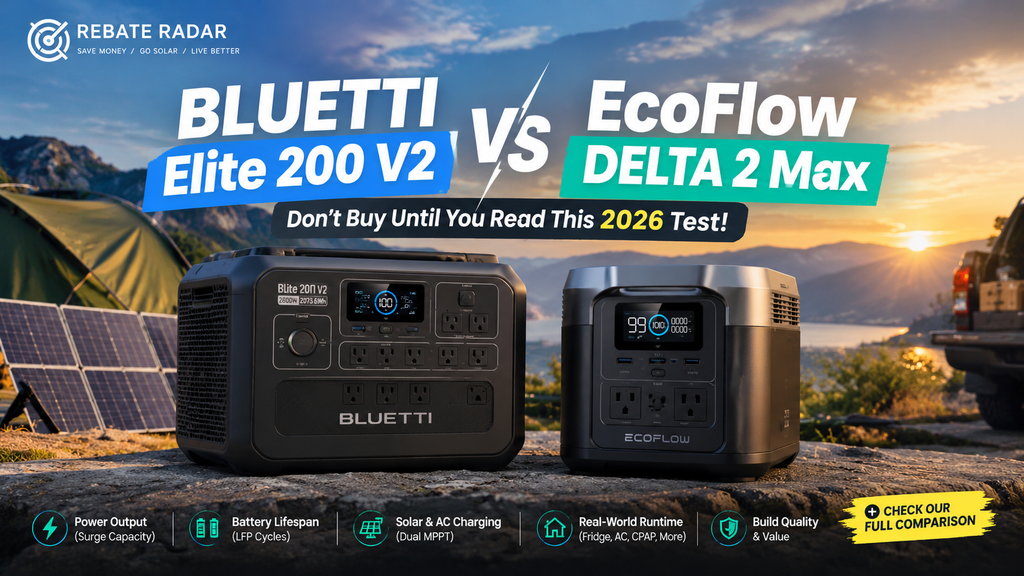
BLUETTI Elite 200 V2 vs. EcoFlow DELTA 2 Max: Which 2kWh Power Station Wins?
Two high-capacity LiFePO₄ power stations, two different approaches to backup power. Compare storage, inverter output, charging, solar input, cycle-life claims and realistic appliance runtimes before choosing a battery for outages, RV trips or off-grid use.
The BLUETTI Elite 200 V2 vs EcoFlow DELTA 2 Max comparison matters to households preparing for outages, RV owners, campers and people who want portable energy without installing a permanently wired home battery. Both products sit in the roughly 2kWh class and use lithium iron phosphate (LFP) chemistry. Their advertised inverter ratings, charging systems and product ecosystems differ, and those details can matter more than a small difference in nominal capacity.
Quick takeaway: based on the supplied listings, BLUETTI advertises a higher continuous AC output, while EcoFlow has a separate solar-panel bundle and an ecosystem worth investigating if you may expand later. The best choice depends on your appliances, recharge options, warranty and total package cost. Neither product is automatically best for every home.
Quick verdict: which should you choose?
BLUETTI Elite 200 V2
The supplied listing describes 2,073.6Wh, 2,600W continuous AC output, a 3,900W Power Lifting mode and 0–80% AC charging in about 50 minutes. It deserves consideration if output headroom and a self-contained setup are priorities.
- Nominal capacity: 2,073.6Wh.
- Advertised continuous AC output: 2,600W.
- Verify which loads the special high-power mode supports.
- Check the current manual for solar input, weight, warranty and expansion.
EcoFlow DELTA 2 Max
The supplied base-unit listing states 2,048Wh and 2,400W AC output. A separate listing describes a kit with a 400W solar panel. The package matters: a station-only unit is not equivalent in value to a complete solar kit.
- Nominal capacity: 2,048Wh.
- Advertised base-unit output: 2,400W.
- Separate supplied listing includes a 400W panel.
- Confirm compatible extra batteries and solar input limits.
Compare the supplied product listings
These are the three affiliate links provided for the guide. Check the live listing for price, seller, stock, warranty, included accessories and the selected product variation.
BLUETTI Elite 200 V2 Portable Power Station
2073.6Wh · listed 2600W AC · LFP
The supplied title describes four AC outlets, 3,900W Power Lifting and 0–80% charging in 50 minutes. Confirm the exact US model and conditions behind these claims.
Check BLUETTI on AmazonRebate Radar may earn a commission from qualifying purchases at no extra cost to you.
EcoFlow DELTA 2 Max 2048Wh
2048Wh · listed 2400W AC · LFP
This is the station-only listing supplied. It may suit buyers who already own compatible panels or want to choose a panel separately.
Check DELTA 2 MaxVerify the box contents and exact product variation before ordering.
EcoFlow DELTA 2 Max + 400W Solar Panel
2048Wh station · listing says 400W panel included
A bundle can simplify setup, but real panel output depends on sunlight, shade, weather, temperature and the station’s input limits.
Check EcoFlow Solar KitConfirm the panel is included in the selected package.
Compare the wider category
See our guides to the best portable power stations of 2026 and best solar generators of 2026. Compare station-only with station-only, or bundle with bundle.
Side-by-side specs
The table distinguishes supplied claims from values that need official verification. Retailer titles can omit conditions or combine details from different packages. Do not guess a technical value simply to fill a table.
| Specification | BLUETTI Elite 200 V2 | EcoFlow DELTA 2 Max |
|---|---|---|
| Nominal capacity | 2,073.6Wh (supplied listing) | 2,048Wh (supplied listing) |
| Continuous AC output | 2,600W (supplied listing) | 2,400W (base-unit listing) |
| Surge / special mode | 3,900W Power Lifting claim; verify restrictions | Verify exact surge rating and mode in manual |
| LFP cycle life | Brief states 6,000+ cycles; verify test conditions | Brief states 3,000+ cycles; verify test conditions |
| AC charging time | Listing says 0–80% in about 50 minutes | Listing says full charge in about 1 hour |
| Max solar input / MPPT | Verify watts, voltage, current and inputs | Verify watts, voltage, current and MPPT setup |
| Expandability | Verify for exact model | Verify compatible batteries and max configuration |
| Weight | Check official specification | Check official specification |
| Solar panel included? | Not indicated in supplied unit-only title | Not in base listing; separate 400W bundle supplied |
Cycle-life figures are not a fair comparison unless depth of discharge, temperature, test rate and end-of-life thresholds are comparable. Replace verification notes with official values after checking current manuals.
Inverter analysis: continuous watts vs startup surge
The inverter converts battery DC power into AC power for appliances. Continuous output describes the load the station can supply within operating limits over time. Surge capability is a brief allowance that may help start a motor or compressor. These figures answer different questions.
What does 2,600W vs 2,400W mean?
Based on supplied listings, BLUETTI advertises 200W more continuous output. That difference may matter for a load near the EcoFlow’s limit, but it may not change the experience for a laptop, modem, lights or small refrigerator. Check outlet-level ratings and the manual as well as the headline number.
For multiple appliances, add likely running watts and leave a margin. Refrigerators, freezers, pumps and air conditioners can draw more at startup than while running. If a station can run a compressor after it starts, that does not prove it can start it reliably. Check the appliance manual and, where appropriate, use a watt meter that captures startup behavior.
Power Lifting and special modes
The supplied BLUETTI title advertises a 3,900W Power Lifting mode. Read the manufacturer’s explanation: a special mode may be intended for selected resistive loads rather than every device rated above normal inverter output. Do not assume it supports every motor, compressor or sensitive electronic appliance. For EcoFlow, confirm the exact surge and special-mode claims in the current DELTA 2 Max manual rather than borrowing figures from another DELTA model.
LFP chemistry and cycle-life claims
Both stations are described as using lithium iron phosphate (LFP or LiFePO₄). LFP batteries are common in portable power products because they can offer long cycle life and favorable thermal stability compared with some other lithium-ion chemistries. They still store substantial energy and must be charged, stored and handled according to the manufacturer’s safety instructions.
What is a battery cycle?
A full equivalent cycle represents cumulative use equal to 100% of battery capacity, even if that happens through several partial discharges. Cycle-life ratings are measured under specified conditions and refer to reaching a defined remaining-capacity threshold. Depth of discharge, temperature, charge/discharge rates and the end-of-life definition all affect the result.
6,000+ vs 3,000+ cycles
The supplied brief states 6,000+ cycles for BLUETTI and 3,000+ for EcoFlow. Do not present this as a definitive two-to-one lifespan result until the exact claims and comparable test conditions are confirmed. A cycle rating does not guarantee a fixed number of calendar years: heat, storage state of charge, frequency of use and calendar aging matter too.
- Keep the station within its recommended temperature range.
- Avoid long storage in a hot vehicle or direct sunlight.
- Use approved chargers, cables and solar configurations.
- Follow the manual’s storage state-of-charge recommendations.
- Read the warranty separately; cycle life is not warranty coverage.
AC charging and solar input
The supplied BLUETTI listing says 0–80% in about 50 minutes, while the EcoFlow listing says a full charge in about one hour. These are not identical measurements. Confirm the exact US model, charging mode, temperature and input conditions. Charging may slow near full capacity to protect the battery.
Understanding MPPT and solar limits
An MPPT controller adjusts the electrical operating point of a solar array to harvest available energy. Maximum solar watts are only one part of compatibility: open-circuit voltage, operating voltage, current, connectors and series/parallel configuration must also remain within the station’s limits. Exceeding maximum input voltage can damage equipment and create a hazard.
A 400W panel does not produce 400W all day. Sun angle, clouds, shade, temperature, season, dust and cable losses affect output. The wattage of a panel included in a bundle also does not establish the station’s maximum solar input. Check the exact manual and estimate a realistic daily harvest for your location and season.
Realistic appliance runtimes: refrigerator, AC, CPAP and microwave
Nominal watt-hours are not equal to energy delivered through an AC inverter. This guide uses an illustrative 85% usable-energy factor for AC loads—not a measured efficiency rating for either product. Under that assumption, BLUETTI provides about 1,762Wh and EcoFlow about 1,741Wh of estimated AC energy. Actual runtime varies with load, standby consumption, temperature, battery age and inverter efficiency.
Interactive runtime estimator
Enter average appliance draw. For cycling appliances, use average consumption over time rather than only compressor running watts.
Estimated runtime: about 17.6 hours at 100W using the 85% assumption.
Simplified estimate only; excludes startup surges, variable cycling and solar charging.
Refrigerator
A refrigerator’s energy use depends on size, age, efficiency, room temperature, door openings and compressor cycling. The nameplate running watts do not reveal average daily energy use. If a refrigerator averages 80W over time, the simple 85% model estimates about 22.0 hours from BLUETTI and 21.8 hours from EcoFlow. At 120W average, estimates fall to roughly 14.7 and 14.5 hours. A hot garage or older appliance may use more energy. Measure consumption over several hours if possible and check startup demand.
During an outage, keep refrigerator and freezer doors closed and follow public-health food-safety guidance. See our practical guide, How to Run a Refrigerator on a Solar Generator.
Window air conditioner
Air conditioners can draw hundreds or more than a thousand watts while running, with an additional compressor startup surge. A hypothetical 600W average load gives about 3.0 hours from BLUETTI and 2.9 hours from EcoFlow under the 85% assumption. At 1,000W average, estimates are about 1.8 and 1.7 hours. These calculations do not confirm that a particular AC will start or run successfully; check its electrical input and startup demand against the station manual.
CPAP machine
CPAP consumption varies with device, pressure settings, humidifier, heated hose and accessories. A 40W average load gives an illustrative estimate of about 44.1 hours from BLUETTI and 43.5 hours from EcoFlow; at 70W, estimates fall to around 25 hours. Medical equipment needs reliable, compatible power. Consult the device manufacturer or clinician and verify the approved power method; do not rely on a generic runtime estimate for medically essential equipment.
Microwave
Microwave cooking output and electrical input differ. Check the label for input watts. A microwave drawing 1,200W for ten minutes uses about 200Wh before conversion losses. It may be within a station’s output rating, but account for other simultaneous loads and the exact appliance input. Do not assume a special mode supports every microwave continuously.
| Example load | Average draw | BLUETTI estimate | EcoFlow estimate |
|---|---|---|---|
| Efficient refrigerator | 80W | About 22.0 h | About 21.8 h |
| Refrigerator in harder conditions | 120W | About 14.7 h | About 14.5 h |
| Window AC example | 600W | About 3.0 h | About 2.9 h |
| CPAP example | 40W | About 44.1 h | About 43.5 h |
| Router, modem and LED lights | 35W | About 50.3 h | About 49.7 h |
Formula: nominal Wh × assumed usable fraction ÷ average watts. These are illustrative calculations, not manufacturer-certified runtime figures.
Home backup, RV and off-grid use
Emergency home backup
Start with essential loads: refrigerator, communications, lights, fans and medical devices. Estimate watt-hours per day and decide how long you need autonomy. A 2kWh station can be valuable, but it is not an unlimited whole-home battery. Plan how to recharge during a prolonged outage. To power household circuits, use compatible transfer equipment installed according to local code by a qualified professional. Never backfeed wiring through a wall outlet or improvised cable.
Related guides: home battery backup without solar, home battery vs. generator, and home battery backup cost.
RV and camping
Consider lifting weight, storage space, outlet layout, charging options and the power needs of cooking and cooling appliances. Solar can help at a sunny campsite but output drops with shade and clouds. Battery stations avoid combustion exhaust, though cooling fans may run under heavy load. Never operate a fuel generator indoors, in a garage or near windows because carbon monoxide can be fatal.
Off-grid cabins
Calculate daily watt-hours for refrigeration, lighting, communications, pumps, cooking and seasonal heating or cooling. Include cloudy-day reserves and charging losses. A portable station may suit light loads or short stays; a larger solar-plus-battery system may be more practical for sustained use. See best off-grid solar kits and solar battery vs. solar generator.
Portable power station tax credits and rebates
Do not assume a portable power station automatically qualifies for a federal tax credit or utility incentive. Eligibility depends on current program rules, equipment definitions, installation requirements, dates and taxpayer circumstances. A product marketed as a “solar generator” is not automatically eligible. Review current official guidance before making a purchase based on an expected credit and consult a qualified tax professional for personal advice.
Read our explainers on the portable power station tax credit in 2026 and the home battery tax credit.
Ten-point buying checklist
- Exact model: verify the full model name and regional version.
- Package contents: distinguish station-only from solar bundles.
- Continuous output: check the manual and outlet limits.
- Surge: confirm supported loads and duration.
- Solar input: match voltage, current, connectors and array configuration.
- Cycle life: compare test conditions and capacity thresholds.
- Warranty: check duration, exclusions and regional service.
- Appliances: calculate energy use and startup demand.
- Recharging: decide whether grid or solar is available.
- Seller and returns: confirm seller identity, return window and included accessories.
Final verdict
The Elite 200 V2 and DELTA 2 Max are close enough in nominal storage that their small capacity difference should rarely decide the purchase. The more important questions are whether BLUETTI’s verified output suits your loads, whether its special mode supports the device you want to run, how each manufacturer documents cycle life, and whether EcoFlow’s accessories or solar bundle provide better value.
Consider BLUETTI if its confirmed output, battery-life documentation and all-in-one design fit your needs. Consider EcoFlow if the current DELTA 2 Max’s verified features, compatible expansion or solar bundle suit your plan and budget. Compare like-for-like packages and estimate runtime using your own appliance measurements before buying.
Frequently asked questions
Is the BLUETTI Elite 200 V2 better than the EcoFlow DELTA 2 Max?
It depends on your use case. Supplied listings state 2,073.6Wh and 2,600W continuous output for BLUETTI, compared with 2,048Wh and 2,400W for the EcoFlow base unit. Verify current specifications and compare charging, solar input, expansion, warranty and package cost.
Which station has more capacity?
The supplied details list 2,073.6Wh for BLUETTI and 2,048Wh for EcoFlow, a 25.6Wh difference.
Can either station run a refrigerator?
Potentially, if the refrigerator’s running consumption and startup demand are within the station’s limits. Measure average use and review our refrigerator solar generator guide.
Can a 2kWh station run a window AC?
Some smaller units may be compatible, but ACs can have high running loads and startup surges. Check the exact appliance and station manuals.
Does the EcoFlow DELTA 2 Max include panels?
The supplied station-only listing does not indicate a panel. A separate listing is described as a kit with a 400W panel. Check the selected package before ordering.
Is 6,000 cycles twice as good as 3,000 cycles?
Not automatically. Cycle-life claims require comparable test conditions. Calendar aging, temperature and usage patterns also influence service life.
How long will a 2,000Wh station run a 100W load?
At an illustrative 85% usable AC-energy factor, 2,048Wh provides about 17.4 hours and 2,073.6Wh about 17.6 hours. Actual runtime varies.
Can I charge with solar while using the station?
Some models support simultaneous charging and output, but permitted modes vary. Check the current manual and stay within solar voltage and current limits.
Can I connect the station directly to my home panel?
Do not connect through a wall outlet or improvised cable. Selected circuits require compatible transfer equipment installed by a qualified professional.
Does a portable power station qualify for a 2026 tax credit?
Not automatically. Eligibility depends on current program rules and equipment details. Review official guidance and consult a tax professional; see our tax credit guide.
Sources and verification
Before publishing, verify technical values using current manufacturer pages and manuals. Retail listings can change and should not be the only source for safety-critical claims.
- BLUETTI official website — locate the Elite 200 V2 product page and manual.
- EcoFlow official website — locate the DELTA 2 Max product page and manual.
- IRS credits and deductions — official federal tax guidance.
- Ready.gov power outages — emergency preparedness.
Pingback: Best Portable Power Stations For Emergency Home Backup (2026)
Pingback: How Long To Charge A 2,000Wh Solar Generator? (2026)
Pingback: Is A 2000Wh Solar Generator Worth It In 2026? (Tested!)