
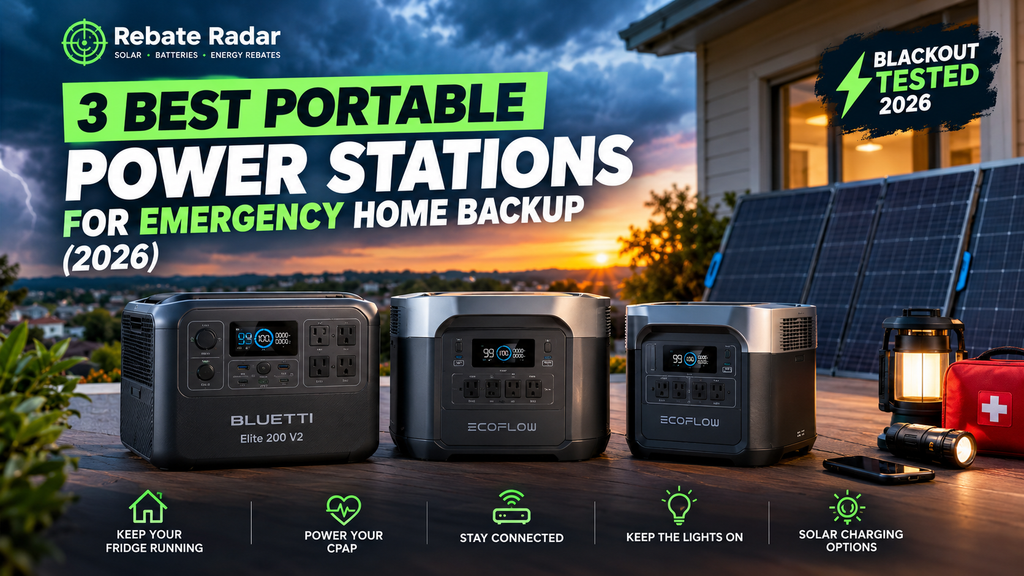
3 Best Portable Power Stations for Emergency Home Backup (2026)
A practical guide to choosing battery backup for refrigerators, CPAP machines, internet equipment, lights, phones, and other essentials when the grid goes down.
Editorial transparency: This guide is based on published manufacturer specifications, product information, and illustrative calculations. Rebate Radar did not physically test these products during a blackout. Runtime estimates below are not laboratory results or guarantees.
At a Glance: The Best Portable Power Station for Emergency Home Backup 2026
A portable power station combines a rechargeable battery, an inverter, charging electronics, and output ports in one unit. During a blackout, it can supply selected appliances without burning gasoline or propane at the point of use. The right model depends on what you need to power, how long the outage may last, and whether you can recharge the battery during the emergency.
For many households, a roughly 2kWh battery is a useful starting point for essential loads. It is not a whole-house solution by itself. A refrigerator, a modem, lights, phones, and a CPAP machine may be manageable if usage is planned, but electric space heaters, electric water heaters, central air conditioning, and electric ranges can consume a battery very quickly.
BLUETTI Elite 200 V2
Higher rated capacity and continuous AC output among these three buying options.
EcoFlow DELTA 2 Max + 400W Panel
A convenient starting package for buyers who want a battery and a solar panel together.
EcoFlow DELTA 2 Max
The battery-only configuration for households planning to add compatible capacity or source panels separately.
Emergency Power Backup Matrix
| Feature | BLUETTI Elite 200 V2 | EcoFlow DELTA 2 Max + panel | EcoFlow DELTA 2 Max |
|---|---|---|---|
| Battery capacity | 2,073.6Wh | 2,048Wh | 2,048Wh |
| Battery chemistry | LiFePO₄ | LiFePO₄ | LiFePO₄ |
| Rated continuous AC output | 2,600W | 2,400W | 2,400W |
| Peak / special power modes | Check peak and Power Lifting conditions in official documentation | Up to 3,400W with X-Boost under compatible conditions; not normal continuous output | Up to 3,400W with X-Boost under compatible conditions; not normal continuous output |
| Maximum solar input | Up to 1,000W | DELTA 2 Max supports up to 1,000W; included panel is rated 400W | Up to 1,000W |
| Expansion | Not expandable according to published product specifications | Compatible expansion batteries can increase capacity up to 6kWh | Compatible expansion batteries can increase capacity up to 6kWh |
| Fridge runtime | Depends on fridge consumption and compressor cycling | Depends on fridge consumption and compressor cycling | Depends on fridge consumption and compressor cycling |
| CPAP runtime | Depends on pressure, humidifier, heated tubing, and DC/AC connection | Depends on device settings and connection method | Depends on device settings and connection method |
| Best fit | High output from a single compact unit | Buyer who wants battery plus panel together | Buyer who wants expansion flexibility |
Specifications are based on published product information and can vary by region, model revision, and package. Confirm current limits, accessories, warranty, and compatibility with the manufacturer before ordering.
How to Choose an Emergency Home Battery Backup
The best portable power station for emergency home backup 2026 is not automatically the one with the biggest wattage figure or the largest advertised list of compatible appliances. You need to match battery energy, inverter output, surge capability, charging options, and the duration of the outage to your actual household priorities.
1. Capacity is measured in watt-hours
Watt-hours (Wh) describe stored energy. A 2,000Wh battery theoretically supplies a 100W load for 20 hours before accounting for conversion losses, reserve capacity, and other system overhead. Real-world runtime is shorter than a simple division of the battery label by appliance watts.
Capacity matters most when you need to keep equipment operating for long periods. A large inverter does not mean a large battery: an appliance can be within the station’s watt limit and still drain the battery quickly.
2. Continuous output determines what you can run
Watts (W) describe the rate at which a device consumes electricity or a station supplies it. Add the running watts of the appliances you want to operate simultaneously. If your refrigerator uses 150W while its compressor is running and you also use a 30W router, the combined running load during that moment is about 180W.
Check the rating plate or owner’s manual for each appliance. Some manufacturers quote maximum input rather than typical operating consumption. A device’s actual draw can also change during startup, heating, cooling, or different operating modes.
3. Starting surges can be more important than average consumption
Motors and compressors can draw a brief surge when starting. Refrigerators, freezers, pumps, and certain tools may need more power for a short period than they use once running. Compare the station’s documented surge rating with the appliance’s starting requirement, and do not assume that every advertised high-watt mode supports every appliance.
BLUETTI’s Power Lifting feature and EcoFlow’s X-Boost feature have specific conditions. A feature advertised as supporting a higher-wattage resistive appliance does not necessarily mean the inverter continuously supplies that wattage at normal voltage. Consult the manual for the exact limitations.
4. LiFePO₄ chemistry is useful for repeated preparedness
All three buying options in this guide use lithium iron phosphate (LiFePO₄ or LFP) batteries. Manufacturers commonly highlight LFP for its cycle-life characteristics and thermal stability relative to some other lithium-ion chemistries. The complete product still includes an inverter, wiring, controls, and a battery-management system, so safe operation depends on the entire design and following the instructions.
Cycle-life claims are not the same as a promise that a battery will last a particular number of calendar years in every household. Temperature, storage state of charge, charging habits, depth of discharge, and usage conditions affect long-term performance.
5. Solar charging helps only when conditions allow
Solar panels can replenish the battery during a long outage, but the advertised panel wattage is a rating under specified test conditions—not a guarantee of continuous production. Clouds, shade, panel angle, season, heat, and limited daylight all reduce energy harvest. A storm that causes an outage may also make solar charging less predictable precisely when you need it most.
Check the station’s permitted solar voltage and current range before connecting panels. A panel or array with incompatible electrical characteristics can prevent charging or damage equipment. Never assume that a connector fitting physically means the electrical specifications are compatible.
6. Consider portability and storage space
A station around 2kWh is a substantial piece of equipment. The BLUETTI Elite 200 V2 is listed at approximately 53.4 pounds, while the EcoFlow DELTA 2 Max is approximately 50 pounds. Both are movable, but not featherlight. Think about stairs, storage location, the person who will move it, and whether you can leave it near the appliances you intend to power.
Keep the station dry, ventilated, and within the operating-temperature range in the manual. Do not place it where floodwater could reach it, block ventilation openings, or store it in a hot vehicle or other environment outside the manufacturer’s limits.
1. BLUETTI Elite 200 V2: Best Single-Unit Output in This Comparison
The BLUETTI Elite 200 V2 is a strong candidate for households that want a high-output portable battery without building a multi-battery system. Its published specifications list 2,073.6Wh of capacity, 2,600W of total AC output, LiFePO₄ chemistry, and solar input up to 1,000W. It is also advertised with a 6,000-plus cycle rating to 80% of original capacity, subject to the manufacturer’s test conditions and warranty terms.
For emergency use, its principal attraction is the combination of roughly 2kWh of energy and a 2,600W continuous-output rating. That gives you more flexibility for running selected kitchen appliances and several low-wattage essentials than a small 300Wh or 500Wh power station. It still does not mean you can run every appliance in the house, particularly high-draw heating or cooling equipment.
Why it makes sense for outages
- Useful energy reserve: Its rated capacity is slightly above 2kWh, useful for planning a limited essential-load circuit or selected appliances.
- High stated AC output: The 2,600W rating can support many household electronics and appliances whose running and startup requirements fit the manual’s limits.
- Solar-ready design: Up to 1,000W of solar input can be useful when compatible panels and favorable conditions are available.
- LFP battery: The manufacturer advertises more than 6,000 cycles to 80% capacity. Treat that as a published rating, not an unconditional lifespan guarantee.
- Multiple charging paths: AC, solar, and vehicle charging options can help in different emergency scenarios; confirm the appropriate cables and input limits.
What to think about before buying
The Elite 200 V2 is not designed to expand with extra batteries according to the published specifications. If your backup plan may grow from a single refrigerator to multiple circuits or a longer multi-day outage, compare that limitation against the EcoFlow expansion ecosystem.
Its weight also matters. A unit in the 50-pound range is better treated as stored emergency equipment than something everyone can easily carry from room to room. Plan a safe, accessible storage location before the outage rather than waiting until a storm is approaching.
Another practical consideration is the actual appliance load. A 2,600W inverter cannot make a high-energy appliance economical to run. A 1,500W electric heater may be within the output rating, but it can consume a large portion of the usable battery in a short time. In an emergency, use battery energy for essential services first.
Who should consider the BLUETTI Elite 200 V2?
It is worth considering if you want a high-output single unit, value the published LFP cycle rating, and do not expect to expand the battery later. It may be less suitable if your main goal is building a large modular backup system over time.
View BLUETTI Elite 200 V2 on AmazonAffiliate link. Product availability, package contents, ratings, and price can change.
For a closer product-to-product comparison, read our guide to BLUETTI Elite 200 V2 vs. EcoFlow DELTA 2 Max. That comparison is useful if your decision comes down to rated output, expansion, and the type of emergency you want to prepare for.
2. EcoFlow DELTA 2 Max + 400W Solar Panel: Best Starting Bundle
The EcoFlow DELTA 2 Max solar bundle is appealing to buyers who want a battery and solar panel in one package. The DELTA 2 Max is listed with a 2,048Wh LFP battery, 2,400W continuous AC output, a 4,800W surge rating, and solar input up to 1,000W. EcoFlow also advertises X-Boost support for certain appliances up to 3,400W under compatible conditions. X-Boost should not be confused with the unit’s normal continuous AC rating.
The bundle listing supplied for this guide identifies a 400W solar panel. Confirm that the exact product page you order still includes that panel, the necessary cables, and any mounting or adapter equipment you expect. Marketplace bundles can change, and a panel’s nameplate rating does not describe how much electricity it will deliver throughout a day.
Why a panel bundle can be useful
- Less guesswork at purchase: You can start with a matched battery and panel package rather than sourcing every component separately.
- Recharging opportunity: When sunlight is available, the panel can add energy back to the battery while you prioritize essential loads.
- Expandable capacity: The DELTA 2 Max supports compatible extra batteries, with EcoFlow describing a configuration up to 6kWh.
- High appliance compatibility: The normal 2,400W AC output can cover many electronics and household devices when their loads fit the system limits.
- Flexible use: The same equipment may be useful for planned outages, camping, and other backup situations.
What a 400W panel really means
A 400W rating is not a promise of 400W from sunrise to sunset. Output varies with solar intensity, angle, shading, temperature, and the panel’s condition. If a panel averaged 200W over five equivalent full-sun hours, the arithmetic would be approximately 1,000Wh before system losses. That is an illustration of energy planning, not a forecast for your location or weather.
In severe weather, sunlight may be poor and outdoor panel placement may be unsafe. Never go onto a roof or expose yourself to lightning, high winds, floodwater, or other storm hazards just to charge a battery. Place panels only where they can be secured safely and where the manufacturer’s instructions permit.
Who should consider the solar bundle?
Consider this package if you do not own compatible solar panels and want a simple path toward solar recharging. It may also suit households that expect rolling outages or want to use the battery regularly away from the grid. Compare the total bundle price with buying the power station and a compatible panel separately; included accessories and sale pricing can change the value equation.
Check the bundle contents before checkout
Confirm the panel model, cable compatibility, shipping details, warranty coverage for each component, and the exact solar input limits. Do not purchase an extra panel simply because it has a higher wattage rating: the combined array must remain within the station’s voltage and current limits.
View DELTA 2 Max + 400W panelAffiliate link. Check the listing to verify current bundle contents and pricing.
3. EcoFlow DELTA 2 Max: Best for an Expandable Backup Plan
The battery-only EcoFlow DELTA 2 Max offers the same core station described above, without the specific 400W panel bundle. Its 2,048Wh battery, 2,400W continuous AC output, 4,800W surge rating, and support for compatible extra batteries make it worth considering for buyers who already own panels or want to choose their own solar setup.
EcoFlow’s published specifications describe the system as expandable up to 6kWh using compatible extra batteries. That modular approach may suit a household that wants to begin with a single power station and increase stored energy later. However, expansion batteries add cost, weight, and storage needs. Work out the total cost of the final system rather than judging the initial unit alone.
Expansion is useful—but it is not unlimited
Adding compatible battery capacity increases the amount of energy available. It does not automatically increase the main inverter’s normal continuous output. If your appliances collectively draw more than the inverter can safely supply, a larger battery bank will not solve that output limitation.
For example, increasing capacity from about 2kWh to about 4kWh can roughly double theoretical stored energy, but a 2,400W output limit remains important when selecting simultaneous loads. Always check the exact supported battery combination and any installation instructions from the manufacturer.
Battery-only or solar bundle?
The answer depends on what you already own. If you have compatible solar panels and the required cables, the battery-only unit may be a cleaner purchase. If you are starting from scratch, a bundle may reduce the work involved in selecting components. Neither configuration is automatically cheaper: compare current package pricing, panel quality, warranty, and the accessories included.
Who should consider this configuration?
Choose the battery-only configuration if you value expansion and already have a plan for compatible solar charging. If you need a panel immediately, compare this listing against the bundle rather than assuming the separate panel will cost less.
View EcoFlow DELTA 2 MaxAffiliate link. Verify model, accessories, seller, and current product details.
How Long Can a 2kWh Power Station Run Your Essentials?
Runtime is one of the most important questions to answer before a blackout. The station’s battery capacity is measured in watt-hours, but the energy available at the AC outlet is lower than the battery’s headline capacity because of inverter losses, standby consumption, and other operating factors.
For the examples below, we use a planning assumption of 85% usable energy at the AC output. This is a simplified estimate, not a measured efficiency claim for either product. Actual results depend on load, temperature, appliance behavior, battery condition, inverter operation, and how the station is configured.
For a 2,048Wh battery, the illustrative energy available for AC loads is about 1,741Wh. For the 2,073.6Wh BLUETTI, it is about 1,762Wh.
| Example load | Assumed average draw | BLUETTI estimate | EcoFlow estimate |
|---|---|---|---|
| Refrigerator while running | 150W | About 11.8 hours of equivalent run time | About 11.6 hours of equivalent run time |
| CPAP machine | 50W | About 35.3 hours | About 34.8 hours |
| Router and modem | 25W | About 70.5 hours | About 69.6 hours |
| LED lighting | 40W | About 44.1 hours | About 43.5 hours |
| Small window air conditioner | 800W | About 2.2 hours | About 2.2 hours |
| Microwave electrical input | 1,000W | About 1.76 cumulative hours | About 1.74 cumulative hours |
These examples treat each load as a constant draw for calculation purposes. A refrigerator cycles on and off, so its elapsed runtime may differ considerably from the equivalent run time shown. CPAP consumption varies with settings and accessories. Microwave time is cumulative time at the assumed input, not a recommendation to run it continuously.
Refrigerator backup: plan for the compressor
Refrigerators are a common priority during power outages because they protect food and medication that requires refrigeration. Yet their consumption varies by size, age, ambient temperature, door-opening frequency, and compressor behavior. The starting surge may also be much higher than the average running draw.
Look for the refrigerator’s rated electrical input and any starting requirements in its manual or on its label. If the exact running and startup requirements are unclear, consult the manufacturer or a qualified technician. Leave the refrigerator closed as much as possible during an outage and use a thermometer to monitor food safety.
Our guide how to run a refrigerator on a solar generator explains the key calculations and practical planning considerations in more detail.
CPAP backup: make a device-specific plan
For anyone who relies on a CPAP machine, do not choose backup power solely from a generic wattage estimate. Actual consumption can change with pressure settings, heated humidifiers, heated tubing, and the particular device. Some systems can use a manufacturer-approved DC power supply that avoids certain inverter losses, but not every setup supports the same accessories or connection method.
Follow the CPAP manufacturer’s electrical requirements and consult your healthcare provider about a safe backup plan. If interruption of therapy could create a medical risk, make a plan that does not rely on an unverified runtime estimate. Check whether the power station’s output is suitable for the equipment and whether you need a separate approved cable or adapter.
Run essentials together, not every appliance at once
Consider a simple emergency schedule. Keep the modem on when you need communication, use LED lights only in occupied rooms, charge phones in short sessions, and avoid high-draw appliances unless they are essential. You can often extend battery life by turning off unused AC outlets and using direct USB outputs for devices that support them.
Remember that a power station’s rated battery capacity is not a promise of all-day refrigerator operation plus CPAP, air conditioning, cooking, lighting, and entertainment. If you need multiple appliances, calculate their combined energy use across the day, not only their instantaneous wattage.
Solar Charging During a Prolonged Outage
For a short outage, charging the battery from a wall outlet ahead of time may be enough. For a multi-day outage, solar charging can help replace some of the energy used by essential appliances. The key is to plan around realistic daily energy harvest and have a safe place to deploy panels.
Understand watt-hours per day
Panel wattage describes power under specified conditions; watt-hours describe energy produced over time. If a panel array averages 200W for five equivalent full-sun hours, the simple calculation is 1,000Wh before conversion and other losses. A real day may produce less because of cloud cover, shade, angle, heat, or short daylight hours.
For a station using 1,000Wh each day, an array that actually delivers 1,000Wh of usable energy would theoretically replace that daily use. But it is unwise to design emergency preparedness around ideal output. Consider a margin for poor weather and plan to reduce consumption when solar production falls.
Place panels safely
- Follow the manufacturer’s setup instructions and use a stable, secure surface.
- Avoid rooftops, exposed ridges, and unstable surfaces during storms or strong winds.
- Keep cables away from walking paths, standing water, sharp edges, and areas where vehicles may crush them.
- Check solar voltage and current limits before connecting panels in series or parallel.
- Keep the power station protected from moisture and outside its operating temperature limits.
- Disconnect or reposition equipment only when it is safe to do so and in accordance with the manual.
Build a layered charging plan
Before an outage, charge the station fully from a reliable AC source, then confirm that the solar cables and adapters are present. Keep phone power banks charged separately. If safe and appropriate, vehicle charging may be another option, but its speed and compatibility vary. Do not run a vehicle in an enclosed garage or other enclosed space because exhaust can cause fatal carbon-monoxide poisoning.
Solar panels are not a guarantee of uninterrupted power. A panel may produce little energy during heavy rain, at night, or in dense shade. The battery capacity you begin with and your willingness to prioritize essential loads are still central to your plan.
If you are planning a larger solar setup, explore our guide to best off-grid solar kits in 2026. For more product categories, see best solar generators in 2026 and best portable power stations in 2026.
Safety: What a Portable Power Station Can and Cannot Do
Portable battery stations are useful because they store electricity without burning fuel during operation. That makes them a different category from gasoline, diesel, or propane generators. However, a battery station is still an electrical appliance with limits. Follow the product manual and do not improvise connections to household wiring.
Never backfeed a household outlet
Do not connect a power station to a wall outlet using a male-to-male cord, and do not attempt to energize home wiring through an improvised connection. This can create a serious electrocution and fire hazard and may energize utility lines unexpectedly.
If you want to power selected home circuits through a transfer switch or another approved connection method, use equipment designed for that purpose and have a qualified electrician determine compatibility and installation requirements. Verify that the specific power station supports the intended arrangement. A product described as “home backup” is not automatically a whole-home backup system.
Know the limits of high-wattage appliances
Electric space heaters, kettles, hair dryers, electric ovens, and hot plates can consume hundreds or thousands of watts. Even when a station can run one of these devices within its output limit, the battery may be depleted quickly. During an outage, use stored energy for essential electronics, communications, medical equipment, lighting, and other priority loads first.
Motors and compressors may also draw a starting surge. Confirm that both the continuous rating and the relevant surge rating meet the appliance’s needs. Special modes such as Power Lifting or X-Boost have conditions and may alter voltage or operating behavior; they should not be treated as a universal substitute for the normal output rating.
Keep the battery within its operating limits
Do not use a station with a damaged case, swollen battery, damaged cable, or signs of liquid intrusion. Keep the ventilation areas clear and follow the instructions for charging temperature, storage, and inspection. Do not disassemble the unit or attempt to repair its battery yourself.
If the station becomes unusually hot, emits an unusual odor, makes unexpected sounds, or appears damaged, stop using it if it is safe to do so and follow the manufacturer’s emergency guidance. Keep children away from outlets and cables, and avoid overloading power strips or extension cords.
Medical equipment deserves special planning
For CPAP machines, oxygen-related equipment, medication refrigeration, or any other medically important device, consult the equipment manufacturer and your healthcare provider. Confirm the device’s power requirements, approved adapters, battery compatibility, and a backup plan for a prolonged outage. Do not assume that a consumer power station alone is a medically approved life-support system.
Emergency Home Backup Checklist
A power station is only one part of outage preparedness. Prepare the equipment before severe weather or a grid interruption, when stores and delivery services may be unavailable.
Before an outage
- Charge the power station and test that each essential device works with it.
- Read the manual and keep it accessible, including the startup and shutdown steps.
- Write down the running watts and startup requirements of the refrigerator, freezer, pump, and other priority appliances.
- Check solar-panel compatibility, cable connections, and the manufacturer’s input limits.
- Keep USB cables, approved adapters, flashlights, spare batteries, and charged phone power banks together.
- Make a priority list of what to power first and what to turn off if the battery gets low.
- Store the unit in a dry, accessible location within the stated temperature range.
- For medical devices, verify the backup plan with the equipment manufacturer and healthcare provider.
During an outage
- Prioritize refrigeration, medical equipment, communications, and essential lighting.
- Use efficient LED lights and unplug equipment that is not needed.
- Keep refrigerator and freezer doors closed as much as possible.
- Monitor battery level and adjust loads before the station reaches a critical state.
- Use solar panels only when conditions are safe and the array is electrically compatible.
- Never backfeed a house through a wall outlet or improvised wiring.
- Do not operate fuel-burning generators indoors or in enclosed spaces.
How much backup capacity do you really need?
For occasional short outages, one 2kWh-class station may be a practical starting point if your priorities are modest. For repeated long outages, a household may need more stored energy, a safe recharging strategy, or a professionally installed home battery system. If you want to power several circuits, central air conditioning, well pumps, or other large loads, calculate their demand and consult a qualified electrician before purchasing equipment.
Do not assume that a portable power station qualifies for a federal tax credit simply because it stores energy or accepts solar input. Eligibility depends on the applicable law and detailed requirements, which can change. Read our information on portable power station tax credit rules for 2026 and verify any tax position with current official guidance or a qualified tax professional.
Which One Should You Buy?
Choose based on your actual outage plan rather than the largest advertised number.
- Choose BLUETTI Elite 200 V2 if you want the highest listed continuous AC output and slightly more rated energy in this comparison, and you do not require battery expansion.
- Choose EcoFlow DELTA 2 Max with a 400W panel if you are starting without solar equipment and prefer a bundled entry point for solar recharging.
- Choose the battery-only EcoFlow DELTA 2 Max if you already have compatible solar panels or expect to expand the battery system with compatible extra batteries.
Before buying, compare the current selling price, warranty, included accessories, return policy, shipping, and seller information. Do not assume that a temporary discount or bundle is still available. Ratings and review counts may change and are not a substitute for matching the product to your power requirements.
For other comparisons, you may also find our guides useful: Jackery Explorer 1000 v2 vs. EcoFlow DELTA 2, EcoFlow DELTA Pro vs. BLUETTI AC300, and EcoFlow DELTA 2 Max vs. Anker SOLIX C1000.
Frequently Asked Questions
What is the best portable power station for emergency home backup in 2026?
In this three-option comparison, the BLUETTI Elite 200 V2 is a strong candidate if you prioritize rated capacity and continuous AC output in a single unit. The EcoFlow DELTA 2 Max may be a better fit if you want a modular system with compatible expansion batteries. The best choice depends on your appliance loads, desired runtime, budget, and charging plan.
Can a 2,000Wh power station run a refrigerator?
Usually, a compatible station can run many household refrigerators, but runtime depends on the refrigerator’s energy use, compressor cycling, ambient temperature, and starting surge. Estimate the energy needed and verify the appliance’s electrical requirements. Do not treat a generic runtime figure as a guarantee for your particular refrigerator.
How long will a 2kWh power station run a CPAP machine?
There is no universal runtime. It depends on the machine, pressure settings, humidifier, heated tubing, power adapter, and whether the device uses AC or a manufacturer-approved DC connection. Check your device’s manual and consult your healthcare provider to plan a reliable backup.
Can I use a portable power station indoors?
Battery power stations do not burn fuel during normal operation and do not produce generator exhaust. Follow the manufacturer’s indoor-use, ventilation, temperature, and moisture instructions. Never operate a gasoline, diesel, or propane generator indoors, in a garage, or in another enclosed area because of carbon-monoxide risk.
Can I connect a portable power station directly to my home’s wiring?
Do not connect it through a standard wall outlet or a male-to-male cord. To power household circuits, use compatible equipment and a proper transfer arrangement installed or approved by a qualified electrician. Confirm the station supports the intended configuration.
Is 2,400W or 2,600W enough for a home during an outage?
It can be enough for selected essential appliances whose combined running loads and startup surges fit the station’s limits. It is not necessarily enough for large heating, cooling, cooking, or whole-house loads. Make an appliance list and compare both continuous output and surge requirements.
Can solar panels recharge a power station during a storm?
They may recharge it when safe conditions and sufficient sunlight are available, but production can fall substantially in cloudy weather and may be negligible at night. Check the solar input voltage and current limits, secure panels safely, and never take risks on roofs or in dangerous weather.
Is a 400W solar panel guaranteed to produce 400 watts?
No. The rating reflects specified test conditions. Actual output varies with sunlight, shade, angle, temperature, and other factors. Use conservative estimates for emergency planning and confirm that the panel’s electrical characteristics are compatible with the station.
Is the EcoFlow DELTA 2 Max solar bundle a different power station?
The bundle uses the EcoFlow DELTA 2 Max as its core station and adds a solar panel package according to the listing. The battery-only option is a separate package configuration. Check the product page at checkout because bundle contents can change.
Can I run an electric space heater from a portable power station?
Only if the heater’s electrical demand fits the station’s documented output limits, but it may drain the battery quickly. Heating is an energy-intensive load. For emergency preparedness, prioritize essential devices and consider safer non-electric strategies consistent with local safety guidance.
Do these power stations qualify for a tax credit in 2026?
Do not assume eligibility based solely on battery capacity or solar compatibility. Tax rules depend on the specific law, equipment, installation, use, and current guidance. Review official IRS information and consult a qualified tax professional before claiming a credit.
How should I store a power station between emergencies?
Follow the manufacturer’s instructions for storage charge level, periodic recharging, temperature, and inspection. Keep the station dry and away from extreme heat, direct water exposure, and obstructed ventilation. Check the manual for the specific product rather than applying one universal storage schedule.
Editorial Methodology, Affiliate Disclosure, and Disclaimer
Editorial methodology: This comparison evaluates published capacity, continuous output, battery chemistry, solar input, expansion options, and practical emergency-planning considerations. Rebate Radar has not physically tested these products in a blackout for this article. Runtime examples are simplified calculations based on stated capacities and an explicitly illustrative 85% usable-energy assumption; actual results can differ substantially.
Affiliate disclosure: This article contains affiliate links. If you purchase through these links, Rebate Radar may earn a commission at no additional cost to you. Affiliate relationships do not change the calculation method or guarantee that a product is right for your needs. Prices, availability, ratings, review counts, seller details, and package contents can change.
Safety and informational disclaimer: This guide is for general informational purposes and is not electrical, medical, or tax advice. Follow the power station and appliance manufacturers’ instructions. Consult a qualified electrician for household wiring or transfer equipment, your healthcare provider for medically important equipment, and a qualified tax professional for tax questions. Never operate a fuel-burning generator indoors and never backfeed household wiring through a wall outlet.
Product data: Confirm current specifications and limits with the manufacturer before purchasing. Manufacturer pages include the BLUETTI Elite 200 V2 specifications and EcoFlow DELTA 2 Max product details.
© 2026 Rebate Radar. All rights reserved.