
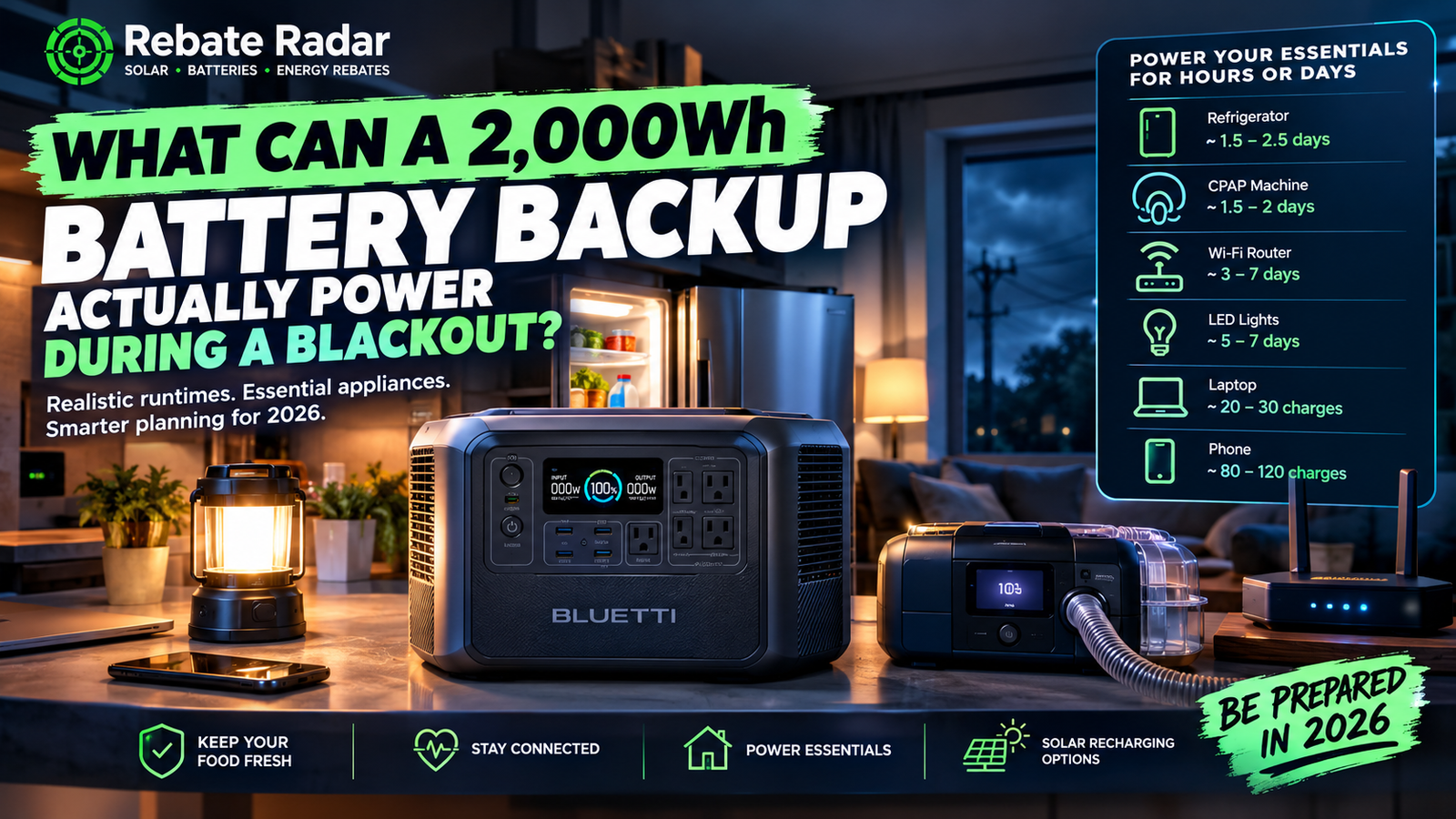
What Can a 2,000Wh Battery Backup Actually Power During a Blackout?
A practical guide to running a refrigerator, Wi-Fi router, lights, fans, a CPAP machine, and other essentials with a 2,000-watt-hour portable power station.
The short answer: a portable power station with a nominal capacity of 2,000 watt-hours (Wh) can be useful for essential backup during an outage. Depending on the appliances, their actual power consumption, conversion losses, and how often they run, it may keep a router and a few LED lights running for many hours, support a refrigerator for a portion of a day, or power a combination of small devices overnight.
But a 2,000Wh label does not mean every household appliance can run for a full day. It describes stored energy, not a guarantee of runtime. A refrigerator that cycles on and off has a different energy profile from an electric space heater that draws power continuously. A device that uses 100 watts for one hour consumes about 100Wh; a device that uses 1,500 watts for one hour can consume most of a 2,000Wh station’s usable energy once losses are considered.
This guide explains how to estimate runtime, how to plan for a short or extended blackout, and when a portable station may be too small for your needs. The examples are calculations based on clearly stated assumptions, not results from physical product testing. Actual performance varies by model, temperature, battery condition, settings, and connected loads.
For a 2,000Wh station, a reasonable first planning estimate is around 1,600–1,800Wh of usable AC energy if you assume 80–90% overall usable energy after conversion and operating losses. Check the manufacturer’s specifications for the exact model. Your real runtime depends on what you plug in and how much energy those devices use.
1. What does 2,000Wh actually mean?
Watt-hours measure energy. Watts measure the rate at which a device consumes energy at a particular moment. These measurements answer two different questions:
- Watt-hours (Wh): how much energy the battery stores or supplies over time.
- Watts (W): how much power a device needs while it is operating.
- Continuous output rating: the maximum power the inverter is designed to supply continuously, subject to its specifications and operating conditions.
- Surge rating: a temporary output capability that may be needed when certain motors start. It is not the same as continuous output.
For example, a 100W device running continuously for five hours consumes approximately 500Wh. A 50W device running for ten hours also consumes approximately 500Wh. Both use the same amount of energy in this simplified example, even though their power requirements are different.
The advertised capacity. This is not necessarily the amount delivered to AC appliances.
A planning example assuming 85% overall usable energy. Replace this with your model’s verified specifications.
Why is usable energy lower than the nameplate capacity? AC power stations typically use an inverter to convert battery power into household-style AC electricity. Conversion is not perfectly efficient. The system may also consume energy for its own electronics, cooling, displays, and standby operation. DC outputs have their own losses, and the final result depends on the specific device and load.
Some manufacturers publish capacity and efficiency details under particular test conditions. When comparing products, look for the rated capacity, AC output rating, supported input/output ports, battery expansion options, and any stated reserve or low-battery cutoff. Do not assume two products with a similar advertised capacity will deliver identical runtime.
2. How long can a 2,000Wh battery run common appliances?
The following table provides a starting point for household emergency planning. The wattage and duty-cycle assumptions are illustrative, not universal appliance specifications. Actual refrigerator energy use, for example, changes with room temperature, door openings, age, condition, and the amount of warm food being cooled.
| Appliance | Illustrative energy use | Estimated runtime or service | What to know |
|---|---|---|---|
| Wi-Fi router | 10W continuous | About 170 hours | Assumes 1,700Wh usable energy and no other load. |
| LED lighting | 10W combined | About 170 hours | Equivalent to one 10W light or several lower-wattage bulbs. |
| Phone charging | 15Wh per charge | About 110 charges | Illustrative energy per full charge; phone and charger efficiency vary. |
| Laptop | 60Wh per charge | About 28 charges | Actual battery capacity and usage determine energy per charge. |
| Television | 100W continuous | About 17 hours | Screen size, brightness, and model affect draw. |
| Box fan | 50W continuous | About 34 hours | Fan speed and motor design affect consumption. |
| CPAP machine | 40W while running | About 42 hours | Humidification and heated tubing may raise consumption substantially. |
| Refrigerator | 1,000Wh/day example | About 1.7 days by energy math | Not a runtime guarantee; starting surge and actual daily use matter. |
| Microwave | 1,200W while heating | About 1.4 hours of equivalent full-power use | Short bursts are more typical; input draw may differ from cooking output. |
| Electric space heater | 1,500W continuous | About 1.1 hours | High-draw resistance heating depletes a portable battery quickly. |
Calculation method: the table uses 1,700Wh of illustrative usable energy. Continuous-load examples divide 1,700Wh by assumed watts. The refrigerator estimate divides 1,700Wh by 1,000Wh per day. Real-world results can be lower, and devices with high startup demand may exceed the station’s output limits.
Refrigerator: the most important variable
A refrigerator does not necessarily consume its rated running wattage every minute. Its compressor cycles as needed, so energy used over 24 hours is often more useful for estimating runtime than a single instantaneous watt reading. If a refrigerator consumes 800Wh in a day, a 1,700Wh usable battery would provide approximately 2.1 days by simple energy arithmetic, assuming no other loads. If the same refrigerator consumes 1,500Wh per day, the estimate drops to about 1.1 days.
These figures do not mean you should expect those exact runtimes. The appliance may have a high startup surge; the inverter may not support it; and the refrigerator’s energy consumption can increase during hot weather or frequent door openings. Check the power station’s continuous and surge ratings, and consult the refrigerator manufacturer’s instructions before relying on battery backup for food safety.
CPAP machines and other medical equipment
For people who rely on CPAP equipment, runtime should be planned using the actual device and configuration. A CPAP machine operating without heated humidification can use substantially less energy than one with a heated humidifier and heated tubing. The illustrative 40W assumption above is only a calculation input, not a claim about every CPAP model.
Check the medical device manual for approved power supplies and battery options. Confirm that the power station’s output is compatible and that any medical-device backup plan meets the user’s needs. Do not rely on a generic runtime estimate as a substitute for medical guidance or a manufacturer-approved backup arrangement.
3. Calculate your own battery runtime
Use this calculator to estimate runtime for a continuous load. Enter the battery’s nominal capacity, the usable-energy percentage you want to assume, and the device’s average power draw. For devices that cycle, use an average measured over time rather than the peak wattage alone.
Battery runtime calculator
An estimate for planning—not a measurement of a particular product.
Estimated runtime: 17 hours
At 100W, 2,000Wh nominal capacity and 85% usable energy, the simplified estimate is 17 hours. Actual results vary.
The calculator uses a simple equation:
Estimated runtime (hours) = nominal capacity (Wh) × usable-energy fraction ÷ average load (W)
For example, 2,000Wh × 0.85 ÷ 100W = 17 hours. If the load rises to 200W, the same assumptions give 8.5 hours. If you run several appliances simultaneously, add their average wattage together—or calculate their total energy consumption over the period.
There are limitations. The equation assumes a steady load and a usable-energy percentage that captures the losses you want to account for. Real batteries may have load-dependent efficiency, reserve limits, temperature restrictions, or automatic shutdown thresholds. The calculator does not check whether your device’s startup surge or continuous power requirement is within a station’s output rating.
4. Watts versus watt-hours: avoid the most common mistake
Product listings often display a large wattage figure next to a battery capacity figure. They are not interchangeable. A station rated for 2,000W of continuous AC output may be able to supply a device drawing 1,500W—if its other specifications allow it—but a 2,000Wh battery will not necessarily run that device for two hours. At 1,500W and 85% usable energy, the simplified runtime is roughly 1.13 hours.
Likewise, a 2,000Wh station with a 1,000W inverter might have enough stored energy for a particular load but still be unable to run an appliance that demands more than 1,000W continuously or exceeds the allowed startup surge. Always verify both the battery capacity and the output limits.
Energy capacity
Wh
Answers: “How much energy is available?” This is the main factor in estimating how long a supported load can run.
Power output
W
Answers: “Can the station power this appliance right now?” Check continuous and surge ratings.
5. Plan for a six-hour blackout
A six-hour outage is often best approached as an essential-load problem. Prioritize communications, lighting, and any devices that are important for health or safety. You may not need to run every appliance in the home continuously.
| Essential load | Illustrative use | Energy over 6 hours |
|---|---|---|
| Router | 10W × 6 hours | 60Wh |
| LED lighting | 15W × 4 hours | 60Wh |
| Phone charging | Two charges at 15Wh each | 30Wh |
| Fan | 50W × 6 hours | 300Wh |
| Refrigerator | Illustrative 1,000Wh/day rate × 6/24 | 250Wh |
| Example total | Before additional losses or unlisted devices | 700Wh |
Under these assumptions, the listed devices consume about 700Wh. That is less than the illustrative 1,700Wh usable energy in our example, leaving room for uncertainty and additional essential devices. It is not a guarantee: a refrigerator can use more energy than assumed, and the station must support each load electrically.
6. Plan for a 24-hour blackout
Over a full day, the same appliances may use much more energy than they do during a short outage. Think in terms of daily energy budgets. If a device uses 100Wh each day, running it for two days consumes 200Wh; if another device consumes 1,000Wh per day, it can dominate your entire backup plan.
For a 24-hour plan, list only the appliances that must remain powered. Use a conservative daily energy figure for the refrigerator, include the router and necessary lighting, and allow a margin for charging devices and unexpected usage. If the total approaches the station’s estimated usable capacity, either reduce the load, arrange another verified power source, or consider a larger system.
Calculate each device’s watt-hours, add them together, and compare the result with the usable energy—not the battery’s advertised nominal capacity. Keep some margin for uncertainty instead of planning to consume every last watt-hour.
7. Plan for a 48-hour blackout
Two days without grid power changes the calculation. Even low-wattage devices accumulate consumption over 48 hours. A 10W router running continuously uses 480Wh over that period before losses. A 50W fan running continuously uses 2,400Wh—more than the entire nominal capacity of this example station.
For a 48-hour plan, decide which devices need to operate continuously and which can run intermittently. Charge phones only when needed, use efficient LED lighting, lower the number of simultaneous loads, and monitor battery state of charge. Never disable a safety-critical device or reduce medically necessary equipment use just to stretch battery life.
Solar charging may extend operation in suitable conditions, but it should not be treated as guaranteed. Actual solar input depends on panel wattage, sunlight, orientation, shading, weather, temperature, the station’s solar-input limits, and connector compatibility. The panel’s rated wattage is not the same as energy it will produce throughout a day. If backup power is critical, plan for cloudy weather and periods without solar generation.
8. Which appliances drain a battery fastest?
High-wattage heating appliances usually consume stored energy quickly. Electric space heaters, kettles, hair dryers, toaster ovens, and many hot plates can draw hundreds or thousands of watts. A battery that seems large when powering lights and networking equipment may run down rapidly when asked to heat water or a room.
- Electric resistance heating: often a very large load relative to portable battery capacity.
- Air conditioning: may require substantial running power and a higher startup surge; compatibility varies by unit and inverter.
- Microwaves: cooking output wattage can differ from electrical input wattage. Check the appliance label or manual.
- Refrigerators and freezers: energy use depends on cycling, environment, and condition, while compressor startup can affect compatibility.
- Small electronics: often more manageable, but several devices operating continuously still add up.
Before connecting an appliance, verify its input requirements, the station’s continuous AC rating, surge limits, outlet limits, and any restrictions in the user manual. Do not connect a load merely because its estimated energy consumption appears low; power output and safe operation are separate questions.
9. How to estimate your refrigerator’s real energy use
The refrigerator is frequently the most important household load in an outage plan because it protects food and may run automatically throughout the day. However, a label showing running watts does not tell you exactly how many watt-hours it consumes over 24 hours.
For a better estimate, look for the appliance’s annual energy use on its EnergyGuide label, if available. Divide annual kWh by 365 to estimate average daily kWh, then multiply by 1,000 to convert to Wh. For example, a hypothetical refrigerator using 500kWh per year averages about 1.37kWh, or 1,370Wh, per day. That annual average is not a prediction for every day or every operating condition.
Alternatively, use a suitable energy monitor where the appliance and electrical setup permit it, following the monitor’s instructions. A short observation may not capture seasonal conditions or compressor cycling over a full day. Do not open or modify electrical wiring to take measurements unless you are qualified to do so.
For more background, see our guide on how to run a refrigerator on a solar generator. If you need to estimate an entire household’s battery requirements, continue with how many home batteries you may need.
10. What about a CPAP, laptop, phone, and internet?
Small electronics can be a good fit for portable battery backup, but the right calculation depends on how each device is powered. A phone’s battery capacity is often stated in milliamp-hours or watt-hours; energy consumed from the power station can be higher than the energy stored in the phone because charging involves losses. A laptop’s draw also varies depending on screen brightness, workload, peripherals, and whether it is charging.
For a router, check the power adapter label for voltage and current. Multiplying volts by amps gives the adapter’s maximum apparent power in watts as a rough ceiling, not necessarily the router’s constant consumption. A 12V, 2A adapter, for example, has a 24W rating, but the router may draw less under normal operation. Measure or find a trustworthy manufacturer specification when accuracy matters.
For medical equipment, confirm manufacturer-approved power options. If the device is essential for breathing or another critical function, use a backup arrangement that has been checked for the exact device and your expected outage duration. Keep charging cables and any approved DC adapters available, but do not assume DC power automatically works with every device.
11. Can a 2,000Wh power station run an entire house?
Usually, a portable station of this capacity is better thought of as an essential-load backup source than a whole-home solution. Some houses have modest essential loads, but whole-home consumption can include refrigeration, lighting, networking, pumps, heating and cooling, cooking, laundry, and many other devices. The total can quickly exceed a portable station’s energy capacity or output rating.
There is also an important distinction between plugging individual devices into a portable station and supplying power to a home’s wiring. Never improvise a connection from a portable power station to a household outlet. Backfeeding can endanger utility workers and occupants, damage equipment, and violate electrical requirements. A connection to household circuits must use equipment and installation methods approved for the system and performed in accordance with applicable codes by a qualified professional.
If you want to support selected household circuits or larger loads, explore a properly designed home battery system. Read our guides to home battery backup costs, home battery backup without solar, and home batteries versus generators.
12. Portable power station vs. installed home battery
A portable power station and a permanently installed home battery serve related but different needs. The better choice depends on the loads you want to protect, how long outages typically last, your budget, portability requirements, and whether you want to power individual appliances or selected household circuits.
| Consideration | Portable power station | Installed home battery |
|---|---|---|
| Primary use | Portable or plug-in backup for compatible devices | Designed as part of a home energy or backup system |
| Installation | Often minimal setup for supported outlets and loads | May require electrical work, permits, and professional installation |
| Home circuits | Do not assume it can supply household wiring | May support selected circuits when designed and installed for that purpose |
| Energy capacity | Varies by model; some units support expansion | Varies by system and may be expandable |
| Solar integration | Depends on compatible inputs and charging limits | Depends on system design, inverter, and controls |
| Best starting point | Essential portable loads and shorter outages | Planned home backup with defined circuits and larger needs |
Portable does not automatically mean inexpensive over the long term, and an installed battery does not automatically provide whole-home backup. Compare usable capacity, continuous output, warranty, installation costs, expansion capability, and the loads supported during an outage.
13. Can solar panels recharge a 2,000Wh station during an outage?
Potentially, if the station supports solar charging and you use compatible panels within its specified input limits. Solar can reduce how quickly stored energy is depleted, but it is variable. A 400W panel does not supply 400W throughout the day; its output changes with sunlight, angle, temperature, shading, and weather.
For a rough planning example, suppose a solar array averages an effective 250W of charging power for four hours. The energy captured would be approximately 1,000Wh before accounting for additional system losses or charge-controller limits. This is an illustrative calculation, not a universal daily yield. Actual conditions may produce much less or more.
Check the station’s allowed solar-input voltage and current, maximum solar wattage, connector type, and charging behavior. Do not wire incompatible panels together or exceed the manufacturer’s input limits. Solar charging also does not make the battery an unlimited power source: if the household uses more energy than the panels replenish over time, the battery will eventually deplete.
14. How to prepare before an outage
- Make an essential-load list. Identify what must stay powered for safety, communication, food storage, and work.
- Find actual power requirements. Check appliance labels, manuals, or measured consumption instead of relying on guesses.
- Estimate total energy. Multiply watts by hours for continuous loads, or use watt-hours per day when a device cycles.
- Check inverter limits. Confirm continuous output, surge capability, and any per-outlet or total-output restrictions.
- Charge the station and inspect accessories. Follow the manufacturer instructions for storage, charging, and operating temperature.
- Plan for communication. Keep phones charged and consider how you will receive local emergency alerts if internet service fails.
- Reassess during the outage. Monitor state of charge, disconnect nonessential loads, and update your runtime estimate.
Follow all battery safety instructions. Use the equipment in the locations and conditions approved by its manufacturer, keep vents unobstructed, protect it from moisture, and avoid damaged cables or unauthorized adapters. Never use a fuel-powered generator indoors or in an enclosed or partially enclosed area; carbon monoxide can be deadly. Keep generators outside and away from doors, windows, and vents, following public-safety guidance and the generator’s manual.
15. Common mistakes when estimating battery backup
Using nominal capacity as usable capacity
Not all stored energy reaches an AC appliance. Account for conversion losses and the manufacturer’s operating limits.
Ignoring startup surge
A motor may need a short burst of power that exceeds its normal running draw.
Assuming rated watts are constant use
A refrigerator may cycle, while a heater can draw high power continuously. Their energy profiles differ.
Forgetting standby consumption
Inverter and system overhead can matter, especially when loads are small or the station runs for a long time.
Another mistake is planning for the ideal case instead of the likely case. If your calculated essential load uses nearly all the available energy, a small change in weather, room temperature, battery condition, or usage could leave you short. Use conservative assumptions and keep a margin whenever the load is important.
16. How to decide whether 2,000Wh is enough
Start with the outage duration you want to cover. For a six-hour outage, a 2,000Wh station may be a practical fit for a modest set of compatible essential loads. For a 24-hour outage, the answer depends heavily on refrigerator consumption, fan usage, medical equipment, and other devices. For a 48-hour outage, you will usually need stricter load management, a replenishment plan, more stored energy, or another suitable backup source.
Then compare both energy and power:
- Energy: will the usable watt-hours cover the total expected consumption over the outage?
- Power: can the inverter support the maximum simultaneous load and any startup surge?
- Recharging: can the battery be replenished from grid power, solar, or another supported source in the conditions you expect?
- Compatibility: do the appliance voltage, connector, and power requirements match the station?
- Safety: does the proposed setup comply with the manufacturer’s instructions and applicable electrical requirements?
If you need a more detailed system estimate, use our guide to calculating how many home batteries you need and compare it with portable power station options. A product’s advertised capacity alone cannot tell you whether it is the right fit.
Frequently asked questions
How long will a 2,000Wh battery last?
It depends on the average load and usable energy. Using an illustrative 85% usable-energy assumption gives 1,700Wh. At 100W, the simple estimate is 17 hours; at 500W, it is 3.4 hours. Actual runtime varies with inverter losses, system overhead, load changes, temperature, and the battery’s specifications.
Can a 2,000Wh battery run a refrigerator overnight?
It may, if the refrigerator is compatible with the station’s output and its overnight energy use fits within the available capacity. Check startup surge, average energy consumption, and the manufacturer’s limits. A nominal 2,000Wh capacity is not a guarantee of a particular runtime.
Can it run a CPAP machine all night?
Possibly, but calculate using the exact CPAP model and its settings. Heated humidification and heated tubing can increase energy use. Follow the medical device manufacturer’s power guidance and confirm compatibility before relying on a battery for essential medical equipment.
Can I run a space heater with a 2,000Wh station?
Some stations may support a compatible heater’s power draw, but electric resistance heating can drain a portable battery quickly. For example, 1,500W against 1,700Wh of illustrative usable energy yields roughly 1.1 hours by simple arithmetic. Verify the station’s output limits and do not use unsafe heating arrangements.
Does 2,000Wh mean 2,000 watts of output?
No. Watt-hours measure energy capacity; watts measure power. A station’s continuous and surge output ratings are separate specifications. Check both before connecting an appliance.
Can solar panels keep the station running indefinitely?
Not necessarily. Solar generation varies with sunlight, weather, orientation, shading, panel ratings, and the station’s input limits. The system can only sustain operation if usable charging energy over time is sufficient for the connected loads and losses.
Can a portable power station power my home’s outlets?
Do not connect a portable station to household wiring by improvising a connection to a wall outlet. Safe circuit backup requires equipment and installation designed for that purpose and compliance with applicable electrical requirements. Consult a qualified electrician.
What is the best way to get a more accurate runtime estimate?
Use the specific station’s usable capacity and measure or verify the appliances’ actual energy consumption. Account for inverter losses, operating overhead, cycling loads, startup surge, and the station’s low-battery behavior. Treat online calculators as planning tools rather than guarantees.
Related Rebate Radar guides
Use these related resources to continue planning your home’s backup power system. Each page addresses a different part of the decision, from product selection to system sizing and cost.
Compare portable backup options. Best Solar Generators
Understand portable solar backup setups. Home Battery Backup Cost
Explore installed-system cost factors. How Many Batteries Do You Need?
Estimate capacity for larger loads. Battery vs. Generator
Compare different backup approaches. Run a Refrigerator on Solar
Plan for a key household load.
Final verdict
A 2,000Wh portable power station can be valuable for keeping essential devices operating during a blackout, but there is no single runtime that applies to every household. A router, lights, and occasional phone charging use energy very differently from a space heater, microwave, or refrigerator running in hot conditions.
For a useful estimate, start with the station’s actual usable capacity, list the appliances you need, calculate their expected energy consumption, and verify output compatibility. Plan for the outage you want to survive—not the ideal conditions shown on a product label. When the goal is longer backup or powering household circuits, compare portable equipment with a professionally designed home battery or generator system.
Pingback: How Long To Charge A 2,000Wh Solar Generator? (2026)