
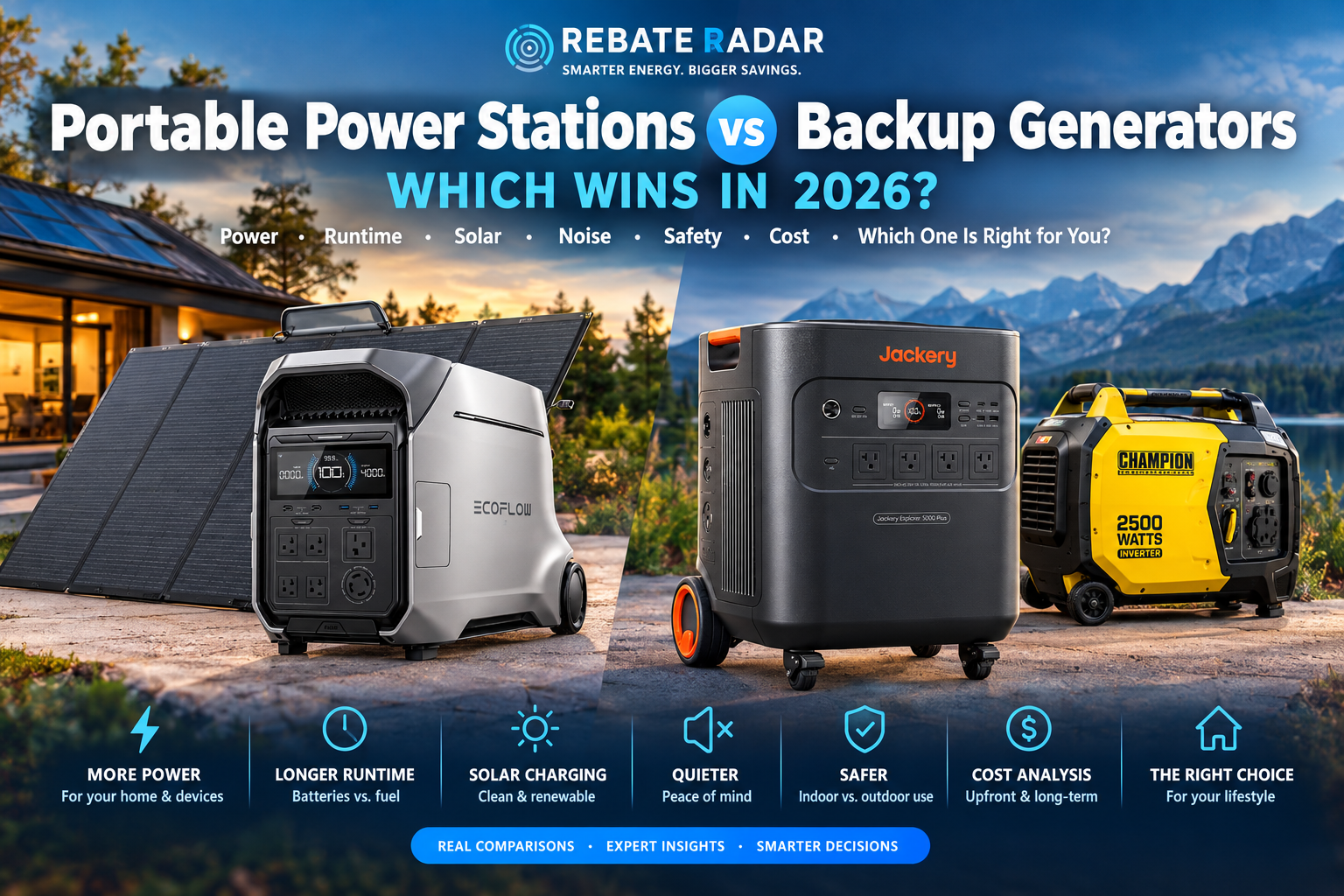
Portable Power Stations vs Backup Generators: Which Is Best in 2026?
The honest answer: neither wins every scenario. Batteries are quieter, cleaner and easier for short outages; fuel generators can run for days as long as you can keep supplying fuel. This guide shows exactly where each technology wins—and how to choose without overspending.
Portable power stations vs backup generators is one of the most important emergency-power decisions homeowners are making in 2026. Modern battery stations now offer thousands of watt-hours, 120/240V capability, fast solar charging, UPS-style protection and enough inverter power for refrigerators, networking equipment, lights and—in some configurations—large appliances. At the same time, compact inverter generators remain extremely difficult to beat when an outage lasts for days and the household needs continuous power.
If you are also comparing battery systems, see our home battery vs. generator guide and our best portable power stations for 2026 roundup. The mistake is treating these technologies as direct substitutes. They are really two different energy strategies. A battery stores energy before the outage and releases it silently. A generator converts fuel into electricity during the outage. That difference affects runtime, noise, maintenance, safety, solar independence, starting surges, operating cost and what happens on day three of a major blackout.
The Short Answer: Who Wins?
If your priority is quiet, instant and renewable backup for essential loads, a large portable power station is usually the better first purchase. You can keep a refrigerator, Wi-Fi router, phones, computers, lights and medical electronics running without engine noise or exhaust. With enough solar input, the battery can also be replenished without buying fuel.
If your priority is maximum endurance during a long outage, a generator still has the fundamental advantage: its energy reservoir is the fuel supply. A battery might contain 4–5 kWh in a single unit, while a generator can continue producing electricity after refueling. The trade-off is that it must be operated outdoors, produces exhaust and requires regular maintenance and fuel management.
🏆 Our 2026 verdict
Best overall for most modern households: a large LiFePO4 power station. It wins on silence, convenience, indoor use, electronics compatibility and solar integration.
Best for multi-day emergencies: an inverter generator. It wins when the outage is long enough that stored battery energy becomes the limiting factor.
Best resilience strategy: use both. A battery can handle the first hours silently, while a properly operated generator can recharge compatible equipment or carry heavy loads when the outage becomes prolonged.
Portable Power Station vs Generator: Full 2026 Comparison
| Category | Portable Power Station | Inverter Generator | 2026 Edge |
|---|---|---|---|
| Energy source | Stored electricity; can recharge from grid or solar | Gasoline/propane depending on model | Battery for flexibility |
| Noise | Essentially silent except cooling fans | Engine noise even with inverter technology | Battery |
| Exhaust | None while operating | Combustion exhaust; outdoor operation required | Battery |
| Long outage | Limited by stored Wh and recharge conditions | Can continue with fuel | Generator |
| Solar recharge | Excellent on compatible models | Usually not native | Battery |
| Refueling | No fuel required | Requires fuel logistics | Battery |
| Heavy 240V loads | Available on selected large systems | Available on selected larger generators | Depends on model |
| Starting effort | Press a button / app | Electric or recoil start depending on model | Battery |
| Maintenance | Very low compared with an engine | Oil, fuel, storage and periodic service | Battery |
| Portable use | Excellent, though large units are heavy | Excellent for smaller inverter models | Tie |
How These Systems Actually Work
1. A battery is an energy reservoir
A power station’s capacity is expressed in watt-hours (Wh) or kilowatt-hours (kWh). A 4,096Wh battery theoretically stores 4.096kWh of energy. The inverter then converts the battery’s DC electricity into AC power for household devices.
For a deeper battery-runtime discussion, see how long a home battery lasts. If you are planning a larger residential storage system, our home battery sizing guide explains how load, usable capacity and outage duration change the answer. Real-world runtime is lower than the simple capacity ÷ appliance-watts calculation because inverter losses, battery management limits and the device’s own electronics consume some energy. A useful planning estimate is to apply an efficiency factor rather than assuming 100% of the printed capacity reaches the appliance.
2. A generator is an energy converter
A generator does not “store” electricity. Its engine burns fuel, spins an alternator and produces electricity. That is why generators can have an enormous practical energy advantage during long outages: adding fuel extends the operating period.
The cost of that endurance is complexity. Engines need oil, ventilation, fuel, maintenance and safe placement. A generator can be extremely useful, but it is not an appliance that should be casually operated inside a garage, basement, shed or enclosed porch.
The Battery Systems Worth Considering in 2026
If you want more options beyond the two featured models, compare our best portable power stations for 2026, best solar generators and solar battery vs. solar generator guides before buying.

EcoFlow DELTA Pro 3 — 4,096Wh / 4,000W
The EcoFlow DELTA Pro 3 is a serious step above small camping power stations. EcoFlow lists a 4,096Wh LFP battery, 4,000W continuous AC output, 8,000W surge output, 120/240V capability, 2,600W maximum solar input and 4,000 cycles to 80% capacity. It can also be expanded substantially with additional batteries.
That combination makes it particularly interesting for homeowners who want one system to cover refrigerators, internet equipment, lights, office equipment and selected larger appliances while retaining the ability to recharge from solar.
Important distinction: the EcoFlow product shown here is a portable power station, not automatically a whole-house electrical installation. If you want selected household circuits to transfer automatically, the required transfer equipment and electrical installation are separate considerations. Always follow the manufacturer’s installation instructions and local electrical code.

Jackery Explorer 5000 Plus — 5,040Wh / 7,200W
The Jackery Explorer 5000 Plus targets homeowners who want unusually high inverter output from a portable battery platform. Jackery lists 5,040Wh capacity, 7,200W rated output, 14,400W surge, 120/240V support and expansion up to 60kWh. Jackery also lists up to 4,000W solar input on compatible configurations.
The high output changes the conversation. Instead of asking only “How many phones can it charge?”, you can start thinking about refrigerators, pumps, larger appliances and selected 240V circuits—provided the electrical setup and load requirements are compatible.
The Generator Side: Why Fuel Still Matters
Battery technology has improved dramatically, but the physics of long-duration backup have not changed. If your house consumes 20kWh over a difficult day and you only have a 5kWh battery, the battery cannot magically become a 20kWh battery. It needs recharge energy.
A fuel generator has the opposite architecture. Once operating, it can keep converting fuel into electricity. That makes it especially valuable during hurricanes, winter storms, grid failures and other events where solar production may be poor and the outage may last several days.
Champion 2500W-class inverter generator
The Champion 2500W inverter-generator family illustrates the compact-generator trade-off. Current Champion specifications for its 2500W inverter models list approximately 2,500W starting power, 1,850W running power, about 53 dBA at 23 feet and up to 11.5 hours at 25% load, depending on the exact model. Some variants add dual-fuel capability.
This class is excellent for a refrigerator, lights, chargers and a limited set of essentials, but it is not a substitute for a high-output 240V whole-home generator. Champion itself notes that some ultralight 2500W models are intended for basic loads rather than emergency whole-home backup.
How Long Does a Portable Power Station Last During an Outage?
Capacity is useful only when translated into hours. The basic estimate is:
Example: if a 5,040Wh station provides an assumed 85% usable AC energy after conversion losses, a 100W load could theoretically run for roughly 42.8 hours. A 500W load would be roughly 8.6 hours. Real results vary with temperature, battery state, load cycling and the specific equipment.
Notice what this means for a refrigerator. A refrigerator may be labeled with a relatively small average power consumption, but the compressor cycles on and off. You should size around realistic energy use and startup behavior rather than simply multiplying the nameplate wattage by 24 hours.
Illustrative 24-hour energy budget
| Load | Example average draw | Hours/day | Daily energy |
|---|---|---|---|
| Refrigerator | 100W average | 24 | 2.4kWh |
| Wi-Fi + modem | 20W | 24 | 0.48kWh |
| LED lighting | 80W | 6 | 0.48kWh |
| TV | 100W | 4 | 0.40kWh |
| Laptops/phones | 80W | 6 | 0.48kWh |
| Total | — | — | 4.24kWh/day |
This example shows why a 4–5kWh station can be excellent for essential loads but may not provide a full day of normal household consumption if you include air conditioning, electric water heating, cooking, dryers or other major loads.
120V vs 240V: The Detail That Changes Everything
One of the biggest mistakes in backup-power shopping is looking only at watt-hours. Voltage and inverter architecture matter just as much.
A compact 120V generator may run a refrigerator beautifully but cannot necessarily power a 240V well pump, electric range, central air-conditioning system or other split-phase appliance. Likewise, a battery station can have thousands of watt-hours and still be unsuitable for a particular 240V load if its output configuration does not support it.
Large modern battery systems such as the EcoFlow DELTA Pro 3 and Jackery Explorer 5000 Plus are attractive because their published configurations include 120/240V output. But “supports 240V” does not mean “powers every 240V appliance.” The appliance’s running watts, startup surge, breaker arrangement and transfer equipment all have to match.
Solar Charging: A Major Advantage for Home Backup
Solar is where portable batteries become much more interesting than ordinary UPS systems. A generator needs fuel. A battery can potentially refill from sunlight.
But solar charging is not magic. A panel’s advertised wattage is a laboratory rating under ideal conditions. Real-world output varies with sun angle, clouds, temperature, shading, orientation and the electrical limits of the battery’s solar input.
The EcoFlow DELTA Pro 3, for example, is specified for up to 2,600W of solar input across its compatible inputs. The Jackery Explorer 5000 Plus is specified for high-voltage and low-voltage solar input and up to 4,000W of solar input in compatible configurations. Those numbers make both platforms far more capable than a basic camping power bank.
If you are building a more independent system, our best off-grid solar kits guide is a useful next step. For emergency planning, the best question is not “How many watts are my panels?” It is: How many watt-hours can I realistically harvest each day during the weather conditions most likely to accompany my outage?
Once you know your likely solar production, our solar savings calculator can help put the energy side of the decision into a broader household context.
Noise, Comfort and Nighttime Operation
This is one category where batteries win decisively. A battery station can operate inside the home without an engine running. That means no exhaust, no fuel smell and no engine noise while powering a refrigerator or networking equipment overnight.
Inverter generators are much quieter than old open-frame generators, but “quiet” does not mean silent. A compact Champion inverter model may operate around the low-50-dBA range under the manufacturer’s test conditions, yet the character of engine noise is still different from a battery system.
If you live in a dense neighborhood, work from home, sleep near your backup equipment or want to avoid disturbing neighbors during an outage, the battery advantage can be worth a lot.
Safety: Battery vs Generator
Battery safety priorities
- Use the correct charger and cables.
- Follow temperature and storage limits.
- Keep vents unobstructed.
- Do not overload the inverter.
- Use only approved expansion batteries and accessories.
- For home-circuit integration, use qualified electrical installation.
Generator safety priorities
- Operate outdoors only.
- Keep exhaust away from openings.
- Use working carbon-monoxide alarms.
- Never backfeed a house through an improvised connection.
- Store fuel legally and safely.
- Perform oil and engine maintenance.
The most dangerous generator mistake is attempting to energize household wiring without a proper transfer mechanism. Backfeeding can put utility workers at risk and can damage equipment. If a generator will connect to household circuits, use equipment designed for that purpose and a qualified electrician.
Portable Power Station vs Generator Cost in 2026
For a broader installation-cost framework, see our home battery backup cost guide.
The sticker price is only part of the calculation. If you are comparing a permanent home battery installation rather than a portable unit, see our home battery backup without solar guide as well.
Battery ownership cost
- Up-front battery and inverter cost.
- Optional expansion batteries.
- Solar panels and charge hardware if desired.
- Possible transfer switch or home-integration equipment.
- Very low routine maintenance.
- No gasoline or propane consumption while operating.
Generator ownership cost
- Generator purchase price.
- Fuel storage and fuel cost.
- Oil and periodic maintenance.
- Possible transfer equipment and installation.
- Replacement parts over the engine’s service life.
- Potentially much lower cost per additional kWh during a long outage.
A battery can be economically attractive when outages are short and infrequent because you are buying convenience and resilience rather than constantly consuming fuel. For a broader household-cost view, you can also use our electricity cost calculator to understand your normal energy consumption. A generator can become economically attractive when outages are long because every additional hour does not require buying another battery module.
How to Compare Backup Power Like a Pro
A good backup-power decision starts with the loads you actually need, not the biggest number printed on a product box. The most useful specifications answer four different questions: How much energy can the system store? How much power can its inverter deliver? Can it supply the voltage your appliance needs? And how can you recharge it after the first battery reserve is depleted?
Wh tells you about endurance
Watt-hours describe stored energy. A 5,040Wh battery has more stored energy than a 2,000Wh battery, all else being equal. But usable AC energy is lower than the printed capacity after conversion losses and operating limits. That is why the calculator below uses an efficiency assumption instead of pretending that every advertised Wh reaches your appliances.
W tells you about simultaneous loads
Watts describe the rate at which electricity is being delivered. A battery can have plenty of Wh and still fail to start a motor if its inverter cannot supply the required starting power. Refrigerators, pumps, compressors and some HVAC equipment deserve particular attention because startup behavior can be very different from normal running demand.
Why the biggest battery is not automatically the best choice
Imagine two households each buying a 5kWh-class battery. One household only wants refrigeration, Wi-Fi, LED lighting and phones during a six-hour outage. The other wants central air conditioning, an electric range, a well pump and a refrigerator. The same nominal capacity can produce very different outcomes because the second household has a much larger instantaneous load and may also require 240V output.
That is why our recommendation is to create an essential-load list before shopping. Separate loads into three groups: must-run equipment, useful equipment and luxury loads. Then estimate the average wattage and hours of operation for the must-run group. This gives you a realistic daily energy target instead of an arbitrary battery size.
Runtime is an estimate, not a promise
Real runtime changes continuously. A refrigerator cycles rather than drawing its nameplate wattage every minute. A laptop may consume very little while idle and substantially more under heavy work. Battery temperature, inverter efficiency, minimum state-of-charge limits and conversion losses also affect the result. For that reason, the calculator is intentionally presented as a planning tool, not as a guarantee of performance.
When a generator makes more sense
A generator becomes increasingly attractive when the outage is long, the load is high and reliable solar charging is unavailable. Fuel is an energy input that can be replenished, so the practical energy reserve can be much larger than the generator’s physical size suggests. That advantage comes with operating requirements: outdoor placement, carbon-monoxide protection, fuel management, maintenance and safe electrical connection.
For many households, the most resilient answer is not choosing one technology forever. A battery can cover the quiet first hours and protect sensitive electronics while a generator handles the longer period. The battery can also reduce the number of hours the engine has to run, which may improve comfort during nighttime or lower-load periods.
Our evaluation framework
For this comparison, the useful decision factors are runtime, usable energy, continuous output, surge capability, voltage compatibility, recharge options, noise, emissions, maintenance, portability and long-outage practicality. Product specifications are treated as manufacturer-published information rather than independent laboratory measurements. Calculated runtime examples are labeled as estimates. This distinction matters because an editorial comparison should help readers understand what is known, what is calculated and what still needs to be verified for their particular home.
What About the 2026 Federal Tax Credit?
This is an important correction because many older articles still repeat the pre-2026 30% battery-credit language. A high-quality 2026 guide should not tell readers they are guaranteed a federal credit when current IRS guidance says otherwise.
Free Backup Runtime & Battery Sizing Calculator
Calculate Your Backup Runtime
Enter your battery capacity, expected average load, efficiency and target outage duration. The tool estimates usable AC energy, runtime and the battery capacity required to cover your target window.
Planning estimate only. Real-world runtime varies with load cycling, temperature, inverter losses, battery-management limits and the exact product configuration.
Which One Should You Buy?
Choose a portable power station if…
- You want silent overnight backup.
- Your priority loads are refrigerator, Wi-Fi, lights and electronics.
- You want solar recharge capability.
- You dislike gasoline storage.
- You need portable power for camping or RV use too.
- You want a battery that can be used every week, not only during emergencies.
Choose an inverter generator if…
- You regularly experience multi-day outages.
- You need continuous power beyond a battery’s stored capacity.
- You can safely operate and store fuel.
- You need a simple fuel-based energy source independent of sunlight.
- You understand the electrical requirements of your appliances.
- You are prepared to maintain an engine.
The Smartest Strategy: Battery First, Generator Second
If you are considering a battery without rooftop solar, our home battery backup without solar guide explains the trade-offs.
For homeowners who can afford both, a hybrid emergency-power strategy can be stronger than either technology alone.
Use the battery for the first stage of an outage: refrigerator, networking, lights, phones, computers and other sensitive electronics. You get quiet operation and immediate power. If the outage continues into the second or third day, the generator becomes the endurance layer.
There is another advantage: a generator can potentially reduce the number of battery expansion modules you need. Instead of purchasing an enormous battery bank sized for the rarest multi-day outage, you can maintain a practical battery system and retain a fuel generator for exceptional events.
Best Value Scenarios
Households that want a larger storage system can also review how many home batteries they may need and our best home batteries and solar generators comparison.
| Household scenario | Best first purchase | Why |
|---|---|---|
| Apartment / condo, refrigerator + electronics | Power station | No exhaust and easy portable deployment |
| Home office with short blackouts | Power station | Silent and excellent for computers/networking |
| Frequent hurricane outages | Generator + battery | Battery handles essentials; generator supplies endurance |
| Remote cabin with good solar | Large battery + solar | Fuel-free daily operation is valuable |
| Electric well pump | Depends on 240V/startup needs | Motor surge and voltage configuration are decisive |
| Central AC during long outage | Large 240V system or generator | High continuous and startup demand |
| Camping / RV | Power station | Quiet, portable and solar friendly |
7 Expensive Buying Mistakes to Avoid
- Buying by Wh alone. Capacity does not tell you whether the inverter can start your appliance.
- Ignoring voltage. A 120V system is not automatically a solution for a 240V appliance.
- Assuming solar will always deliver its nameplate wattage. Weather and panel conditions matter.
- Forgetting refrigerator compressor cycles. Average energy and startup power are different measurements.
- Running a generator in a garage. Never do this—even with the door open.
- Improvising a house connection. Use appropriate transfer equipment and qualified electrical work.
- Buying far more battery than you need. First identify the essential loads and calculate their daily energy demand.
Frequently Asked Questions
Are portable power stations better than generators in 2026?
For quiet, short-duration and solar-rechargeable backup, often yes. For multi-day high-load outages, generators still have a major endurance advantage because fuel can be replenished.
Can a portable power station run a refrigerator?
Yes, if its inverter can handle the refrigerator’s running and startup requirements and the battery has sufficient usable energy. A larger LFP station is generally better suited than a small camping unit.
How long will a 5,000Wh battery last?
It depends entirely on the load. At an illustrative 300W average load and 85% usable AC efficiency, 5,000Wh would provide roughly 14 hours. Actual runtime varies.
Can a generator run a whole house?
Only if the generator has sufficient output and the house is connected through properly designed transfer equipment. A 2,500W portable inverter generator is not equivalent to a large whole-home standby generator.
Is an inverter generator safer than a traditional generator?
Inverter generators can provide cleaner electrical output and often quieter operation, but they still produce combustion exhaust and carbon monoxide. The same outdoor-operation rules apply.
Can I use solar panels with a portable power station?
Many modern models support solar input. Check the station’s voltage, current and maximum solar-input limits before connecting a panel configuration.
Does a portable power station need gasoline?
No. The battery itself stores electricity. It can often be charged from a wall outlet, solar panels or other compatible charging sources. Some ecosystems can also integrate with generators.
Is 240V support enough to run central air conditioning?
Not by itself. You must also check continuous wattage, startup or surge requirements, breaker configuration and whether the specific system is approved for that application.
What is better for a hurricane: battery or generator?
A combination is often strongest. Battery backup provides silent immediate power, while a generator provides extended endurance when the outage lasts longer than the battery reserve.
Can I claim the old 30% federal battery tax credit in 2026?
Current IRS guidance says Section 25D is not allowed for expenditures made after December 31, 2025. Verify any prior-year expenditure, carryforward or other incentive with the IRS and a qualified tax professional.
Final Verdict
🔋 If you want the easiest backup: buy the battery.
A modern LiFePO4 power station is exceptionally convenient. It is quiet, requires little maintenance, can be recharged from solar and can serve as useful everyday equipment rather than sitting unused for 11 months of the year.
⛽ If you need the longest outage endurance: buy the generator.
A fuel generator has a simple superpower: its runtime is linked to fuel availability rather than the size of a battery bank. For severe multi-day outages, that matters.
⚡ If resilience is the goal: combine them.
The most robust setup is often a layered system: battery for immediate, quiet essential-load backup; solar for renewable recharge; and an appropriately sized generator for extended emergencies.
Make the Backup-Power Decision With Your Actual Loads
Before you buy, list the refrigerator, internet equipment, lighting, medical devices, computers and other essentials you want during an outage. Then compare usable watt-hours for runtime with continuous/starting watts and voltage for compatibility.
Sources & Editorial Notes
Accuracy standard: We do not claim independent laboratory testing, guaranteed savings, guaranteed runtime, universal permit requirements, or tax eligibility unless those statements are supported by manufacturer or government guidance. Product prices, availability, specifications and local electrical requirements can change.
- EcoFlow DELTA Pro 3 manufacturer specifications: 4,096Wh LFP capacity, 4,000W continuous output, 8,000W surge, 120/240V output, 2,600W solar input and 4,000-cycle-to-80% specification.
- Jackery Explorer 5000 Plus manufacturer specifications: 5,040Wh capacity, 7,200W output, 14,400W surge, 120/240V output and expansion options.
- Champion Power Equipment manufacturer specifications for its 2500W inverter-generator models, including running/starting output, noise and runtime figures.
- U.S. Internal Revenue Service guidance regarding the termination of Section 25D residential clean-energy credits for expenditures after December 31, 2025.
- Google Search Central guidance on helpful, people-first content, Article structured data and image best practices.
- All product specifications and prices can change. Verify the exact model, configuration, accessories and current terms before purchasing.
Pingback: Why Solar Stops Working In Outages & How To Fix It
Pingback: Anker SOLIX Vs Jackery 2000 Plus (2026 Modular Backup Review)