
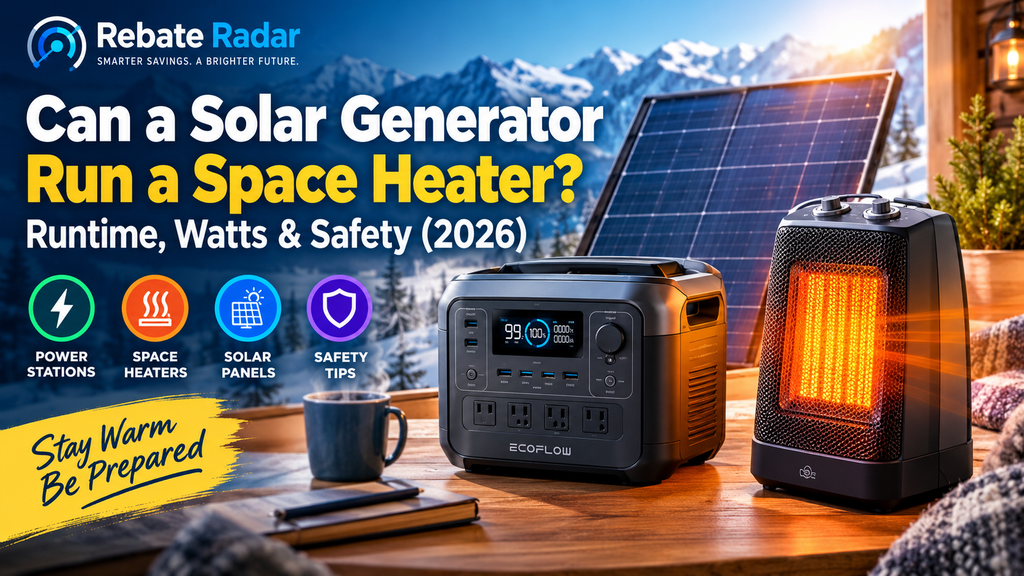
Can a Solar Generator Run a Space Heater? Runtime, Watts & Safety (2026)
Yes, many portable power stations can run an electric space heater. The real challenge is how quickly a heater can drain the battery. Here is how to check wattage, estimate runtime, compare power stations, and choose a safer winter backup setup.
Yes—but battery capacity and inverter output matter more than the phrase “solar generator.” A 1,500-watt heater may run from a power station whose continuous AC output supports at least 1,500 watts, provided the unit’s instructions permit that load. A battery with about 2,000Wh of nominal capacity might power it for roughly an hour under a simplified estimate, not all night.
For longer heating, reducing the heater’s wattage or warming one occupied space more efficiently can make a bigger difference than simply buying a larger solar panel.
1. Can a solar generator run a space heater?
In many cases, yes. A portable power station—often marketed as a solar generator—stores energy in a rechargeable battery and uses an inverter to supply AC electricity to compatible household devices. If the power station can deliver the heater’s required wattage and has enough stored energy, it may run that heater without a wall outlet.
But there is a crucial distinction: being able to power a heater is not the same as being able to heat a room for many hours. Electric resistance heaters turn electrical energy into heat, so a heater operating at 1,500 watts consumes approximately 1,500 watt-hours of electricity for each hour it runs continuously. That is a substantial load for a portable battery.
Before connecting anything, verify three things:
- Continuous AC output: The inverter’s continuous rating must support the heater’s actual power draw. Do not rely only on a short-duration surge rating or a marketing feature that changes the operating limits.
- Available battery energy: Capacity is usually advertised in watt-hours (Wh). The energy available at the AC outlet will be lower than the battery’s nominal capacity because of conversion losses and the power station’s operating requirements.
- Operating instructions: Confirm that the manufacturer permits the intended load, the outlet is appropriate, and the power station can operate safely in the environment where you plan to use it.
A heater that draws 750 watts may be easier to support than one that draws 1,500 watts. However, the lower-wattage heater does not necessarily produce enough heat for every room or climate. Room size, insulation, outside temperature, drafts and ceiling height all affect comfort.
Why do some power stations shut down with a heater?
A shutdown does not automatically mean that a power station is defective. The heater may exceed the inverter’s continuous output rating, the battery may be nearly empty, the system may be too hot or too cold, or a protective limit may have been triggered. Some models also have operating modes that change which loads they support.
Never bypass a protective shutdown or repeatedly restart a unit that is reporting an overload or temperature fault. Disconnect the load and follow the manufacturer’s troubleshooting instructions.
2. How long will a solar generator run a space heater?
Runtime depends mainly on battery capacity, heater wattage and the amount of energy lost between the battery and the AC outlet. The following table uses a simple planning assumption: 85% of nominal battery energy is available to the AC load. This is an estimate, not a measured efficiency figure for any specific product.
| Nominal battery capacity | Estimated usable AC energy at 85% | Runtime at 750W | Runtime at 1,500W |
|---|---|---|---|
| 500Wh | 425Wh | 34 minutes | 17 minutes |
| 1,000Wh | 850Wh | 1 hour 8 minutes | 34 minutes |
| 2,000Wh | 1,700Wh | 2 hours 16 minutes | 1 hour 8 minutes |
| 3,600Wh | 3,060Wh | 4 hours 5 minutes | 2 hours 2 minutes |
| 5,000Wh | 4,250Wh | 5 hours 40 minutes | 2 hours 50 minutes |
These figures assume a continuous load at the stated wattage. Actual results may be shorter because of inverter idle consumption, battery reserve settings, temperature, battery condition, power-station configuration and other loads connected at the same time. A thermostat that cycles the heater on and off can reduce average energy use, but it does not guarantee a particular runtime.
What if the heater has a low setting?
Suppose a heater offers settings of 600W, 900W and 1,500W. On a nominal 2,000Wh battery, the simplified estimates at 85% usable AC energy are:
| Heater power | Approximate runtime | Practical takeaway |
|---|---|---|
| 300W | 5 hours 40 minutes | Much lower energy demand, if the heater offers this setting. |
| 600W | 2 hours 50 minutes | Can be a better compromise for a small, reasonably insulated space. |
| 900W | 1 hour 53 minutes | Uses energy faster; real runtime may be lower. |
| 1,500W | About 1 hour 8 minutes | High output, but demanding for a portable battery. |
For example, a 2,073.6Wh power station using the same 85% planning assumption would provide about 1,762Wh of estimated AC energy. At a continuous 1,500W load, that works out to approximately 1.17 hours, or about 70 minutes. This is a calculation, not a promise of real-world performance.
3. How to calculate space-heater runtime
You can estimate runtime using the battery capacity and the heater’s actual wattage. You do not need a complicated energy model for an initial comparison.
Estimated runtime (hours) = battery capacity (Wh) × usable-energy factor ÷ heater power (W)
For this guide, the illustrative usable-energy factor is 0.85. Replace it with a measured or manufacturer-supported value if you have reliable data for your particular setup.
Worked example: 2,000Wh battery and 1,500W heater
- Start with nominal capacity. The battery is rated at 2,000Wh.
- Allow for conversion and operating losses. Applying the illustrative 85% factor gives 2,000 × 0.85 = 1,700Wh of estimated AC energy.
- Divide by heater power. Calculate 1,700Wh ÷ 1,500W = 1.13 hours.
- Convert to minutes. 1.13 hours is approximately 68 minutes.
- Plan a margin. Do not schedule essential heating around the theoretical endpoint. Conditions and actual power draw can vary.
Why real-world results can be different
The 85% factor is a planning assumption, not a universal property of lithium batteries. Actual usable energy depends on the specific power station, inverter efficiency at the load, background consumption, battery temperature, age, battery-management settings and reserve limits. Very cold conditions can also affect battery performance and charging behavior.
Heaters with thermostats may draw their rated wattage only while the heating element is on. If the heater cycles, its average load can be lower than its maximum rating. However, the duty cycle depends on room conditions, so it should not be used as a guaranteed runtime multiplier.
For a more precise estimate, use a compatible power meter or the power station’s own monitoring display, if the manufacturer supports that method. Measure the actual wattage during operation and observe how quickly the remaining-energy estimate changes. Follow all equipment instructions and never modify wiring or protective devices.
For another practical energy calculation, see our guide to what a 2,000Wh battery backup can power.
4. Watts, watt-hours and inverter limits explained
Many buying mistakes happen because product listings use watts and watt-hours close together. They describe different things, and both matter when you want to run an electric heater.
Watts (W): how much power the heater needs now
A 1,500W heater uses energy at a rate of 1,500 watts while its heating element is running at full power. At 120 volts, a purely resistive 1,500W load draws approximately 12.5 amps, using the simple relationship watts = volts × amps.
Watt-hours (Wh): how much energy the battery stores
A battery rated at 2,000Wh has a nominal energy capacity of 2 kilowatt-hours. That number helps estimate duration, but it does not tell you the maximum power the inverter can deliver. Two power stations with similar capacity may have different continuous output ratings.
Continuous output versus surge output
Continuous output is the power a unit is designed to provide within its stated operating conditions. Surge output is a separate, usually short-duration capability intended for compatible loads that briefly require extra power. Do not assume that a surge figure can support a heater continuously.
Some products advertise a special mode that allows certain resistive appliances to operate at a higher rated load. Read the exact conditions carefully. Such modes can work differently from ordinary continuous AC output and should not be treated as a universal increase in the unit’s normal output rating.
What about a 1,000W power station?
The wording matters. If “1,000W” refers to a station’s maximum continuous AC output, it generally cannot support a heater drawing 1,500W at full power. If the listing refers to battery capacity or a different specification, that number alone does not establish compatibility. Always check the product’s continuous AC output and the heater’s actual draw.
For a broader comparison of battery backup options, visit our portable power station guide for emergency home backup.
5. Power stations and heaters to compare
The products below serve different purposes. The heaters are examples of portable electric heating appliances; the power stations provide stored electricity. They are not interchangeable categories. Check the current product listing and owner’s manual before purchasing or connecting equipment.
Portable electric space heaters
Amazon Basics 1500W Ceramic Personal Space Heater
A compact ceramic heater can be useful for targeted warmth, depending on its design and the space being heated. The key figure for battery planning is its actual wattage at the selected setting—not just the product name.
At a continuous 1,500W draw, a heater uses 1.5kWh of electricity per hour. That makes full-power heating a demanding use case for portable batteries.
Check the current listing for safety features, operating modes, dimensions, certifications and instructions.
Check on Amazon →Dreo Space Heater for Home (1500W PTC Ceramic Heater)
PTC ceramic heating is a common approach in portable electric heaters. Features vary by model, so verify the exact product’s thermostat, controls, safety protections and available power settings before deciding whether it suits your room.
For battery use, a lower operating setting can extend runtime if it provides enough warmth for the conditions. The actual result depends on the selected setting and how often the heater cycles.
Do not assume that a ceramic design uses substantially less energy than another electric resistance heater when both are delivering the same wattage of heat.
Check on Amazon →Portable power stations and solar generator kits
EcoFlow DELTA 2 Max (Standalone Unit)
The DELTA 2 Max is a portable power station designed for a range of backup and off-grid uses. When evaluating it for space heating, confirm the exact model’s nominal capacity, continuous AC output, operating limits and any applicable settings in the current manufacturer documentation.
A higher output rating addresses whether a load can be supported; battery capacity determines how long that load may run. You need both figures to evaluate a heater.
Standalone means you should confirm whether solar panels, cables and other accessories are included in the exact offer you select.
Check on Amazon →EcoFlow DELTA Pro 3.6kWh with 400W Portable Solar Panel
A larger battery can offer more stored energy for high-demand appliances than a small portable station. The listed configuration describes a 3.6kWh unit and a 400W portable solar panel; verify the current listing to confirm exact included equipment, output specifications and compatibility.
Even with a larger battery, continuous operation of a 1,500W heater can use energy quickly. Solar input can help replenish the battery when conditions allow, but it should not be assumed to cover the heater’s full consumption throughout the day.
Check the current listing for the exact model, expansion compatibility, solar input limits, warranty and included accessories.
Check on Amazon →BLUETTI Elite 200 V2 with 2 × 200W Solar Panels
BLUETTI lists the Elite 200 V2 with a nominal capacity of 2,073.6Wh and 2,600W of AC output. Its manufacturer documentation also describes a Power Lifting mode for certain pure resistive loads. Read the manual for the exact operating conditions and limitations of that mode before connecting any appliance.
Using the guide’s illustrative 85% usable-energy assumption, 2,073.6Wh corresponds to approximately 1,762Wh of estimated AC energy. At a constant 1,500W load, that would be about 70 minutes mathematically. Actual runtime may differ.
The product configuration you supplied includes two 200W solar panels. Confirm the package contents and the station’s solar-input limits in the live listing before purchasing.
Capacity and output specifications are based on manufacturer information; the runtime above is calculated, not a hands-on test result.
Check on Amazon →How should you compare these options?
| What to compare | Why it matters | What to verify |
|---|---|---|
| Continuous AC output | Determines whether the inverter can support the heater. | Manufacturer’s continuous output rating and operating conditions. |
| Battery capacity | Helps estimate how long the heater can run. | Nominal Wh and any usable-energy information. |
| Solar input | Limits how quickly the battery can be replenished by panels. | Maximum supported solar watts, voltage and current limits. |
| Included accessories | Packages can differ even when product names look similar. | Whether panels, cables and adapters are included. |
| Safety and support | Important for winter backup and long-term ownership. | Manual, warranty, temperature limits and support terms. |
For a more detailed comparison between two battery systems, read BLUETTI Elite 200 V2 vs. EcoFlow DELTA 2 Max. For a broader look at whole-home battery options, see Tesla Powerwall alternatives.
6. Can solar panels keep a space heater running?
Solar panels can replenish a portable power station during daylight, but their rated wattage is not the same as the energy they will produce every hour. Actual solar generation varies with sunlight, panel orientation, shading, weather, season, temperature and the power station’s input limits.
Consider a 400W portable solar panel. Its rated output does not mean it will deliver 400W continuously from sunrise to sunset. If it produces an illustrative average of 200W for five hours, that would equal 1,000Wh before accounting for system losses and any restrictions. This is an example calculation, not a forecast for a particular location.
A 1,500W heater operating continuously for one hour uses about 1,500Wh. A solar panel system producing 1,000Wh over the same general period would not fully replace that energy use, and the timing matters: generation may be strongest when the heater is not needed as much.
Why solar charging is not an overnight solution by itself
Heating demand may be highest after sunset, when photovoltaic panels are no longer generating electricity. In that situation, the battery must store enough energy in advance to cover evening and overnight consumption. On cloudy winter days, it may also be difficult to restore the battery fully before the next night.
Solar panels can still be useful. They may extend the amount of energy available across a day or help recharge the battery during a power outage. The important question is whether expected daily solar production is sufficient to replace the energy used by the heater and any other appliances.
For related planning, see how long it takes to charge a 2,000Wh solar generator and how many solar panels a home may need.
7. What does electric heating really cost in battery capacity?
The energy requirement of a resistance heater is easy to underestimate because a small appliance can have a high wattage. A 1,500W heater uses about 1.5kWh for every hour its heating element runs continuously. If it operates for four hours at full power, the energy consumed is approximately 6kWh—before accounting for battery conversion losses.
| Continuous operating time | Energy at 750W | Energy at 1,500W |
|---|---|---|
| 30 minutes | 0.375kWh | 0.75kWh |
| 1 hour | 0.75kWh | 1.5kWh |
| 2 hours | 1.5kWh | 3.0kWh |
| 4 hours | 3.0kWh | 6.0kWh |
| 8 hours | 6.0kWh | 12.0kWh |
These are energy-use calculations at a constant load, not estimates of the heater’s electricity bill or the total battery capacity required. A battery system needs extra nominal capacity to account for conversion losses and operating limits.
Can a 2kWh battery heat a room all night?
It generally should not be assumed that a 2kWh-class portable battery can run a 1,500W heater continuously for an eight-hour night. Using the illustrative 85% usable-energy factor, a 2,000Wh battery offers an estimated 1,700Wh of AC energy. At 1,500W, that is about 1.13 hours of continuous operation.
If the heater cycles on and off, it may use less energy over the night, but the amount depends on the room’s heat loss and thermostat behavior. It is not safe to count on an unverified duty cycle when planning essential heating in very cold weather.
Why improving the room can be more effective
Heat escapes through windows, exterior walls, ceilings, gaps and poorly sealed doors. Reducing drafts and improving insulation where practical can help a room retain warmth, potentially reducing how long a heater needs to run. Close unused rooms where appropriate and follow local guidance for safe winterization. Do not block required ventilation or use unsafe indoor combustion methods.
If your main goal is backup power for several appliances, consider the whole load rather than choosing a battery around one heater. Our guide to how many home batteries you may need provides a useful starting point for thinking about capacity.
8. Essential safety rules for space heaters and power stations
Using a portable power station does not remove the ordinary fire and burn risks associated with a space heater. It also introduces battery, inverter and electrical-load considerations. Follow the heater and power-station manuals, and use equipment only within its stated limits.
The U.S. Consumer Product Safety Commission recommends keeping portable heaters at least three feet away from combustible materials, plugging electric space heaters directly into a wall outlet rather than an extension cord or power strip, and turning heaters off while sleeping. If you are powering a heater from a portable power station, follow the power station manufacturer’s instructions for compatible loads, cables, clearances and ventilation as well.
Keep clear space around the heater
Keep the heater away from curtains, bedding, upholstered furniture, clothing, paper and other materials that could ignite. Place it on a stable, level surface and keep it out of walkways where it could be knocked over. Never cover a heater or use it to dry clothing unless the manufacturer’s instructions specifically permit the intended use.
Do not use an extension cord or power strip unless the manufacturer explicitly permits a particular approved setup
Portable heaters can draw high current. The CPSC’s general guidance is to plug electric space heaters directly into a wall outlet and not into an extension cord or power strip. When using a portable power station, do not improvise with household extension leads, adapters or modified plugs. Follow the instructions for both devices and use only an expressly permitted connection method.
Do not leave a portable heater running while you sleep
The CPSC recommends turning portable heaters off when sleeping. Do not treat a large battery, a thermostat or an automatic shutoff feature as a reason to ignore this advice. Plan other safe ways to stay warm overnight, particularly if temperatures could become dangerously low.
Protect the power station from unsuitable conditions
Do not operate or charge a power station outside its specified temperature, moisture or ventilation limits. Keep it away from heater exhaust, hot surfaces, water and combustible clutter. Do not cover ventilation openings, disassemble the battery, bypass protection circuitry or continue using equipment that is damaged, swollen, unusually hot or emitting an unusual smell.
Never use outdoor fuel-burning equipment inside
Do not run a gasoline generator, camping stove, charcoal grill or outdoor fuel-burning heater inside a home, garage, tent or other enclosed area. These devices can produce carbon monoxide, an odorless and potentially fatal gas. Only use a fuel-burning appliance indoors if it is specifically certified for that use and its manufacturer instructions and applicable safety requirements are followed. Never use a camp stove as an indoor heating solution.
Understand the limits of backup power
A portable power station can be helpful for selected devices during an outage, but it is not automatically a substitute for a properly designed home backup system. Do not connect a power station to household wiring through an improvised connection. Any connection to home circuits must use equipment and installation methods specifically designed and approved for that purpose.
For additional guidance, consult the U.S. Consumer Product Safety Commission’s winter heating safety guidance.
9. Better ways to stay warm during an outage
If your priority is staying warm for several hours, running a high-wattage resistance heater from a portable battery may not be the most energy-efficient plan. The right solution depends on your climate, home, mobility needs, budget and the severity of the outage.
Use targeted heating when appropriate
Rather than attempting to heat an entire home, focus on maintaining a comfortable, safe space for the people using it. Close doors to unused rooms when it is appropriate to do so, reduce drafts without blocking required ventilation, and use normal bedding and clothing. These measures may lower the amount of time a heater needs to run.
Consider an electric blanket or heated throw
Some personal heating products use substantially less power than a 1,500W space heater, although wattage varies by model and setting. If a product is rated at 60W, for example, its theoretical energy use is 60Wh per hour while operating at that power. That is much less than a 1,500W heater’s 1,500Wh per hour.
This comparison is about energy consumption, not an assertion that the products provide equivalent heating. Follow the product instructions, check compatibility with the power station, and do not use heated bedding that is damaged or prohibited by its manufacturer.
Use a larger battery only after estimating the load
A larger power station can increase the amount of energy available, but it may also be heavier, more expensive and slower to recharge from limited solar input. Estimate the energy required for your intended use before choosing a system. If you need to power several devices, add their expected consumption rather than considering the heater alone.
Consider a properly designed home backup system
For frequent outages or essential heating needs, a home energy assessment may be more useful than buying portable equipment based on battery capacity alone. A qualified professional can help evaluate the home’s heating system, insulation, electrical loads, backup requirements and local safety requirements.
Explore these related Rebate Radar guides:
10. Space-heater and solar-generator buying checklist
Before buying a power station for winter use, work through this checklist. It can help prevent an expensive mismatch between the heater and the battery.
- Read the heater’s label. Confirm its maximum wattage, voltage and any lower-power modes.
- Check continuous AC output. Choose a power station that can support the actual load within the manufacturer’s stated limits.
- Estimate energy demand. Multiply the heater’s watts by the hours it will operate to calculate approximate watt-hours consumed.
- Allow for losses. Do not assume all nominal battery energy reaches the AC outlet.
- Check solar input compatibility. Confirm supported solar voltage, current and maximum input power, not just the panel’s advertised wattage.
- Confirm what is included. Product bundles can differ in panels, cables, adapters and other accessories.
- Read the operating manual. Verify temperature limits, ventilation requirements, permitted loads and any special operating mode restrictions.
- Review the return policy and warranty. Make sure the seller and product terms suit your needs.
- Plan for poor weather. A solar setup may generate much less energy on a cloudy winter day.
- Have a safety plan. Do not rely on a portable heater running unattended while you sleep, and never use unsuitable fuel-burning equipment indoors.
Which setup makes sense for your needs?
For occasional, short-duration heating: start by checking whether your existing power station’s continuous AC output supports the heater. Estimate runtime before relying on it during an outage.
For several hours of heating: compare lower heater settings, actual heat requirements, battery capacity and realistic recharge opportunities. Do not select a system based only on its peak output number.
For overnight or whole-home heating: do not assume a portable battery and electric space heater are an adequate primary backup. Consider safe heating alternatives and professional advice suited to the home and local conditions.
11. Frequently asked questions
Can a 1,000W solar generator run a 1,500W space heater?
If 1,000W is the power station’s maximum continuous AC output, it generally cannot support a heater drawing 1,500W at full power. Check the exact output specification and the heater’s wattage. Battery capacity alone does not solve an inverter-output mismatch.
How long will a 2,000Wh solar generator run a 1,500W heater?
Using an illustrative 85% usable AC-energy assumption, 2,000Wh × 0.85 ÷ 1,500W gives approximately 1.13 hours, or 68 minutes. Real runtime may be shorter or otherwise different depending on the specific unit, conditions and actual load.
Can the BLUETTI Elite 200 V2 run a 1,500W space heater?
BLUETTI lists the Elite 200 V2 with 2,600W AC output and 2,073.6Wh capacity. A 1,500W heater is below that stated output rating, but you should verify the exact unit, operating conditions, other connected loads and manual before use. Its expected runtime is limited by battery energy.
Does a ceramic heater use less electricity than other space heaters?
Not necessarily at the same electrical wattage. A 1,500W electric resistance heater uses approximately 1,500Wh for each hour its heating element runs at full power, regardless of whether it uses a ceramic or another resistance-heating design. Controls and thermostat cycling can affect average consumption.
Can a 400W solar panel power a 1,500W heater?
A 400W-rated panel does not continuously produce 400W in all conditions, and its rated output is below a 1,500W heater’s demand. A battery can supply the difference for a time, but whether the system can sustain the load depends on actual solar production, stored energy and the power station’s input limits.
Can I run a space heater from a power station overnight?
Do not assume that a portable power station can safely provide overnight heating. A high-wattage heater may deplete a battery quickly, and the CPSC recommends turning portable heaters off while sleeping. Plan for safe heating and follow both manufacturers’ instructions.
Is a larger battery always the best solution?
A larger battery generally stores more energy, but it may be heavier, more expensive and require more time or solar input to recharge. Check both the inverter output and the energy required for your planned runtime before choosing a system.
Will a space heater work if the battery is being charged by solar panels?
It may, if the power station supports simultaneous charging and AC output under the intended conditions. Solar production varies and may be far below the heater’s demand. Check the device’s manual for pass-through or simultaneous-operation rules rather than assuming all models support the same behavior.
Can I use a propane camping stove to heat a room during a power outage?
No. Do not use a camping stove or outdoor fuel-burning appliance indoors as a heating method. Such equipment can produce carbon monoxide and create serious fire risks. Use only appliances specifically approved for indoor use, in accordance with their instructions and applicable safety guidance.
What is the most important specification when choosing a power station for a heater?
Check two specifications together: continuous AC output, which determines whether the station can support the heater’s power draw, and battery capacity in watt-hours, which helps estimate how long it can run. Neither figure alone gives the full answer.
Choose your backup power based on real energy needs
Before you buy a solar generator for winter heating, check the heater’s wattage, calculate the expected runtime and confirm the power station’s limits. A realistic estimate is more useful than a headline capacity number alone.
Explore 2,000Wh battery backup capacity →Sources and methodology
This guide uses transparent arithmetic for the example runtime estimates and manufacturer-published specifications where identified. It is not a report of independent laboratory tests, and it does not claim that any product was physically tested by Rebate Radar.
- BLUETTI Elite 200 V2 official product specifications — nominal battery capacity and stated AC output.
- U.S. Consumer Product Safety Commission: winter heating and generator safety — general portable-heater safety guidance.
- Google Search Central: Get on Discover — official recommendations for Discover eligibility, content and images.
Specifications, product bundles, pricing, availability and warranty terms may change. Verify current details in the relevant manufacturer’s documentation and live Amazon listing before purchase. Runtime examples are mathematical estimates based on the assumptions stated in the article.