
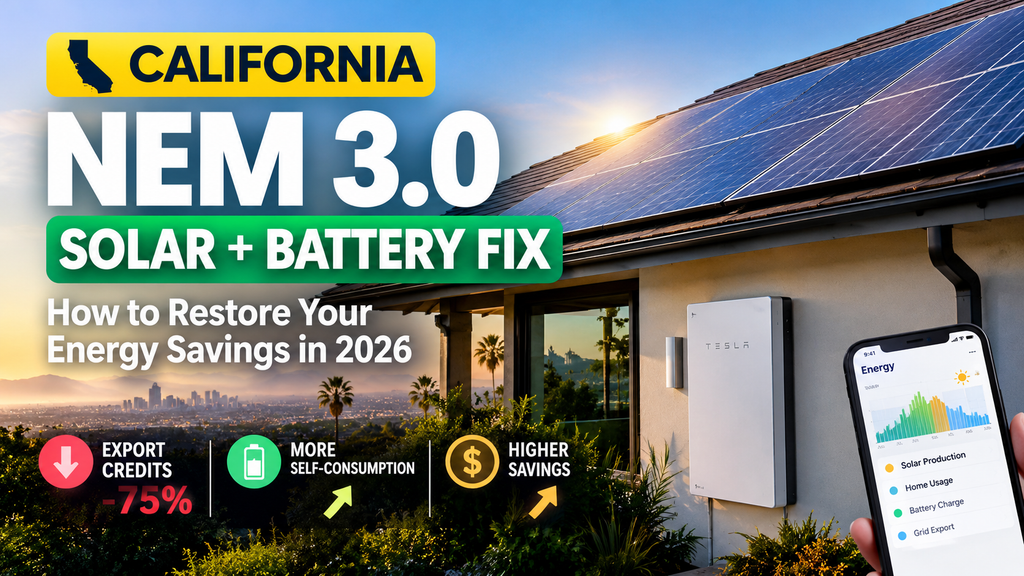
Why California’s NEM 3.0 Changed Solar-Only Savings — And When a Battery Can Help
California homeowners can still benefit from rooftop solar, but the value of electricity exported to the grid is different under the state’s newer Net Billing Tariff. Here’s how to understand the rules, calculate your own numbers, and decide whether battery storage makes financial sense.
The key idea: a battery does not cancel NEM 3.0. It can help you use more of the electricity your panels produce instead of exporting it when export credits are relatively low.
Quick answer: California’s NEM 3.0 framework—officially called the Net Billing Tariff, or NBT—changed how many new solar customers are credited for electricity sent to the grid. Under older net energy metering arrangements, eligible customers could receive credits tied to retail electricity rates. Under the newer tariff, export credits are based on the value of electricity to the grid at the time it is exported.
That difference can make a solar-only system less financially attractive for a household that produces a large surplus in the middle of the day and buys electricity back during expensive evening hours. A properly sized battery can store some of that daytime surplus for later use, potentially reducing purchases from the utility.
But the result is not automatic. Battery equipment, installation, financing, efficiency losses, utility rates, export compensation, and household consumption all affect the outcome. This guide explains how to evaluate those variables without relying on a one-size-fits-all savings promise.
1. What Is California NEM 3.0?
NEM 3.0 is the common name used for California’s newer rooftop-solar compensation framework. The California Public Utilities Commission (CPUC) calls the successor arrangement the Net Billing Tariff (NBT). Investor-owned utilities commonly refer to their implementation as the Solar Billing Plan.
The tariff generally applies to eligible new interconnection applications submitted on or after April 15, 2023, in the covered utility territories. Existing customers who qualified for earlier NEM tariffs were not automatically moved to the new arrangement simply because the policy changed. Eligibility depends on the system’s application history, utility, and applicable tariff rules.
Under the NBT, your home’s solar production first serves electricity demand in the home. Any surplus can be exported to the grid, and that export receives a bill credit under the applicable export-compensation schedule. When your home needs more electricity than the panels are producing, you can draw from the grid and pay according to your utility rate plan.
Why this changes the calculation
Producing one kilowatt-hour of solar electricity does not necessarily have the same financial value at every moment. Electricity used immediately in your home can offset a retail purchase. Electricity exported to the grid may receive a different credit. Electricity bought back later may cost more than the credit you earned earlier.
The CPUC explains that export credits are usually lower than the retail rate under the Net Billing Tariff, although they can rise above the retail rate during certain late-summer evening periods. The actual result depends on the applicable tariff and time of export—not on a single statewide percentage that applies to every home.
For the current framework, consult the California Public Utilities Commission’s Net Energy Metering and Net Billing page.
2. NEM 2.0 vs. NEM 3.0: What Changed?
The main distinction is how surplus electricity is valued. Under earlier NEM tariffs, eligible customers generally received bill credits for exports based on retail rates under their applicable rate structure. Under the newer NBT, export compensation is tied to the estimated value of that electricity to the grid, which varies over time.
| Feature | Earlier NEM tariffs | NEM 3.0 / NBT |
|---|---|---|
| Value of exported power | Generally credited using retail-rate components under the applicable legacy tariff. | Based on the applicable export-compensation schedule and time-dependent grid value. |
| Value of using solar at home | Can reduce electricity purchases at the home’s retail rate. | Can also reduce electricity purchases at the home’s retail rate. |
| Role of a battery | May provide backup and shift energy use, but financial value depends on the legacy tariff and rate plan. | May increase self-consumption and shift stored energy to periods when it has greater value. |
| Export credit value | Typically more closely tied to retail-rate compensation. | Varies by time and tariff; it is not one fixed statewide rate. |
| Who should check eligibility? | Existing customers considering system changes or a tariff transition. | New solar applicants and customers whose application or system configuration may affect tariff eligibility. |
This table is a high-level comparison, not a substitute for reviewing your specific utility tariff. Rate structures, billing details, export schedules, and eligibility rules can differ. Before making a financial decision, check the tariff attached to your utility account and ask your installer to identify it in writing.
Important: Do not assume that every California solar homeowner is on NEM 3.0. Customers on qualifying earlier tariffs may have different economics. A battery decision that makes sense for one tariff may not make sense for another.
3. Why Solar Export Credits Can Be Worth Less Than the Electricity You Buy
Solar panels often produce their most abundant energy during the middle of the day. Household demand does not always follow the same pattern. If residents are away at work or school, a home may use relatively little electricity while its panels are generating heavily.
That can create a surplus. Under a net-billing arrangement, the surplus is exported to the grid and earns the applicable export credit. Later, when people return home and use air conditioning, cooking appliances, lighting, computers, and other equipment, solar production may have fallen. The home then buys electricity from the utility.
Solar production is high
The panels may produce more electricity than the home needs. Surplus electricity can be exported and credited under the applicable tariff.
Household demand rises
Solar production declines while the home’s electricity use may increase. The home may purchase electricity from the grid at its retail rate.
The financial gap between the value of exported electricity and the cost of electricity purchased later is one reason battery storage receives attention under NEM 3.0. Instead of exporting every surplus kilowatt-hour, a system can store some of it and use it later.
Is it accurate to say NEM 3.0 cut export credits by 75%?
You may see large percentage reductions quoted in solar marketing and online discussions. Those figures can describe particular comparisons or examples, but 75% is not a universal reduction that applies to every California customer, hour, or utility tariff. The financial effect depends on the applicable export schedule, the hours when the home exports, and the rate plan used for electricity purchases.
For a fair comparison, use your utility’s current export-compensation schedule and your actual consumption profile. Do not use a statewide headline percentage as the only input in a payback calculation.
Why timing matters
Two homes with identical solar systems can have different savings. One may use a large share of its solar electricity during the day. The other may export most of its midday production and consume more electricity in the evening. Their solar generation may be similar, but their self-consumption and bill-credit patterns can differ significantly.
Export compensation may also vary across the day and season. This means a battery should not be judged only by its total capacity. The question is whether it can store energy at useful times and discharge it when that energy provides a meaningful benefit.
4. The Battery Strategy: Store More Solar, Buy Less Grid Electricity
A home battery changes the timing of electricity use. During sunny hours, solar power can serve the home first, charge the battery with surplus production, and export any remaining energy if the system and tariff permit it. Later, the battery can discharge to serve some household demand.
The basic energy flow
- Solar panels produce electricity.
- The home uses what it needs.
- Surplus electricity charges the battery, subject to system settings and available capacity.
- The battery discharges later to supply eligible household loads.
- The home imports from the grid when solar and stored energy are insufficient.
The system does not create extra energy. It shifts some energy from one time to another, with conversion losses along the way.
How a battery may improve the economics
- More self-consumption: use a greater share of your own solar generation at home.
- Less evening importing: discharge stored energy when the home would otherwise buy electricity from the grid.
- Time-of-use optimization: where permitted and configured appropriately, charge and discharge based on the value of electricity at different times.
- Backup power: a compatible system may power selected circuits or, with appropriate equipment, more of the home during an outage.
- Possible grid-program payments: some eligible customers may be able to participate in utility or virtual power plant programs, subject to their terms.
What a battery does not do
- It does not erase NEM 3.0 or change the utility’s export-compensation schedule.
- It does not guarantee that the home will have a zero-dollar electricity bill.
- It does not eliminate fixed charges or other charges that still apply under the tariff.
- It does not automatically pay for itself.
- It does not necessarily provide whole-home backup during an outage; the inverter, transfer equipment, load limits, and system design matter.
For a separate look at outage protection, see our guide: Why Solar Panels Stop Working During Power Outages—and How Battery Backup Can Help. That article covers the grid-safety reason conventional grid-tied solar generally shuts down during an outage and explains why backup capability depends on the system design.
5. A Simple Example: When Could a Battery Add Value?
The example below illustrates the calculation method. It is not a forecast for a specific California utility customer, and the numbers are hypothetical. Replace them with your actual tariff rates, solar export profile, battery efficiency, and installed cost before making a purchase decision.
Illustrative daily energy-shifting example
Suppose a solar home has 8 kWh of midday surplus available on a typical sunny day. Without a battery, assume that surplus would be exported for an average credit of $0.06 per kWh. Later, the home would otherwise buy 6.8 kWh from the grid at $0.35 per kWh. Assume 85% round-trip usable energy for this simplified example.
Export credit without storage: 8 kWh × $0.06 = $0.48 Potential grid energy offset: 8 kWh × 85% = 6.8 kWh Illustrative avoided purchase: 6.8 kWh × $0.35 = $2.38 Illustrative gross daily difference: $2.38 − $0.48 = $1.90This simplified estimate represents the gross difference between an assumed export credit and an assumed avoided grid purchase. It does not include battery cost, degradation, financing, taxes, fixed charges, changes in tariff rates, or the possibility that the battery could export energy at a more valuable time.
Why this is not the same as a payback guarantee
Even if the example’s $1.90 difference occurred every day, it would not mean the battery automatically saves that amount on every day of the year. The home might not have enough solar surplus on cloudy days. It may not use enough electricity in the evening to absorb the stored energy. Some days the battery may already be full, and some days it may not fully charge.
Export credits also vary. A battery may be configured to export during selected high-value periods where the tariff and system permit it, but the actual benefit depends on the approved rate plan and control settings. A battery’s usable energy is less than or equal to its nominal capacity, and charging and discharging are not perfectly efficient.
Turn the example into a personal estimate
Gather at least these inputs before comparing quotes:
- Your utility’s current import rates, including time-of-use periods.
- Your export-compensation schedule under the applicable tariff.
- Hourly or interval data showing when your solar system exports electricity.
- Hourly or interval data showing when your home imports electricity.
- The battery’s usable capacity, efficiency, power rating, and warranty terms.
- The total installed price, including electrical work and any required backup equipment.
- Any incentive for which you have verified eligibility and funding availability.
If a proposal gives you only an annual savings figure without showing assumptions, request a more detailed model. A transparent quote should explain the rates used, the battery’s expected operating pattern, estimated energy throughput, and how the model accounts for degradation.
6. When a Battery May Be Worth Considering in California
A battery is most financially compelling when the household has a useful combination of solar surplus, later electricity demand, a meaningful difference between export value and avoided import cost, and a reasonable installed price. Backup power may also be valuable to a homeowner even when the purely financial payback is longer.
Strong daytime surplus
Your panels regularly produce more electricity than the home can use while the sun is shining, leaving energy available for storage.
High evening consumption
Your home uses electricity after solar production falls, creating opportunities to use stored energy instead of buying from the grid.
Expensive import periods
Your utility rate makes some later hours meaningfully more expensive than the hours when your panels produce surplus energy.
Backup has real value
You want resilience for selected loads or essential equipment and understand the cost of the additional backup configuration.
Homeowners who work outside the home
If the home is mostly empty during daylight hours, solar production may exceed immediate demand. A battery can potentially shift part of that surplus to the evening, when occupants return and use lights, appliances, cooking equipment, and cooling systems.
However, do not assume that a typical household needs a large battery simply because nobody is home during the day. The correct size depends on the amount of surplus available, the timing of evening demand, and the cost of storage. A smaller system that is regularly cycled can be a better match than a larger system that often remains underused.
Homes with air conditioning or electric appliances
Cooling, electric cooking, heat pumps, water heating, and electric vehicle charging can influence a home’s load profile. If significant demand occurs during periods when solar production is low, storage may help shift energy to those hours. Yet these appliances can also require substantial power, so both battery energy capacity and inverter power rating matter.
A battery rated for a particular number of kilowatt-hours may store enough energy for several hours of modest loads but still be unable to run every large appliance simultaneously. Have the installer model both the amount of energy needed and the peak power demand.
Homeowners who value resilience
Some buyers place value on maintaining power during an outage, reducing disruption, and keeping selected circuits available. This is a separate benefit from bill savings. If resilience is a major reason for buying storage, compare the cost of the backup configuration with the value you place on it instead of forcing every benefit into a solar-bill payback calculation.
7. When a Battery May Not Pay Off
Battery storage is not automatically the best financial move for every solar household. There are several situations where the economics may be weak.
1. Your home already uses most solar production
If the household uses a large portion of its solar generation immediately, there may be little surplus left to charge a battery. Storage can still provide backup or shift energy bought from the grid if the tariff and equipment allow it, but the solar-export savings opportunity may be limited.
2. Your evening electricity demand is low
If the home has little demand after sunset, a battery may not discharge enough energy to justify its cost. A system that frequently reaches its minimum state of charge or remains partly unused may deliver less value than expected.
3. The installed cost is too high
A battery’s financial benefit must be compared with its full installed cost—not just the price of the battery unit. Electrical upgrades, inverter compatibility, permitting, backup gateways, labor, and other equipment may change the final quote.
4. Your current tariff is already favorable
Customers who remain on an eligible legacy NEM tariff may have a different economic calculation from customers on NEM 3.0. Before switching tariffs, expanding a system, or adding storage, ask your utility and installer to explain how the change affects your existing compensation and eligibility.
5. You expect the battery to eliminate every bill
A battery can reduce some electricity purchases but does not necessarily eliminate fixed charges, minimum bills, taxes, or other applicable charges. A proposal that promises a zero-dollar bill without explaining the tariff and assumptions deserves careful scrutiny.
6. You are relying on an unverified incentive
Do not subtract a rebate from the quoted price until you have verified that the program is active, that funds are available, and that your household and equipment meet the eligibility requirements. Some incentives have income limits, location restrictions, approved-equipment requirements, reservation procedures, or other conditions.
Decision rule: if the battery’s financial case depends on an unconfirmed incentive, an assumed export rate, or a promised savings figure with no supporting data, pause and obtain a written estimate based on your actual utility tariff.
8. How to Size a Solar Battery for NEM 3.0
Battery sizing should begin with energy data, not with the largest product you can afford. A battery has two important limits: its energy capacity, usually measured in kilowatt-hours (kWh), and its power rating, measured in kilowatts (kW).
- Energy capacity (kWh): how much energy the battery can store and deliver, subject to its usable-capacity limits.
- Power rating (kW): how much power it can supply at a given moment.
- Round-trip efficiency: how much energy is returned after charging and discharging losses.
- Depth-of-discharge and reserve settings: how much stored energy the system makes available for normal use versus backup.
- Warranty and cycle limits: the manufacturer’s terms governing performance, capacity retention, and covered operation.
Start with the electricity you export
Review interval data from your utility or solar monitoring platform. Identify the typical amount of surplus energy available during sunny hours. A battery that is too large relative to your actual surplus may not charge consistently. A battery that is too small may fill early and leave additional energy to be exported.
Then estimate evening demand
Measure how much electricity your home consumes after solar production drops. The battery does not need to supply every load to be useful. In some homes, the most sensible strategy is to support selected circuits or the loads that create the most expensive grid imports.
Match energy capacity to power demand
For example, a home may use several kilowatt-hours after sunset but still have short periods of high power demand from an air conditioner, oven, pump, or other appliance. The battery must have enough usable energy for the duration you need and enough power capacity to handle the loads that operate at the same time.
Plan for backup separately
Financial dispatch and outage backup are related but different objectives. Some settings may preserve a reserve for outages rather than using all available stored energy to reduce bills. That reserve can provide peace of mind, but it also means less energy is available for routine bill optimization.
For a deeper sizing discussion, read How Many Home Batteries Do You Need? and How Long Does a Home Battery Last During an Outage?
9. Virtual Power Plants: Can Your Battery Earn Additional Value?
A virtual power plant (VPP) coordinates many distributed energy resources—such as home batteries, solar-plus-storage systems, and other flexible loads—to support the electric grid. Depending on the program, participants may be asked to discharge batteries or reduce demand during specified events in exchange for payments, bill credits, or other compensation.
For an eligible homeowner, a VPP can potentially add another value stream to a battery. But participation is not a guaranteed source of income. Payment amounts, event frequency, enrollment rules, control arrangements, and availability differ among programs.
Questions to ask before enrolling
- Is the program currently accepting new customers in your utility territory?
- Does your specific battery model qualify?
- Is there an upfront incentive, an ongoing payment, a bill credit, or a combination?
- How often can the program dispatch the battery?
- Can you set a minimum backup reserve?
- Who controls dispatch, and how much notice do you receive?
- Are there minimum participation periods, penalties, or early-exit conditions?
- Could participation affect battery warranty terms or the availability of stored energy during an outage?
California’s Self-Generation Incentive Program (SGIP) is another resource worth reviewing. SGIP provides incentives for qualifying distributed energy resources, including certain energy-storage systems. The program has specific eligibility criteria, and the status of a budget category can change. Some residential storage incentives target eligible low-income customers rather than every homeowner.
Start with the official CPUC SGIP page and verify current budget availability and requirements before assuming that a rebate will reduce your cost.
You can also explore our guides to virtual power plants and virtual power plant incentives. These explain the concept and the types of program terms homeowners should review.
Keep the math conservative. Calculate the battery’s value without assuming a VPP payment first. Then add only the compensation that you have verified for a program you are eligible to join. This prevents uncertain incentives from making an otherwise weak investment appear profitable.
10. Compare Your Options Before Buying Storage
A battery is one possible way to improve the use of solar electricity, but it is not the only option. The right choice depends on your current equipment, utility tariff, household schedule, budget, and whether outage backup is a priority.
| Option | Potential benefit | What to verify |
|---|---|---|
| Solar only | Lowest additional equipment cost if the system is already installed; daytime generation can offset home use. | Export compensation, daytime consumption, and remaining electricity purchases. |
| Solar + battery | Can shift surplus solar to later hours and may provide backup with compatible equipment. | Installed cost, usable capacity, inverter power, warranty, dispatch settings, and tariff-specific savings. |
| Load shifting without a battery | Move flexible tasks—such as laundry or some charging—to hours when solar production is high. | Whether the household can change its schedule and whether the equipment can be scheduled safely. |
| Energy efficiency | Reduce the amount of electricity the home needs in the first place. | Upfront costs, comfort, actual energy use, and eligibility for local programs. |
| Battery participation in a VPP | May add payments or credits for eligible grid-support events. | Current enrollment, dispatch control, payment terms, and reserve requirements. |
Try simple load shifting first
Before buying storage, look for flexible electricity use that can move to sunny hours. Depending on the appliance and the household, this could include laundry, dishwashing, charging an electric vehicle, or scheduling some water heating. Only use manufacturer-approved scheduling and avoid changes that compromise safety, comfort, or equipment requirements.
Load shifting cannot replace a battery when you need electricity after dark or during an outage, but it may increase the share of solar generation used directly in the home. It can also help you understand your actual load profile before investing in storage.
Improve efficiency where it makes sense
Reducing unnecessary energy use can be less expensive than buying equipment to store electricity that would otherwise be wasted. Review heating and cooling settings, insulation, air leakage, appliance efficiency, and high-use equipment. A home energy assessment can help identify improvements suited to the property.
For more planning resources, explore our home energy rebates guide and home energy savings calculator. Confirm the current status and eligibility of any program before budgeting for a rebate.
11. How to Evaluate Battery Payback Without Inflated Claims
Battery proposals often highlight potential annual savings. The figure can be useful, but only if the assumptions are visible and realistic. Ask the installer to show the model inputs rather than relying on a single headline number.
Calculate annual gross benefit
Start with the value of grid purchases the battery is expected to avoid. Add any export value the system can realistically earn from stored energy if the applicable tariff and configuration permit it. Subtract the export credit you give up by storing that energy instead of exporting it immediately.
In a simplified form:
Approximate annual storage benefit = avoided electricity-purchase costs + any verified incremental export revenue − forgone export credits − other incremental operating costs.
This is a conceptual framework, not a universal formula for every tariff. Detailed models may need to account for hourly dispatch, fixed charges, efficiency losses, degradation, rate changes, and program rules.
Compare the benefit with the true installed cost
Use the complete installed price, including equipment, installation, permitting, required electrical upgrades, and backup hardware. Subtract only incentives you have verified as available and applicable to your situation.
A simple payback estimate divides net upfront cost by estimated annual net savings. It can be a useful screening tool, but it does not fully represent financing costs, battery degradation, maintenance, future electricity rates, or the value of backup power. A discounted cash-flow model is more appropriate for comparing investments over time.
Use a conservative scenario
Ask for at least three cases: conservative, central, and optimistic. The conservative case should not depend on maximum export credits, a rebate that has not been reserved, or perfect battery cycling every day. Review what happens if utility rates change, the battery delivers less usable capacity over time, or the household uses less electricity than forecast.
Our home solar battery cost guide can help you organize the cost side of the decision. For comparisons involving larger storage products, see EcoFlow DELTA Pro Ultra vs. Tesla Powerwall 3 and Tesla Powerwall alternatives.
12. Questions to Ask Your Solar Installer
Before signing a battery contract, ask the installer to answer these questions in writing. Clear answers make it easier to compare quotes and spot unrealistic promises.
Which tariff applies to my home?
Ask the installer to identify your current tariff and explain whether the proposed project affects your eligibility or compensation arrangement. Confirm the details with your utility.
What export rates did you use?
Request the actual export-compensation schedule and import rates used in the savings model. The estimate should reflect the relevant time periods rather than one assumed average rate without explanation.
How much energy will the battery actually shift?
Ask for modeled charge and discharge data, expected energy throughput, round-trip efficiency, and assumptions about sunny and cloudy days.
Does the quote include backup capability?
Not every battery installation automatically provides outage backup. Confirm the transfer equipment, backed-up circuits, operating limits, and whether the solar system can recharge the battery during an outage.
Which incentives are confirmed?
Ask for the program name, administrator, eligibility criteria, application status, reservation requirements, and whether the quoted savings assume that funding will remain available.
What are the warranty and replacement assumptions?
Review the battery warranty, capacity-retention terms, power limits, cycle or throughput conditions, and any labor or service exclusions.
What happens if I change my utility plan?
Ask whether the modeled benefit depends on a specific rate plan and how a future tariff or rate change might affect the result.
13. Your California NEM 3.0 Decision Checklist
Use this checklist before deciding whether to add storage or replace an existing system.
- ☐ I confirmed which net billing or legacy NEM tariff applies to my system.
- ☐ I reviewed my utility’s current import rates and export-compensation schedule.
- ☐ I checked when my home exports solar electricity and when it imports electricity.
- ☐ I estimated the amount of surplus energy a battery could realistically store.
- ☐ I checked usable capacity, power rating, efficiency, warranty, and backup capability.
- ☐ I compared the full installed cost rather than only the equipment price.
- ☐ I verified every rebate or incentive rather than assuming eligibility.
- ☐ I requested a conservative savings model and reviewed its assumptions.
- ☐ I considered load shifting and efficiency improvements as alternatives or complements.
- ☐ I understand that a battery does not automatically eliminate fixed charges or guarantee a zero-dollar bill.
If several of these items are still unknown, the best next step is to collect your tariff and interval data—not to buy the largest battery available. Better inputs usually lead to a more useful comparison.
15. Frequently Asked Questions About NEM 3.0 and Solar Batteries
Does NEM 3.0 make solar panels useless in California?
No. Solar panels can still offset electricity used in the home. The newer tariff changes how surplus exports are credited, which can make the timing of electricity use more important. The financial outcome depends on system size, consumption, utility rates, export compensation, and costs.
Did California cut every solar export credit by 75%?
No single percentage applies to every customer and every hour. Export compensation under the Net Billing Tariff varies by the applicable schedule and time. Some export periods may be more valuable than others, so homeowners should check the current tariff instead of relying on a universal percentage.
Can a battery restore the savings I would have received under NEM 2.0?
A battery can improve self-consumption and shift electricity to later hours, but it does not restore the old tariff or guarantee equivalent savings. Whether it compensates for lower export credits depends on the battery cost, efficiency, rates, household use, and applicable program rules.
Will a battery eliminate my California electric bill?
Not necessarily. A battery may reduce electricity imports, but fixed charges, minimum bills, taxes, and other applicable charges can remain. Your final bill depends on the tariff, energy use, export credits, and system operation.
Do I need a battery with every new solar installation?
No. A battery may improve the economics for some homes, especially when there is substantial daytime surplus and evening demand, but it adds upfront cost. Compare a solar-only proposal with a solar-plus-storage proposal using the same realistic assumptions.
Can I add a battery to solar panels I already own?
Often, but compatibility depends on the inverter, electrical configuration, battery system, and whether backup power is required. A qualified installer should assess the existing system and explain whether additional equipment or electrical work is needed.
Can a battery charge from solar panels during a grid outage?
Some properly configured solar-plus-storage systems can continue operating during an outage and recharge from solar, but not every setup can do this. The inverter, transfer equipment, battery controls, available sunlight, reserve settings, and backed-up loads all matter. Confirm the capability with the installer.
Are California battery rebates available to everyone?
No. Incentives have specific eligibility requirements and may depend on income, location, utility, approved equipment, or program funding. Check the official program administrator for current availability and do not assume that a rebate will be approved.
What is the Self-Generation Incentive Program (SGIP)?
SGIP is a California program that provides incentives for qualifying distributed energy resources, including certain energy-storage systems. Different budget categories have different eligibility rules. See the official CPUC SGIP page for current program information.
Can a virtual power plant pay me for using my battery?
Some programs may compensate eligible participants for allowing their batteries to support grid needs. Availability, payment, dispatch frequency, equipment eligibility, and reserve settings differ. Confirm the terms of a specific active program before including any payment in your financial model.
Should I buy a bigger battery to maximize savings?
Not automatically. A larger battery can cost more and may not fill or discharge fully on a regular basis. Size the system using your export data, evening demand, required backup duration, usable capacity, and inverter power rating.
What is the first step before getting a battery quote?
Identify your utility tariff and gather interval data showing when your home imports and exports electricity. These inputs help you evaluate how much energy could be shifted and whether the likely benefit justifies the installed cost.
16. Official Sources and Further Reading
Policy and incentive details can change. The following primary sources are useful for verifying the rules and program requirements relevant to your home.
- California Public Utilities Commission — Net Energy Metering and Net Billing
Overview of NEM tariffs, the Net Billing Tariff, and export-compensation concepts. - California Public Utilities Commission — NEM Revisit
Regulatory background on the transition to the successor tariff and related proceedings. - California Solar Consumer Protection Guide
Consumer information about solar and storage, billing expectations, and misleading sales claims. - California Public Utilities Commission — Self-Generation Incentive Program
Program overview, eligible technologies, and guidance on checking incentive availability. - California Public Utilities Commission — DER Cost-Effectiveness
Background on the Avoided Cost Calculator and its role in valuing distributed energy resources.
The Smart Next Step Is to Check Your Own Numbers
NEM 3.0 does not create one universal answer for every California home. The best decision starts with your actual utility tariff, the hours when your panels export electricity, your evening demand, and the complete installed cost of storage.
Compare solar-only operation with solar-plus-storage using realistic assumptions, verify incentives through official sources, and ask for a written explanation of the savings model before committing to a system.
Continue with our California Solar Rebates Guide and Home Solar Battery Cost Guide to review the next part of your decision.