
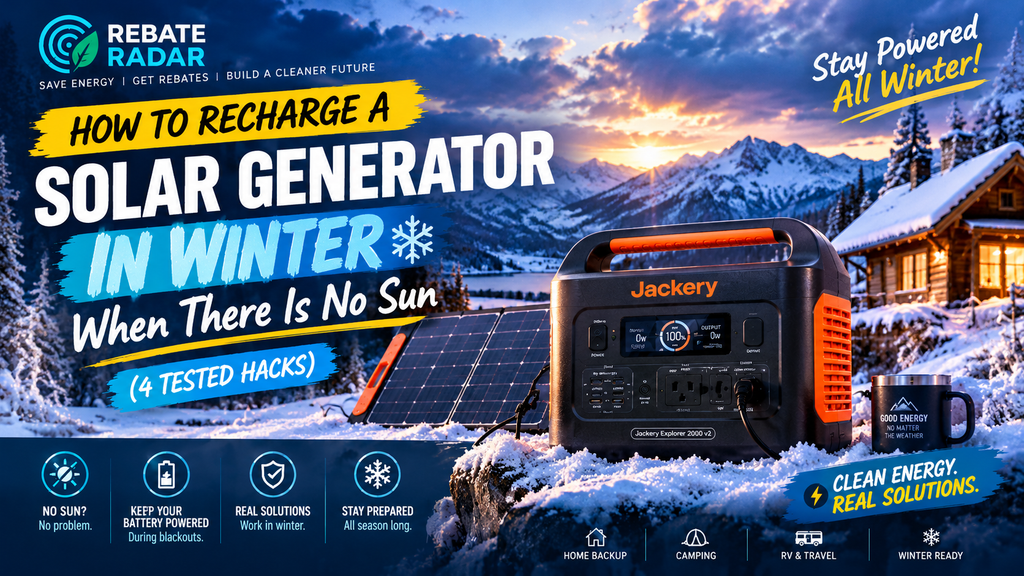
How to Recharge a Solar Generator in Winter When There Is No Sun (4 Tested Hacks)
A winter blackout can turn a full battery into a countdown. Learn four practical ways to recharge a solar generator when snow, short days, clouds, or an outage limit your options—plus the cold-weather battery rules that help protect your equipment.
Quick answer: if the sun disappears, the most dependable way to recharge a portable solar generator is usually a compatible AC outlet or a properly sized inverter generator. Solar panels can still contribute on bright, cold days and sometimes in diffuse daylight, but snow cover, shading, panel angle, and weak winter sun can reduce output sharply. A dual-fuel generator can serve as a backup charging source when the grid is down, provided it is operated outdoors and according to its manual.
The right method depends on what you need to power, how much energy remains, the charging inputs supported by your power station, and whether you can safely run another generator. This guide explains the trade-offs instead of promising that any one product or trick will work in every storm.
1. Four practical ways to recharge a solar generator in winter
A “solar generator” is generally a battery power station with an inverter and charging inputs; it does not create energy on its own. The solar panel is one possible charging source. In winter, plan around more than one source so a stretch of overcast weather does not leave you without power.
Method 1: Use AC wall power before a storm
If grid power is available, charge the station from a compatible household outlet before severe weather arrives. AC charging is usually more predictable than relying on a few hours of weak winter sun. Use only the supplied or manufacturer-approved charging cable and follow the unit’s maximum input rating.
Best for: preparing ahead of a forecasted storm, topping up between outages, and restoring charge when utility service returns.
Limit: this method cannot help if the grid is already down unless you have a separate, safe source of AC power.
Method 2: Capture whatever winter sunlight is available
Solar panels can generate electricity in cold weather; they need light, not warm air. However, short daylight hours, thick cloud, shade, low sun angles, dirt, and snow on the modules can greatly reduce real-world energy. Set panels where they receive the clearest exposure and keep them clear only when it is safe to do so.
Best for: extending runtime on bright winter days and gradually replacing energy used overnight.
Limit: never assume the panel’s advertised wattage is what it will deliver in a storm.
Method 3: Recharge from a small inverter generator
When the grid is unavailable and sunlight is poor, a compatible gasoline or propane inverter generator can provide AC power to the station’s charger. This can restore a useful amount of energy without waiting for the weather to improve. Choose a generator with sufficient continuous output and use the power station’s supported charging rate.
Best for: multi-day outages when you need to recharge a battery without running a large generator continuously.
Limit: fuel, exhaust, noise, local rules, and generator maintenance all matter.
Method 4: Combine sources and reduce consumption
Use solar when it is available, recharge from AC or a generator when necessary, and reduce nonessential loads at the same time. A battery that powers only essential devices lasts much longer than one running resistive heaters, cooking appliances, and other high-wattage loads.
Best for: stretching stored energy through an uncertain outage.
Limit: charging methods must be compatible with the station; do not connect power sources in improvised ways.
2. How long does it take to recharge a solar generator in winter?
Recharge time depends on usable battery capacity, starting charge, charging input, temperature, conversion losses, and how the station manages power near full charge. The simplest estimate is:
Estimated charging hours ≈ energy to add (Wh) ÷ average charging power (W)
This is a planning estimate, not a guarantee. Real charging curves slow near the top, and the device may reduce or stop charging if its battery temperature is outside the permitted range.
For example, replenishing 1,000 watt-hours at an average of 500 watts takes about two hours in an idealized calculation. If the average input falls to 200 watts, the same amount takes about five hours. Add conversion losses and charging taper, and actual elapsed time may be longer.
| Charging source | What determines speed? | Winter reliability | Planning note |
|---|---|---|---|
| AC wall outlet | Station’s AC input limit, charger, battery temperature, charge curve | High when grid power is available | Usually the easiest way to prepare before a storm. |
| Portable solar panels | Actual sunlight, panel wattage, orientation, shade, snow, MPPT input limits | Variable | Use realistic daily energy estimates, not panel nameplate wattage alone. |
| Inverter generator + AC charger | Generator continuous output and station’s AC charging rate | High when fuel and safe outdoor operation are available | Use an efficient charging rate appropriate for the generator; follow both manuals. |
| Vehicle outlet | Vehicle’s 12V/USB output and station compatibility | Usually slow | Check vehicle limits and avoid draining a starter battery. |
| Mixed solar + AC input | Whether the station supports simultaneous inputs and its total input ceiling | Potentially useful | Do not assume combined input is supported; confirm model-specific instructions. |
Winter sunlight is particularly hard to predict. A 400W panel does not deliver 400 watts all day. The label is a laboratory rating under defined conditions. In real use, the panel may spend much of the day below its rated output, especially when the sky is cloudy or the sun sits low. If you depend on solar, plan for several charging windows rather than one perfect hour.
Example: topping up a 2,000Wh battery
Suppose a station has a nominal capacity around 2,000Wh and you have used half of its stored energy. You need to replace roughly 1,000Wh before losses. If its actual average input is 800W, the arithmetic estimate is 1.25 hours; at 400W, it is 2.5 hours; at 200W, it is five hours. These examples illustrate the math only—your device’s maximum input and actual charging curve may be different.
For solar charging, estimate energy over the whole daylight period. If a panel system averages 200W for three effective hours, that is about 600Wh before system losses. If it averages only 80W for three hours, that is 240Wh. That difference can decide whether you finish the day with a meaningful reserve.
Use our related guide to estimate your own situation: How Long to Charge a 2000Wh Solar Generator? You can also compare practical loads in What Can a 2000Wh Battery Backup Power?
3. The hybrid method: use a small inverter generator to recharge the battery
When there is no sun and the grid is down, the most practical workaround may be a hybrid setup: a fuel-powered inverter generator supplies AC power to a portable power station, which then runs sensitive electronics and essential loads quietly from its battery. Rather than operating the generator all day, you can run it during a planned charging window and turn it off once the station has reached the reserve level you need.
Some people use a short charging session—perhaps 30 to 60 minutes—as a partial top-up. Whether 45 minutes is worthwhile depends on the station’s AC input rate, how empty the battery is, and the generator’s continuous capacity. Do not interpret “45 minutes” as a universal full-charge time. Check the station’s input specifications and observe the charging display.
Choose a compatible inverter generator
Examples to research include the Champion Power Equipment 2000-Watt Dual Fuel Inverter Generator, the Westinghouse iGen2200 Portable Inverter Generator, and the Champion 4000-Watt Dual Fuel RV Ready Portable Inverter Generator. Their output, fuel type, noise rating, and runtime differ by model. Confirm the continuous wattage—not just the peak number—before pairing one with a power station.
Place the generator outdoors, far from openings
Never run a fuel-burning generator in a house, garage, basement, shed, enclosed porch, or near an open window or door. Carbon monoxide is odorless and can be fatal. Follow the generator manufacturer’s clearance instructions and current public-safety guidance; use working CO alarms inside the home. Never refuel a hot generator.
Start the generator before connecting the load
Follow the generator’s starting procedure and allow it to stabilize. Then connect the station using the approved AC charging cable. If the power station lets you set an AC charging rate, start at a level the generator can sustain without overloading or surging. Do not use damaged cords, improvised adapters, or indoor extension-cord arrangements.
Charge strategically, then shut down correctly
Monitor both devices and stop if you notice abnormal heat, smell, noise, unstable output, or an error message. When you have the reserve you need, disconnect and shut down in the sequence described in the manuals. Let the generator cool before refueling or storing it.
Gasoline or propane?
Dual-fuel models offer flexibility, but neither fuel is universally better. Gasoline can be readily available but needs appropriate storage and can degrade over time. Propane may be convenient to store when handled correctly, but cold conditions can affect cylinder performance and usable output. Check the model’s specifications for output differences between fuels, and follow local rules for fuel storage. Never store gasoline or propane cylinders inside living spaces.
A generator can be louder and less convenient than a battery, but a hybrid system can preserve battery power for overnight use. A useful pattern is to charge during a safe daytime window, then use the power station for lights, communications, networking equipment, and other loads that do not require continuous generator operation.
For a broader comparison of the two technologies, read Portable Power Stations vs. Backup Generators.
4. How to recharge a solar generator when the sun is weak
Solar can still help in winter, but it works best when you treat it as a variable resource. Cold temperatures can be favorable for panel efficiency under some conditions, yet low sun angle and clouds reduce the amount of light reaching the modules. Snow on the panel can block production almost entirely.
Set up panels for the actual winter sun
- Prioritize an unobstructed view of the sky. A small shadow from a tree, railing, chimney, or roof edge can have a disproportionate effect depending on the panel and wiring design.
- Adjust the tilt when safe. A steeper angle can help shed snow and may improve exposure to a low winter sun. Follow the panel manufacturer’s mounting guidance and secure panels against wind.
- Keep modules clear without damaging them. Use only safe, manufacturer-approved methods to remove snow. Do not scrape with metal tools, step on panels, or climb onto an icy roof to clear them.
- Check the station’s solar input window. Voltage, current, connector type, and maximum solar input must all be compatible. More panels are not automatically better if they exceed the device’s limits.
- Use daylight opportunistically. If the sky brightens for a few hours, connect panels during that window and reduce loads while charging.
Do not assume that diffuse light will produce enough power to run high-demand appliances. A solar array that adds a few hundred watt-hours can be useful for phones, lights, and communication devices, yet still fall short of replacing the energy used by an electric space heater.
Can you charge a solar generator in snow?
Yes, if the panel is exposed to light and the equipment is installed and used within its rated conditions—but snow on top of a panel can sharply reduce output. Protect connectors from moisture as specified by the manufacturer, keep the power station itself in a dry location, and avoid connecting wet or damaged cables. Do not assume that a weather-resistant solar panel makes the battery power station weatherproof.
Temperature limits differ by component. The panel may tolerate cold conditions while the battery inside the power station may have a narrower charging range. Check both manuals. The coldest part of the system, not the warmest, may determine whether charging is permitted.
5. Battery safety: what happens below 32°F (0°C)?
This is one of the most important winter details. Many portable power stations use lithium iron phosphate (LiFePO₄ or LFP) cells. LFP chemistry is valued for cycle life and stability, but that does not mean it can be charged at any temperature. Charging a lithium battery below its specified minimum temperature can damage cells. Some systems use a battery-management system (BMS) to reduce or stop charging when conditions are unsafe; the presence of a BMS is not permission to charge below freezing.
Safe cold-weather charging checklist
- Read the manual for minimum charging temperature and storage limits.
- If the battery is below its permitted charging temperature, disconnect the charger and let the unit warm gradually in a dry, ventilated indoor space.
- Do not use a fireplace, stove, heat gun, hair dryer, or other direct high heat to warm the battery.
- Keep the station away from snow, standing water, condensation, and wet cables.
- Allow a cold device to acclimate before charging if condensation may form after moving it indoors.
- Stop using the unit if its casing is swollen, cracked, leaking, unusually hot, or producing an unusual smell; follow the manufacturer’s safety instructions.
- Keep the battery away from blankets or enclosed spaces that could trap heat while it is operating.
Some products advertise low-temperature protection or battery-management safeguards. Those features may protect the battery by stopping charging, rather than by enabling charging below freezing. Always interpret safety features through the product manual rather than a marketing phrase.
For emergency planning, the safest habit is to keep the power station indoors within its specified temperature range, charge it before the storm, and use properly rated cables to connect only the equipment intended for outdoor use.
6. Portable power stations to compare for winter backup
The products below are options to compare—not a claim that one model is best for every home. Check the current manufacturer specifications, included accessories, charging limits, warranty, and return policy before buying. Prices and availability can change. Some listings may offer a station alone, while others bundle a solar panel.
BLUETTI Elite 200 V2 Portable Power Station
A capacity class around 2kWh can be useful for essential electronics, lighting, routers, and selected appliances when their combined energy use is planned. Compare its AC input rate, output rating, ports, expansion support, and temperature limits with your needs.
Important: verify the exact product page for charging speed and cold-temperature protections. Battery protection does not necessarily mean charging below 32°F is allowed.
Check BLUETTI on Amazon ↗Affiliate link · Verify specifications and current price.
EcoFlow DELTA 2 Max + 400W Solar Panel Bundle
A bundle can simplify shopping when you want a compatible panel and power station together. Actual winter harvest depends on sunlight, panel angle, shade, snow, and the unit’s solar input limits—not just the panel’s rated wattage.
Check the exact bundle contents and current maximum solar input before planning an array.
View solar bundle ↗Affiliate link · Bundle contents can vary.
EcoFlow DELTA 2 Max (Standalone Unit)
The standalone unit may suit buyers who already own compatible solar panels or want to choose a separate array. Expansion options and total capacity depend on compatible extra batteries and model configuration; confirm the maximum supported capacity before purchase.
Do not assume that a larger battery automatically charges faster. Charging time depends on input power as well as capacity.
View standalone unit ↗Affiliate link · Confirm expansion compatibility.
Jackery Explorer 2000 v2 Portable Power Station
This model is listed as a 2,042Wh station with 2,200W AC output and a LiFePO₄ battery. It may be worth comparing for emergency loads, but check its actual AC and solar charging limits, port selection, operating-temperature range, and the loads you intend to run.
Check Jackery Explorer 2000 v2 ↗Affiliate link · Confirm the exact listing and model.
BLUETTI Elite 300 Portable Power Station
The supplied listing describes a 3,014.4Wh capacity and 2,400W output, with a higher surge rating and an RV-oriented port. A larger battery can store more energy, but it also takes longer to recharge if input power stays the same.
Confirm output type, port details, surge limits, battery temperature requirements, and any required cables.
View BLUETTI Elite 300 ↗Affiliate link · Check compatibility for your loads.
Champion 4000-Watt Dual Fuel Inverter Generator
A dual-fuel inverter generator can provide an alternate AC charging source during extended outages. Check continuous wattage, fuel-specific output, noise, runtime, starting method, and the power station’s charging demand before pairing them.
Operate outdoors only and follow all carbon-monoxide precautions.
View Champion generator ↗Affiliate link · Fuel and output ratings vary by mode.
EcoFlow DELTA 2 Max Solar Generator with 400W Panel
This supplied listing describes the DELTA 2 Max with a 400W solar panel. Compare this listing with the separate bundle above to see whether the included accessories, seller, warranty, and price differ.
Compare EcoFlow solar kit ↗Affiliate link · Check for duplicate or variant listings.
EcoFlow DELTA 2 Max Portable Power Station
The supplied product description lists a 2,048Wh battery and 2,400W output. Treat these as listing details to verify against the current manufacturer specifications. Assess the appliances you need to run and the energy they consume over time.
View EcoFlow DELTA 2 Max ↗Affiliate link · Verify listing authenticity and specs.
For a direct comparison, see BLUETTI Elite 200 V2 vs. EcoFlow DELTA 2 Max, Best Portable Power Station for Emergency Home Backup, and Jackery Explorer 1000 v2 vs. EcoFlow DELTA 2.
7. Build a winter battery backup plan before the forecast turns
A reliable winter plan starts with the loads you actually need—not with the largest power station you can afford. Write down the essential devices, their wattage, and how many hours you need each one to run. Then estimate energy use in watt-hours.
Energy used (Wh) ≈ device watts × hours used. A 10W device running for 8 hours uses about 80Wh. A 60W device running for 5 hours uses about 300Wh. Real-world use can differ due to cycling, startup surges, inverter losses, and device behavior.
Make a priority list
- Tier 1 — safety and communication: phones, emergency radios, medical equipment that has been approved for backup power, and essential communications.
- Tier 2 — basic comfort: LED lighting, Wi-Fi/router, laptops, and selected low-wattage devices.
- Tier 3 — high-energy appliances: refrigerators, pumps, cooking appliances, and space heaters. Check startup watts and total daily energy before connecting them.
Electric space heaters deserve special attention. A 1,500W heater running continuously for one hour consumes about 1,500Wh before losses—most of the nominal capacity of many portable stations. A thermostat may cycle the heater on and off, but you should not rely on that to guarantee runtime. Use safe, manufacturer-approved heating methods and never operate outdoor combustion appliances indoors.
Learn more in How Long Will a Solar Generator Power a Space Heater? and Can a Solar Generator Run a Space Heater?. If you need to keep food cold, review How to Run a Refrigerator on a Solar Generator.
Before the storm checklist
- Charge the power station while utility power is available, following the manual.
- Inspect cables, plugs, panel connectors, and generator maintenance items.
- Store the battery in a dry place within its specified temperature range.
- Place solar panels where they can be safely deployed without climbing on icy roofs.
- Keep fuel only in approved containers and follow local storage rules.
- Test critical devices in advance; do not discover compatibility issues during an outage.
- Keep CO alarms working and never run a fuel generator indoors.
- Use a written charging schedule and reserve some capacity for unexpected needs.
What size battery is enough?
There is no single answer for every home. A 1,000Wh-class station may be suitable for phones, lights, and selected electronics; a roughly 2,000Wh unit can provide a larger energy reserve; a 3,000Wh-class station can run more loads for longer, assuming the output rating supports them. None of those labels guarantees a specific runtime. Calculate the energy required and allow for inverter losses, temperature effects, and reserve capacity.
Use the site’s related sizing resources: Is a 2000Wh Solar Generator Worth It? and How Many Home Batteries Do I Need?
8. Common winter charging mistakes to avoid
Relying on the panel’s rated wattage
Rated watts are not an all-day output promise. Use observed output, seasonal conditions, and conservative estimates.
Charging a frozen battery
Do not override a BMS or attempt to force a charge. Follow the temperature limits and allow the unit to warm naturally.
Running a generator in a garage
Even with the garage door open, carbon monoxide can build up and enter the home. Keep the generator outdoors and away from openings.
Using unapproved adapters
Incorrect voltage, polarity, connectors, or wiring can damage equipment and create a fire or shock hazard.
Trying to power every appliance
Prioritize essential loads. Resistive heaters and other high-wattage appliances can deplete a portable battery quickly.
Confusing watts with watt-hours
Watts describe power at a moment; watt-hours describe energy over time. Both matter when sizing a backup system.
9. Rebate Radar winter power knowledge hub
Use these guides to compare backup power options, estimate energy needs, and research incentives. Tax rules and utility programs change; verify current eligibility with official program sources before making a purchase decision.
Winter power & heater guides
Calculators & battery benchmarks
Tax credits & financial incentives
10. Frequently asked questions
How do I recharge a solar generator in winter when there is no sun?
Use a compatible AC outlet if grid power is available. During a blackout, a properly sized inverter generator can supply AC charging power when operated outdoors and safely. Solar panels may still provide some energy in daylight, but output varies with cloud cover, panel angle, shading, and snow. Follow the power station’s charging limits and temperature instructions.
Can I recharge a solar generator without sunlight?
Yes. Many portable power stations can charge from a wall outlet, a compatible generator, or certain vehicle outputs. Available options vary by model. Confirm the input type, voltage, current, and wattage limits in the manufacturer’s manual.
Can I charge a solar generator in snow?
Only if the panel, cables, power station, and installation are used within their rated conditions. Snow covering the panel can greatly reduce or stop production. Keep the battery unit dry, clear panels safely, and never climb onto an icy roof to access them.
Is it safe to charge a lithium power station below 32°F (0°C)?
Do not assume it is. Many lithium power stations prohibit charging below freezing, even when they can discharge in colder temperatures. Check the exact model’s minimum charging temperature. If it is too cold, disconnect it and let it warm gradually in a dry indoor environment.
Will a battery management system let me charge in freezing weather?
A battery management system may protect the cells by limiting or stopping charging when the temperature is unsafe. That does not mean charging below freezing is supported. Follow the manufacturer’s stated operating and charging ranges.
Can a portable inverter generator charge a solar generator?
Often, yes, if the power station supports AC charging and the generator supplies compatible, stable power at sufficient continuous wattage. Confirm both manuals, set an appropriate charging rate if available, and operate the fuel generator outdoors far from openings because carbon monoxide can be fatal.
Can I fully recharge a 2,000Wh power station in 45 minutes?
That depends on the model’s actual AC input rate and charging curve. A 45-minute session may provide a useful partial top-up, but it is not a universal full-charge time. Estimate energy added by multiplying average charging watts by hours, then allow for losses and charge taper.
Does a 400W solar panel produce 400W in winter?
Not consistently. The rating is measured under defined conditions. Cloud cover, low sun angle, shading, panel temperature, snow, and orientation affect real-world output. Use conservative estimates and monitor the station’s input display.
Is propane better than gasoline for a backup generator in winter?
Neither fuel is automatically best. Compare availability, storage requirements, cold-weather performance, fuel-specific output, runtime, and the generator’s manual. Store fuel safely and never use a generator indoors.
Can a solar generator run a space heater during a winter blackout?
It depends on the heater’s wattage, battery capacity, inverter output, and runtime needed. A 1,500W heater can use about 1,500Wh in one hour if it runs continuously, before losses. Many portable batteries therefore provide limited runtime with high-wattage heaters. Review the heater and power station manuals and follow all heating safety instructions.
Should I leave my power station in a cold garage?
Only if the manufacturer’s storage and operating limits permit the garage’s actual temperatures and humidity. Charging limits may be stricter than discharge limits. A dry indoor location within the specified temperature range is generally easier to manage.
Can I charge from solar and a generator at the same time?
Only if the exact power station explicitly supports simultaneous inputs and you follow its input limits. Do not combine sources using improvised wiring or adapters. The device’s total input ceiling still applies.
What size power station should I buy for winter emergencies?
List the devices you need, their wattage, and how long you need them to run. Estimate watt-hours, account for inverter losses and startup surges, then choose a station with sufficient capacity and output. Larger capacity stores more energy but can take longer to recharge.
Do portable power stations qualify for a federal tax credit?
Eligibility depends on current law, product characteristics, installation, use, and the specific credit or incentive. Do not assume every portable power station or solar generator qualifies. Check current IRS guidance and the official terms of any program before relying on a tax benefit.
Pingback: How Many Battery Backups Do I Need For A Whole House?